
Become a Genome Engineer and Explore CRISPR-Cas9’s Potential to Cure Human Genetic Disorders!
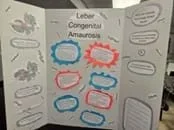 Students present their research to the class.Copyright Heidi Bordeleau
Students use the engineering design process as they work in groups to research one of five genetic disorders and learn about CRISPR-Cas9 using a paper model and an online interactive tool. They adapt the paper model to simulate how CRISPR-Cas9 could potentially cure their assigned disorder. Using their research and models, they create a pitch for research funding in the form of a trifold poster. Finally, the entire class debates and discusses which disease should receive the most funding to develop a CRISPR-based cure, considering humanity’s need for a cure (number of cases, disease severity, availability of other treatments, etc.) and the feasibility of targeting their disease with CRISPR.
Genome engineering is the process of precisely modifying the genetic material of an organism to achieve desired traits or outcomes. This field uses tools such as CRISPR-Cas9, TALENs, and zinc-finger nucleases to edit DNA by adding, deleting, or altering specific sequences. Genome engineering is widely used in medicine, agriculture, and research, enabling breakthroughs such as correcting genetic disorders, creating disease-resistant crops, and studying gene function. By combining principles of molecular biology, genetics, and bioengineering, genome engineering offers transformative potential for addressing global challenges in health, food security, and environmental sustainability.
After this activity, students should be able to:
- Explain how an error in DNA (mutation) can lead to disease.
- Model how CRISPR-Cas9 alters DNA.
- Differentiate between homology-directed repair and non-homologous end joining.
- CCSS.Math.Content.HSS-MD.B.7 (+) Analyze decisions and strategies using probability concepts (e.g., product testing, medical testing, pulling a hockey goalie at the end of a game).
Grades 9-12
Do you agree with this alignment?
- HS-ETS1-1 Analyze a major global challenge to specify qualitative and quantitative criteria and constraints for solutions that account for societal needs and wants.
Grades 9-12
This resource focuses on the following Three Dimensional Learning aspects of NGSS:
Science & Engineering Practices- Analyze complex real-world problems by specifying criteria and constraints for successful solutions.Do you agree with this alignment?
Disciplinary Core Ideas- Criteria and constraints also include satisfying any requirements set by society, such as taking issues of risk mitigation into account, and they should be quantified to the extent possible and stated in such a way that one can tell if a given design meets them.Do you agree with this alignment?
- Humanity faces major global challenges today, such as the need for supplies of clean water and food or for energy sources that minimize pollution, which can be addressed through engineering. These global challenges also may have manifestations in local communities.Do you agree with this alignment?
Crosscutting Concepts- New technologies can have deep impacts on society and the environment, including some that were not anticipated. Analysis of costs and benefits is a critical aspect of decisions about technology.Do you agree with this alignment?
Do you agree with this alignment? - Analyze complex real-world problems by specifying criteria and constraints for successful solutions.
- HS-LS3-1 Ask questions to clarify relationships about the role of DNA and chromosomes in coding the instructions for characteristic traits passed from parents to offspring.
Grades 9-12
This resource focuses on the following Three Dimensional Learning aspects of NGSS:
Science & Engineering Practices- Ask questions that arise from examining models or a theory to clarify relationships.Do you agree with this alignment?
Disciplinary Core Ideas- All cells contain genetic information in the form of DNA molecules. Genes are regions in the DNA that contain the instructions that code for the formation of proteins.Do you agree with this alignment?
- Each chromosome consists of a single very long DNA molecule, and each gene on the chromosome is a particular segment of that DNA. The instructions for forming species' characteristics are carried in DNA. All cells in an organism have the same genetic content, but the genes used (expressed) by the cell may be regulated in different ways. Not all DNA codes for a protein; some segments of DNA are involved in regulatory or structural functions, and some have no as-yet known function.Do you agree with this alignment?
Crosscutting Concepts- Empirical evidence is required to differentiate between cause and correlation and make claims about specific causes and effects.Do you agree with this alignment?
Do you agree with this alignment? - Ask questions that arise from examining models or a theory to clarify relationships.
Each student needs:
- 1 device (computer, Chromebook, iPad, etc.) with internet access
- access to the BioInteractive CRISPR-Cas9 Mechanisms and Applications Interactive found here: https://www.biointeractive.org/classroom-resources/crispr-cas9-mechanism-applications
(Note: If needed, this can be displayed on the board and completed as a class)
- 1 printed copy of each of the following (from here: https://www.biointeractive.org/classroom-resources/building-paper-model-crispr-cas9)
Each group needs:
- 1 trifold display poster board
- various colored markers, colored paper, etc. for decorating the poster board
- 1 pair of scissors
- 1 role of clear tape (or glue stick)
- access to a printer, or ability to share documents with the teacher for printing
- 1 Information Gathering Worksheet (PDF)
- 1 Project Rubric (PDF)
- 1 CER Worksheet (PDF)
- 1 BioInteractive Cas9 Model Sheet (PDF)(additional paper copy of the Cas9 Model Sheet linked above)
- 1 electronic copy of the Editable RNA/DNA Model Sheet (PPTX), or strips of paper that match the size of the RNA and DNA strips in the model sheet
- Information Gathering Worksheet (docx)
- Information Gathering Worksheet (pdf)
- Information Gathering Worksheet Answer Key- Huntington’s Disease (docx)
- Information Gathering Worksheet Answer Key- Huntington’s Disease (pdf)
- Information Gathering Worksheet Answer Key- Sickle Cell Anemia (docx)
- Information Gathering Worksheet Answer Key- Sickle Cell Anemia (pdf)
- Information Gathering Worksheet Answer Key- Duchenne MD (docx)
- Information Gathering Worksheet Answer Key- Duchenne MD (pdf)
- Information Gathering Worksheet Answer Key- Leber Congenital Amaurosis (docx)
- Information Gathering Worksheet Answer Key- Leber Congenital Amaurosis (pdf)
- Information Gathering Worksheet Answer Key- Cystic Fibrosis (docx)
- Information Gathering Worksheet Answer Key- Cystic Fibrosis (pdf)
- CER Worksheet (docx)
- CER Worksheet (pdf)
- CER Worksheet Answer Key (docx)
- CER Worksheet Answer Key (pdf)
- Editable RNA/DNA Model Sheet (pptx)
- Editable RNA/DNA Model Sheet Answer Key (pptx)
- Project Rubric (docx)
- Project Rubric (pdf)
- BioInteractive Student Handout (pdf)
- BioInteractive Teacher Handout (pdf)
- BioInteractive Cas9 Model Sheet (docx)
- BioInteractive Cas9 Model Sheet (pdf)
- BioInteractive RNA/DNA Model Sheet (docx)
- BioInteractive RNA/DNA Model Sheet (pdf)
Students need to be familiar with the structure and function of DNA and RNA, including base-pairing rules.
Have you ever heard of genetic disorders such as sickle cell anemia or cystic fibrosis? Do any of you know someone who has one of these, or another genetic disorder? (Allow students to share their experiences if they are comfortable. If no one shares, ask if they have heard of these diseases.)
Genetic disorders such as sickle cell anemia and cystic fibrosis occur when there are mutations or changes in the DNA, which is the set of instructions our cells use to function and grow. Our DNA is made up of molecules called nucleotides, which are arranged in a specific sequence that tells our cells how to produce proteins, the building blocks of our bodies. However, sometimes a mistake or change occurs in this sequence—this is called a mutation. These mutations can happen naturally or be inherited from our parents.
In disorders such as sickle cell anemia, a single mutation in the gene responsible for producing hemoglobin—the protein that carries oxygen in our blood—causes the hemoglobin to form abnormally. This leads to misshapen red blood cells, which can block blood flow and cause pain and damage to organs. Similarly, cystic fibrosis is caused by mutations in a gene that makes a protein responsible for controlling the movement of salt and water in and out of cells. This leads to thick, sticky mucus in the lungs and other organs, making it harder to breathe and digest food properly.
These genetic mutations disrupt the normal function of the body, leading to the symptoms of the diseases. Did you know that, as of now, there are no cures for these diseases? However, scientists around the world are working hard to develop cures by addressing the root cause—editing the genetic mutations responsible for these disorders. This is where an exciting new technology called CRISPR-Cas9 comes in. Scientists known as genome engineers are using CRISPR to precisely edit DNA, giving hope for treating and possibly curing these diseases. The ability to use CRISPR to change DNA at a very specific location is one of the most revolutionary advances in medicine today.
Have any of you heard of CRISPR-Cas9? (Encourage responses and ask students what they already know, if anything.)
In this activity, you will take on the role of genome engineers and explore how CRISPR-Cas9 works. You will use this knowledge to design a potential cure for a specific genetic disorder. Are you ready to dive into the world of genome engineering and help tackle some of the most pressing medical challenges of our time? Let’s get started!
Background
The following information is summarized from the Educator Background section of the “Building a Paper Model of CRISPR-Cas9 Activity Educator Material” (Brokaw, 2020):
CRISPR-Cas9 (commonly called CRISPR) is a revolutionary technology that allows scientists to edit a cell's DNA with high precision. First described in 2012, CRISPR has garnered significant attention for its potential to treat genetic diseases, as well as for ethical and safety concerns, such as its possible use to create designer babies or enhance human traits. Originally discovered in bacteria as part of an immune defense system, CRISPR has since been adapted into a powerful biotechnology tool for gene editing.
CRISPR-based technologies are widely used in research, enabling advances in biological studies and the development of treatments for genetic diseases such as sickle cell anemia and cystic fibrosis. The technology is cost-effective and easy to use, and it accelerates scientific discovery by allowing researchers to address complex questions with unprecedented speed.
In this activity, students explore the mechanisms and applications of CRISPR using a paper model adapted from Dr. David Wollert at Chattanooga State Community College. The model demonstrates two key applications: gene inactivation and gene editing, which leverage the cell's natural DNA repair processes.
- Gene Inactivation (Knockout): CRISPR uses non-homologous end joining (NHEJ), a repair mechanism that often introduces errors by incorrectly rejoining DNA ends, leading to mutations that disrupt gene function. If the DNA repair is accurate, Cas9 will repeatedly cut the sequence until a mutation prevents further binding by the guide RNA.
- Gene Editing: CRISPR can also direct precise edits using homology-directed repair (HDR), which is activated during specific phases of the cell cycle. Scientists supply a "donor DNA" template to guide HDR, allowing the cell to repair the DNA break with a new or corrected sequence.
CRISPR-Cas9 is a cornerstone of biomedical engineering, empowering scientists to correct genetic mutations, engineer immune cells for targeted therapies, and develop rapid diagnostics for genetic disorders and infectious diseases. By combining molecular biology and engineering design, CRISPR is transforming medicine and advancing treatments for previously incurable conditions.
Before the Activity
- Purchase one trifold display poster board for each group.
- Make sure students have access to a printer.
- Gather materials for decorating the poster.
- Make copies of the worksheets and paper models:
- BioInteractive Student Handout (PDF) (1 per student)
- BioInteractive Cas9 Model Sheet (PDF)(1 per student)
- BioInteractive RNA/DNA Model Sheet (PDF)(1 per student)
- Information Gathering Worksheet (PDF) (1 per group)
- Project Rubric (PDF)(1 per group)
- CER Worksheet (PDF)(1 per group)
- BioInteractive Cas9 Model Sheet (PDF)(additional 1 per group)
During the Activity
Day 1: Ask and Research (Students ask and research questions about genetic disorders)
- Review the engineering design process.
- Divide the class into groups of three to five students.
- Assign each group one of the following genetic disorders:
- Huntington’s disease
- Sickle cell anemia
- Cystic fibrosis
- Duchene muscular dystrophy
- Leber congenital amaurosis
- β-Thalassemia and AIDS are other diseases that could be used if there are more than 5 groups.
- Explain to students that each of these diseases is a genetic disorder that currently has no cure. However, due to recent advances in CRISPR technology, some genetic disorders may be able to be cured in the future.
- Explain the overall expectations and timeline for this activity:
- Groups will have one day to research their genetic disorder and fill out their Information Gathering Worksheet (PDF).
- They will have two days to learn about CRISPR and make a model to show how it could be applied to their genetic disorder.
- They will have two days to make a trifold display explaining what they have learned.
- They will have the last day to present their displays to each other and evaluate which disease should receive the most funding to research a CRISPR-based cure.
- Go over the Project Rubric (PDF) to clarify the expectations.
- Hand out (or share electronically) the Information Gathering Worksheet (PDF). Remind students to use reliable sources, such as the National Institute of Health (NIH) website, and to cite their sources.
- Give students time to work on their group’s Information Gathering Worksheet (PDF).
Day 2: Ask and Research (Students ask and research questions about how CRISPR-Cas9 works)
- Hand out the BioInteractive Student Handout (PDF) and paper model pages (1 per student) found at https://www.biointeractive.org/classroom-resources/building-paper-model-crispr-cas9.
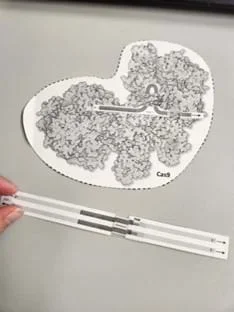 Using the paper model to show gene knockout.Copyright Heidi Bordeleau
 - Ensure students have internet access to use the CRISPR-Cas9 interactive found at https://www.biointeractive.org/classroom-resources/crispr-cas9-mechanism-applications. (Alternatively, you can display the interactive on the board and work through it as a class.)
- Give student groups time to work through the BioInteractive Student Handout (PDF).
Day 3:
Part 1: Imagine and Plan (Students imagine how genome editing tools may be used to cure their disease and plan how CRISPR-Cas9 can edit their assigned mutation.)
- Groups need to determine whether non-homologous end joining (“gene knockout”) or homology-directed repair (“gene knock-in”) would be best suited for their genetic disorder.
- Have each group fill out the CER Worksheet (PDF).
- Have students consider the following questions:
- Is it enough to simply turn the diseased gene off, or does the cell need a corrected version of the gene?
- Is the disease dominant or recessive?
- Does the body have a working version of this gene, or are both copies mutated?
- How will this affect the protein being produced?
- Each group can either have an informal discussion with you, OR students can use the CER Worksheet (PDF) to explain their choice.
Part 2: Create (Students create a paper model of CRISPR-Cas9 that targets and edits their mutated DNA strand.)
- To model CRISPR repair of their gene, students need to create a template DNA molecule that matches their diseased gene sequence.
- They will then need to create a corresponding guide RNA molecule.
- Groups that are modeling homology-directed repair will also need to create a Donor DNA molecule. This can be done by hand, using strips of paper that match the size in the RNA/DNA Model Template (PDF). Or students can edit the Editable RNA/DNA Model Sheet (PPTX)and print the needed model components.
- See Part 1 of the BioInteractive Student Handout (PDF)for how students create their paper model.
Days 4 and 5: Create
- Give students time to construct their trifold displays. Students present their research to the class.Copyright Heidi Bordeleau
Day 6: Test and Evaluate
- Before the presentations begin, remind students that there is only enough funding for one of their research projects, and that it is their job as a class to decide which project should receive this funding.
- Let students generate their own criteria for evaluating the projects. (Or you can give them specific criteria and ask them to rank them by importance.) Criteria to consider include the following:
- How many people will benefit from a cure?
- Are other treatments available?
- How severe is the disease (current life expectancy and quality of life for those affected)?
- How early in life does the patient need to be treated to avert most negative effects?
- Does the type of mutation make a good target for CRISPR?
- Does the type of tissue/cell make a good target for CRISPR? (Note: For this last point, students need to consider how CRISPR can be delivered to the target tissue. For example, Huntington’s disease would be more difficult to target, because it involves neurons in the brain, while blood disorders are more easily targeted because we already can remove, treat, and then replace bone marrow.)
- Have each group take a turn presenting their trifold and using their paper models to explain how CRISPR could potentially cure their disorder.
- Have a class discussion about which research project should receive funding, and why.
- base-pairing
- Hydrogen bonding of specific nucleotides. (A pairs with T or U; G pairs with C)
- cleaving
- Cutting; in this context, cutting of the DNA molecule.
- nuclease
- An enzyme that cuts DNA, such as Cas9.
- nucleotides
- The building blocks (monomers) of DNA and RNA.
- phosphodiester bond
- The chemical bond the holds the sugar and phosphate backbone of DNA and RNA in place. This bond is cut by nucleases.
Pre-Activity Assessment
Introduction questions: Group/whole class discussion during activity introduction. (See questions in the “Introduction and Motivation” section.)
Information Gathering Worksheet: Students research genetic disorders that currently have no cures but may be cured with CRISPR-Cas9 in their Information Gathering Worksheet (PDF).
Activity Embedded (Formative) Assessment
BioInteractive Student Handout: Assess student answers in the BioInteractive Student Handout. (Answer key can be found under educator materials here https://www.biointeractive.org/classroom-resources/crispr-cas9-mechanism-applications or here: BioInteractive Teacher Handout (PDF))
Research Documents: Assess groups’ Information Gathering Worksheets (PDF) and CER Worksheet (PDF). (Answer keys in the Attachments section.)
Post-Activity (Summative) Assessment
Presentation Rubric: Assess the trifold display presentations and models using the Project Rubric (PDF).
Finding nucleotide sequence for the mutated genes can be tricky. Students may need help using specific search terms (such as name of the mutation and gene) to find this information. The National Center for Biotechnology Information is a great resource for finding and downloading nucleotide sequences. However, there is a learning curve to using this site and students will need help navigating it. It would be best for you to have a good understanding of the website. The National Library of Medicine YouTube channel has a series of webinars called NCBI minute. This is a great resource for familiarizing yourself with the website before students start this activity.
An excellent way to extend students’ learning is to have them use CRISPR in the lab. If the required lab equipment is available, students can perform “Knockout! A CRISPR/Cas Gene Targeting Lab” by miniPCR, which allows them to genetically engineer E. coli by disrupting the LacZ gene. This is visible as a phenotypic change in the bacterial colonies’ color. If the needed equipment is available, the lesson can be further extended to incorporate the “Knockout! PCR Genotyping Experiment.” This allows students to confirm the changes they made to the LacZ gene, and further their understanding of molecular biology techniques such as PCR and gel electrophoresis.
The most difficult portion of the information gathering step is finding the sequence of the mutated gene. The National Center for Biotechnology Information is a great resource for this, but students will need help navigating the website. It would be best for you to have a good understanding of the website. The National Library of Medicine YouTube channel has a series of webinars called NCBI minute that is a great resource for familiarizing yourself with the website. For lower grades, you can simply provide the sequences to your students (see answer keys). Students will still meet the learning targets, even if they do not find the gene sequence themselves.
It is up to you whether you require students to consider the PAM sequence in their models. More advanced students should be able to find a PAM sequence in their gene target and design their guide RNA accordingly.
About cystic fibrosis. Cystic Fibrosis Foundation. (n.d.). https://www.cff.org/intro-cf/about-cystic-fibrosis
Brokaw, A. (2020, February). Building a Paper Model of CRISPR-Cas9 Activity Educator Material. HHMI BioInteractive.
Duchenne muscular dystrophy (DMD) - diseases. Muscular Dystrophy Association. (2024, May 31). https://www.mda.org/disease/duchenne-muscular-dystrophy
HHMI BioInteractive. (2020, February 25). Building a paper model of CRISPR-Cas9. https://www.biointeractive.org/classroom-resources/building-paper-model-crispr-cas9
Mayo Foundation for Medical Education and Research. (n.d.). Sickle cell anemia. Mayo Clinic. https://www.mayoclinic.org/diseases-conditions/sickle-cell-anemia/symptoms-causes/syc-20355876
Overview of Huntington’s disease - Huntington’s disease society of America. Huntington’s Disease Society of America - Family Is Everything. (2020, November 6). https://hdsa.org/what-is-hd/overview-of-huntingtons-disease
U.S. National Library of Medicine. (n.d.). Leber congenital amaurosis: Medlineplus Genetics. MedlinePlus. https://medlineplus.gov/genetics/condition/leber-congenital-amaurosis
U.S. National Library of Medicine. (n.d.). Variation viewer. National Center for Biotechnology Information. https://www.ncbi.nlm.nih.gov/variation/view
Contributors
Heidi Bordeleau; Dr. David Schulz; Dr. Satish Nair
Supporting Program
Research Experience for Teachers (RET), University of Missouri Columbia
Acknowledgements
This work is based on work supported in part by the National Science Foundation under grant no. EEC-1801666—Research Experiences for Teachers at the University of Missouri. Any opinions, findings and conclusions or recommendations expressed in this material are those of the authors and do not necessarily reflect the views of the National Science Foundation.
Copyright
2025 by Regents of the University of Colorado; original © 2024 University of Missouri