
Measuring Muscle Biopotential Signals Using EMG Sensors During Exercise
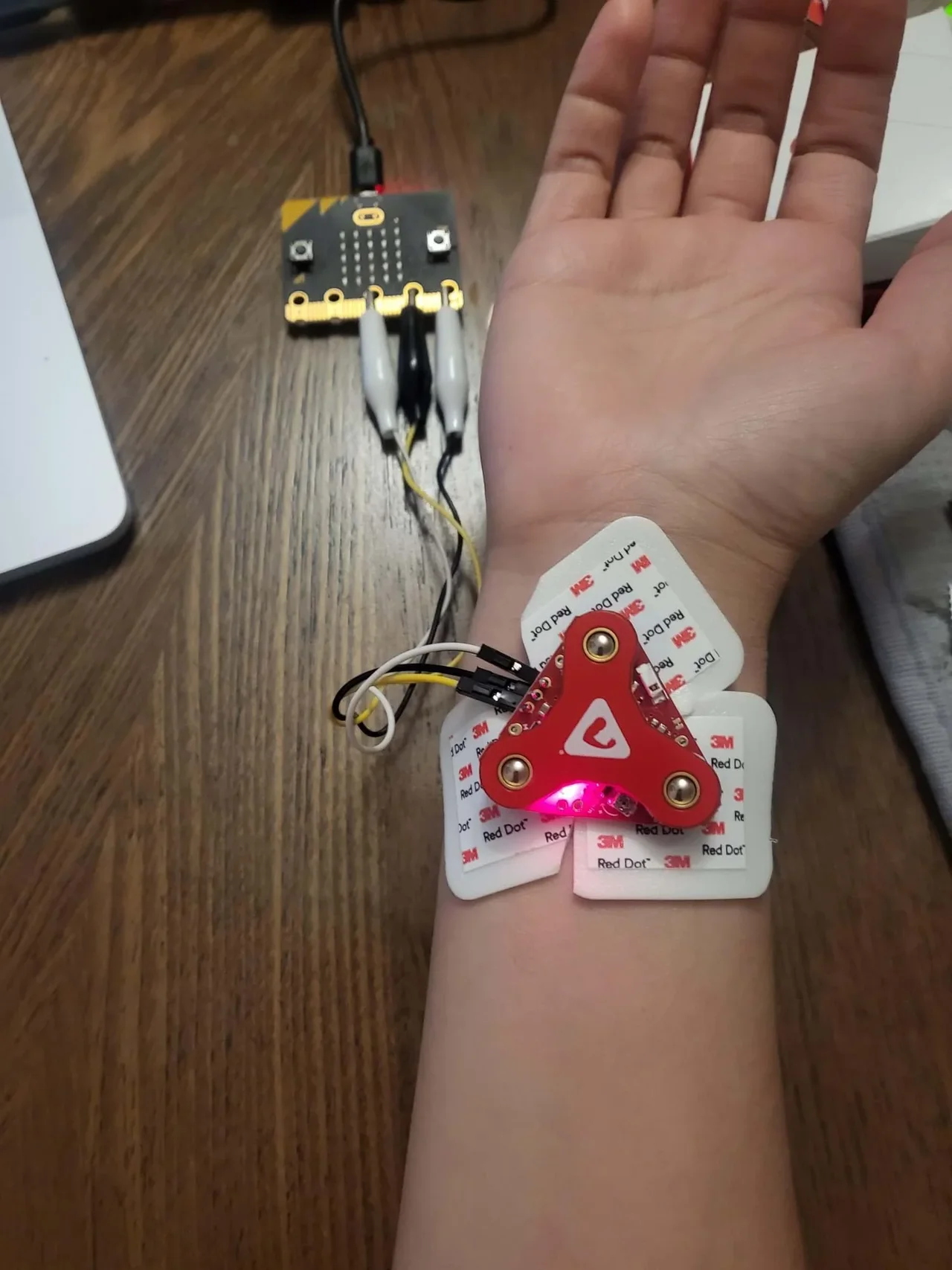 Copyright Taken during classroom testing
Students explore neuroscience concepts to understand muscle performance during exercise, focusing on motor units, muscle fibers, adenosine triphosphate (ATP), and fatigue. They create diagrams to compare large and small motor units and learn basic coding through a beating heart activity. Using the engineering design process, students design and build prototypes to record biopotential signals using EMG sensors during selected arm exercises. They test their prototypes, gather feedback, and refine their designs to improve signal recording and data accuracy. Finally, students analyze their data to identify signs of muscle fatigue and present real-world connections to fitness and health.
Biomedical engineers apply engineering principles and design concepts to medicine and biology to improve healthcare and quality of life for people. They design medical devices and equipment such as prosthetics, pacemakers, artificial organs, diagnostic machines, and surgical tools. They also develop software and technologies used for medical diagnostics, simulations, health monitoring, and patient care. Biomedical engineers often work with medical imaging and signal processing, analyzing biological signals such as electromyography (EMG), electrocardiogram (ECG), or electroencephalogram (EEG) to help diagnose or monitor health conditions. In addition, they innovate in areas such as tissue engineering and biomaterials, creating materials and structures that can safely interact with the human body.
After this activity, students should be able to:
- Identify and describe neuron parts and their functions.
- Describe small and large motor units and discuss the direct link between more motor unit recruitment and strength.
- Describe peripheral and central fatigue.
- Understand the role of cellular respiration in ATP creation and anaerobic fermentation leading to accumulation of lactic acid (fatigue).
- Draw conclusions from their data about muscle fatigue, fitness, and well-being.
- CCSS.ELA-Literacy.RST.11-12.7 Integrate and evaluate multiple sources of information presented in diverse formats and media (e.g., quantitative data, video, multimedia) in order to address a question or solve a problem.
Grades 11-12
Do you agree with this alignment? - CCSS.ELA-Literacy.WHST.11-12.2 Write informative/explanatory texts, including the narration of historical events, scientific procedures/experiments, or technical processes.
Grades 11-12
Do you agree with this alignment? - CCSS.ELA-Literacy.WHST.11-12.2e Provide a concluding statement or section that follows from and supports the information or explanation provided (e.g., articulating implications or the significance of the topic).
Grades 11-12
Do you agree with this alignment?
- DCI.LS1.A.9-12.8 Multicellular organisms have a hierarchical structural organization, in which any one system is made up of numerous parts and is itself a component of the next level.
Grades 9-12
Do you agree with this alignment? - DCI.ETS1.B.9-12.12 Both physical models and computers can be used in various ways to aid in the engineering design process. Computers are useful for a variety of purposes, such as running simulations to test different ways of solving a problem or to see which one is most efficient or economical; and in making a persuasive presentation to a client about how a given design will meet his or her needs.
Grades 9-12
Do you agree with this alignment? - SEP.2.9-12.3 Analyze complex real-world problems by specifying criteria and constraints for successful solutions.
Grades 9-12
Do you agree with this alignment? - SEP.12.9-12.11 Use mathematical models and/or computer simulations to predict the effects of a design solution on systems and/or the interactions between systems.
Grades 9-12
Do you agree with this alignment? - SEP.3.9-12.11 Evaluate a solution to a complex real-world problem, based on scientific knowledge, student-generated sources of evidence, prioritized criteria, and tradeoff considerations.
Grades 9-12
Do you agree with this alignment?
Materials for teacher:
- whiteboard or large piece of paper
Each group needs:
- 1 laptop/computer with internet access
- 1 micro:bit V2 starter kit
- 1 2.0 MyoWare muscle sensor
- 3-9 MyoWare electrodes (depends on number of trials conducted; can also use 3M red dot electrodes)
- access to MakeCode online program (https://makecode.microbit.org)
- 1 pair of scissors
- 3 connecting wires for the micro:bit
- 2 alligator clips
- 1 chronometer or cellphone timer
- Peer Review Handout (PDF)(Note: Each group needs one handout for every other group they are reviewing. For example, if there are 5 groups total, each group will need 4 handouts—one for each of the other groups.)
Each student needs:
- 1 Day 1 Handout (PDF)
- 1 Day 2 Handout (PDF)
- 1 Day 3 Handout (PDF)
- 1 writing utensil
- Day 1 Handout (docx)
- Day 1 Handout (pdf)
- Day 1 Handout Answer Key (docx)
- Day 1 Handout Answer Key (pdf)
- Day 2 Handout (docx)
- Day 2 Handout (pdf)
- Day 2 Handout Answer Key (docx)
- Day 2 Handout Answer Key (pdf)
- Day 3 Handout (docx)
- Day 3 Handout (pdf)
- Day 3 Handout Answer Key (docx)
- Day 3 Handout Answer Key (pdf)
- Peer Review Handout (docx)
- Peer Review Handout (pdf)
- Presentation Rubric (docx)
- Presentation Rubric (pdf)
Students should have:
- A basic understanding of cell structure and the function of organelles.
- A foundation of the storage of energy through ATP and the process of making this molecule through cellular respiration.
- A basic knowledge of experimental design.
You’ve just been hired by a top biomedical engineering team! Your challenge is to design a new device that helps athletes detect muscle fatigue early, before injuries happen. But before you can engineer solutions, you need to understand the body’s natural electrical system: neurons.
Your first mission is to study a diagram of a neuron. You'll write down what you already know about neurons, and at least one thing you wonder about how they work. Then, your team will come together to dive into some big questions:
- What is muscle fatigue? Recall the last time you felt fatigue after exercise—what did it feel like?
- Why are athletes able to exercise for longer periods of time while non-athletes often get tired more quickly?
- When you run or play sports, how does your body control your muscles?
Each person will think about these questions individually, and then share their ideas with their group. A team speaker will be chosen at random to present the group’s best ideas to everyone.
Once your team understands how neurons and muscles work together, and how fatigue sets in, you’ll start the engineering design process. Using your knowledge, you’ll brainstorm ideas, sketch designs, build prototypes using micro:bits and sensors, and test your inventions. Just like real engineers, you’ll gather data, analyze your results, and improve your designs. Together, you'll engineer a solution that could help real athletes stay healthy and strong!
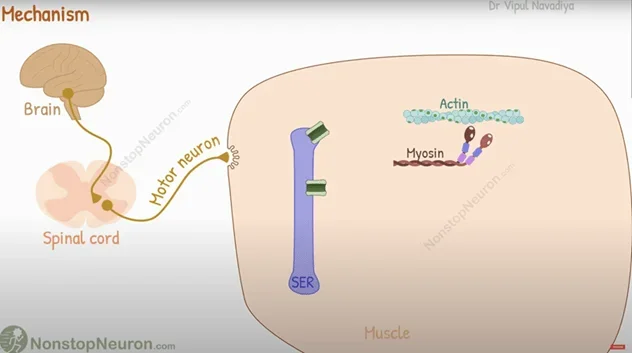 A diagram showing both the central fatigue and peripheral fatigue during the mechanism behind fatigue.Copyright https://www.youtube.com/watch?v=LomfcuSrdos
Background
Neurons consist of dendrites, which receive signals; the cell body, which processes those signals; and the axon, which sends signals. At the axon terminals, neurotransmitters are released to communicate with other cells, including muscles. Neurons are essential in controlling muscle movement, as motor neurons transmit signals from the brain and spinal cord to muscles, instructing them to contract.
Muscle fatigue occurs when muscles are no longer able to generate effective force. This can be caused by the build-up of lactic acid, the depletion of energy (ATP), or a disruption in neuron signaling. The symptoms of muscle fatigue include weakness, heaviness, and a burning sensation during or after exercise. Understanding how muscle fatigue happens is crucial for the design of devices that can detect this condition early.
Athletes and non-athletes experience muscle fatigue differently due to the adaptations in their muscles and nervous systems. Athletes' muscles are more efficient, with increased mitochondria for energy production, better blood flow, and more effective removal of waste products such as lactic acid. Additionally, athletes’ nervous systems are better adapted to quickly and efficiently send signals to muscles, allowing them to exercise for prolonged periods without fatigue.
When it comes to muscle control during exercise, the brain sends electrical signals through motor neurons to muscles, causing them to contract. This complex process requires rapid and continuous signaling, as the nervous system continuously adjusts movement through sensory feedback loops. This knowledge is crucial for understanding how muscles work together during activities such as running or lifting weights.
Micro:bits are an ideal tool for this activity because they offer a hands-on, accessible way for students to engage with technology and learn about sensors, data collection, and programming. Micro:bits are compact, affordable, and easy to use, making them perfect for educational settings. In this specific activity, micro:bits are used to detect electrical signals produced by muscle contractions via an EMG sensor. This allows students to observe and measure muscle activity in real time, bringing the scientific principles they’re learning to life in a tangible way.
Additionally, micro:bits are equipped with multiple inputs and outputs (such as buttons, sensors, and LED displays) that make them versatile for a range of experiments and projects. Their compatibility with the MakeCode platform simplifies coding for beginners, so students can focus on understanding how the data they collect connects to the biological and engineering concepts of muscle fatigue and nervous system function. The ability to visualize and analyze the data collected from the EMG sensors on a micro:bit encourages critical thinking and problem-solving, key skills in both STEM and engineering.
Before the Activity
- Gather all materials.
- Ensure that all micro:bits and sensors work.
- Make copies of the following:
- Day 1 Handout (PDF) (1 per student)
- Day 2 Handout (PDF) (1 per student)
- Day 3 Handout (PDF)(1 per student)
- Peer Review Handout (PDF)(Note: Each group needs one handout for every other group they are reviewing. For example, if there are 5 groups total, each group will need 4 handouts—one for each of the other groups.)
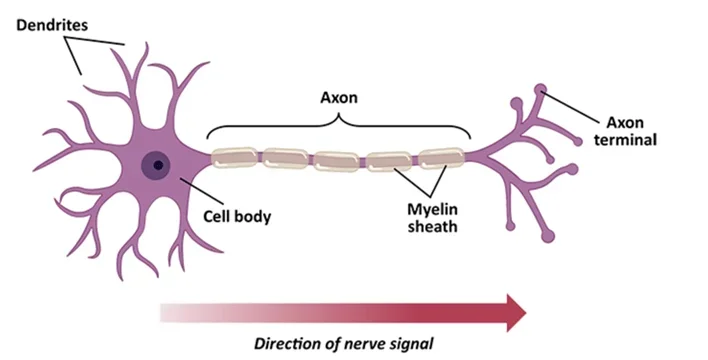 A neuron cell showing all of the parts and the direction of the nerve signal.Copyright https://www.ninds.nih.gov/health-information/public-education/brain-basics/brain-basics-know-your-brain
With the Students
Day 1: Introduction to Neuroscience (60 min)
- DO NOW (10 min)
- Give one Day 1 Handout (PDF)to each student.
- Put students into groups of 2-4 students.
- Read through the top of the handout as a class.
- Give students 5 minutes to do the “DO NOW” section, where they write down what they know about neurons and at least one question they have about neurons.
- Take 5 minutes and have students share what questions they have about neurons with the class.
- Part 1: Discussion (15 min)
- Give students 5 minutes to individually answer the questions in Part 1 of the Day 1 Handout (PDF). The same questions are below:
- What is muscle fatigue? Recall the last time you felt fatigue after exercise and describe what you felt.
- Why are athletes able to exercise for prolonged periods of time while non-athletes are not?
- Think about exercise; how does your body control your muscles when you run?
- Give each team 5 minutes to discuss their answers within their groups.
- After each group has time to discuss, randomly choose a speaker from each group to share the ideas surfaced during their group discussion. (5 min)
- Part 2: Reading Text (15 min)
- Give students time to individually read the text in Part 2 of the Day 1 Handout (PDF).
- Have students underline four pieces of evidence that will help revise the questions that arose during the “DO NOW” section.
- Give students time to share their ideas from the text within their small groups.
- Have each group pick two pieces of evidence from the text to share with the class.
- Optional: Write each group’s pieces of evidence on the whiteboard.
- Part 3: Diagram & Video (15 min)
- Have students move on to Part 3 of the Day 1 Handout (PDF).
- Using their group laptop/computer, have each group watch the first four minutes of the following YouTube video: How do muscles get tired video (5:53 minutes).
- After watching the video, have students answer Question A: According to this segment of the video, what is muscle fatigue?
- Have students complete the diagram about the mechanism of fatigue.
- After students complete their diagram, have them explain in their own words the difference between peripheral fatigue and central fatigue. (Note: Make sure students provide examples.)
- Part 4: Assessment (5 min)
- Have students write a short paragraph in Part 4 of the Day 1 Handout (PDF)addressing the introduction questions using the information from class and class discussion. In their explanation, students must address how muscle fatigue during intensive exercise affects motor units; their explanation must include motor units, muscle fibers, and fatigue (peripheral and central).
Day 2: Getting Familiar with the Micro:bit (60 min)
- DO NOW and Videos (25 min)
- Give one Day 2 Handout (PDF) to each student.
- Have students rejoin their groups from the day before, or assign new small groups.
- Give each group a micro:bit and a laptop/computer.
- Have each group complete the “DO NOW” section, identifying the parts of their micro:bit.
- Have each group view Video 1: Micro:bit Flashing Heart Tutorial (https://www.youtube.com/watch?v=hiERNxxfxJQ; 4:35 minutes).
- After their tutorial, have students practice using the MakeCode online program and micro:bits.
- Have each group view the first two minutes of Video 2: Science Experiment 05 EMG Sensor (https://www.youtube.com/watch?v=vxlPQZIwYRc; 5:20 minutes).
- Have students write a short explanation about how sensory nerves and motor nerves work and how they communicate information through electrical impulses.
- As a class, ask students to share their ideas.
- Practice Creating EMG Sensors (35 min)
- Have students move to the “Practice Creating EMG Sensors” section and follow the Procedure steps in the Day 2 Handout (PDF). Below are some helpful reminders and hints for you.
- Procedure: Remind students to put a checkmark next to each step they complete.
- Program the Micro:bit
- Open the MakeCode editor.
- Write a simple program that reads the analog input from the EMG sensor (electrode connected to the analog pin).
- Display the readings on the micro’s LED matrix, or send them over to a connected computer via USB for further analysis.
- Drag serial write value under forever. Type “EMG_Sensor”.
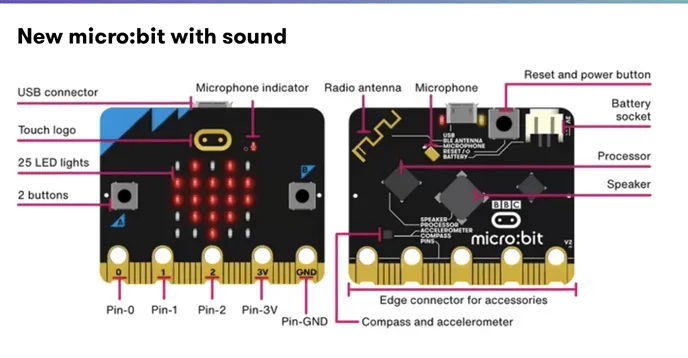 A diagram showing all of the different parts of the micro:bit.Copyright https://microbit.org/get-started/features/overview
- Click on Pins and then on analog read pin.
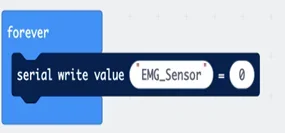 Sample code for the micro:bit reads the analog input from the EMG sensor (the electrode connected to the analog pin).Copyright Taken during classroom testing
- Drag the pin to the right of the serial write value. Drag it and place it over =0. Click on pin and change it to P2.
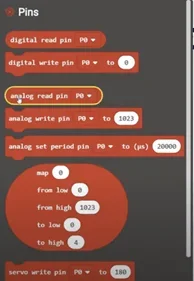 Sample code for the micro:bit showing the different read pins available and which one to choose (highlighter in yellow “analog read pin p0).Copyright Taken during classroom testing
- Pair your micro:bit and download the program then click on show console.
- Create the Electrodes
- If the electrodes are too big, ask students to make them smaller by cutting around the edges.
- These electrodes will pick up the electrical signals generated by muscle activity.
- Connect Electrodes to the Micro:bit
- Use the alligator clips already attached to the muscle sensor and attach them to the micro:bit.
- Attach Electrodes to the Skin
- Make sure skin is dried and clean before attaching the electrodes below the wrist.
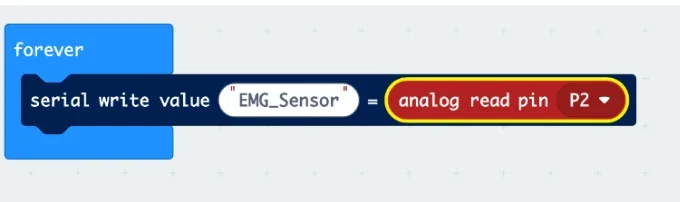 A micro:bit program showing all the blocks needed to connect the micro:bit to the muscle sensor.Copyright Taken during classroom testing
- Test the Setup: Flex your muscle and observe the changes in the readings on the micro:bit. When you contract the muscle under the electrodes, the readings should increase, indicating the detection of muscle activity.
Sample experiment setup, with electrodes and jump cables connecting muscle sensor and microbat.Copyright Taken during classroom testing
- Data Collection and Analysis
- Use the data collected by the micro:bit to analyze muscle activity. Students can modify the code to record data over time or trigger specific actions based on muscle contractions.
- Have students take a couple of screenshots of their data and write a conclusion paragraph in the MEAL format (main idea, evidence, analysis, and link to real world). The evidence part must be taken from the EMG signals collected using the micro:bit.
- Self-assessment: Ask students to write about the part(s) of this activity that were most difficult for them, and to specify their reasoning. Have students also write about the part(s) of the activity that they found easier to do.
Day 3: Ask, Imagine, and Plan (60 min)
- DO NOW (10 min)
- Give each student a Day 3 Handout (PDF).
- Have students read the passage about muscle fatigue in the Day 3 Handout (PDF).
- After they read the paragraph, have each student answer the following question: “Do you think muscle fatigue is different between athletes and non-athletes when doing the same exercise?” Remind students to provide biological reasoning.
- After students write their answers, give students 5 minutes to discuss their individual answers within their small groups.
- Engineering Design Process (5 min)
- Introduce the steps of the engineering design process:
- Ask - Identify the Need & Constraints: Engineers ask critical questions about what they want to create, whether it be a skyscraper, amusement park ride, bicycle, or smartphone. These questions include: What is the problem to solve? What do we want to design? Who is it for? What do we want to accomplish? What are the project requirements? What are the limitations? What is our goal?
- Research - Research the Problem: This includes talking to people from many different backgrounds and specialties to assist with researching what products or solutions already exist, or what technologies might be adaptable to your needs.
- Imagine - Develop Possible Solutions: Work with a team to brainstorm ideas and develop as many solutions as possible. This is the time to encourage wild ideas and defer judgment! Build on the ideas of others! Stay focused on topic, and have one conversation at a time! Remember: good design is all about teamwork!
- Plan - Select a Promising Solution: Revisit the needs, constraints, and research from the earlier steps, compare your best ideas, select one solution, and make a plan to move forward with it.
- Create - Build a Prototype: Building a prototype makes your ideas real! These early versions of the design solution help your team verify whether the design meets the original challenge objectives. Push yourself for creativity, imagination, and excellence in design.
- Test - Test and Evaluate Prototype: Does it work? Does it solve the need? Communicate the results and get feedback. Analyze and talk about what works, what doesn't, and what could be improved.
- Improve - Redesign as Needed: Discuss how you could improve your solution. Make revisions. Draw new designs. Iterate your design to make your product the best it can be.
And now, REPEAT!
- Ask (5 min):
- Present the engineering design challenge: Create a prototype using micro:bits, MakeCode, and EMG sensors to measure muscle fatigue. Potential questions for students to consider include:
- How can we detect and measure muscle fatigue using EMG sensors?
- What is muscle fatigue, and how is it observed biologically?
- What biopotential signals are we measuring?
- What muscle group will we focus on?
- What kind of physical task will induce measurable fatigue?
- Optional: Research (5 min):
- Ask students to summarize what they know about muscle fatigue and EMG sensors from the previous days.
- Imagine (10 min):
- Give students 5 minutes to individually brainstorm possible solutions in their Day 3 Handout (PDF). Questions to prompt students in their brainstorming include:
- Where should the EMG sensors be placed?
- What physical task could effectively produce fatigue (e.g., squeezing a ball, holding a plank)?
- How can the micro:bit be coded to capture or display signal changes?
- What variables could impact your readings (e.g., sensor placement, body movement, sweat, etc.)?
- Plan (25 min):
- Have each team member share their ideas with the group.
- Then, as a team, have each group select ONE solution. This can be one specific solution or a mixture of ideas.
- Have each group member draw their team’s solution in in their Day 3 Handout (PDF). Remind students to label parts and list the materials they plan to use.
- Optional homework: If students are not done with their planning during class, they can complete their planning as homework. This must be completed for peer review on the following day.
Day 4: Peer Feedback, Create, and Test (60 min)
- DO NOW (5 min)
- As a DO NOW, give students 5 minutes in their groups to get ready to share their planned experimental/device setup with the class.
- Peer Review Presentations (20 min)
- Provide one Peer Review Handout (PDF)for each group to each group.
- Have each group present their prototype and procedure to the class. These presentations should not take more than 3 minutes each.
- Have students complete the Peer Review Handout (PDF)after each group presents.
- Create and Test (35 min)
- Give students time to review their peer review feedback.
- Give students time to adjust their planned prototype based on feedback.
- Give students 10 minutes to build their sketched prototype.
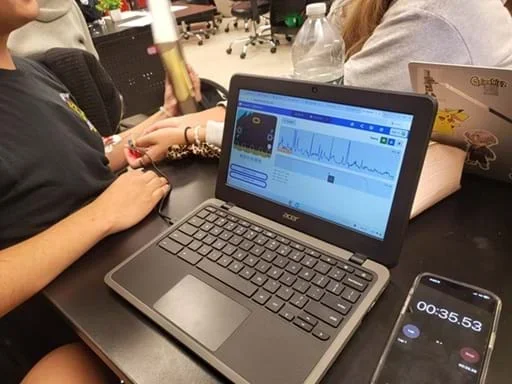 A student collecting data during the experiment.Copyright Taken during classroom testing
- Give students 15 minutes to test their prototype and collect biopotential signal data.
- Remind students that they should collect the data in the form of graphs. They should have one graph from the non-athletes’ biopotential signal data and another from the athletes’ data.
- Also remind students to record any other observations that can help them make sense of the data.
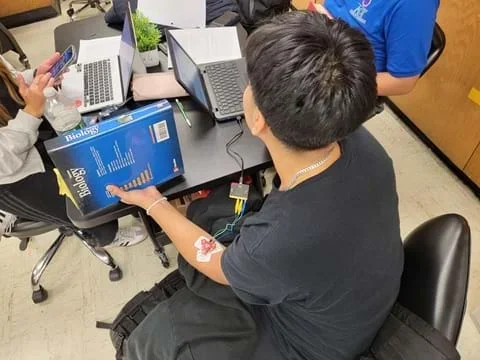 Students working on their prototype.Copyright Taken during classroom testing
- After collecting data, have students complete both the data analysis and conclusion sections. Students will analyze the data collected during their experiment and write a paragraph explaining their data using the claim, evidence, and reasoning (CER) format. Students must state whether their claim was supported by the data collected. Evidence taken directly from their data will be used to either support or refute their hypothesis. The reasoning must also include the neuroscience background information learned, as well as the technology they learned to create their prototypes. Last, they must connect this idea to real-world applications and make suggestions on how to improve this experiment and/or create a better prototype for the type of experiment they proposed. (Optionally, this can be assigned as homework.)
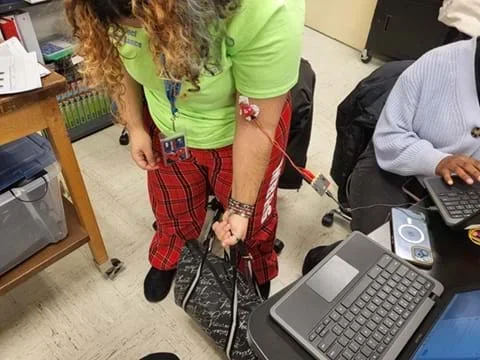 Another student prototype.Copyright Taken during classroom testing
Day 5: Presentations (60 min)
- Give students 20 minutes to work on organizing their lab report to be presented to the class. All members of the group are expected to participate in the presentation.
- Optional: If there is enough time, ask students to create a PowerPoint or Google Sheets presentation.
- Have each group present their prototype and experiments to the class. Each student will provide feedback to the presenting group. Use the Presentation Rubric (PDF) to grade each team’s presentation.
- dependent variable
- The variable in an experiment that is being measured or tested.
- independent variable
- The variable that is deliberately manipulated or changed in an experiment to observe its effect on the dependent variable.
- control group
- The group in an experiment that does not receive the experimental treatment or intervention.
- experimental group
- The group in an experiment that receives the treatment or intervention being tested. This group is exposed to the independent variable.
- neuron
- A specialized cell in the nervous system that transmits information through electrical and chemical signals. Neurons are the basic building blocks of the nervous system and are responsible for receiving sensory input, processing information, and sending signals to muscles and glands.
- motor unit
- A single motor neuron and all the muscle fibers it innervates. When the motor neuron sends a signal, all of the muscle fibers in the motor unit contract simultaneously. Motor units are important for controlling the force of muscle contractions.
- muscle fiber
- A single muscle cell, and the basic unit of a muscle. Muscle fibers are long, cylindrical cells that contract in response to signals from motor neurons, leading to muscle movement. Each muscle fiber contains many myofibrils, which are responsible for the contraction process.
- central fatigue
- A decline in the ability of the central nervous system (CNS) to activate muscles during prolonged physical activity. It is characterized by a reduction in the voluntary drive to muscles, which can limit physical performance.
- peripheral fatigue
- Occurs within the muscles themselves and is the result of biochemical changes that impair muscle contraction. This can include the depletion of energy stores (such as ATP) or the accumulation of metabolic byproducts (such as lactic acid) that interfere with muscle function.
- atp (adenosine triphosphate)
- The primary energy carrier in cells. It provides the energy needed for many cellular processes, including muscle contraction. When ATP is broken down into ADP (adenosine diphosphate) and a phosphate group, energy is released, which is used to power cellular activities.
- lactic acid
- A byproduct of anaerobic metabolism, which occurs when oxygen levels are low, such as during intense exercise. It is produced in muscle cells when glucose is broken down for energy without enough oxygen. Accumulation of lactic acid in muscles can contribute to the sensation of muscle fatigue and soreness.
Pre-Activity Assessment
Pre-Activity Assessment Questions: The questions below are presented to the students during the Introduction and Motivation section. Students are encouraged to think about and share out their answers. This will help teachers to gain an understanding of students’ prior knowledge.
- What is muscle fatigue? Recall the last time you felt fatigue after exercise—what did it feel like?
- Why are athletes able to exercise for longer periods of time while non-athletes often get tired more quickly?
- When you run or play sports, how does your body control your muscles?
DO NOW Activities: The activities in preparation for their experiment (pre-activity) will take place during Days 1 and 2. During the beginning of these two activities, students will complete DO NOW activities for you to gain understanding of their prior knowledge. In addition, students will be assessed through group discussions, short reads, and answering review questions (checking for understanding).
Activity Embedded (Formative) Assessment
Formative Assessment: Students complete the Day 3 Handout (PDF) as they work through the engineering design process to plan, design, build, and test their prototypes and procedures.
Post-Activity Assessment
Prototype and Procedure: Students design a prototype and procedures to test differences in muscle fatigue between athletes and non-athletes.
Conclusion Paragraph: Using the data collected, students write a conclusion paragraph using the CER format.
Group Presentations: Students present their projects to the class and then answer follow-up questions from other peers and teachers.
- Make sure your micro:bit is connected to MakeCode.
- Review hypothesis and variables in an experiment.
- Students can be grouped based on academic level.
- More guided steps and demos can be provided to students who need more help.
- Have students make connections to real-world applications.
“After-Fatigue Condition: A Novel Analysis Based on Surface EMG Signals.” (Nguyen, Thien Luu, & Ravier, 2023) https://ar5iv.labs.arxiv.org/html/2309.04770.
“ATP Production in Skeletal Muscle,” Kevin Petti, Ph.D. https://www.youtube.com/watch?v=zRlQvOrjYYo.
“Effects of Physical Activity and inactivity on Muscle Fatigue,” (Bogdanis, 2012) https://www.frontiersin.org/journals/physiology/articles/10.3389/fphys.2012.00142/full.
“How exactly do the muscles get tired? Muscle fatigue, peripheral fatigue” https://www.youtube.com/watch?v=LomfcuSrdos.
Jing-jing Wan,1,2 Zhen Qin,1,2 Peng-yuan Wang,1 Yang Sun,1 and Xia Liu1 “Muscle Fatigue: General Understanding and Treatment,” National Library of Medicine, 6 Oct. 2017, https://www.ncbi.nlm.nih.gov/pmc/articles/PMC5668469/#:~:text=the%20motor%20system.-,1,into%20central%20and%20peripheral%20components.
Lin TW, Tsai SF, Kuo YM. Physical Exercise Enhances Neuroplasticity and Delays Alzheimer's Disease. Brain Plast. 2018 Dec 12;4(1):95-110. doi: 10.3233/BPL-180073. PMID: 30564549; PMCID: PMC6296269. https://www.ncbi.nlm.nih.gov/pmc/articles/PMC6296269.
"Muscle Fatigue." Physiopedia, 3 Jan 2022, 15:44 UTC. 1 Sep 2024, 22:52 https://www.physio-pedia.com/index.php?title=Muscle_Fatigue&oldid=290326.
micro:bit: Flashing heart tutorial, https://www.youtube.com/watch?v=hiERNxxfxJQ.
Palumbo A, Vizza P, Calabrese B, Ielpo N. “Biopotential Signal Monitoring Systems in Rehabilitation: A Review.” Sensors (Basel). 2021 Oct 28;21(21):7172. doi: 10.3390/s21217172. PMID: 34770477; PMCID: PMC8587479. https://www.ncbi.nlm.nih.gov/pmc/articles/PMC8587479.
Recruitment of small and large motor units, https://www.youtube.com/watch?v=1E3MLkvnCME.
The motor unit and recruitment in Skeletal Muscle,” https://www.youtube.com/watch?v=UnNGGD4-IHU.
V. -H. Nguyen, G. T. Luu, T. Van Luong, M. X. Trang, P. Ravier and O. Buttelli, "After-Fatigue Condition: A Novel Analysis Based on Surface EMG Signals," 2023 Asia Pacific Signal and Information Processing Association Annual Summit and Conference (APSIPA ASC), Taipei, Taiwan, 2023, pp. 272-277, doi: 10.1109/APSIPAASC58517.2023.10317458. https://ieeexplore.ieee.org/document/10317458.
Contributors
Carolina Gallego; Hend Rasheed; Dr. David A. Bergin; Dr. Satish S. Nair
Supporting Program
Research Experience for Teachers (RET), University of Missouri Columbia
Acknowledgements
This work is based on work supported in part by the National Science Foundation under grant no. EEC-1801666—Research Experiences for Teachers at the University of Missouri. Any opinions, findings and conclusions or recommendations expressed in this material are those of the authors and do not necessarily reflect the views of the National Science Foundation.
Copyright
2025 by Regents of the University of Colorado; original © 2024 University of Missouri