
E.T. Phone Home: Fact or Fiction?
 Detail of “Any Given Sunday,” artwork by Kiel Johnson.Copyright 2016 Kiel Johnson. Used with permission. http://kieljohnson.com/any-given-sunday
A favorite movie, “E.T. the Extra-Terrestrial,” provides the backdrop scenario for students to discover how harnessing the sun’s energy provides unlimited power for many purposes, including the operation of thousands of satellites in orbit today and communication over long distances. In the movie, E.T., an alien life form, is stranded on Earth and befriends Elliott, the little boy who rescues him. As E.T. becomes gravely ill, Elliott realizes that E.T. needs to return home in order to survive. To arrange for transport, E.T. must “phone home.” Teams engage in an interactive quest to answer the question: E.T. phone home—fact or fiction? They must discover four clues in order to unlock four padlocks on a box that contains the answer. This requires them to watch a one-minute online video, complete a crossword puzzle, scan three QR codes for articles to read, and put together a cut-apart puzzle with an invisible ink clue. They watch short online movie excerpt videos to kick off and wrap up the activity.
Since Russia launched Sputnik 1 into space in 1957—the first satellite in orbit—researchers and engineers have continued to develop innovative technological capabilities to support exploration into the vastness beyond our planet, deeper and deeper into space. Fast-forward to 2017, more than 1,100 active satellites orbit Earth, in addition to the 2,600 satellites still in orbit that are no longer operational.
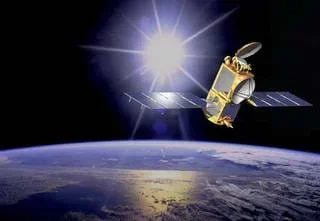 Powered by solar energy, the Jason-2 satellite orbits Earth, carrying tools and sensors that help researchers study the oceans.Copyright NASA https://www.nasa.gov/audience/forstudents/5-8/features/nasa-knows/what-is-a-satellite-58.html
What do satellites have to do with photovoltaics? Satellites are powered by sunlight using the solar cells built into them, transforming the sun’s energy into electricity, a useable form of power. These satellites enable so many benefits to people on Earth, such as widespread communication, photographs for storm tracking and weather predictions, as well as capturing and relaying images from far beyond our universe in the human quest to discover life beyond Earth. The innovations that engineers have developed in order to power the thousands of satellites in orbit today might prove to be the very innovations that help us improve our electricity-generation challenges on Earth.
After this activity, students should be able to:
- Explain how solar (photovoltaic) cells transform the sun’s energy into a useable form of power, electricity.
- Explain how solar (photovoltaic) cells are used to power satellites.
- Explain how satellites enable communication over long distances.
- Students will develop an understanding of and be able to select and use energy and power technologies.
Grades K-12
Do you agree with this alignment? - Students will develop an understanding of the relationships among technologies and the connections between technology and other fields of study.
Grades K-12
Do you agree with this alignment? - Power systems are used to drive and provide propulsion to other technological products and systems.
Grades 6-8
Do you agree with this alignment? - STEL-3F Apply a product, system, or process developed for one setting to another setting.
Grades 6-8
Do you agree with this alignment?
- Know that there have been manned and unmanned journeys to space and to the moon.
Grade 5
Do you agree with this alignment? - Explain how energy from the sun supports life on Earth.
Grade 7
Do you agree with this alignment?
- CCC.5.6-8.6 Energy may take different forms (e.g. energy in fields, thermal energy, energy of motion).
Grades 6-8
Do you agree with this alignment? - CCC.5.6-8.8 The transfer of energy can be tracked as energy flows through a natural system.
Grades 6-8
Do you agree with this alignment?
Note: The expendable cost for this activity covers an invisible ink pen, five dancing solar-powered flower pots and Reece’s Pieces candy packets for 30 students (and the latter two are optional). The other many non-expendable items—such as tackle boxes, padlocks and black light flashlights (~$45 per group)—are expensive, yet fully reusable to run the activity many times, and many (similar) items you may already have in your classroom or home.
Each group needs:
- E.T Phone Home Fact Box Message (PDF) (2 on a sheet)
- Clue Numero Uno (PDF) (5 on a sheet)
- Solar Energy AWESOMENESS Crossword Puzzle (PDF) (answers on page 2)
- QR Code: What Is a Satellite?
- QR Code: Your Cool Basics on Renewable Energy
- QR Code: Periodic Table of the Elements
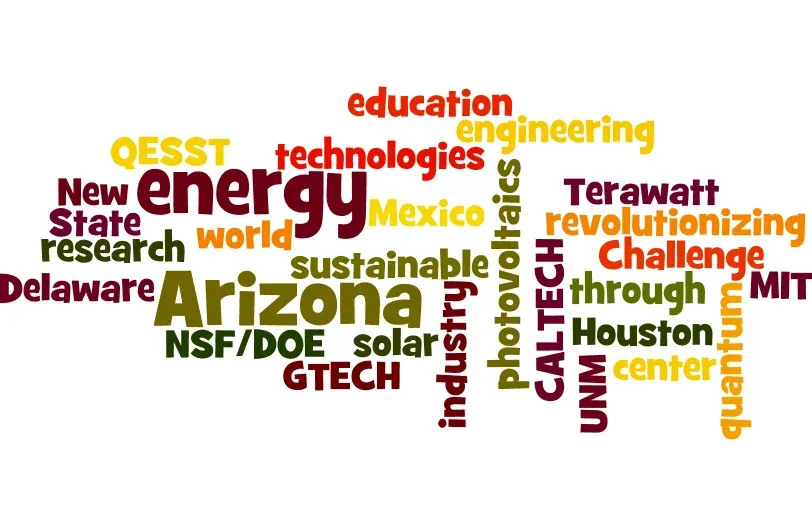
- QESST Wordle Puzzle
- Small Group Participation Rubric Criteria and Scoring Sheet (PDF) (4 on a sheet), one per student
- tackle box, or any sort of box with a lid that can be locked with four padlocks, such as a 19-inch tool box at Amazon
- alphabet padlock, such as the 5-dial resettable wordlock combination padlock at Amazon
- directional padlock, such as the resettable combination lock for $8 at Amazon
- 2 three-digit combination locks, such as from a 4-pack of resettable locker locks at Amazon
- UV flashlight, such as from a 5-pack of black light flashlights with batteries at Amazon
To share with the entire class:
- red marker
- invisible ink pen, such as from a four-pack from Amazon
- (optional) ~5 solar-powered, dancing flower pots, 1 for each member of the winning team; such as a set of two from Amazon
- (optional) Reese’s Pieces (peanut butter) candy (1.53-oz) packet, one per student; such as a box of 36 packets from Amazon
- smart device with QR reader installed, such as a Chromebook
- computer with internet access and capability to show the class many short online videos
- E.T. Phone Home Fact Box Message (docx)
- E.T. Phone Home Fact Box Message (pdf)
- Clue Numero Uno (docx)
- Clue Numero Uno (pdf)
- Solar Energy AWESOMENESS Crossword Puzzle (pdf)
- QR Code: What Is a Satellite? (jpg)
- QR Code: Your Cool Basics on Renewable Energy (jpg)
- QR Code: Periodic Table of the Elements (jpg)
- QESST Wordle Puzzle (png)
- Small Group Participation Rubric Criteria and Scoring Sheet (docx)
- Small Group Participation Rubric Criteria and Scoring Sheet (pdf)
Students should have a basic understanding that a variety of different energy forms can be converted into electricity, which is used to provide power (electricity) to the built world around us.
(As class begins, read the following scenario to students.)
E.T. (the extra-terrestrial) is an alien life form stranded on Earth. He is discovered by a little boy named Elliott, and the two quickly become friends. However, E.T. knows that in order to survive, he must find a way to return home. (Show the 3:19-minute video clip of the moment E.T. communicates to Elliott and Gertie that he wants to “phone home,” at https://www.youtube.com/watch?v=6xZif3WmG7I.)
After E.T. becomes gravely ill, Elliott realizes that E.T. must return home in order to save his life. Remember, in order to arrange for his transport, E.T. must “phone home.” (Show students the 3:29-minute video clip at https://www.youtube.com/watch?v=a-9990dlfvo.)
Is it too late to save E.T.’s life? Today, you will discover if E.T. DID in fact phone home, by embarking on an interactive quest activity; each clue will lead your group one step closer to uncovering the truth.
Background
(Provide the class with the following science and engineering background information.)
Although the science and engineering behind photovoltaics can be difficult to understand, the process of converting solar energy into electricity, a useable form of power, is quite simple.
- The sun hits the surface of a solar (photovoltaic) cell, exciting the electrons and generating direct current (DC) electricity.
- A semi-conductor material made of silicon (Si, often from sand) converts the sunlight into electricity.
- The electricity is fed into a solar inverter that converts it to alternating current (AC) electricity, which is readily used by common appliances and devices.
Many engineers today are focusing on advancing photovoltaics technology. For example, researchers at Quantum Energy and Sustainable Solar Technologies (QESST)—a multi-university engineering research center supported by the National Science Foundation and the U.S. Department of Energy—are dreaming up and testing innovative and sustainable new electricity-generation solutions to meet the growing demand.
(Teaching students about renewable energy sources helps to prepare our next generation of researchers, engineers and space pioneers to be able to make wise future decisions about how we power our world and venture to distant space.)
Before the Activity
- Gather materials.
- Make copies of the attachments listed in the Materials List. Note that the Clue Numero Uno (PDF) has five per sheet, E.T Phone Home Fact Box Message (PDF) has two per sheet, the Small Group Participation Rubric Criteria and Scoring Sheet (PDF) has four per sheet, and the answers to the Solar Energy AWESOMENESS Crossword Puzzle (PDF) are on page 2—so factor in these details when making copies.
- On each group’s copy of the Solar Energy AWESOMENESS Crossword Puzzle (PDF), use a red marker to circle the follow items: 3 across, 6 across, 1 down, 2 down and 4 down.
- Cut each group’s copy of the QESST Wordle Puzzle into several pieces and use the invisible ink pen to write 911 on three different cut pieces (see Figure 1).
- Set the following padlocks to the indicated combinations, one type of each lock for each group:
- Set the alphabet padlock to STAR.
- Set the directional padlock to left arrow, left arrow, down arrow, down arrow, down arrow.
- Set the first three-digit lock to 014.
- Set the second three-digit lock to 911.
- For more information on setting the locks, as well as video tutorials, see https://www.breakoutedu.com/locks/
- Inside each group’s box, place its E.T Phone Home Fact Box Message (PDF) and candy packets (one per student). Then use all four locks to secure the box.
- Set a virtual timer for 30 minutes, such as by using this online stopwatch.
Instructor Tips
- It is recommended that teachers be actively involved with students throughout this interactive activity, intervening when necessary to help them stay focused and on task and to curb any frustrations, as well as to observe students’ teamwork and participation.
- In order to uncover the various lock combinations, students must correctly solve each clue. At two points, HINTS are provided for the instructor to help struggling teams.
- If it is not possible to provide each group with its own smart device equipped with a QR reader to access the necessary resources to solve the clues, provide copies of these resources for each group. The three article URLs are provided below.
- Be ready to show the class a short online video—the first minute of “Bill Nye - The Sun!” at https://www.youtube.com/watch?v=qv1KVC6jRQ8.
With the Students
- Divide the class into groups of five students each.
- Review the quest objective, expectations, instructions and rules. Tell the students:
- The Challenge: You have 30 minutes to discover if E.T. DID, in fact, phone home, by embarking on an interactive quest, in which each clue leads your group a step closer to uncovering the truth.
- You must work together as a team. I will be observing everyone’s team participation so let me tell you my expectations. (Read the rating 4 [best] criteria from the Small Group Participation Rubric Criteria and Scoring Sheet (PDF).)
- Each time you discover the answer to a clue, communicate that answer to the rest of your team.
- The better you communicate with your teammates, the greater your chance for success.
- Each group gets a tackle box secured with four locks, as well as all of the clues and necessary resources to discover the combinations to open each lock.
- Each clue provides the combination to one lock that secures your box. It requires teamwork to determine which combination unlocks which lock. This is part of the challenge and part of the fun!
- Each group also gets a Chromebook (or other device) equipped with a QR reader, which will help you access the information contained within these resources.
- As soon as you unlock one lock, move on to the next clue.
- If your team is stuck and needs help, please ask me for a hint!
- Remember, the clock is ticking, and E.T.’s life hangs in the balance!
- First clue: Hand out to each group Clue Numero Uno (PDF). Then tell students: The answer to your first clue is hidden within the first minute of this video: The sun is the closest _____ to Planet Earth. Then play for the class the first minute of the video. (Answer: STAR)
- Start the 30-minute timer.
- While groups are working to figure out the four clues, circulate the room and make observations about each student’s ability to work as a team member, rating each student (1-4) using the rubric sheet. At activity end, individually provide this feedback to students.
- Second clue: As each group finishes solving the first puzzle, hand out the crossword puzzle. Tell students: Complete the crossword puzzle to uncover your second clue. Remember that we read from left to right. (Answer: left arrow, left arrow, down arrow, down arrow, down arrow.)
- Third clue: Tell students: Read these awesome articles to discover the third clue: What is the power source for a satellite, and what is that power source MADE of? (Answer: 014; silicon is atomic number 14)
- Once scanned, the QR Code: What Is a Satellite? takes students to a NASA article, “What Is a Satellite?” If no QR reader, give students the URL: https://www.nasa.gov/audience/forstudents/5-8/features/nasa-knows/what-is-a-satellite-58.html
- Once scanned, the QR Code: Your Cool Basics on Renewable Energy takes students to an article, “Your Cool Basics on Renewable Energy!” If no QR reader, give students the URL: http://www.eschooltoday.com/energy/renewable-energy/solar-energy.html
- HINT #1: If necessary, have students scan the QR Code: Periodic Table of the Elements. Once scanned, this QR code takes students to an online periodic table of the elements. If no QR reader, give students the URL: https://ptable.com/
- Fourth clue: Provide each group with a UV flashlight and all pieces for one complete wordle puzzle. Then tell students: Your fourth and final clue to unlock the answer is hidden somewhere on the word cloud puzzle! Put together the puzzle and search for the clue (see Figure 1.) (Answer: 911) HINT #2: Who do YOU call when you need help?
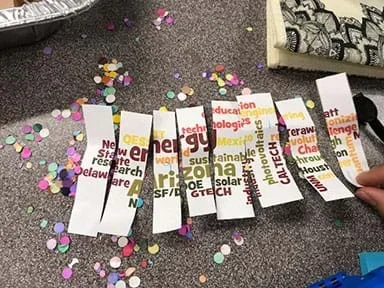 Figure 1. Students put together the wordle (word cloud) puzzle and use their flashlights to look for the fourth clue.Copyright 2016 Jodie Guillen, RET Program, University of New Mexico
- Upon solving the final clue, teams unlock their boxes and discover the following items: E.T. Phone Home Fact (PDF) (answer and congratulations message) and packets of Reece’s Pieces candy (one per student). In addition, give each member of the winning team—the first group to solve the challenge—a dancing solar flower pot.
- As a class, provide teams with the following explanations and video clips so they understand the significance of the candy and flower pot items and make connections to the activity concepts. Then play the four video clips, especially since some students may not have seen the full movie.
- The dancing flower pots use solar energy to move and dance, which is the same energy source we have been learning about and that enabled E.T. to phone home.
- Also, throughout the E.T. movie, the flowers in the pot reflected the state of E.T.’s health. (For students who may not have seen the entire film, ask other students to explain this to them.)
- Reese’s Pieces candy played a role in the E.T. movie. Enjoy them as a snack while you watch these final video clips.
- Elliott uses candy to lure E.T. (3:37): https://www.youtube.com/watch?v=WQoRHNSarsc
- E.T. is still alive (3:29): https://www.youtube.com/watch?v=a-9990dlfvo
- Ride in the sky (2:39): https://www.youtube.com/watch?v=oR1-UFrcZ0k
- I’ll be right here (final scene; 3:29): https://www.youtube.com/watch?v=75M1XXEZciU
- Conclude by assigning the exit-ticket to all students, as described in the Assessment section. As they write, take this time to give individual feedback to students about their level of teamwork.
- photovoltaics
- The science of transforming solar energy into electricity, a useable form of power. The word breaks down into “photo,” meaning light, and “voltaic,” meaning electricity. Abbreviated as PV.
- photovoltaic cell
- A device that converts the energy of the sun into electricity. Also called a solar cell.
- solar array
- A group of solar panels.
- solar energy
- Energy that comes from the sun.
- solar panel
- A panel consisting of many, individual solar cells that work together to produce electricity.
Activity Embedded Assessment
Small Group Participation: Early in the activity, spell out the team participation expectations, as listed on the Small Group Participation Rubric Criteria and Scoring Sheet (PDF). Then, while teams are discovering the four clues to open their boxes, circulate the room to make observations about each student’s ability to work as a member of a team using the 1-4 rubric rating scale (4 being best). At activity close, give students personal feedback.
Post-Activity Assessment
Exit Ticket: At activity end, give students 10-15 minutes to write short, bulleted answers to each of the following learning targets, which serve as their exit-tickets. (An exit ticket is a quick check for understanding at activity end to gauge understanding of the covered material, as well as to inform future instruction, ensuring that misconceptions and misunderstandings are resolved before moving ahead with new content.)
- How do solar cells (photovoltaic cells) transform the energy of the sun into electricity, a useable form of power? (Answers: The sun hits the surface of the solar cell [photovoltaic cell], generating DC [direct current] electricity. A material called a semi-conductor, usually made of silicon [Si], converts the light into electricity. Then the electricity is fed into a solar inverter that converts it into AC [alternating current] electricity.
- How are solar cells (photovoltaic cells) used as a source of energy for power on satellites? (Answer: Solar energy can be transformed into electricity, through the placement of solar cells on satellites.)
- How do satellites help with communication over long distances? (Answer: Satellites can then be used for communication on Earth, as well as millions of miles away from home, without the interference of mountains, oceans or the vastness of space.)
Personal Teamwork Feedback: Individually discuss with students the team participation ratings they received during the group activity. Have a productive dialog about areas for celebration as well as areas for improvement with the aim to increase student awareness in advance of the next group activity they participate in.
If any students have peanut sensitivities or allergies, choose a candy without peanuts.
You may want to watch or shows students a two-minute video, Energy 101: Solar PV, that provides a simple explanation of how solar cells work, at https://www.youtube.com/watch?v=0elhIcPVtKE
You may want to show students a 3:15-minute video excerpt from an interview with actor Matt Damon about The Martian movie in which he talks about the importance of continued engineering, space exploration and a pioneering spirit to the future of our species. The Martian: Matt Damon Official Movie Interview - Science Fiction at https://www.youtube.com/watch?v=jgIZRdeMO_I
Knier, Gil. “How Do Photovoltaics Work?” NASA Science Newsletter, Science Beta, NASA. Accessed December 12, 2017. https://science.nasa.gov/science-news/science-at-nasa/2002/solarcells
May, Sandra. What is a satellite? Last updated August 4, 2017. NASA Knows (Grades 5-8). Accessed December 17, 2017. https://www.nasa.gov/audience/forstudents/5-8/features/nasa-knows/what-is-a-satellite-58.html
Petty, John Ira. Now That's a Long-Distance Call! Last updated November 30, 1007. NASAexplores, Human Exploration and Development of Space Enterprise, NASA. Accessed December 17, 2017. https://www.nasa.gov/vision/space/livinginspace/Now_Thats_A_Long-Distance_Call.html
Ritter, Malcolm. How Many Man-Made Satellites Are Currently Orbiting Earth? Published March 28, 2014. Talking Points Memo, The Associated Press. Accessed December 17, 2017. http://talkingpointsmemo.com/idealab/satellites-earth-orbit
Solar Arrays. Airbus. http://www.space-airbusds.com/en/news2/production-od-solar-arrays.html
What is solar energy? Solar cells and solar panels? eSchoolToday with BusinessGhana.com. Accessed December 17, 2017. http://www.eschooltoday.com/energy/renewable-energy/solar-energy.html
- Solar Power to the Rescue!
- E.T. Phone Home: Fact or Fiction?
Contributors
Jodie Guillen
Supporting Program
Energizing Engineering Education (E3) RET Program, School of Engineering and College of Education, University of New Mexico
Acknowledgements
This curriculum is based upon work supported by the National Science Foundation under RET grant no. EEC 1301373—the Energizing Engineering Education (E3) Research Experiences for Teachers site, investigating energy research and engineering practice at the School of Engineering and College of Education at University of New Mexico. Any opinions, findings, and conclusions or recommendations expressed in this material are those of the author(s) and do not necessarily reflect the views of the National Science Foundation.
Many thanks to the Quantum Energy and Sustainable Solar Technologies Engineering Research Center (QESST) sponsored by the National Science Foundation and the U.S. Department of Energy for the author’s summer 2016 RET lab experience at the University of New Mexico, research educational poster session at Arizona State University in July 2016, and NSF site visit at ASU in April 2017.
Thanks also to Kiel Johnson for permitting our use of a portion of his incredible artwork, “Any Given Sunday.” See http://kieljohnson.com/any-given-sunday.
Copyright
2017 by Regents of the University of Colorado; original © 2016 University of New Mexico