
Packed for Shipping: Using Linear Regression in Engineering Design
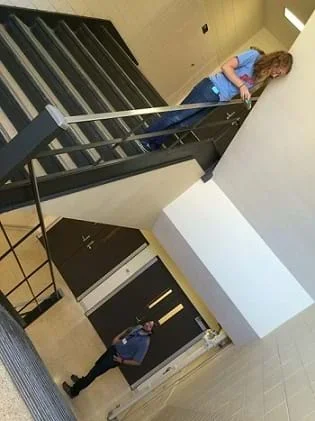 Will the prototype packaging design protect a dropped cell phone?Copyright 2016 Brett Doudican, Universities of Central State, Dayton, and Wright State
Students apply their knowledge of linear regression and design to solve a real-world challenge to create a better packing solution for shipping cell phones. They use different materials, such as cardboard, fabric, plastic, and rubber bands to create new “composite material” packaging containers. Teams each create four prototypes made of the same materials and constructed in the same way, with the only difference being their weights, so each one is fabricated with a different amount of material. They test the three heavier prototype packages by dropping them from different heights to see how well they protect a piece of glass inside (similar in size to iPhone 6). Then students use linear regression to predict from what height they can drop the fourth/final prototype of known mass without the “phone” breaking. Success is not breaking the glass but not underestimating the height by too much either, which means using math to accurately predict the optimum drop height.
Students apply scientific and engineering ideas to design, evaluate and refine a device that minimizes the force on an object during a collision. They work through the engineering design process to create new packaging to prevent shipping damage while also considering cost analysis of the design. In materials engineering, researchers figure out which material types are the most suitable—safest, most effective and efficient—for the product they are creating. Students study the provided materials to learn more about their characteristics and then combine them creatively in their designs. Like engineers, students test the quality of their “products,” collect data and then refer to their linear regression graphs to determine with precision (not too high, but not too low) the height at which they can safely drop their final prototype devices.
After this activity, students should be able to:
- Follow the steps of the engineering design process to find a composite material solution for creating the most cost-effective and durable packaging for cell phones.
- Describe the positive and negative attributes of using different materials to design protective structures and apply an understanding of the different materials to make choices concerning structure and design.
- Identify and discuss relationships between independent and dependent variables.
- Perform linear regression.
- Use the regression equation to solve problems.
- CCSS.Math.Content.HSA-CED.A.2 Create equations in two or more variables to represent relationships between quantities; graph equations on coordinate axes with labels and scales.
Grades 9-12
Do you agree with this alignment? - CCSS.Math.Content.HSA-CED.A.4 Rearrange formulas to highlight a quantity of interest, using the same reasoning as in solving equations.
Grades 9-12
Do you agree with this alignment? - CCSS.Math.Content.HSS-ID.A Summarize, represent, and interpret data on a single count or measurement variable
Grades 9-12
Do you agree with this alignment? - CCSS.Math.Content.HSS-ID.B Summarize, represent, and interpret data on two categorical and quantitative variables
Grades 9-12
Do you agree with this alignment? - CCSS.Math.Content.HSS-ID.B.6 Represent data on two quantitative variables on a scatter plot, and describe how the variables are related.
Grades 9-12
Do you agree with this alignment? - CCSS.Math.Content.HSS-ID.B.6c Fit a linear function for a scatter plot that suggests a linear association.
Grades 9-12
Do you agree with this alignment? - CCSS.Math.Practice.MP1 Make sense of problems and persevere in solving them.
Grades K-12
Do you agree with this alignment? - CCSS.Math.Practice.MP2 Reason abstractly and quantitatively.
Grades K-12
Do you agree with this alignment? - CCSS.Math.Practice.MP4 Model with mathematics.
Grades K-12
Do you agree with this alignment?
- Students will develop an understanding of the attributes of design.
Grades K-12
Do you agree with this alignment? - Students will develop an understanding of engineering design.
Grades K-12
Do you agree with this alignment? - Students will develop an understanding of the role of troubleshooting, research and development, invention and innovation, and experimentation in problem solving.
Grades K-12
Do you agree with this alignment? - Students will develop abilities to apply the design process.
Grades K-12
Do you agree with this alignment?
- HS-ETS1-2 Design a solution to a complex real-world problem by breaking it down into smaller, more manageable problems that can be solved through engineering.
Grades 9-12
This resource focuses on the following Three Dimensional Learning aspects of NGSS:
Science & Engineering Practices- Design a solution to a complex real-world problem, based on scientific knowledge, student-generated sources of evidence, prioritized criteria, and tradeoff considerations.Do you agree with this alignment?
Disciplinary Core Ideas- Criteria may need to be broken down into simpler ones that can be approached systematically, and decisions about the priority of certain criteria over others (trade-offs) may be needed.Do you agree with this alignment?
Do you agree with this alignment? - Design a solution to a complex real-world problem, based on scientific knowledge, student-generated sources of evidence, prioritized criteria, and tradeoff considerations.
- HS-ETS1-3 Evaluate a solution to a complex real-world problem based on prioritized criteria and trade-offs that account for a range of constraints, including cost, safety, reliability, and aesthetics, as well as possible social, cultural, and environmental impacts.
Grades 9-12
This resource focuses on the following Three Dimensional Learning aspects of NGSS:
Science & Engineering Practices- Evaluate a solution to a complex real-world problem, based on scientific knowledge, student-generated sources of evidence, prioritized criteria, and tradeoff considerations.Do you agree with this alignment?
Disciplinary Core Ideas- When evaluating solutions it is important to take into account a range of constraints including cost, safety, reliability and aesthetics and to consider social, cultural and environmental impacts.Do you agree with this alignment?
Crosscutting Concepts- New technologies can have deep impacts on society and the environment, including some that were not anticipated. Analysis of costs and benefits is a critical aspect of decisions about technology.Do you agree with this alignment?
Do you agree with this alignment? - Evaluate a solution to a complex real-world problem, based on scientific knowledge, student-generated sources of evidence, prioritized criteria, and tradeoff considerations.
- HS-PS2-1 Analyze data to support the claim that Newton's second law of motion describes the mathematical relationship among the net force on a macroscopic object, its mass, and its acceleration.
Grades 9-12
This resource focuses on the following Three Dimensional Learning aspects of NGSS:
Science & Engineering Practices- Analyze data using tools, technologies, and/or models (e.g., computational, mathematical) in order to make valid and reliable scientific claims or determine an optimal design solution.Do you agree with this alignment?
- Theories and laws provide explanations in science.Do you agree with this alignment?
- Laws are statements or descriptions of the relationships among observable phenomena.Do you agree with this alignment?
Disciplinary Core Ideas- Newton's second law accurately predicts changes in the motion of macroscopic objects.Do you agree with this alignment?
- Attraction and repulsion between electric charges at the atomic scale explain the structure, properties, and transformations of matter, as well as the contact forces between material objects.Do you agree with this alignment?
Crosscutting Concepts- Empirical evidence is required to differentiate between cause and correlation and make claims about specific causes and effects.Do you agree with this alignment?
Do you agree with this alignment? - Analyze data using tools, technologies, and/or models (e.g., computational, mathematical) in order to make valid and reliable scientific claims or determine an optimal design solution.
- HS-PS2-3 Apply scientific and engineering ideas to design, evaluate, and refine a device that minimizes the force on a macroscopic object during a collision.
Grades 9-12
This resource focuses on the following Three Dimensional Learning aspects of NGSS:
Science & Engineering Practices- Apply scientific ideas to solve a design problem, taking into account possible unanticipated effects.Do you agree with this alignment?
Disciplinary Core Ideas- Criteria and constraints also include satisfying any requirements set by society, such as taking issues of risk mitigation into account, and they should be quantified to the extent possible and stated in such a way that one can tell if a given design meets them.Do you agree with this alignment?
- Criteria may need to be broken down into simpler ones that can be approached systematically, and decisions about the priority of certain criteria over others (trade-offs) may be needed.Do you agree with this alignment?
- If a system interacts with objects outside itself, the total momentum of the system can change; however, any such change is balanced by changes in the momentum of objects outside the system.Do you agree with this alignment?
- Attraction and repulsion between electric charges at the atomic scale explain the structure, properties, and transformations of matter, as well as the contact forces between material objects.Do you agree with this alignment?
Crosscutting Concepts- Systems can be designed to cause a desired effect.Do you agree with this alignment?
Do you agree with this alignment? - Apply scientific ideas to solve a design problem, taking into account possible unanticipated effects.
- HS.A-CED.2 Create equations in two or more variables to represent relationships between quantities; graph equations on coordinate axes with labels and scales.
Grades 9-12
Do you agree with this alignment? - HS.A-CED.4 Rearrange formulas to highlight a quantity of interest, using the same reasoning as in solving equations.
Grades 9-12
Do you agree with this alignment? - HS.S-ID.6c Fit a linear function for a scatter plot that suggests a linear association.
Grades 9-12
Do you agree with this alignment?
- A.CED.2 Create equations in two or more variables to represent relationships between quantities; graph equations on coordinate axes with labels and scales.
Grades 9-12
Do you agree with this alignment? - A.CED.4 Rearrange formulas to highlight a quantity of interest, using the same reasoning as in solving equations.
Grades 9-12
Do you agree with this alignment? - HSS-ID.B Summarize, represent, and interpret data on two categorical and quantitative variables.
Grades 9-12
Do you agree with this alignment? - MP.1 Make sense of problems and persevere in solving them.
Grades K-12
Do you agree with this alignment? - MP.2 Reason abstractly and quantitatively.
Grades K-12
Do you agree with this alignment? - MP.4 Model with mathematics.
Grades K-12
Do you agree with this alignment? - S.ID.6 Represent data on two quantitative variables on a scatter plot, and describe how the variables are related.
Grades 9-12
Do you agree with this alignment? - S.ID.6.c Fit a linear function for a scatterplot that suggests a linear association.
Grades 9-12
Do you agree with this alignment? - HSS-ID.A Summarize, represent, and interpret data on a single count or measurement variable.
Grades 9-12
Do you agree with this alignment?
- Use technology and mathematics to improve investigations and communications
Grades 9-12
Do you agree with this alignment? - Formulate and revise explanations and models using logic and evidence (critical thinking)
Grades 9-12
Do you agree with this alignment? - Recognize and analyze explanations and models
Grades 9-12
Do you agree with this alignment? - Communicate and support a scientific argument
Grades 9-12
Do you agree with this alignment? - Using graphs (average velocity, instantaneous velocity, acceleration, displacement, change in velocity)
Grades 9-12
Do you agree with this alignment?
Each group needs:
- Twizzlers, 1 red licorice candy twist per student, for the pre-activity
- 1 ruler
- 4 pieces of glass to represent cell phones; suggest 3 x 5-inches x 3/32-inches thick; tip: order the glass weeks in advance; for example, Lowe’s clear replacement picture frame/cabinet glass, 24 x 36 x 3/32-inches for $14, can be cut into ~50 smaller pieces for a $15 cutting charge
- Linear Regression Pre-Activity Quiz (PDF), one per student
- Twizzlers Linear Regression Pre-Activity & Worksheet (PDF), one per student
- Engineering Design Process Quiz (PDF), two each per student
- Project Packet (PDF), one per student
- Lab Report Rubric (PDF), one per student
To share with the entire class:
- cardboard pieces; for example, cut up two 18 x 12 x 6-inch cardboard boxes for a class of ~25; cutting on the fold lines of boxes like these generates 12 pieces of potential construction materials
- saran wrap; one 100-sq-ft box for a class of ~25
- rubber band, pieces; 1 bag of 500 rubber bands for a class of ~25
- paper and/or paper bags; such as copy paper and/or a 50-pack of paper bags
- fabric; 2 yards of fleece fabric for a class of ~25
- tape; such as duct and/or masking tape
- 2-4 hot glue guns and glue sticks; 1 pack of hot glue sticks for a class of ~25
- 2-4 scales
- 1 tape measure
- 2-4 stopwatches
- 6-8 pairs of scissors, to cut cardboard into specific sizes
- capability to show the class a six-minute online video
- computers with Internet access, for student research
- graph paper, for creating scatterplots
- broom, dust pan and trash can, for clean up during drop testing
- Linear Regression Pre-Quiz (docx)
- Linear Regression Pre-Quiz (pdf)
- Linear Regression Pre-Quiz Answer Key (docx)
- Linear Regression Pre-Quiz Answer Key (pdf)
- Twizzlers Linear Regression Pre-Activity & Worksheet (docx)
- Twizzlers Linear Regression Pre-Activity & Worksheet (pdf)
- Twizzlers Linear Regression Pre-Activity & Worksheet Answer Key (docx)
- Twizzlers Linear Regression Pre-Activity & Worksheet Answer Key (pdf)
- Engineering Design Process Quiz (docx)
- Engineering Design Process Quiz (pdf)
- Engineering Design Process Quiz Answer Key (docx)
- Engineering Design Process Quiz Answer Key (pdf)
- Project Packet (docx)
- Project Packet (pdf)
- Lab Report Rubric (docx)
- Lab Report Rubric (pdf)
Students should be able to:
- Manipulate formulas to solve for a specific variable.
- Create a graph.
- Identify independent and dependent variables.
- Use a graph to create an equation for a straight line.
- Find slope and y-intercept.
- Create a scatter plot.
- Draw a line of best fit.
- Create a linear regression.
- Calculate speed, velocity, acceleration, and momentum.
- Apply Newton’s second law of motion.
The U.S. Postal Service reports that many cell phones are damaged in the shipping process. Your engineering challenge is to design new packaging to better protect cell phones during transport. You will conduct trials of your prototype design composed of numerous construction materials to determine the safest height from which to drop the phone while trying to make it weigh as little as possible. Here are the project constraints.
 Copyright 2012 Ashwin Kumar, Wikimedia Commons CC BY-SA 2.0 https://commons.wikimedia.org/wiki/File:Samsung_Galaxy_S2_shattered_screen.jpg
For the trials testing, your group will create three prototypes based on your best design idea. Then, you will create a fourth prototype of the same design for the final testing day. So, your team will:
- Make your first prototype protective package that weighs 20-22 grams.
- Make the second package weigh 16-18 grams.
- Make the third weigh 12-14 grams.
- Make the final package weigh 8-10 grams.
The size of each prototype must be no smaller than 13 x 7 x 0.5 cm and no larger than 20 x 10 x 5 cm. The prototype devices must be able to open up and close in order to hold the “cell phone.” The final testing day prototype must follow all of the same expectations, but be the lightest weight—8-10 grams.
Your team may choose from the following materials: cardboard, plastic, rubber bands, paper and fabric. Each prototype must be made of the same materials and have the same general design; the only thing that may differ is how much material is used so that the weight varies to meet the requirements.
We’ll use pieces of glass to represent the cell phones. If, when tested, no damage happens to the “cell phone—such as breaks, chips, cracks and scratches—you will have achieved a safe drop.
 Composites are formed by combining materials together to form an overall structure with properties that differ from the sum of the individual components.Copyright 2009 PerOX, Wikimedia Commons (public domain) https://commons.wikimedia.org/wiki/File:Composite_3d.png
By the end of the design process, your team will be able to compare and contrast across teams, and determine the most reliable design of composite materials, taking into considering cost effectiveness and durability. You will do this by creating a budget for your prototype costs and comparing that to other groups. This project requires you to use the math and science concepts of graphing data, linear regression, velocity, acceleration, and force. Let’s get started to protect that cell phone!
Background
Scatter plots are made by plotting data with the independent variable on the x-axis and the dependent variables on the y-axis. The independent variable is something that the student changes and the dependent variable changes based on the independent variable’s value. In this activity, prototype weight is the independent variable and the height at which the package sustains damage is the dependent variable.
A line of best fit is created by drawing a straight line on the scatterplot through the middle of the data points. The equation for a straight line is y=mx+b, where m is the slope and b is the y-intercept.
Before making predictions, students determine the slope and intercept of their lines of best fit. They find the slope by picking two points on the line of best fit and using the formula m=Y2-Y1/X2-X1. After finding the slope, they determine the y-intercept by using the formula y=mx+b. To do this, pick a point on the line of best fit and put the slope (m) and x and y into the equation y=mx+b, and solve for b.
Students can use graphs to make further predictions about data by picking either an x or y point and plugging it into y=mx+b to solve for the missing variable (because the slope and y-intercept will be the same).
Simple linear regression is a prediction when a variable (y) is dependent on a second variable (x) based on the regression equation of a given data set. This is useful in this design challenge when students are trying to decide how high they can (safely) drop their final packages. To do this, they place their weights on the x-axis for each package, and the heights at which their other packages broke on the y-axis. Then they predict from how high they can drop their final packages, using the known weight of the final packages.
When students use many materials to create their prototypes, they are making composite materials. A composite material is a combination of two or more materials for the purpose of creating a better and unique material. While designing their packages, suggest that students keep in mind not only the package weight, but also how well the “phone” fits, how secure the “phone” nests into its protective container, and how easy it is to remove the “phone.”
Background on motion:
- Speed is the distance covered divided by the amount of time it takes to cover that distance.
- Velocity is the distance covered divided by the amount of time it took to cover that distance plus a direction.
- Acceleration is the final speed minus the initial speed divided by the time it takes to reach the final speed.
- Momentum is the speed of the object multiplied by the mass of the object.
- Newton’s second law of motion states that the force on an object is proportional to the mass of the object and the acceleration of the object. This is usually written as F=ma. For a free-falling object near the surface of the Earth, gravitational force acts on the object and the acceleration is due to gravity, which is 9.8 m/s2.
Suggested Schedule
To complete this design challenge, plan on giving students seven 50-minute class periods. Below are suggested schedule and interim deadlines to help teams keep moving forward and stay on task.
Before Day 1: To gauge students’ mastery of the pre-requisite concepts, administer the Linear Regression Pre-Quiz (PDF) and the Twizzlers Linear Regression Pre-Activity (PDF). (It’s fun; they measure the candy, take a bite, measure again, and repeat until the candy is gone. Then they use their data to graph and do a linear regression analysis.)
Day 1: Administer the design process quiz (pre-assessment). Show a fun online video (6:30 minutes) of kids following the engineering design process to make a bike trailer, and have students read an article that helps start the conversation for why this project about cell phones is being done (step 1: identify the problem/need).
Day 2: Introduce the design challenge and constraints. Groups brainstorm, research, design and plan.
Day 3: Groups create four replicas of their prototype design (different weights).
Day 4: Groups collect data using first three prototypes and then make height predictions based on their linear regression graphs.
Day 5: Groups test their final design prototypes, starting at their predicted heights.
Days 6-7: Groups write up their lab reports. Administer the design process quiz again (post-assessment).
Before the Activity
- Gather information about available materials and pricing by visiting local hardware, grocery and/or dollar/discount stores. Then create a budget sheet for your class project in an Excel® or Google Sheets spreadsheet. Decide whether you will give students access to the costs via computer or paper handouts.
- Make copies of the Linear Regression Pre-Activity Quiz (PDF), Twizzlers Linear Regression Pre-Activity & Worksheet (PDF), Engineering Design Process Quiz (PDF), Project Packet (PDF) and Lab Report Rubric (PDF).
- Decide in advance how to divide the class into group of four students each.
- Make sure the scale and stopwatch batteries are good.
- For Day 3, gather materials and make available in a central location.
- For Days 4 and 5, find an appropriate testing site, such as a tall, open staircase or balcony.
With the Students
- Before Day 1: Have students complete the linear regression pre-quiz and the Twizzlers pre-activity and worksheet. Review their answers to gauge their mastery of the pre-requisite concepts. Provide additional instruction and clarification, as necessary.
- Day 1: Students explore the engineering design process.
- Administer the engineering design process quiz.
- Show the class a six-minute Design Squad video about the engineering design process, “Kid Engineer: Bike Trailer.”
- Have students individually read and annotate the article, “Inside Apple’s Secret Packaging Room,” which describes some detailed aspects of how Apple does its product packaging.
 Copyright 2011 angelcandy.baby, Wikimedia Commons CC BY-SA 2.0 https://commons.wikimedia.org/wiki/File:White_iPhone_4S_with_box.jpg
- Day 2: Introduce the design challenge and the project expectations (engineering constraints) by presenting to the class the Introduction/Motivation section content.
- Provide a project overview. Hand out and go through the 11-page project packet, which includes an introduction as well as the expectations-constraints; a diagram of the engineering design process steps; what to work on/accomplish each day (mapped to the design process); prompts for drawing, research, linear regression graph, making a height prediction; blank data tables; analysis questions; testing steps; grading rubrics for 10 parts of the project packet; and a list of the required sections for a final lab report. (10 minutes)
- Direct students to brainstorm on their own, doing minimal research, about what they think the protective product might look like, given the provided/permitted materials. Have students draw sketches of their individual prototype designs, indicating material usage ideas. (10 minutes)
- Divide the class into pre-assigned groups of four.
- Direct the groups to start researching materials and answering the packet’s design research questions. These questions help to guide students as they create final prototype designs. At this point, the goal is to decide as a group a plan for their final prototypes. (30 minutes)
- Direct students to draw their team’s final prototype packing device plans in their packets. Require them to label the drawings with materials used, packing device parts and estimated dimensions. (10 minutes)
- Day 3: Building day!
- Set out the supplies in a central location. Give students access to the budget sheet for costs.
- Direct the teams to use the provided materials to create three-dimensional prototypes of their designs, meeting the prototype requirements outlined in the packet. Since students are in groups of four, have each team member be responsible for fabricating one prototype. (50 minutes)
- Remind students to keep track of how much each material costs (based on cost information on the teacher-created budget sheet) and how much of that material they use for the prototypes they are making.
- Day 4: Testing and data collection day!
- Make the stopwatches available. Refer to the Safety Issues section for safe testing tips.
- Lead groups to the designated area to test their three heaviest designs (three different weights; refer to the packet). They will use their lightest prototypes to test predictions the following day. (45 minutes)
- Using the collected trial data, have students graph weight vs. the height at which each prototype package incurred “cell phone” damage. Have them draw lines of best fit through their plotted data in order to write the equation that enables them to predict the height at which they can safely drop their final packages. Based on their linear regression graphs, require each team to make a prediction of the maximum height its final prototype can be dropped, given its known weight (8-10 grams). Part 8 in the project packet provides final grading incentives to encourage students to hone their predictions, aiming not to undershoot or overshoot the height.
- Day 5: Final test day!
- Give the teams some time to determine their final predictions. Make sure each student within each group contributes to the discussion and concurs with the team’s agreed-upon prediction. (5 minutes)
- Have all teams test the height predictions they calculated. As a class, watch each group's prototype drop from the predicted heights. Make sure students record the time that it takes from the start of dropping the “cell phone” to it hitting the ground. (25 minutes)
- Have students answer the packet analysis questions. (20 minutes).
- Days 6-7: Distribute the rubric and give students two class periods to write up their lab reports. Also administer the design process quiz again.
- acceleration
- An increase in the rate or speed of an object.
- composite material
- A material that is made with two or more materials, often with the objective to make the resulting material stronger.
- force
- A push or pull upon an object due to the object’s interaction with another object.
- height
- A measure of vertical distance.
- line of best fit
- A straight line that best represents the data on a scatter plot. The line may pass through some, non, or all of the points.
- linear regression
- A way to describe data by explaining the relationship between one dependent variable and one or more independent variable(s).
- speed
- The rate at which an object travels some distance.
- velocity
- The rate of change of an object’s position with respect to a frame of reference, and is a function of time.
- weight
- The force on an object due to gravity; the amount or quantity of heaviness or mass.
Pre-Activity Assessment
Pre-Quizzes & Mini-Activity: In advance of starting this activity, have students complete the seven-question Linear Regression Pre-Quiz (PDF) and the Twizzlers Linear Regression Pre-Activity & Worksheet (PDF) (fun and quick!). Review their answers to gauge their mastery of the pre-requisite concepts. Then, on Day 1, administer the two-question Engineering Design Process Quiz (PDF) to gauge students’ base understanding of this topic.
Activity Embedded Assessment
Project Packet: As students work on this project-based activity, have them use and complete the Project Packet (PDF), which outlines what to do each day and gives them work to do each day. Below are the Part 10: Analysis Questions and expectations for student answers.
- What was the velocity that the prototype package fell for each trial and on the final testing day? What was the acceleration of the package for each trial and on the final testing day? Does a trend exist for velocity and acceleration impacting the amount of damage on the package? Explain. (Expect that student answers for velocity are around 0.5- 2 m/s. Expect them to notice a trend that as the velocity and acceleration increase, the amount of damage on the package also increases. Students may realize that this is due to the increased force of impact on the package when it hits the ground.)
- Using the mass and velocity, with how much momentum did the box hit the ground for each trial? How did the amount of momentum affect damages? What would have happened if the momentum was higher or lower? (Expect that student answers for momentum are in the range of 0.0075-0.03 kg*m/s. Expect students to explain that higher momentum would have increased the damage to the package and lower momentum would have reduced damage. Since momentum relates to mass and velocity, the more massive the package or the higher its speed, the more damage it is likely to sustain.)
- What elements of your prototype package were successful and what elements were unsuccessful, and why? (While answers will vary, use this as an opportunity to see if students understand that different designs yield different results and discuss/explore that engineers utilize the most successful parts of a prototype when redesigning and optimizing their designs.)
- How would a higher weight on your prototype package impact the height at which the package could be dropped without being damaged? (Expect students to have gained an understanding that a higher-weight prototype package would be damaged when dropped from the height that does not damage a lower-weight prototype package.)
- Why is the engineering design process important when making new products? Explain. (While answers will vary, students might suggest that doing research is a way to find out which products would be beneficial/desirable to the public, developing ideas and imagining different product designs generates the best initial product prototypes for testing, learning from failures when testing products yields a robust and successful product, refining/revising results in product improvements so end users do not have problems with the products, and iterating the design process enables even further revisions that include new ideas and innovations that might not have occurred to the inventors before testing and revising—all benefits from going through the engineering design process.)
Post-Activity Assessment
Lab Report: Students individually write summary lab reports to describe what they did in the project, and their results and findings. Part 11 of the Project Packet (PDF) lists the required report sections. Students and the teacher refer to the Lab Report Rubric (PDF) for expectations/grading details.
Post-Quiz: At activity end, administer the Engineering Design Process Quiz (PDF) again. Compare students’ pre and post scores to determine their knowledge gains about the engineering design process from conducting the activity.
- Even though the glass is “packaged for shipping,” it might shatter during the testing drops, so make sure students wear safety goggles and that observers stand far enough away to not get hit by any flying debris.
- Have a broom, dust pan and trash can nearby to sweep up the testing area after each test.
For lower grades, eliminate the budget/cost aspect of the project. Simplify the activity further by having the class decide on one design and then have each group create one of the four different-weight prototypes instead of each group creating four. Create the graph together as a class.
Show students a great introductory video (6:30 minutes) so they understand the steps of the engineering design process, “Kid Engineer: Bike Trailer | Design Squad” at https://www.youtube.com/watch?v=Vcma79mVAYw.
Have students read the article, “Inside Apple’s Secret Packaging Room,” about how Apple values its product packaging.
Contributors
Brett Doudican; Abbie Morneault; Kellee Callahan
Supporting Program
Collaborative RET Program, Universities of Central State, Dayton, and Wright State in Ohio
Acknowledgements
This material is based upon work supported by the National Science Foundation under grant no. EEC 1405869—a collaborative Research Experience for Teachers Program titled, “Inspiring Next Generation High-Skilled Workforce in Advanced Manufacturing and Materials,” at the University of Dayton, Central State University and Wright State University in Ohio. Any opinions, findings, and conclusions or recommendations expressed in this material are those of the authors and do not necessarily reflect the views of the National Science Foundation.
Copyright
2017 by Regents of the University of Colorado; original © 2016 Universities of Central State, Dayton, and Wright State