
Around the World and Back: Redesigning an International Market for Accessibility
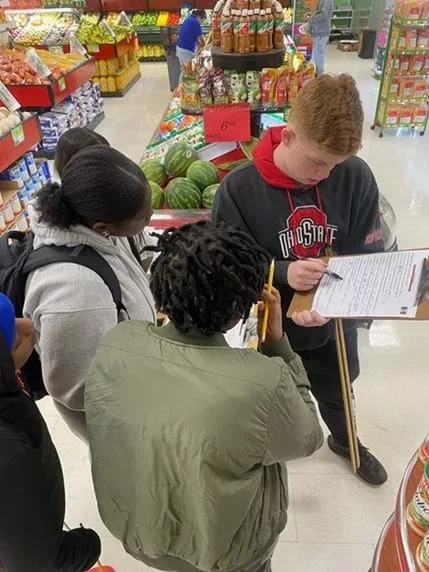 How are international markets arranged?Copyright The picture was taken by Kurtz Miller at the La Michoacana Mexican Market, Huber Heights, Ohio. Dr. Miller retains the copyright. Dr. Miller grants permission for this picture to be used in a TeachEngineering lesson plan.
Students use original research and field trips to investigate the content, layout, and structure of local international markets (e.g., a Korean, Mexican, or Turkish market). Students learn about the cultural components and importance of the stores to the local immigrant populations through a multi-day field trip experience. Students investigate the food staple products of the store, and where they are situated within the layout of the market. Considering the area, available space, and shelving, students propose a store remodel using the engineering design process to celebrate culture, encourage diverse customers, and maximize profits. Student groups redesign an international store using research-based store placement best practices. The class conducts gallery walks and receives feedback from international partners to improve the final design. After the final designs are completed, students compare the patterns and trends of the periodic table to types of grocery stores.
Students use the engineering design process to propose a supermarket remodel. Students engage in original research to investigate the content, layout, structure, and ADA accessibility of local supermarkets. This involves gathering data, analyzing the layout of the stores, and understanding cultural components, brainstorming solutions, creating prototypes (store redesign proposals), and testing and iterating on those designs. Students must consider constraints such as available space, shelving, and cultural significance when proposing store remodels.
Finally, students compare the patterns and trends of the periodic table to types of grocery stores. The periodic table serves as a foundational tool for engineers across various disciplines, providing essential information about the properties and behavior of elements that is vital for designing and optimizing engineering systems and processes.
After this activity, students should be able to:
- Describe the layout, organization, and structure of an international market.
- Explain the cultural components of international markets, including customs, decorations, food, and products.
- Plan updates and/or upgrades to a market to meet one more U.S. Federal Government ADA Standards for Accessible Design.*
- Rationalize a redesign of an international market using a free, collaborative technology platform such as Tinkercad (by Autodesk©, Inc., https://www.tinkercad.com) based on pre-established and/or collaborative engineering constraints, such as accessibility and physical product placement.
- Compare and contrast the organization, patterns, and trends at American and international markets judged against the periodic trends of elements on the periodic table.
*SPECIAL NOTES: International markets are not the only buildings that may not have been updated to meet U.S. Federal Government ADA Standards for Accessible Design. More than likely, there are hundreds or thousands of buildings in your local community that have not been redesigned or updated to meet ADA guidelines. Many small business owners are unable to implement ADA updates due to financial constraints. Please exercise great care and caution to ensure that students do not acquire a misconception that international markets are the only facilities that need ADA updates.
- HS-ETS1-1 Analyze a major global challenge to specify qualitative and quantitative criteria and constraints for solutions that account for societal needs and wants.
Grades 9-12
This resource focuses on the following Three Dimensional Learning aspects of NGSS:
Science & Engineering Practices- Analyze complex real-world problems by specifying criteria and constraints for successful solutions.Do you agree with this alignment?
Disciplinary Core Ideas- Criteria and constraints also include satisfying any requirements set by society, such as taking issues of risk mitigation into account, and they should be quantified to the extent possible and stated in such a way that one can tell if a given design meets them.Do you agree with this alignment?
- Humanity faces major global challenges today, such as the need for supplies of clean water and food or for energy sources that minimize pollution, which can be addressed through engineering. These global challenges also may have manifestations in local communities.Do you agree with this alignment?
Crosscutting Concepts- New technologies can have deep impacts on society and the environment, including some that were not anticipated. Analysis of costs and benefits is a critical aspect of decisions about technology.Do you agree with this alignment?
Do you agree with this alignment? - Analyze complex real-world problems by specifying criteria and constraints for successful solutions.
- HS-ETS1-2 Design a solution to a complex real-world problem by breaking it down into smaller, more manageable problems that can be solved through engineering.
Grades 9-12
This resource focuses on the following Three Dimensional Learning aspects of NGSS:
Science & Engineering Practices- Design a solution to a complex real-world problem, based on scientific knowledge, student-generated sources of evidence, prioritized criteria, and tradeoff considerations.Do you agree with this alignment?
Disciplinary Core Ideas- Criteria may need to be broken down into simpler ones that can be approached systematically, and decisions about the priority of certain criteria over others (trade-offs) may be needed.Do you agree with this alignment?
Do you agree with this alignment? - Design a solution to a complex real-world problem, based on scientific knowledge, student-generated sources of evidence, prioritized criteria, and tradeoff considerations.
- HS-ETS1-3 Evaluate a solution to a complex real-world problem based on prioritized criteria and trade-offs that account for a range of constraints, including cost, safety, reliability, and aesthetics, as well as possible social, cultural, and environmental impacts.
Grades 9-12
This resource focuses on the following Three Dimensional Learning aspects of NGSS:
Science & Engineering Practices- Evaluate a solution to a complex real-world problem, based on scientific knowledge, student-generated sources of evidence, prioritized criteria, and tradeoff considerations.Do you agree with this alignment?
Disciplinary Core Ideas- When evaluating solutions it is important to take into account a range of constraints including cost, safety, reliability and aesthetics and to consider social, cultural and environmental impacts.Do you agree with this alignment?
Crosscutting Concepts- New technologies can have deep impacts on society and the environment, including some that were not anticipated. Analysis of costs and benefits is a critical aspect of decisions about technology.Do you agree with this alignment?
Do you agree with this alignment? - Evaluate a solution to a complex real-world problem, based on scientific knowledge, student-generated sources of evidence, prioritized criteria, and tradeoff considerations.
- HS-PS1-1 Use the periodic table as a model to predict the relative properties of elements based on the patterns of electrons in the outermost energy level of atoms.
Grades 9-12
This resource focuses on the following Three Dimensional Learning aspects of NGSS:
Science & Engineering Practices- Use a model to predict the relationships between systems or between components of a system.Do you agree with this alignment?
Disciplinary Core Ideas- Each atom has a charged substructure consisting of a nucleus, which is made of protons and neutrons, surrounded by electrons.Do you agree with this alignment?
- The periodic table orders elements horizontally by the number of protons in the atom's nucleus and places those with similar chemical properties in columns. The repeating patterns of this table reflect patterns of outer electron states.Do you agree with this alignment?
Crosscutting Concepts- Different patterns may be observed at each of the scales at which a system is studied and can provide evidence for causality in explanations of phenomena.Do you agree with this alignment?
Do you agree with this alignment? - Use a model to predict the relationships between systems or between components of a system.
- Periodic trends of the elements
Grades 9-12
Do you agree with this alignment?
Each group needs:
- 1 laptop computer (or Chromebook) – one device per student is best
- access to the internet
- pencils
- clipboard (for field trips)
- handouts:
- How Your Grocery Store’s Layout Is Costing You Money Article (PDF)
- Grocery Store Placement Research Activity (PDF)
- Example American Grocery Store Layout (PDF)
- ADA Checklist for Existing Facilities (PDF)
- American Disabilities Act Research Form (PDF)
- Field Trip Form (PDF)
- Grocery Store Redesign Rubric (PDF)
- Grocery Store Project Learning Blueprint (PDF)
- Design a Grocery Store Gallery Walk Questions (PDF)
- Gallery Walk Post-Questions (Exit Ticket) (PDF)
- graph paper (for thumbnail and/or rough sketching) – (optional)
- rulers (for thumbnail and/or rough sketching) – (optional)
- colored pencils (for thumbnail and/or rough sketching and gallery walk poster) – (optional)
- tape measure (with inches)
- poster paper
For the entire class to share:
- blindfold
- wheelchair
- Example Parent Letter (English and Spanish) (pdf)
- Pre-Assessment (docx)
- Pre-Assessment (pdf)
- Hook Activity Instructions and Post-Questions (docx)
- Hook Activity Instructions and Post-Questions (pdf)
- ADA Checklist for Existing Facilities (based upon the 2010 ADA Standards for Accessible Design) (pdf)
- American Disabilities Act Research Form (docx)
- American Disabilities Act Research Form (pdf)
- Grocery Store Placement Research Activity - ALL WORKSHEETS (docx)
- Grocery Store Placement Research Activity - ALL WORKSHEETS (pdf)
- How Your Grocery Store’s Layout Is Costing You Money Article (docx)
- How Your Grocery Store’s Layout Is Costing You Money Article (pdf)
- American Grocery Store Analysis Activity (pptx)
- American Grocery Store Analysis Activity (pdf)
- Example American Grocery Store Layout (docx)
- Example American Grocery Store Layout (pdf)
- Field Trip Form (docx)
- Field Trip Form (pdf)
- Grocery Store Comparison Chart (jpg)
- Key Terms PowerPoint Presentation and Background Information (pptx)
- Key Terms PowerPoint Presentation and Background Information (pdf)
- Design a Grocery Store Gallery Walk Questions (docx)
- Design a Grocery Store Gallery Walk Questions (pdf)
- Gallery Walk Post-Questions (Exit Ticket) (docx)
- Gallery Walk Post-Questions (Exit Ticket) (pdf)
- Grocery Store Project Learning Blueprint (docx)
- Grocery Store Project Learning Blueprint (pdf)
- Grocery Store Redesign Rubric (docx)
- Grocery Store Redesign Rubric (pdf)
- Post-Assessment (docx)
- Post-Assessment (pdf)
- It is helpful to have some basic knowledge about the food staple products at each international market.
- Knowledge and an initial experience using a free, collaborative technology platform (Google Slides, Google Docs, Tinkercad) where students can redesign an international market.
- If this project is used in a physical science class, students should already be familiar with the basic organization of the periodic table to conduct analogical comparisons and thinking
(Optional: Show the Key Terms PowerPoint Presentation and Background Information (PPTX) while presenting the Introduction and Motivation section.)
Raise your hand if you’ve been shopping at the supermarket and weren’t able to reach an item on the top shelf. Now, raise your hand if you have observed someone who couldn’t reach an item, but you were able to reach it yourself. Did you help the person out? I hope so!
Now, imagine you were a wheelchair user or were visually impaired: How would you locate and reach items in a supermarket? Instead of using “Click-List”, an automated ordering service supermarkets may use, you wanted the full shopping experience by going inside the store. So, how would this work out?
Put your hand up if you have observed an international market in your local community. What types of international markets have you seen nearby? How many do you think are in our part of the state? Why do these markets exist? Do you know what is inside of them? Have you been inside an international market before? Why or why not? Would you feel comfortable going inside an international market? Why or why not?
In this project, we will be visiting (two) international markets within walking distance of our school. We will explore the cultures, customs, traditions, and food staples displayed in the store(s). We will determine whether we think a redesign may help to sell more products based on the social science of product placement. Your design group will be responsible for making determinations and producing a new design.
We will also observe whether the stores are accessible to people with disabilities based on criteria set forth by the American Disabilities Act (ADA). Could anybody share what they think the word accessible means? What do you think makes buildings and grounds accessible to people with disabilities? Have you observed any accessibility features in our school building? If so, what features are here? Can you think of places in the community that aren’t accessible?
Finally, this is a (physical science) class, so we are learning chemistry and physics. This project may seem disconnected from anything scientific. In fact, you may think we are learning about culture or even engineering; however, grocery stores are analogies for understanding something important in chemistry. Can anybody guess the analogical connection between grocery stores and chemistry?
The first several days of the activity will involve conducting background research, including activities to simulate what it is like having a disability. The field trips will be next, followed by usage of the engineering design process (EDP) to propose changes to one of the grocery stores. Enrichment and extension activities, if appropriate, may follow afterward.
Suggested Instructional Timeline
Day #1
- Hook activity (see the Introduction and Motivation section – class discussion)
- Accessibility activity·
- Group reflection (exit ticket)
Day #2
- Grocery store organization activity; students learn how grocery stores are often organized based on market placement.
Day #3
- Grocery store organization activity; students learn how grocery stores are often organized based on market placement.
- Case study – discussion
- Group reflection (exit ticket)
Day #4
- Accessibility discussion
- ADA research activity
Day #5
- Field trip discussion
- Field Trip #1 – international market
Day #6
- Debrief on Field Trip #1
- Imagine possible solution(s)
Day #7
- Field trip discussion
- Field Trip #2 – international market
Day #8
- Debrief on Field Trip #2
- Imagine possible solution(s)
Day #9
- Plan possible, promising solution(s)
- Group work
Days #10-#13
- Create/redesign a solution
- Gallery walk on or near Day #13
Days #14-15
- Closure activities
- Periodic table analogical reasoning activity
- Post-activity and sense-making activity
Additional Day(s) (optional)
- Enrichments
- Extensions
Background
American Disabilities Act (ADA)
The American Disabilities Act (ADA) (42 U.S.C. § 12101), which passed Congress in 1990, banned the discrimination of people with disabilities in the private sector. The initial purpose of the ADA was to address private sector discrimination, but public sector agencies may also be subject to its stipulations. The ADA is an antidiscrimination law, while the Individuals with Disabilities Act (IDEA) is a law that stipulates school officials must “identify, assess, and serve students with disabilities.”
The “ADA Checklist for Existing Facilities” (Institute for Human Centered Design, 2016) explains how to meet the ADA’s 2010 update for making buildings accessible for people with disabilities. Although there are many aspects and criteria for retrofitting existing buildings to make them more accessible, here are several examples of requirements in the “Approach and Entrance” section:
- Approach and Entrance – Entranceways should be 36 inches wide (p. 14).
- Approach and Entrance – A ramp or lift instead of stairs (set maximum slopes) (p. 16).
- Approach and Entrance – Accessible parking spaces that are wider than a standard space (8’ wide with a 5’ aisle way) (pp. 11-12).
- Approach and Entrance – Accessible parking spaces for vans (8’ wide and 8’ aisle way) (pp. 11-12).
- Approach and Entrance – Handicapped parking signs are present (pp. 13-14).
- Approach and Entrance – Easy access aisle that leads from the accessible parking space to the store (p. 13).
- Approach and Entrance – Accessible parking spaces are located near the entranceways of buildings (p. 13).
Individuals may take businesses or even public agencies to court to claim ADA discrimination. For example, a federal trial court in Concerned Parents to Save Dreher Park Center v. City of West Palm Beach (1994) found that “the elimination of all recreation programs for individuals with disabilities violated ADA where similar programs were still offered to those who did not have disabilities.” The U.S. Supreme Court ruled in March 2023 in Luna Perez v. Sturgis Public Schools in favor of a deaf student who was failed by his school district. This ruling opens the legal system up to individuals and families to pursue ADA lawsuits to seek financial compensation from school districts.
Engineering Design Process
The engineering design process (EDP), otherwise referred to as the design process or design thinking process, is understood to be the iterative, engineering approach that “emphasizes open-ended problem solving and encourages students to learn from failure.” The TeachEngineering EDP includes seven steps (see Figure 1), starting with Step 1 – Ask Questions; Step 2 – Research; Step 3 – Imagine; Step 4 – Plan; Step 5 – Create; Step 6 – Test; and Step 7 – Improve. The EDP should involve team-based work, multiple iterations (if possible), collaboration, and hopefully high levels of student engagement. The EDP is not just an engineering process, because there are similar recursive processes in art, science, technology, and writing. Depending on the nature of the challenge, the full EDP may be utilized or just part of the process. The EDP is becoming more relevant to science education because the Next Generation Science Standards (NGSS) integrates engineering practices into the national science curriculum.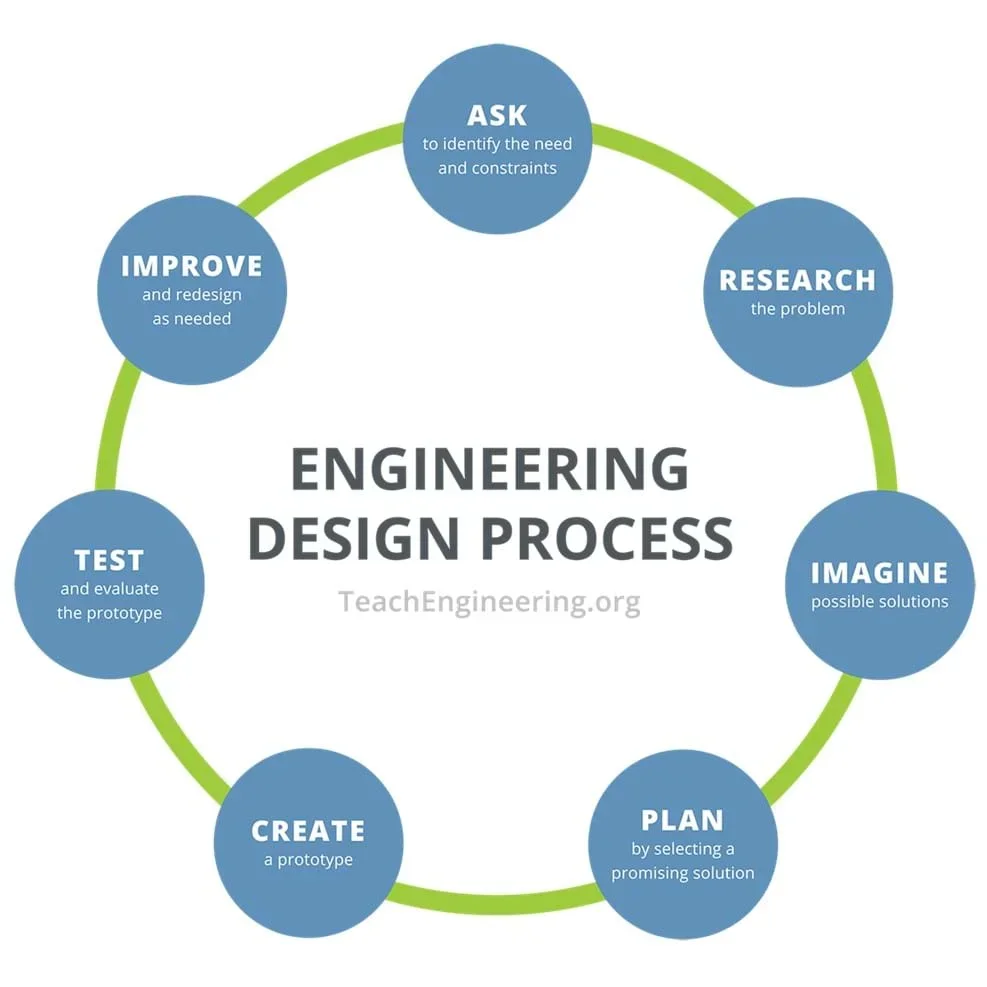 Figure 1. The TeachEngineering.org version of the Engineering Design Process (EDP).Copyright TeachEngineering.org
Periodic Table Chemistry
In a sense, the periodic table is like a grocery store for elements. Grocery stores have specified aisles where you may locate products. For instance, Aisle 10 may be the International Aisle. Soy sauce, rice, Japanese noodles, black pinto beans, and burrito wraps are probably located in Aisle 10. The items in this aisle have something in common: They are all considered international food. The aisle may have a trend from one end to the other. For example, the rice may be located on one end of the aisle, and next to this product may be noodles, and then beans after the noodles. Perhaps the name brands are located at eye level, while other hands are featured on higher shelves.
The development of the periodic table was the culmination of many chemical and elemental discoveries made by numerous chemists. Russian chemist Dimitry Mendeleyev is credited with the discovery of the periodic table. Mendeleyev studied chemistry under the guidance of German chemist Robert Bunsen (the inventor of the Bunsen burner). While writing a chemistry textbook, Mendeleyev considered whether the elements could be arranged in an incremental order. Originally, Mendeleyev’s periodic table organized the elements in ascending atomic weights. He placed each element on a card with the corresponding atomic weight, and then he attempted to arrange them. Mendeleyev fell asleep and dreamed about a table of elements. After waking up, he noted his dream and began to develop a table pattern.
The modern periodic table is organized based on increasing atomic number left to right. During Mendeleyev’s time, the nature of subatomic particles was not understood, so measurements were made based on atomic weight. The modern periodic table is organized into seven periods (or rows) and 18 groups (or columns, sometimes called families). The elements in the same group (or family) share a so-called “family resemblance” regarding similar chemical/physical properties. Elements in the same group (or family) have the same number of valence electrons, which means they have similar chemical properties, since electrons influence chemical bonding. The chemical properties of elements recur as one moves across the periodic table because elements in the same group possess similar electron configurations. This concept is called the periodic law.
Let us go back to the grocery store analogy again. A supermarket such as Walmart or Meijer is like the periodic table because one side of the store may contain non-food items, while the other side contains grocery/food products. The periodic table houses the metals on the left-hand side of the periodic table, the transition metals in the middle, and the nonmetals on the right-hand side. There is a transition in elements from one side to the other side of the periodic table. Properties such as atomic radius, electronegativity, electron affinity, and so forth change while moving left to right or up and down across the table. Elements in the periodic table have a coordinate location based on the group and period numbers. For example, the element boron (B) is in Group 13 and Period 2 (13, 2). In a grocery store, products may have similar coordinate locations based upon the aisle and shelf numbers, such as Great Value chips being in Aisle 12 and Shelf 5 (12, 5). Product locations could further be described by using an additional number such as a bin number, so chips could be located at (12, 5, bin 7). Many warehouses use similar numbering and coordinate systems; however, they may not make a good analogy because space allocation as well as product placement may be organized differently than a grocery store.
Sustainable Development Goals (SDGs)
At the Earth Summit in 1992, the United Nations (U.N.) adopted Agenda 21 to improve the environment and human lives across the world. In 2013, the U.N. set up a working group to develop sustainable development goals (SDGs). Later in 2015, the U.N. General Assembly adopted the 2030 Agenda for Sustainable Development with a total of 17 SDGs. This year was important for global sustainability because the Sendai Framework for Disaster Risk Reduction, Addis Ababa Action Agenda on Financing for Development, transforming our world: the 2030 Agenda for Sustainable Development, and the Paris Agreement on Climate Change were all agreed upon by the U.N.
SDG #10 is “reduce inequalities within and among countries,” which pertains to the improvement of disparities between people groups. SDG #10 has two indicators that pertain to people with disabilities, as the following:
Target 10.2 – By 2030, empower and promote the social, economic, and political inclusion of all, irrespective of age, sex, disability, race, ethnicity, origin, religion or economic or other status.
Target 10.2 aims to promote the full empowerment and inclusion of people with disabilities into social, economic, and political activities. This includes the consideration of people with disabilities in the local economics of community shopping. It is important to have local, inclusive shopping venues that are easily accessible.
Target 10.3 – Ensure equal opportunity and reduce inequalities of outcome, including by eliminating discriminatory laws, policies, and practices and promoting appropriate legislation, policies, and action in this regard.
Target 10.3 aims to reduce inequalities of outcome by removing discriminatory practices in all segments of society. This target would include making places of employment fully accessible for people with disabilities. With accessible places of employment, people with disabilities would hopefully have equal opportunities to earn a living, which may result in the reduction of inequalities.
Before the Activity
- Gather the materials listed in the “Equipment and Materials” section, including downloading and photocopying/printing the required print materials.
- Update the materials as appropriate for your class:
- Update field trip location names and cultural details/references on the Field Trip Form (PDF).
- Update the location mentioned in the Pre-Assessment (PDF) and Post-Assessment (PDF).
- Update the location and field trip stops/information mentioned on Slides 3-5 of the Key Terms PowerPoint Presentation and Background Information (PPTX).
- Cut out sets of questions on the Design a Grocery Store Gallery Walk Questions (PDF) handout. Each document contains three sets of questions. Each student needs one set.
- Coordinate field trip(s):
- Contact the international market owners to pitch your proposal. Ask for and receive permission for field trip visitation.
- Fill out a field trip request form and submit it to the administration for approval. You may consider attaching a letter modeled after the Example Parent Letter (PDF)to the back of the form.
- Once the administration has approved the field trip and project, request school transportation (if required). Please keep in mind that some school districts have limited transportation availability during school hours. Further, the transportation availability may dictate when you leave and return.
- Locate the school district’s field trip form. Fill out the required portion(s) and send this home for parents to sign. Optional: Also include a letter modeled after the Example Parent Letter (PDF).
- Locate the school district’s required health and medical form. Send this paperwork home for parents to sign.
- Field trip permission forms must be returned before Day #5! Students who do not return the paperwork on time may not attend the field trip portion of the project. Make proper supervision arrangements for students who do not return the signed paperwork. Perhaps a neighboring teacher or the study hall monitor could provide supervision.
- Contact the school district public information officer if you think this project may positively contribute to social media messaging. The public information officer may even contact local newspaper reporters.
- Optional: Before Day #14, find a place in the community that is accessible as well as a place that is not accessible. Get permission to take pictures of the accessible and non-accessible locations to show to students.
During the Activity – Day #1
- Divide the class into groups of no more than three students per group. An occasional student may work alone.
- Introduce students to the importance of the topic by going through the “Introduction and Motivation” section.
- Lead a class discussion based on the “Introduction and Motivation” section. Bring up the Sustainable Development Goals, and how SDG #10 is “reduce inequalities within and among countries,” which pertains to the improvement of disparities between people groups.
- Conduct Accessibility Activity #1 (refer to the Hook Activity Instructions and Post-Questions (PDF) for full instructions). Confine a student to a wheelchair. Ask the student to perform a task. Have the other students make observations. The purpose of this activity is to simulate what it is like to have a disability.
- Conduct Accessibility Activity #2 (refer to the Hook Activity Instructions and Post-Questions (PDF) for full instructions). Blindfold a student or several students. Ask them to perform a predetermined task. The purpose of this activity is to simulate what it is like to have a disability.
- Lead a class discussion based on the accessibility activities.
- Have students complete an exit ticket using the Post-Questions from the Hook Activity Instructions and Post-Questions (PDF).
During the Activity – Day #2
- Have students watch a short video clip and/or read an article about how grocery stores are organized to maximize profits. Distribute copies of the How Your Grocery Store’s Layout Is Costing You Money Article (PDF). Show students videos such as “How to Save Money at the Supermarket” (6:30 minutes), “Supermarket Psychology – Entrances, layouts and shelving” (3:05 minutes), and/or “Concept of Retail (Supermarket) Layout” (3:42 minutes).
- Have the students, in their groups, respond to a series of worksheet questions. Distribute copies of the Grocery Store Placement Research Activity (PDF)handout to each group. Have them complete the questions under Worksheet 1.
- Have students study the design of an American-style supermarket to theorize about the market placement built into the layout. Use the American Grocery Store Analysis Activity PowerPoint to guide discussion. Have students reflect on the layout of a local American grocery store (e.g., Kroger, Acme, Giant, King Soopers, etc.) and create lists of which parts of the store use similar or different logic to arrange products.
- Conduct exit question/reflection. Use the the last slide of the American Grocery Store Analysis Activity (PPTX)PowerPoint as an exit ticket.
During the Activity – Day #3
- Distribute to students a map of a supermarket design of an American supermarket, the Example American Grocery Store Layout (PDF)handout. Have them work to locate different sections of the store on the map.
- Have students theorize about how a grocery store is like the periodic table. Allow students to discuss similarities and differences in their groups.
- Have students answer a series of questions in their groups. They should complete the questions under Worksheet 2 and Worksheet 3 on the Grocery Store Placement Research Activity (PDF) handout.
- Conduct a class discussion. Have students discuss: How are items placed in a grocery store? Why? How is the grocery store arranged to maximize profits?
- Conduct exit question/reflection. Have students reflect on the locations of different items in different grocery stores.
During the Activity – Day #4
- Have students read about the American Disabilities Act (ADA), which aims to eliminate discrimination based on disability. Distribute copies of the ADA Checklist for Existing Facilities (PDF) handout to groups. Give them time to read through the checklist and discuss any items they find interesting or intriguing.
- Conduct ADA research activity. Distribute copies of the American Disabilities Act Research Form (PDF) to groups and have them study the ADA Checklist for Existing Facilities (PDF) to answer the questions on the research form.
- Lead students through a 10-minute accessibility field trip inside the school building, as time permits. Instruct students to observe accessibility features firsthand. Bring along a tape measure and have students make measurements to determine whether the school is in compliance.
- Conduct exit question/reflection. Have students reflect on the importance of the ADA and how their school is in compliance (or not).
During the Activity – Day #5
- Conduct field trip discussion; review rules, where the field trip is taking place, why they are visiting the site, and what to observe.
- Hand out supplies such as paperwork, clip boards, and tape measures. Students need copies of the Field Trip Form (PDF).
- Lead Field Trip #1 – International Market.
- Return to classroom.
- Lead a brief discussion on student observations.
During the Activity – Day #6
- Debrief on Field Trip #1. Have students discuss observations, food staples, cultural symbols, food placement, accessibility features, and ideas for redesign.
- “Imagine Possible Solution(s)” – Have student groups work on brainstorming possible ideas to redesign a grocery store based on what they learned from Field Trip #1. Encourage students to develop as many ideas as possible, think of wild ideas, and defer judgment. Have students record their brainstorming and sketch their designs (if available, they may use Tinkercad to draw their ideas).
- Conduct exit question/reflection, time permitting. Have students briefly share a few of their brainstormed ideas.
During the Activity – Day #7
- Conduct field trip discussion; review rules, where the field trip is taking place, why they are visiting the site, and what to observe.
- Hand out supplies such as paperwork, clip boards, and tape measures. Make sure students have their copies of the Field Trip Form (PDF).
- Lead Field Trip #2 – international market and/or American market.
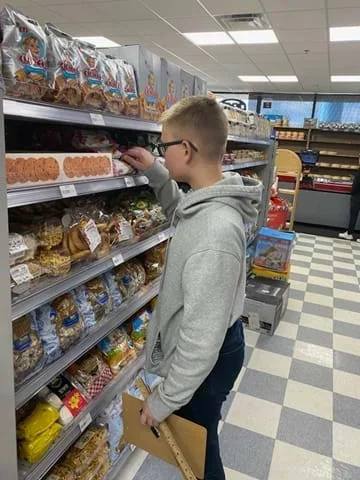 How do the products change down an aisle at an international market?Copyright The picture was taken by Kurtz Miller at the Huber Mart, Huber Heights, Ohio. Dr. Miller retains the copyright. Dr. Miller grants permission for this picture to be used in a TeachEngineering lesson plan.
 - Lead a brief discussion on student observations.
During the Activity – Day #8
- Debrief on Field Trip #2. Have students discuss observations, food staples, cultural symbols, food placement, accessibility features, and ideas for redesign.
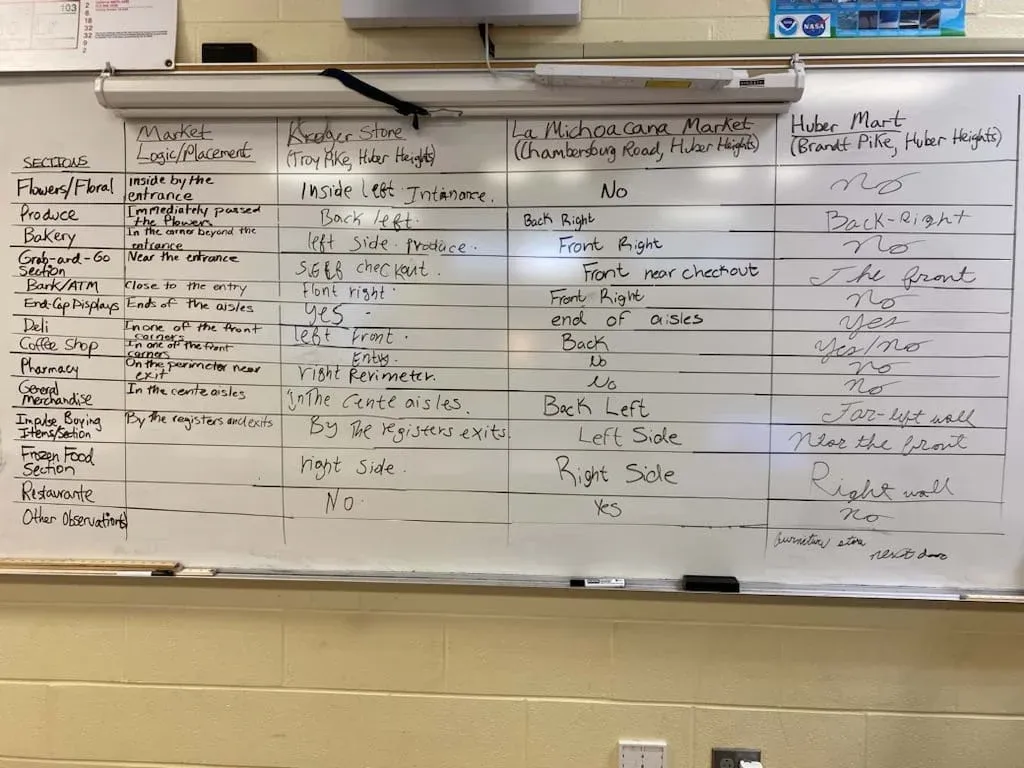
- Draw a chart on the board and have students compare the locations of grocery store sections in different grocery stores (see Grocery Store Comparison Chart for an example).
- “Imagine Possible Solutions” – Have student groups continue to work on brainstorming possible ideas to redesign a grocery store based on what they learned from Field Trip #2 and comparing the stores. Encourage students to develop as many ideas as possible, think of wild ideas, and defer judgment. Have students record their brainstorming and sketch their designs (if available, they may use Tinkercad to draw their ideas).
- Conduct exit question/reflection, time permitting. Have students briefly share a few of their brainstormed ideas.
During the Activity – Day #9
- Discuss redesign solution(s) student groups have imagined so far. Have each student group share one idea with the entire class. Students may share a “thumbnail sketch” or a product they have in Tinkercad, if they choose to do so.
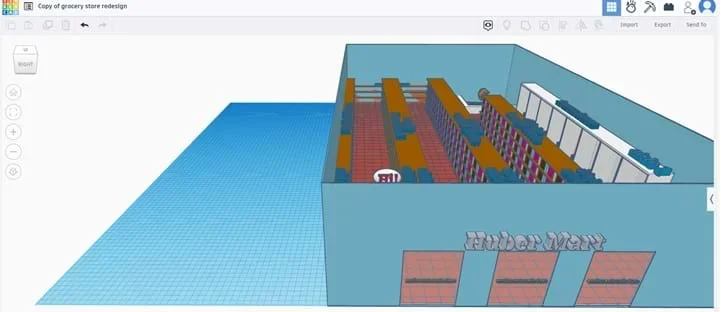 Students were required to redesign an international grocery store, adjusting the layout to improve sales, increase accessibility, and promote culture. This screenshot is an example of a group’s final Huber Mart store redesign in Tinkercad.Copyright The screenshot was acquired by Kurtz Miller. The student provided Dr. Miller with permission to use this screenshot in promotional materials.
 - "Plan, possible, promising solution(s)” – Have groups review their brainstormed ideas and select a solution to use for their grocery store redesign. Distribute copies of the Grocery Store Redesign Rubric (PDF) and the Grocery Store Project Learning Blueprint (PDF) to help students select their solution(s). Have students record their chosen solution and the reasoning for why they chose that solution over their other ideas.
- Conduct exit question/reflection, time permitting. Have students briefly share why they chose or did not choose one of their brainstormed designs.
During the Activity – Day #10-13
- Ask a student from each group to provide a quick update to share with the class. Optional: Share example design decisions/products (e.g., checkout counters with lower sections for wheelchair users, no product displays in the middle of the aisle that would block peoples’ paths, ample accessible parking spaces, etc.), time permitting.
- “Creating/Redesigning a Solution” – Have groups create sketches and visuals of their grocery store redesign on poster paper. Tell students that they will be sharing these final design solutions with the class and remind them to refer to the Grocery Store Redesign Rubric (PDF).
- Conduct a gallery walk on about Day #13 (sooner, if possible). Distribute copies of the Design a Grocery Store Gallery Walk Questions (PDF). Each student group will have a spot in the classroom where they will entertain student questions about the final design solution to the grocery store redesign. International parties could potentially attend this gallery walk to provide feedback, if possible.
- Conduct exit question/reflection, time permitting. Have students complete the Gallery Walk Post-Questions (Exit Ticket) (PDF) at the end of class (or as homework).
During the Activity – Day #14-15
- Lead a discussion about students’ redesigns and how accessible they are. Optional: Highlight a place in the community that is accessible, as well as a place that is not accessible, by providing pictures. Discuss these situations.
- Have student groups finalize their redesigns of a grocery store. Remind students to reflect on feedback from the gallery walk and refer to the Grocery Store Redesign Rubric (PDF) as they finalize their designs.
- Conduct periodic table analogical reasoning activity. Have student groups discuss and write their answer to the question: How is a grocery store like the periodic table? Encourage students to review their answers to the Design a Grocery Store Gallery Walk Questions (PDF) and the Grocery Store Project Learning Blueprint (PDF)handout.
- Lead students through the post-assessment and sense-making activity (see the included information in the “Assessment” section).
Additional Day(s) (optional)
- Enrichments
- Extensions
- Communication with international partners
- accessibility
- The quality of being easy to approach, reach, enter, speak with, use, or understand.
- accessibile
- A site, building, facility, or portion thereof that complies with this part [of the ADA, see below].
- ada standards for accessible design
- Provide guidance about what is required for a building or facility to be physically accessible to people with disabilities.
- american disabilities act (ada) (usc title 47, chapter 5)
- Prohibits discrimination against people with disabilities in several areas, including employment, transportation, public accommodations, communications and access to state and local government’ programs and services.
- architectural blueprint
- A process of photographic printing, used chiefly in copying architectural and mechanical drawings, which produces a white line on a blue background.
- culture
- The distinctive customs, values, beliefs, knowledge, art, and language of a society or a community. These values and concepts are passed on from generation to generation, and they are the basis for everyday behaviors and practices.
- customs
- A traditional behavior, ritual, or action that is transmitted through generations and is defined by a culture as appropriate or desirable for a particular situation.
- electronegativity
- A measure of the ability of a specified atom to attract electrons in a molecule.
- engineering design process
- A series of steps that guides engineering teams as they solve problems. The design process is iterative, meaning that the steps are repeated as many times as needed, making improvements along the way as teams learn from failure and uncover new design possibilities to arrive at great solutions.
- food staple
- A food that is eaten often and in such quantities that it constitutes a dominant portion of a standard diet for an individual or a population group, supplying a large fraction of energy needs and generally forming a significant proportion of the intake of other nutrients as well.
- group
- Vertical columns of elements located on the period table. Elements in the same group have similar chemical properties because they (generally) possess the same number of valence electrons (excluding the transition metals).
- group number
- Groups on the periodic table are numbered 1 through 18. Each group is typically named after the top element in each group.
- intercultural competence
- The ability to adeptly navigate complex environments marked by a growing diversity of peoples, cultures, and lifestyles; the ability to perform effectively and appropriately when interacting with others who are linguistically and culturally different from oneself.
- iteration (iterate)
- The act of repeating; a repetition.
- metals
- Any of a class of elementary substances, such as gold, silver, or copper, all of which are crystalline when solid and many of which are characterized by opacity, ductility, conductivity, and a unique luster when freshly fractured. Metals are located on the right-hand and center parts of the periodic table.
- model
- An informative representation of an object, person or system.
- nonmetals
- Elements not having the character of a metal, such as carbon or nitrogen. Nonmetals are located on the upper right-hand portion of the periodic table.
- period
- Horizontal rows of elements on the periodic table. Elements in the same group have similar electron orbital parameters.
- period number
- Periods on the periodic table are numbered 1 through 7.
- periodic law (mendeleev's law)
- The statement that the chemical and physical properties of the elements recur periodically when the elements are arranged in the order of their atomic weights.
- periodic table
- A table illustrating the periodic system, in which the chemical elements, formerly arranged in the order of their atomic weights and now according to their atomic numbers, are shown in related groups.
- periodic trends
- Specific patterns that are present in the periodic table that illustrate different aspects of a certain element.
- prototype
- Noun: The original or model on which something is based or formed. Verb: To create the prototype or an experimental model of (something digital or physical).
- representative elements
- Representative elements are in groups 1, 2, and 13 through 18.
- scale diagram
- A drawing or plan outlining and explaining the parts, operation, etc., of something (often using a graphic or numeric scale).
- sustainable development goals (sdgs)
- A universal call to action to end poverty, protect the planet, and ensure that by 2030 all people enjoy peace and prosperity.
- thumbnail sketch
- Reduced-size versions of pictures or videos, used to help in recognizing and organizing them, serving the same role for images as a normal text index does for words. Engineers may use a thumbnail sketch to quickly get a concept or idea on paper –- even on the back of a napkin.
- transition metals
- Any element in any of the series of elements with atomic numbers 21–29, 39–47, 57–79, and 89–107 that, in a given inner orbital, has less than a full quota of electrons. The transition metals are located in groups 3 through 12.
- valence electrons
- An electron of an atom, located in the outermost shell (valence shell) of the atom, that can be transferred to or shared with another atom.
Pre-Activity Assessment
Pre-Assessment: Students should complete the Pre-Assessment (PDF).
Activity Embedded (Formative) Assessment
Groupwork Check-ins: Monitor students as they work through the Engineering Design Process to redesign a grocery store. Check that students are recording their progress and that each student is contributing to the group.
Post-Activity (Summative) Assessment
Gallery Walk Post-Questions: Have students complete the Gallery Walk Post-Questions (Exit Ticket) (PDF) after the Gallery Walk (on or before Day #13).
Post-Assessment: Have students complete the Post-Assessment (PDF).
Visiting an international market with students with disabilities (e.g., students in wheelchairs) may pose a challenge, especially if the store is not truly accessible. Teachers will need to troubleshoot potential challenges in advance of the visit.
Rural schools may not have international markets within walking distance, so this poses a potential challenge in obtaining bus transportation with limited funding. Suburban and urban teachers may have an international market within walking distance. One possible solution would be to invite a store owner to speak to the class. They could provide a diagram of the market, discuss how it is arranged, and then share cultural traditions with the class. Another possible solution would be to have a virtual visit through Google Meet, Skype, or Microsoft Teams.
Taking a field trip in busy urban centers may require extra safety precautions due to traffic. School districts may require a permission form to be filled out with attached medical records. Check with the principal weeks in advance.
If funding is not available for school transportation, then consider writing a local community foundation grant to cover the costs. This grantsmanship process must start months in advance.
- For upper grades (chemistry students), the extension activities may involve studying the patterns and trends in the periodic table such as ionization energy, electron affinity, atomic radius, as well as metallic and non-metallic character. Students can compare the organization of international markets and/or American supermarkets based upon more advanced chemistry concepts. At some point, the analogical comparisons may be difficult to make, so the analogy breaks down.
- Students could have a global partner who lives in another country. The students could share the design of the international market with them to request feedback about whether the design would be culturally adequate elsewhere in the world.
- A local immigrant (e.g., a store owner) could visit the classroom and participate in the gallery walk to provide feedback on the design solutions. Students would likely receive an international and cultural perspective they would not have otherwise.
- Ask immigrant students if they visit certain international markets. Select one of those markets for a field trip and ask students if they would be willing to provide a tour of the store. Further, you could ask students to explain the staple food products, what they eat at home, and insider information about shopping at an international market. Make sure the students are comfortable speaking up. Do not force students to contribute if they are not comfortable; putting students on the spot is not a good approach.
- For lower grades, the analogical comparisons between the supermarket design and the periodic table may be as simple as “Aisles in the store are like groups or periods on the periodic table.” Or sections of the supermarket could be like families of elements on the periodic table, assuming the products have similar uses.
- For younger students and/or studies with disabilities, it may be more appropriate to draw and prototype supermarket designs by using graph paper and rulers. This is a decision teachers will need to make on a case-by-case basis.
- For upper grades (chemistry students), more chemistry content information may be required (see the extensions section).
- For more advanced students in physical science class, high school chemistry concepts (such as electronegativity or atomic radius) could be introduced to help the students make further analogical comparisons.
Alejandria, L. N., Bajenting, J. M. S., Pacatan, M. A. L. D., & Tomas Jr, A. D. (2023). The Use of Educational Board Game as a Supplemental Tool in Learning Periodic Table of Elements Among Senior High School Students. American Journal of Education and Technology, 2(1), 60-67.
Bayir, E. (2014). Developing and playing chemistry games to learn about elements, compounds, and the periodic table: Elemental Periodica, Compoundica, and Groupica. Journal of Chemical Education, 91(4), 531-535.
Eisenkraft, A. (2011). Engineering design challenges in a science curriculum. NCETE, 1, 24-28.
Eisenkraft, A. (2007). Active chemistry: Project-based inquiry approach. McMinnville, TN: Walrus Books Company.
Franco-Mariscal, A. J., & Cano-Iglesias, M. J. (2014). Design and implementation of a bingo game for teaching the periodic table. School Science Review, 95(353), 56-59.
Institute for Human Centered Design. (2016).. https://adachecklist.org/doc/fullchecklist/ada-checklist.pdf ADA checklist for existing facilities
Jee, B. D., Uttal, D. H., Gentner, D., Manduca, C., Shipley, T. F., Tikoff, B., Ormand, & Sageman, B. (2010). Commentary: Analogical thinking in geoscience education. Journal of Geoscience Education, 58(1), 2-13.
Levy, J. (2010). Periodic table: An exploration of the elements. New York: Metro Brooks.
Luna Perez v. Sturgis Public Schools, No. 21 – 887 533. (2023). https://www.supremecourt.gov/opinions/22pdf/21-887_k53m.pdf
Miller, K. (2018). Where the Money Is. The Science Teacher, 85(1), 47-52.
Miller, K. (2013). Using analogies to teach stellar evolution. The Earth Scientist, 29(4), 8-12.
Miller, K. K. (2012). The Hertzsprung-Russell Diagram of cars: Is it an effective analogy in teaching stellar astronomy? Geological Society of America (GSA) Abstracts with Program, 44(5), 78.
Miller, K. K., & O’Malley, C. E. (2012). Stellar astronomy for high school earth science students: Teaching by using analogies. Geological Society of America (GSA) Abstracts with Program, 44(5), 77.
Montejo Bernardo, J. M., & Fernández González, A. (2021). Chemical battleship: Discovering and learning the periodic table playing a didactic and strategic board game. Journal of Chemical Education, 98(3), 907-914.
National Research Council. (2013). Next generation science standards: By states for states. Washington, D.C.: The National Academies Press.
Russo, C. J., & Osborne, A. G. (2008). Essential concepts & school-based cases in special education law. Thousand Oaks, CA: Corwin Books.
Tejeda, S., & Palacios, J. (1995). Chemical elements bingo. Journal of Chemical Education, 72(12), 1115.
UNESCO. (2013). Intercultural competences: Conceptual and operational framework.
United Nations. (n.d.). Sustainable development goals: United Nations Development Programme. UNDP. https://www.undp.org/sustainable-development-goals
United Nations. (n.d.). The 17 goals | sustainable development. United Nations. https://sdgs.un.org/goals#history
Contributors
Kurtz K. Miller, Ph.D.; Marjorie Langston
Supporting Program
Global STEM Research Experience for Teachers (RET) — Appropriate Technology for Developing Communities, University of Dayton, Central State University
Acknowledgements
We would like to thank the following for their assistance on this work: Margaret Pinnell, Ph.D; Leanne Petry, Ph.D.; Kellie Schneider, Ph.D.; Amy Anderson, Ph.D; Kelly Bohrer; Suzanne Seleem, Ph.D; Sharath Krishna, Ph.D.; Rajeev Swami, Ph.D.; Dr. Denise Taylor, Ph.D.; Sharath Krishna, Ph.D.;Rydge Taylor, Ph.D.; Miranda van Iersel, Ph.D. (Note: Her last name starts with a capital "I".); Kevin Hallinan, Ph.D.; Andrew Chaisson, Ph.D.; Dave Perkins, Ph.D.; and Jacob Cress, Ph.D. This curriculum was developed under National Science Foundation RET grant number EEC. 1855231/1855239. Any opinions, findings, and conclusions or recommendations expressed in this material are those of the authors and do not necessarily reflect the views of the National Science Foundation.
Copyright
2024 by Regents of the University of Colorado; original © 2023 Central State University and University of Dayton