
Get the Materials Down the Hill!
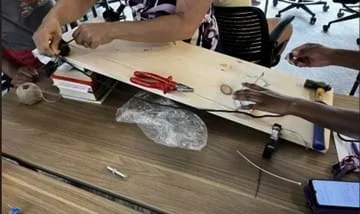 Students set up their prototype and load (a small cup) to test on the wooden ramp.Copyright 2024, Yamila Cancel-Sanchez & Ethan Shade
Students use readily available materials to design and build a device that transports a large amount of material down a hill. They must work within limited resources to construct their design. As they learn about motion and forces, students apply concepts of kinematics and dynamics to evaluate the performance of their system to determine the maximum weight it can safely carry down the hill in the least amount of time without breaking the rope. Finally, students perform a force analysis to calculate the acceleration of their load.
Civil engineers and construction managers often face optimization problems in their daily work. They must design systems and processes that move materials efficiently, safely, and cost-effectively. For example, when planning how to transport heavy loads on a construction site or how to design slopes, ramps, or pulley systems, they consider factors such as weight, tension, friction, time, and available resources. By applying principles of physics and engineering, they find solutions that balance safety, performance, and efficiency to achieve the best possible outcome within real-world constraints.
After this activity, students should be able to:
- Analytically and experimentally describe the kinematics and dynamics of the mass being transported.
- Calculate the acceleration of the mass being transported downhill.
- Experimentally prove that acceleration is directly proportional to the mass of the system.
- CCSS.Math.Content.HSA-REI.C.6 Solve systems of linear equations exactly and approximately (e.g., with graphs), focusing on pairs of linear equations in two variables.
Grades 9-12
Do you agree with this alignment? - CCSS.Math.Content.HSF-TF.B.7 (+) Use inverse functions to solve trigonometric equations that arise in modeling contexts; evaluate the solutions using technology, and interpret them in terms of the context.
Grades 9-12
Do you agree with this alignment? - CCSS.Math.Content.HSG-SRT.C.8 Use trigonometric ratios and the Pythagorean Theorem to solve right triangles in applied problems.
Grades 9-12
Do you agree with this alignment?
- HS-ETS1-1 Analyze a major global challenge to specify qualitative and quantitative criteria and constraints for solutions that account for societal needs and wants.
Grades 9-12
This resource focuses on the following Three Dimensional Learning aspects of NGSS:
Science & Engineering Practices- Analyze complex real-world problems by specifying criteria and constraints for successful solutions.Do you agree with this alignment?
Disciplinary Core Ideas- Criteria and constraints also include satisfying any requirements set by society, such as taking issues of risk mitigation into account, and they should be quantified to the extent possible and stated in such a way that one can tell if a given design meets them.Do you agree with this alignment?
- Humanity faces major global challenges today, such as the need for supplies of clean water and food or for energy sources that minimize pollution, which can be addressed through engineering. These global challenges also may have manifestations in local communities.Do you agree with this alignment?
Crosscutting Concepts- New technologies can have deep impacts on society and the environment, including some that were not anticipated. Analysis of costs and benefits is a critical aspect of decisions about technology.Do you agree with this alignment?
Do you agree with this alignment? - Analyze complex real-world problems by specifying criteria and constraints for successful solutions.
- HS-ETS1-2 Design a solution to a complex real-world problem by breaking it down into smaller, more manageable problems that can be solved through engineering.
Grades 9-12
This resource focuses on the following Three Dimensional Learning aspects of NGSS:
Science & Engineering Practices- Design a solution to a complex real-world problem, based on scientific knowledge, student-generated sources of evidence, prioritized criteria, and tradeoff considerations.Do you agree with this alignment?
Disciplinary Core Ideas- Criteria may need to be broken down into simpler ones that can be approached systematically, and decisions about the priority of certain criteria over others (trade-offs) may be needed.Do you agree with this alignment?
Do you agree with this alignment? - Design a solution to a complex real-world problem, based on scientific knowledge, student-generated sources of evidence, prioritized criteria, and tradeoff considerations.
- HS-ETS1-3 Evaluate a solution to a complex real-world problem based on prioritized criteria and trade-offs that account for a range of constraints, including cost, safety, reliability, and aesthetics, as well as possible social, cultural, and environmental impacts.
Grades 9-12
This resource focuses on the following Three Dimensional Learning aspects of NGSS:
Science & Engineering Practices- Evaluate a solution to a complex real-world problem, based on scientific knowledge, student-generated sources of evidence, prioritized criteria, and tradeoff considerations.Do you agree with this alignment?
Disciplinary Core Ideas- When evaluating solutions it is important to take into account a range of constraints including cost, safety, reliability and aesthetics and to consider social, cultural and environmental impacts.Do you agree with this alignment?
Crosscutting Concepts- New technologies can have deep impacts on society and the environment, including some that were not anticipated. Analysis of costs and benefits is a critical aspect of decisions about technology.Do you agree with this alignment?
Do you agree with this alignment? - Evaluate a solution to a complex real-world problem, based on scientific knowledge, student-generated sources of evidence, prioritized criteria, and tradeoff considerations.
- HS-PS2-1 Analyze data to support the claim that Newton's second law of motion describes the mathematical relationship among the net force on a macroscopic object, its mass, and its acceleration.
Grades 9-12
This resource focuses on the following Three Dimensional Learning aspects of NGSS:
Science & Engineering Practices- Analyze data using tools, technologies, and/or models (e.g., computational, mathematical) in order to make valid and reliable scientific claims or determine an optimal design solution.Do you agree with this alignment?
- Theories and laws provide explanations in science.Do you agree with this alignment?
- Laws are statements or descriptions of the relationships among observable phenomena.Do you agree with this alignment?
Disciplinary Core Ideas- Newton's second law accurately predicts changes in the motion of macroscopic objects.Do you agree with this alignment?
- Attraction and repulsion between electric charges at the atomic scale explain the structure, properties, and transformations of matter, as well as the contact forces between material objects.Do you agree with this alignment?
Crosscutting Concepts- Empirical evidence is required to differentiate between cause and correlation and make claims about specific causes and effects.Do you agree with this alignment?
Do you agree with this alignment? - Analyze data using tools, technologies, and/or models (e.g., computational, mathematical) in order to make valid and reliable scientific claims or determine an optimal design solution.
For the entire class to share:
- laptop or computer with projector to display videos.
- minga work video #1 (2:01 minutes): The Essence of the Minga
- minga work video #2 (0:37 minutes): Minga work video
- 1 wooden plank 1.905 cm x 30.48 cm x 91.44 cm
Each student needs:
- Pre/Post Quiz (PDF) (2 copies)
- Pre-/Post Reflection (PDF)(2 copies)
Each group needs:
- Get the Materials Down the Hill! Worksheet (PDF)
- laptop or computer to do research.
- access to The art of Minga and why we should be more like Ecuador article
Suggested building materials for each group:
- 1 0.15 cm x 5971 cm twisted jute rope
- 3 cups
- 3 sealable plastic bags (e.g., sandwich bags)
- 3 carabiners
- 1 pulley
- 1 spool
- 1-2 clamps
- 1 scissors
- 1 timer (can be a cell phone)
- dirt, rocks, organic material, or something to be the test load
- Get the Materials Down the Hill! Worksheet (docx)
- Get the Materials Down the Hill! Worksheet (pdf)
- Get the Materials Down the Hill! Worksheet Answer Key (docx)
- Get the Materials Down the Hill! Worksheet Answer Key (pdf)
- Pre/Post Quiz (docx)
- Pre/Post Quiz (pdf)
- Pre/Post Quiz Answer Key (docx)
- Pre/Post Quiz Answer Key (pdf)
- Pre/Post Reflection (docx)
- Pre/Post Reflection (pdf)
- Pre/Post Reflection Answer Key (docx)
- Pre/Post Reflection Answer Key (pdf)
Students should:
- Be able to solve algebraic systems of equations.
- Have full knowledge of Newton’s second law of motion.
Can you think of a physical task you have done that completely drained your energy or felt risky to do? What are some different ways you could accomplish that task? Can you think of an easier or safer method? (Give students time for reflection.) Now turn to your shoulder partner and discuss how the work could have been made less tiring or safer.
In many remote locations, people must be creative with the resources and tools they have to complete physical tasks. In the town of Yambiro, near Otavalo, Ecuador, there is an ancestral practice known as “minga” where community members of all ages collaborate on projects that benefit their entire community. The group is referred to as the minga only when they come together to work for the good of their community.
For example, in one minga project, the community needed to move dirt, rocks, and sand in large, heavy-duty plastic bags down a steep and slippery hill. These materials would form the foundation and concrete walls of a new irrigation reservoir tank. When filled, each bag weighed more than 40 pounds. To complete the job, the minga organized themselves into a line along the hillside, passing or dragging the heavy bags from person to person. This collective effort required more than 300 hours of hard, exhausting work, but it succeeded because of teamwork and collaboration.
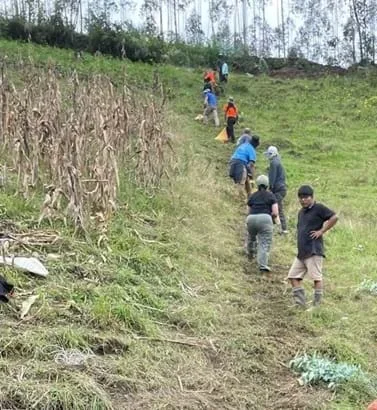 Otavalo, Ecuador minga work of transporting materials by bag to build a water tank for irrigation and raising tilapia.Copyright 2024, Yamila Cancel-Sanchez & Ethan Shade
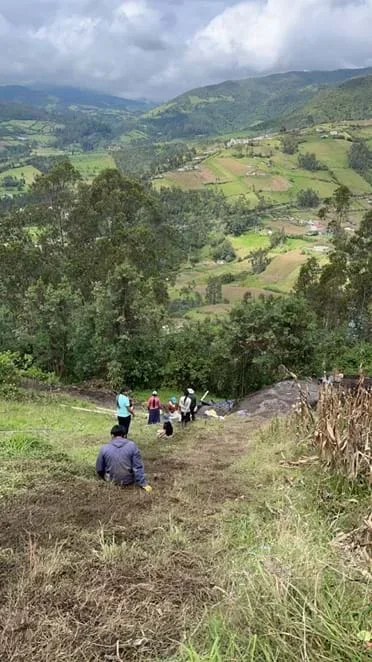 Otavalo, Ecuador minga work of transporting materials by bag to build a water tank for irrigation and raising tilapia.Copyright 2024, Yamila Cancel-Sanchez & Ethan Shade
Here is your challenge: Your task is to move a large amount of material down a hill using only the limited tools and resources provided. You have 5 minutes to move as much material as possible. How will you transport the materials efficiently with the resources available to you? Let’s get started!
Background
Newton’s second law of motion states that an object’s acceleration depends on the net force acting on it and its mass (Fnet=mass x acceleration). This means that the more force applied to an object, the more it accelerates, and the heavier the object, the more force is needed to achieve the same acceleration. For example, pushing an empty shopping cart is easier and makes it accelerate faster than pushing a full cart because the full cart has more mass. This law helps us understand how forces affect the motion of objects in everyday life and in physics problems.
A free body diagram (FBD) is a visual tool used in physics to show all of the forces acting on an object. The object is usually represented as a simple shape, like a dot or a box, and arrows are drawn to represent each force acting on it. Each arrow is labeled to indicate the type of force, such as gravity (weight), normal force from a surface, friction resisting motion, tension in a rope, or any applied force. FBDs help identify all forces acting on an object, making it easier to apply Newton’s second law (Fnet=mass x acceleration) to calculate acceleration, force, or mass, and solve physics problems systematically.
In this activity, students use Newton’s second law to determine the maximum amount of mass per unit time (or load per unit time) a mechanism is able to move material during a 5-minute period. Civil engineers and construction managers do optimization problems like this in their jobs. This activity allows students to practice these skills in a scaled and approachable model within the classroom by devising a solution with the objective of transporting the maximum amount of mass down a hill.
To determine the net force acting on each mass, students draw FBDs and apply Newton’s second law to calculate mass, acceleration, or individual forces as needed. Each component of the system is analyzed using either a FBD or the net mass of the system. From this analysis, students create a system of equations describing the relationships between mass, acceleration, and forces, which allows them to optimize their design.
Before the Activity
- Make copies of the Get the Materials Down the Hill! Worksheet (PDF) (1 per group).
- Make copies of the Pre/Post Quiz (PDF) (2 per student).
- Make copies of the Pre/Post Reflection (PDF) (2 per student).
- Optional: Prepare the wooden plank by using available tools (e.g., power tools) to drill holes into the wood to allow students to anchor dowels or wooden sticks to work with their design.
- Prepare a testing area.
- Option 1: Place one end of a 1.905 cm x 30.48 cm x 91.44 cm wooden plank atop a safe and stable surface. Suggested surfaces include a table or a chair in the classroom.
- Option 2: Find a location (e.g., playground, slope, or hill) where an inclined plane already exists. Determine the angle of the hill or slope ahead of time by taking measurements of the hypotenuse and base of the hill/slope to determine the angle of it.
- Note: The angle of the inclined plane is chosen by you based on the class level. It is suggested for a lower-level physics course to use a 45-degree angle. Higher level physics courses can use other degrees, but they should be less than 45 degrees.
- Gather building supplies (e.g., ropes, containers, bags, wheels, pulleys, carabiners, spools, and other supplies at your discretion, which students can use to create a transportation mechanism) for each group.
During the Activity
Day 1
Ask (25 minutes)
- Give each student a Pre/Post Quiz (PDF).
- Give students 10 minutes to complete the Pre/Post Quiz (PDF).
- Give each student a Pre/Post Reflection (PDF).
- Give students 5 minutes to complete the Pre/Post Reflection (PDF).
- Show students the minga work video #1 (2:01 minutes): The Essence of the Minga.
- Show students the minga work video #2 (0:37 minutes): Minga work video.
- Pose the scenario and challenge: You are trying to move a large amount of material (dirt, rocks, sand) down a hill. You have limited tools and resources for your use: plastic bags, ropes, aluminum foil, and 1 gallon plastic jugs.
- Show students the testing area. (Note: The scaled model of the hill is a plank of wood, or you can recreate a scaled model using clay. Also, suggest to reference/show Figure 1.)
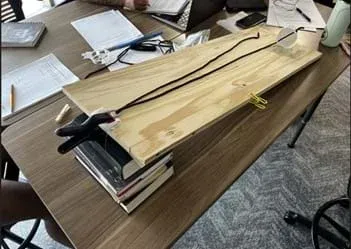 Testing ramp for student prototypes.Copyright 2024, Yamila Cancel-Sanchez & Ethan Shade
- Remind students of the Motivation/Introduction questions:
- Can you think of a physical task you had to do that drained all your energy or was risky to do?
- Can you think of different ways you can accomplish the given task?
- Can you think of an easier way to accomplish such a task?
- Are there any machines (simple or complex) that could help with the task?
Research (15 minutes)
- Give students time to research different methods of moving materials up and down hills or slopes with and without technology across the world.
Imagine (40 minutes)
- Give each group a Get the Materials Down the Hill! Worksheet (PDF).
- Review the brainstorming rules:
- All ideas are good and accepted.
- Only one person talks at the time within the group.
- One student records group ideas on the group’s Get the Materials Down the Hill! Worksheet (PDF).
- Give students 15 minutes to complete Section A as a group.
- Use the rest of the class period to have each group report out to the class and receive feedback on their ideas.
Day 2
Plan (20 minutes)
- Give students 5 minutes to read The art of Minga and why we should be more like Ecuador.
- Briefly discuss the article as a class.
- Instruct each group to complete Section B in the Get the Materials Down the Hill! Worksheet (PDF).
- Have each group complete Section C in their group worksheet, sketching their planned prototype on a hill or inclined plane.
Practice (20 minutes)
- Give students time to practice drawing free body diagrams (FBDs) in Section D.
- Discuss the FBD answers as a class, referencing the Get the Materials Down the Hill! Worksheet Answer Key (PDF).
- Make sure students understand the FBD examples and their answers.
Create and Test (40 minutes)
- Have each group calculate the angle of the inclined plane that they will be testing their prototype on in Section E.
- Allow each group to obtain the necessary materials for their planned prototype.
- Instruct each group to build their prototype as they sketched and planned in Sections C and D.
- Have students test their prototype in the testing area and collect their data. Data should be recorded in the data table in Section E.
- Optional homework: Have each group finish the calculations and analysis questions in Section E.
Students set up their prototype and load (a small cup) to test on the wooden ramp.Copyright 2024, Yamila Cancel-Sanchez & Ethan Shade
Day 3
Improve and Iterate (40 minutes)
- Have each group report their prototype solution and data collected to the class.
- Instruct the listening groups to provide feedback on the design and data collection. Note: Each group should use the Get the Materials Down the Hill! Worksheet (PDF) to document the feedback received from their peers.
- Give students time to rework their solution based on their peers’ feedback.
- Have students collect data based on their improved solution and complete the analysis of it.
- Optional: Let students iterate on their improved solution if time exists.
Design Showcase (20 minutes)
- Have each group briefly present their final, improved solution and data (even if they only iterated once).
- As a class discuss:
- Which group achieved the best results (e.g., maximum load, lowest effort, fastest time)?
- What was the best design element they saw from another group, and why was it effective?
Reflection and Conclusions (20 minutes)
- Give each student a Pre/Post Quiz (PDF) and have them complete it.
- Give each student a Pre/Post Reflection (PDF) and have them complete it.
- Conclude the activity by tying the technical aspects of the project with the introductory theme of community problem-solving. (Note: These questions are also in section H of the Get the Materials Down the Hill! Worksheet (PDF).)
- Global Problem-Solving: "How do other countries work to solve a common problem regarding transporting materials necessary for construction?"
- Resourcefulness: "How did the 'minga' concept of community and limited resources influence your group's design decisions?"
- Takeaways: "What are your most important takeaways regarding collaborative problem-solving and resource management?"
- force
- A physical quantity that denotes the ability to push, pull, twist, or accelerate a body and that has a direction and is measured in a unit dimensioned in mass × distance/time² (ML/T²): SI: Newton (N).
- free body diagram
- A diagram showing a single body or system of bodies with vectors indicating all forces acting on the system.
- friction
- A force that resists the relative motion or tendency to such motion of two bodies in contact.
- gravitational force
- A very long-range, but relatively weak fundamental force of attraction that acts between all particles that have mass; believed to be mediated by gravitons.
- inclined planes
- One of the simple machines; a sloping surface (e.g., a ramp) such that an object can be raised with less effort than being lifted vertically.
- load
- A weight to be carried.
- mass
- A measure of the inertia of a mass of matter, one of four fundamental properties of matter. SI unit of mass: kilogram.
- minga work
- Collaborative work in which friends and neighbors volunteer their time, effort, and sometimes funds to achieve a shared goal for the betterment of the community.
- net force
- The combination of all the forces that act on an object.
- newton’s second law of motion
- The observation that the rate of change of the momentum of a body is directly proportional to, and in the same direction as, the net force acting on it. Often stated as F = ma: F = force, m = mass, a = acceleration.
- normal force
- Any force acting normal to a surface, or perpendicular to the tangent plane.
- pulley
- One of the simple machines; a sheave, a wheel with a grooved rim, in which a pulled rope or chain lifts an object (more useful when two or more pulleys are used together, as in a block and tackle arrangement, such that a small force moving through a greater distance can exert a larger force through a smaller distance).
- tension
- Force transmitted through a rope, string, cable, or similar object (used with prepositions on, in, or of, e.g., "The tension in the cable is 1000 N," to convey that the same magnitude of force applies to objects attached to both ends).
- weight
- The force an object exerts on the object it is on due to gravitation.
Pre-Activity Assessment
Pre Quiz: Have students complete the Pre/Post Quiz (PDF), which tests them on the topics to be covered in the activity.
Class discussion: Remind students of the Motivation/Introduction questions and discuss as a class:
- Can you think of a physical task you had to do that drained all your energy or was risky to do?
- Can you think of different ways you can accomplish the given task?
- Can you think of an easier way to accomplish such a task?
- Are there any machines (simple or complex) that could help with the task?
Activity Embedded (Formative) Assessment
Imagine possible solutions: Teacher provides the Get the Materials Down the Hill! Worksheet (PDF)on which students complete Section A as a group.
Testing: Students test their prototypes, collect data, and complete analysis as indicated on the Get the Materials Down the Hill! Worksheet (PDF)Sections D, E, F, G, H, I, and J.
Report and feedback: Students report to the class and receive feedback. Use the Get the Materials Down the Hill! Worksheet (PDF) to document the feedback received from students’ peers.
Post-Activity (Summative) Assessment
Post Quiz: Perform the Pre/Post Activity Reflection (PDF) and the Pre/Post Quiz (PDF).
Reflection: Students reflect on how other countries work to solve a common problem regarding transporting materials necessary for construction. How do they use their resources to solve that specific problem? What are your takeaways regarding solving their specific problem? This reflection will be completed in the Get the Materials Down the Hill! Worksheet. (PDF)
Your discretion is recommended to determine the materials to be used in this activity. It is recommended that useful materials be provided to promote critical thinking and problem-solving during this activity, as well as options to be potentially used for the problem solution.
- For lower-grade / less experienced students, work through the free body diagrams as a class.
- For older / advanced students, do not provide the design of the data collection and analysis section. Instead, have them design their own experiment, including how the data is collected and analyzed.
- For older/ advanced students, require students to consider friction when solving for acceleration of the prototype.
Otavalo Ecuador Videos. “The Essence of the Minga.” YouTube, YouTube, 5 Apr. 2018, www.youtube.com/watch?v=abxPohPcGb8.
Star-Leonard, Serena. “The Art of Minga and Why We Should Be More Like Ecuador.” Fivepointfive.Org, Five Point Five, 25 Oct. 2013, https://fivepointfive.org/minga-ecuador. Accessed 07 July 2024.
“Wiktionary, the Free Dictionary.” En.wiktionary.org, https://en.wiktionary.org/wiki/Wiktionary:Main_Page.
Contributors
Yamila Cancel Sanchez; Ethan Shade
Supporting Program
Global STEM Research Experience for Teachers (RET) — Appropriate Technology for Developing Communities at Central State University and the University of Dayton
Acknowledgements
This curriculum was developed under National Science Foundation RET EEC grant number: #1855231/1855239 as part of the Global STEM Research Experience for Teachers (RET) — Appropriate Technology for Developing Communities at Central State University and the University of Dayton. Any opinions, findings, and conclusions or recommendations expressed in this material are those of the authors and do not necessarily reflect the views of the National Science Foundation.
We would like to thank the following for their assistance on this work: Margaret Pinnell, Ph.D., Principal Investigator; Leanne Petry, Ph.D., Principal Investigator; Kelly Bohrer; Marjorie Langston; Douglas Picard; Sakthi Kumaran Subburayalu, Ph.D.; Marcus Nagle, Ph.D.; KrishnaKumar Nedunuri, Ph.D.; Rydge Mulford, Ph.D.; Denise Taylor, Ph.D.; Sarah McKnight, Ph.D.; and Rajeev Swami, Ph.D. In addition, we would like to thank the Kichwa people of Yambiro, Otavalo, Ecuador with special thanks to Doña Marta, Doña Virgiñia, Doña Elena, Doña Rosa, Doña Concepcíon, and their families. Finally, we would like to thank Anna Taft, Hope Taft, Shelley Kawamura Gaetan Moussa, Omar Flores, Kuri Moreta, and other associates of the Tandana Foundation.
Copyright
2025 by Regents of the University of Colorado; original © 2024 Central State University and University of Dayton