
The Dragging Dilemma: Overcoming Friction to Move Rocks
Students explore the concept of dragging friction and participate in an activity to understand the cultural significance of the minga tradition. They then apply this knowledge to design a method for transporting materials up a hill. Their solution must reduce friction without altering the inclined plane, incorporate principles of the minga tradition, and utilize discarded materials commonly found in the area.
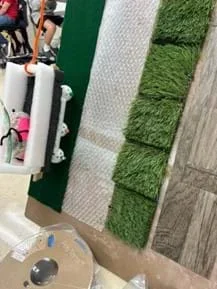 A prototype is being tested on the design apparatus.Copyright Douglas Picard and Christina Smith (2024)
Engineers across several disciplines study friction, mechanical advantage, material choice, and force analysis to design efficient and reliable systems. Mechanical engineers use these concepts to optimize machines, tools, and structures for performance and safety. Civil engineers apply them when designing buildings, bridges, and transportation systems to ensure stability and durability. Aerospace engineers rely on these principles to reduce drag and improve the performance of aircraft and spacecraft. Materials engineers focus on selecting and testing materials that can withstand specific forces and reduce friction.
After this activity, students should be able to:
- Understand how to calculate the force required in Newtons to move materials up an inclined plane with varying amounts of friction.
- Use the engineering design process to design a prototype that considers the end users’ available resources.
- Make mechanical advantage predictions based on resistance, distance, and force variables.
- Recognize patterns in data that suggest relationships worth investigating further. Distinguish between causal and correlational relationships.
Grades K-12
Do you agree with this alignment?
- 3-5-ETS1-1 Define a simple design problem reflecting a need or a want that includes specified criteria for success and constraints on materials, time, or cost.
Grades 3-5
This resource focuses on the following Three Dimensional Learning aspects of NGSS:
Science & Engineering Practices- Define a simple design problem that can be solved through the development of an object, tool, process, or system and includes several criteria for success and constraints on materials, time, or cost.Do you agree with this alignment?
Disciplinary Core Ideas- Possible solutions to a problem are limited by available materials and resources (constraints). The success of a designed solution is determined by considering the desired features of a solution (criteria). Different proposals for solutions can be compared on the basis of how well each one meets the specified criteria for success or how well each takes the constraints into account.Do you agree with this alignment?
Crosscutting Concepts- People's needs and wants change over time, as do their demands for new and improved technologies.Do you agree with this alignment?
Do you agree with this alignment? - Define a simple design problem that can be solved through the development of an object, tool, process, or system and includes several criteria for success and constraints on materials, time, or cost.
- 3-5-ETS1-2 Generate and compare multiple possible solutions to a problem based on how well each is likely to meet the criteria and constraints of the problem.
Grades 3-5
This resource focuses on the following Three Dimensional Learning aspects of NGSS:
Science & Engineering Practices- Generate and compare multiple solutions to a problem based on how well they meet the criteria and constraints of the design problem.Do you agree with this alignment?
Disciplinary Core Ideas- Research on a problem should be carried out before beginning to design a solution. Testing a solution involves investigating how well it performs under a range of likely conditions.Do you agree with this alignment?
- At whatever stage, communicating with peers about proposed solutions is an important part of the design process, and shared ideas can lead to improved designs.Do you agree with this alignment?
Crosscutting Concepts- Engineers improve existing technologies or develop new ones to increase their benefits, to decrease known risks, and to meet societal demands.Do you agree with this alignment?
Do you agree with this alignment? - Generate and compare multiple solutions to a problem based on how well they meet the criteria and constraints of the design problem.
- 3-5-ETS1-3 Plan and carry out fair tests in which variables are controlled and failure points are considered to identify aspects of a model or prototype that can be improved.
Grades 3-5
This resource focuses on the following Three Dimensional Learning aspects of NGSS:
Science & Engineering Practices- Plan and conduct an investigation collaboratively to produce data to serve as the basis for evidence, using fair tests in which variables are controlled and the number of trials considered.Do you agree with this alignment?
Disciplinary Core Ideas- Tests are often designed to identify failure points or difficulties, which suggest the elements of the design that need to be improved.Do you agree with this alignment?
- Different solutions need to be tested in order to determine which of them best solves the problem, given the criteria and the constraints.Do you agree with this alignment?
Do you agree with this alignment? - Plan and conduct an investigation collaboratively to produce data to serve as the basis for evidence, using fair tests in which variables are controlled and the number of trials considered.
- MS-PS2-2 Plan an investigation to provide evidence that the change in an object's motion depends on the sum of the forces on the object and the mass of the object.
Grades 6-8
This resource focuses on the following Three Dimensional Learning aspects of NGSS:
Science & Engineering Practices- Plan an investigation individually and collaboratively, and in the design: identify independent and dependent variables and controls, what tools are needed to do the gathering, how measurements will be recorded, and how many data are needed to support a claim.Do you agree with this alignment?
- Science knowledge is based upon logical and conceptual connections between evidence and explanations.Do you agree with this alignment?
Disciplinary Core Ideas- The motion of an object is determined by the sum of the forces acting on it; if the total force on the object is not zero, its motion will change. The greater the mass of the object, the greater the force needed to achieve the same change in motion. For any given object, a larger force causes a larger change in motion.Do you agree with this alignment?
- All positions of objects and the directions of forces and motions must be described in an arbitrarily chosen reference frame and arbitrarily chosen units of size. In order to share information with other people, these choices must also be shared.Do you agree with this alignment?
Crosscutting Concepts- Explanations of stability and change in natural or designed systems can be constructed by examining the changes over time and forces at different scales.Do you agree with this alignment?
Do you agree with this alignment? - Plan an investigation individually and collaboratively, and in the design: identify independent and dependent variables and controls, what tools are needed to do the gathering, how measurements will be recorded, and how many data are needed to support a claim.
- Forces between objects act when the objects are in direct contact or when they are not touching.
Grade 8
Do you agree with this alignment?
Day 1
Each group needs:
- 1 3-lb weight (flat plate weight or bagged sand)
- 12-24 inches of string or thin rope
- Five strips (approximate sizes of 4-6” x 24-36”) of different surfaces. You can choose any surfaces. Examples include the following:
- high-pile carpet (can get samples/swatches for free from big box home improvement store)
- low-pile carpet (can get samples/swatches for free from big box home improvement store)
- marine carpet
- low grit number sandpaper
- bubble wrap
- aluminum foil
- felt
- artificial turf
- wax paper
- foam or rubber mat
- fabric
- Day 1: Student Drag Inquiry Activity Sheet (PDF) (1 per student)
Day 2
Each group needs:
- Day 2: Polarizing Collaboration – Problem-Solving Challenge in the Minga Tradition (PDF) (1 per student)
For the entire class to share:
- 1 laptop computer with internet access and projector (to show YouTube video to class)
Day 3
Each group needs:
- 1 3-lb weight (flat plate weight or bagged sand)
- 12-24” of string or thin rope
- 1 Newton scale/spring scale
- Day 3: IMA/AMA, Hypotheses, and Calculations (PDF) (1 per student)
For the entire class to share:
- 1 laptop computer with internet access and projector (to show IMA/AMA Calculations Presentation (PPTX) and YouTube video to class)
- Five strips (4-6” x 24-36” strips) of turf, carpet, bubble wrap, vinyl flooring and felt. (or substitutions as appropriate.) Cut enough for each group or put all five strips a general area where students can test dragging their weights.
Day 4
Each group needs:
- 1 3-lb weight (flat plate weight or bagged sand)
- 1 2-24” of string or thin rope
- 1 Newton scale/spring scale
- scissors
- glue or tape
- Day 4: Using Engineering Design Process, IMA/AMA, Hypotheses, and Calculations (PDF) (1 per student)
- access to commonly discarded items, large enough to hold weights, such as the following:
- empty plastic jug or bottle
- dog or cat food bag
- empty flour or rice bag
- other recyclable materials
For the entire class to share:
- testing apparatus (created by you before the activity; see Before the Activity section for instructions on how to create)
- hot glue, white glue, or wood glue
- scissors
- 1 24” x 48” plywood board
- 4-6” x 24-36” strips of the following surfaces (suitable substitutions can be made):
- turf
- carpet (can get samples/swatches for free from big box home improvement store)
- bubble wrap
- vinyl flooring
- felt
Day 5
Each group needs:
- 1 3-lb weight (flat plate weight or bagged sand)
- 12-24” of string or thin rope
- 1 Newton scale/spring scale
- scissors
- glue or tape
- Day 5: Redesign Using Engineering Design Process, IMA/AMA, Hypotheses, and Calculations (PDF) (1 per student)
- Engineering Design Challenge Rubric (PDF)(1 per group)
- access to commonly discarded items, large enough to hold weights, such as the following:
- empty plastic jug or bottle
- dog or cat food bag
- empty flour or rice bag
- other recyclable materials
For the entire class to share:
- testing apparatus (created by you before the activity; see Before the Activity section for instructions on how to create)
- Day 1: Student Drag Inquiry Activity Sheet (docx)
- Day 1: Student Drag Inquiry Activity Sheet (pdf)
- Day 2: Polarizing Collaboration - Problem-Solving Challenge in the Minga Tradition (docx)
- Day 2: Polarizing Collaboration - Problem-Solving Challenge in the Minga Tradition (pdf)
- Day 3: IMA/AMA, Hypotheses, and Calculations (docx)
- Day 3: IMA/AMA, Hypotheses, and Calculations (pdf)
- Day 4: Using Engineering Design Process, IMA/AMA, Hypotheses, and Calculations (docx)
- Day 4: Using Engineering Design Process, IMA/AMA, Hypotheses, and Calculations (pdf)
- Day 5: Redesign Using Engineering Design Process, IMA/AMA, Hypotheses, and Calculations (docx)
- Day 5: Redesign Using Engineering Design Process, IMA/AMA, Hypotheses, and Calculations (pdf)
- Engineering Design Challenge Rubric (docx)
- Engineering Design Challenge Rubric (pdf)
- IMA and AMA Calculations (pptx)
- IMA and AMA Calculations (pdf)
Students should:
- Be familiar with the engineering design process.
- Be able to solve basic algebraic expressions.
- Be familiar with basic acute angle measurement.
Have you ever tried to push a heavy box across the floor and noticed how much harder it is on carpet than on smooth tile? That’s because of something called friction—and today, you’re going to investigate it like real engineers. Engineers study force and friction all the time when they’re designing machines, roads, shoes, or even rockets! Understanding how surfaces affect movement can help solve real-world problems, such as making it easier to move heavy materials or helping vehicles stop safely. You're going to be scientists and engineers today, testing different surfaces to figure out what makes some easier—or harder—to move objects across.
Before we dive in, let’s go over a few key terms. First, what is force? A force is a push or a pull. It's what makes things start moving, stop, or change direction. Think about kicking a soccer ball—that’s a force! Or pulling open a door—that’s also a force. Now, when something is moving and comes into contact with another surface, there’s usually a force that resists the movement. That’s called friction. Friction is what keeps us from sliding all over the place when we walk, but it also makes it harder to move heavy things. When you're pulling something along the ground, that’s a special kind of friction called dragging friction—and it's what we’re going to explore.
But this activity isn’t just about engineering—it’s also about the power of working together, just like in the minga tradition. Minga is a Latin American community practice where people come together to solve a problem, build something, or help one another. It’s all about teamwork, shared responsibility, and combining strengths to overcome challenges.
The Indigenous people of Otavalo, Ecuador, known as the Otavaleños, practice minga as part of their cultural heritage rooted in the Andes. They are known for their vibrant textiles, craftsmanship, and strong entrepreneurial spirit. Despite limited access to modern technology in mountainous regions—where roads may be difficult to navigate or machinery could cause environmental harm—the Otavaleños find creative ways to complete projects. Rather than relying on machines, they rely on each other. Through minga, they use collective strength, ingenuity, and cultural knowledge to solve problems in ways that reflect deep community values.
For example, when materials need to be moved up a steep hillside, the Otavaleños use the minga tradition to organize and work together. Lack of resources such as money or access to modern tools doesn’t stop them—they lean on solidarity, cooperation, and shared effort to get things done. This is a powerful reminder that problem-solving isn’t always about having the best tools—it’s about the best teamwork.
Today, your job is to test which surfaces create more or less dragging friction by pulling a weighted object across them. Before testing, you’ll make predictions based on what you know—or think you know—about each surface. Is it smooth or rough? Slippery or grippy? You’ll work in small teams, gather data, and write down your observations. Then, we’ll come back together as a class to discuss what you found, what surprised you, and how your thinking may have changed.
This activity is your foundation—your research—for an engineering design challenge you’ll tackle later this week. You’ll be asked to design a way to move materials up a hill using only limited tools and recycled materials. Just like in a real minga, your team will need to combine your knowledge and effort to reach a shared goal. The stronger your teamwork and your understanding of friction today, the better your design will be tomorrow.
Over the next few days, you’ll be challenged not just to understand how friction works, but also to design a solution with your team that reflects the spirit of minga—solving a tough problem by combining your ideas, testing your thinking, and helping each other succeed. This tradition fosters strong social bonds and community resilience, allowing groups to accomplish great things—together.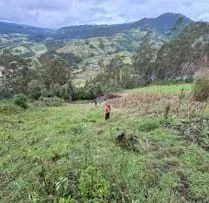 The bags of material (concrete and rocks) moved on the hill weighed approximately 40-50 pounds each.Copyright Douglas Picard and Christina Cook (2024)
 This bag was a repurposed rice bag, and it carried approximately 40-50 pounds of rocks/concrete up and down the hill multiple times before it failed.Copyright Douglas Picard and Christina Smith (2024)
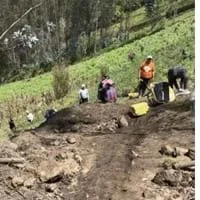 The group of people work together to move materials on the hill.Copyright 2024 Douglas Picard and Christina Smith
Background
Minga is a term that originates from Indigenous communities in Latin America, particularly in the Andes region. It refers to a collective, cooperative effort or community work where people come together to perform a task that benefits the group or community. The work is typically done voluntarily, without monetary compensation, and it often involves a sense of solidarity and mutual aid.
In many cultures, minga has historical and cultural significance, as it fosters a sense of unity and shared responsibility. It can include a variety of activities, such as building infrastructure, farming, or organizing community events. The concept is rooted in values of reciprocity, where individuals contribute to the well-being of others with the understanding that they will receive support in return when needed.
This activity introduces students to the concept of friction and force through hands-on experimentation, while also incorporating the principles of teamwork and community collaboration inspired by the minga tradition. The goal is for students to explore how different surfaces affect movement, focusing specifically on dragging friction, and then apply this understanding to solve a real-world engineering challenge. This activity also serves as an introduction to the engineering design process, which will be expanded on later in the week.
Friction is a force that resists the motion of objects when they come into contact with each other. In this activity, students will investigate dragging friction, which occurs when an object is pulled across a surface. By testing various surfaces with different textures, students will observe how smooth or rough surfaces influence how easily an object moves. This is an important concept for engineers, who must consider friction when designing vehicles, machinery, and everyday products such as shoes or conveyor belts. Understanding how to reduce or manage friction is critical in many fields, from aerospace to transportation.
Incorporating the minga tradition adds a unique cultural and collaborative element to the lesson. Minga is a practice in many Indigenous communities, particularly in the Andes, where groups come together to work toward a common goal. It emphasizes shared responsibility, teamwork, and creativity in solving problems, often in environments where resources are limited. By learning about the minga tradition, students will understand how community effort and cooperation can overcome challenges, even when modern technology is unavailable.
This collaborative mindset will be crucial when students apply their understanding of friction and force to the engineering design challenge. In the second part of the activity, students will work in teams to solve the problem of moving materials up a hill using only limited resources—just as the minga tradition encourages. Success in this challenge depends not on having the best materials, but on effective collaboration, resourcefulness, and creative problem-solving, all key aspects of both the minga and engineering design processes.
As the teacher, you’ll guide students through both individual and group activities. They will start by testing the effect of various surfaces on dragging friction, making predictions, and recording their findings. This will serve as foundational research for their larger design challenge, where they will design a solution to move materials up a hill. Through teamwork, experimentation, and reflection, students will connect the concepts of friction, force, and collaboration to successfully complete the challenge ahead.
Before the Activity
- A few weeks before the activity, collect and clean commonly discarded items (see examples in the Materials List).
- Before Day 1:
- Choose and cut 4-6” x 24-36” strips of various surfaces for students to test during the drag inquiry activity (e.g., felt, high-pile rug, low-pile rug, sandpaper, bubble wrap, aluminum foil, cardboard, wood, foam or rubber mat, tile, wax paper, etc.).
- Cut string or thin rope into 12-24” lengths (one per group).
- Organize materials for each group: weight and string.
- Print copies of the Day 1: Student Drag Inquiry Activity Sheet (PDF)(one per student).
- Before Day 2:
- Print copies of the Day 2: Polarizing Collaboration – Problem-Solving Challenge in the Minga Tradition (PDF) (one per student).
- Review and prepare to show this video (2:01 minutes): https://youtu.be/abxPohPcGb8?si=uulUlq7ko-gae336.
- Before Day 3:
- Cut 4-6” x 24-36” strips of turf, carpet, bubble wrap, vinyl flooring and felt. (Either cut enough for each group or put in a general area where students can test dragging their weights.)
- Cut string or thin rope into 12-24” lengths (one per group).
- Organize materials for each group: weight, string, and Newton scale/spring scale.
- Review and prepare to show the IMA/AMA Calculations Presentation (PPTX).
- Review and prepare to show this video (00:59 minutes): How to use a spring scale.
- Print copies of the Day 3: IMA/AMA, Hypotheses, and Calculations (PDF) (one per student.)
- Before Day 4:
- Build the testing apparatus (instructions below).
- Print copies of the Day 4: Using Engineering Design Process, IMA/AMA, Hypotheses, and Calculations (PDF) (one per student.)
- Organize materials for each group: weight, string, Newton scale/spring scale, scissors, glue or tape, and commonly discarded items, large enough to hold weights (e.g., empty plastic jug or bottle, dog or cat food bag or empty flour or rice bag.) .
- Before Day 5:
- Print copies of Day 5: Redesign Using Engineering Design Process, IMA/AMA, Hypotheses, and Calculations (PDF) (one per student.)
- Print copies of the Engineering Design Challenge Rubric (PDF) (one per group).
- Organize materials for each group: weight, string, Newton scale/spring scale, scissors, glue or tape, and commonly discarded items, large enough to hold weights (e.g., empty plastic jug or bottle, dog or cat food bag or empty flour or rice bag.) .
Instructions for building the testing apparatus:
- Using scissors or shears, cut a piece of each surface material into 4-6” x 24-36” strips (suitable substitutions can be made):
- turf
- carpet (can get samples/swatches for free from big box home improvement store)
- bubble wrap
- vinyl flooring
- felt
- With the 24” x 48” board held in portrait orientation, affix each strip of material to it to ensure they all fit.
- Material should be centered vertically, leaving space at the top and bottom of board. See schematic example below.
- Once fit is verified, apply glue (hot glue, white glue, wood glue) to the wood surface and then affix strip to it.
- Repeat for remaining strips.
- Allow to dry per glue specifications.
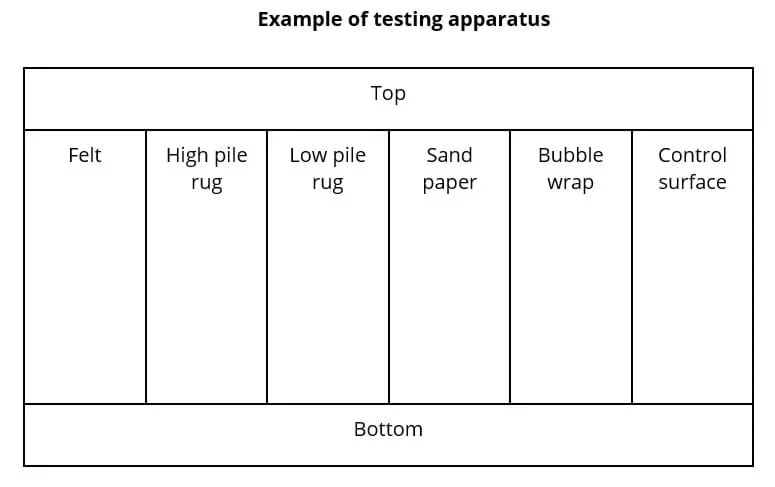 A schematic of an example testing apparatus setup.Copyright Douglas Picard and Christina Smith (2024)During the Activity
Day 1
- (10 min) Introduction
- Read aloud the “Introduction and Motivation” section of the activity.
- Ask if students have any questions.
- Optional: Lead a class discussion to review (or introduce) the following terms:
- What is force? What are some examples? (Answer: Force is a push or a pull on something. It can make an object start moving, stop moving, change direction, or change shape. For example, when you kick a ball, you're using force to make it move. When you pull a door open, that’s also a force!)
- What is friction? What are some examples? (Answer: Friction is a force that happens when two surfaces rub against each other. It tries to slow things down or stop them from moving. For example, when you slide your hand across a table, you can feel it resist a little—that’s friction! It helps us walk without slipping and stops cars when we hit the brakes.)
- What is dragging friction? What are some examples? (Answer: Dragging friction is the force that tries to stop something when you pull or drag it across a surface. It happens because the object is rubbing against the surface, and they push back against each other. The rougher the surface, the more dragging friction there is—and the harder it is to move the object!)
- (25 min) Drag Inquiry Activity
- Divide students into groups of 3-4.
- Give each student a Day 1: Student Drag Inquiry Activity Sheet (PDF).
- Show students the various surfaces that they can test.
- Have each group gather the materials needed to complete the activity: weight, string, and strips of five surface types.
- Have students follow the instructions on the Day 1: Student Drag Inquiry Activity Sheet (PDF). These steps are summarized below.
- Have each group discuss which of the available surfaces would be easiest to move a weight across, and why.
- Instruct students to consider factors of smoothness, texture, and material of the surfaces.
- Have each group fill out the “Before” section in the Inquiry Data Table before moving on to the “During” section.
- Have each group attach a length of string or thin rope to the weight.
- Give students time to test each surface by dragging the weight across the surface.
- Have students record the surface tested and then, under the “Comments/Observations” section, have students discuss the surface (e.g., smooth, waxy, multiple fibers, etc.) and what happened when they dragged the weight across the surface in the “During” section.
- Have students complete the reflection question in the “After” section.
- (10 min) Class Discussion and Conclusions
- Allow students to share their findings with the rest of the class, including evidence that supports and challenges their original hypotheses.
- As the class discusses, direct the conversation to enforce the ideas of force and friction.
Day 2
- (5 min) Introduce the Challenge
- State the activity objective: “The objective of this activity is to help you understand the dynamics and importance of community collaboration inspired by the minga tradition, while exploring the effects of inclusion and exclusion on group dynamics and outcomes.”
- Set up three groups of students following these guidelines:
- Group A: One student, works independently in a designated area of the room, only permitted to talk to you.
- Group B: 25% of students, works in designated area of room, separate from other groups, only permitted to talk within the group and to you.
- Group C: 75% of students, works in designated area of room, separate from other groups, only permitted to talk within the group and to you.
- Explain that students will participate in a collaborative problem-solving challenge that will involve both group dynamics and individual reflection.
- Present the challenge scenario to the groups, noting that each group will work on the SAME task. (Note: The challenge can be chosen by you or chosen by class from the options below.)
- Plan a school-wide sustainability initiative
- Plan a school field trip or picnic
- Plan a school dance
- (10 min) Student Planning Activity
- Explain that each group will present their proposed solution or project idea to the class, with an outline of their plan, rationale, and how they would involve the school community.
- Give students time to come up with a solution or project idea.
- (20 min) Student Outcome and Discussion
- Hand out one Day 2: Polarizing Collaboration – Problem-Solving Challenge in the Minga Tradition sheet (PDF) to each student.
- Have each group present their proposed solution or project idea to the class, outlining their plan, rationale, and how they would involve the school community.
- Give students time to respond to each of the presentations on their Day 2: Polarizing Collaboration – Problem-Solving Challenge in the Minga Tradition sheet (PDF).
- (10 min) Wrap-Up and Connection to the Minga Tradition
- Allow students to share some of their responses on the Day 2: Polarizing Collaboration – Problem-Solving Challenge in the Minga Tradition sheet (PDF).
- Summarize the key learnings from the activity, emphasizing the importance of collaboration, resource access, and mutual support in achieving collective goals in the minga tradition.
- Show this video (2:01 minutes): https://youtu.be/abxPohPcGb8?si=uulUlq7ko-gae336.
- Optional: Have students review the IMA/AMA Calculations Presentation (PPTX)as homework.
Day 3
- (10 min) Review IMA/AMA Calculations
- Review the IMA/AMA Calculations Presentation (PPTX) with the class.
- (5 min) Introduction to Activity
- Hand out one Day 3: IMA/AMA, Hypotheses, and Calculations sheet (PDF) to each student.
- Go over the activity with the students. Students will:
- Gather the necessary materials.
- Watch this video (00:59 minutes): How to use a spring scale.
- Attach the string to the weight securely so it can be pulled easily.
- Use the spring scale to gently pull the weight up the inclined plane on the control surface.
- Record how many Newtons of force it takes to move the weight.
- Discuss with their team which of the other five surfaces they think will be easier or harder to drag the weight across and write down their predictions and reasoning (smoothness, texture, material).
- Hypothesize how many Newtons it will take to pull the weight on each of the other five surfaces.
- One at a time, repeat the test on each surface using the spring scale.
- Record the actual Newtons needed for each surface.
- Calculate the difference between their prediction and the actual measurement for each surface.
- Summarize their findings.
- Remind students how to use the testing apparatus: Starting at the bottom of the control surface, slowly drag the hand weight all the way to the top and have a partner record the “consistent/steady” measurement on the scale. Aim for a consistent duration of dragging and arm/hand height to control this variable.
- (30 min) Activity
- Give students the rest of the period to make their measurements and finish the Day 3: IMA/AMA, Hypotheses, and Calculations sheet (PDF).
Day 4
- (5 min) Introduction
- Hand out one Day 4: Using Engineering Design Process, IMA/AMA, Hypotheses, and Calculations sheet (PDF) to each student.
- Introduce the design challenge: “Design a method to transport material up a hill. The method must reduce the amount of friction and can’t involve modifying the inclined plane. The design must incorporate the minga tradition, while also using discarded materials common to the area.”
- Review the materials for the activity.
- (5 min) Engineering Design Process
- Review the engineering design process steps in the Day 4: Using Engineering Design Process, IMA/AMA, Hypotheses, and Calculations sheet (PDF).
- Walk through the activity instructions, highlighting steps of the engineering design process:
- Ask: Review the design challenge and have a discussion with the students, answering any questions they may have in order to understand the challenge. Emphasize the constraints of the challenge: time, materials available, etc.
- Research: Tell students that the activities completed in the previous three class periods are the research portion of the engineering design process.
- Imagine: Have students examine the available materials and discuss which ones might provide the greatest mechanical advantage.
- Plan: Have students plan their solution using the selected materials to help move the weight across an inclined plane.
- Create: Have students build their prototype and then predict how many Newtons will be needed to drag their prototype across each of the five surfaces.
- Test: Have students test their design over the different surfaces and then calculate the difference between their predicted and measured values for each surface.
- Iterate: Tell students they will complete this step in the next class period.
- (35 min) Activity
- Have students work through the Day 4: Using Engineering Design Process, IMA/AMA, Hypotheses, and Calculations sheet (PDF).
 The student explores a surface of choice in order to assess for friction and movability.Copyright Douglas Picard and Christina Smith (2024)A prototype is being tested on the design apparatus.Copyright Douglas Picard and Christina Smith (2024)
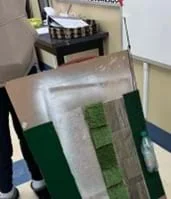 A prototype is being tested on the design apparatus.Copyright Douglas Picard and Christina Smith (2024)
Day 5
- (35 minutes) Activity Improvements and Retesting
- Hand out one Day 5: Redesign Using Engineering Design Process, IMA/AMA, Hypotheses, and Calculations sheet (PDF) to each student.
- Display or provide a copy of the Engineering Design Challenge Rubric (PDF) to each group.
- Explain that students will be redesigning their prototype based on their data from Day 4.
- Encourage students to make purposeful changes to their original design.
- Questions to consider asking in order to prompt their ideas:
- What specific issues did we encounter with the current design related to reducing friction?
- How effectively did the current design handle the task of pulling the sandbag uphill?
- What alternative materials could we use to reduce friction between the sandbag and the inclined plane?
- Which redesign concepts show the most promise in reducing friction while pulling the sandbag uphill?
- Are there unexpected challenges or benefits from the designed components that we need to address?
- During redesign, make sure to point out that factors such as increasing mass will impact the design.
- For the “Findings Summary” section, have students use quantitative as well as qualitative data, as well as a recommendation for the ideal surface.
- (10 minutes) Class discussion and conclusions
- As a class, discuss each group’s findings, including what worked, and what didn’t work during the engineering challenge.
- friction
- A force that resists the relative motion or tendency to such motion of two bodies in contact.
- effort
- A force acting on a body in the direction of its motion.
- mechanical advantage
- The ratio of the output force produced by a machine (especially a simple machine) to the applied input force.
- force
- Something or anything that has the power to produce a physical effect upon something else, such as causing it to move or change shape.
- newton
- In the International System of Units, the derived unit of force; the force required to accelerate a mass of one kilogram by one meter per second per second. Symbol: N.
- minga
- South American labor group whose members perform community service work for the benefit of all.
- collaborate
- To work together with others to achieve a common goal.
- dragging friction
- The resistance felt when pulling (or dragging) something across a surface. It's a type of frictional force that acts opposite to the direction of motion and tries to slow the object down.
Pre-Activity Assessment
Drag Inquiry Activity: On Day 1, students complete the Day 1: Student Drag Inquiry Activity Sheet (PDF). Use this activity as a formative assessment to determine the students’ background knowledge.
Activity Embedded (Formative) Assessment
Worksheets: As students fill out the daily worksheets, there are multiple opportunities for you to formatively assess student growth based on the activities and design challenge. Verify correct mechanical advantage calculations and perform spot checks for correct testing methodology.
IMA/AMA Calculations: Students fill out the Day 3: IMA/AMA, Hypotheses, and Calculations Sheet (PDF), which you can use as an additional formative check. This worksheet will help you assess student calculations for understanding and correctness.
Post-Activity (Summative) Assessment
Prototype: Students will be assessed based on the Engineering Design Challenge Rubric (PDF).
- Use caution when using scissors/shears to cut materials.
- Additional activities that explore the activity topic further and may be used in conjunction with or before this activity:
- If time and conditions permit, have students complete the activity on a hill with a larger amount of material to move.
LatinTrails. “The Unique & Picturesque Otavalo Culture: Latin Trails.” Latin Trails, 13 Feb. 2019, http://latintrails.com/the-unique-otavalena-culture.
“Otavalo People Facts for Kids.” Otavalo People Facts for Kids, http://kids.kiddle.co/Otavalo_people. Accessed 18 July 2024.
Contributors
Douglas Picard; Christina Smith
Supporting Program
Global STEM Research Experience for Teachers (RET) — Appropriate Technology for Developing Communities at Central State University and the University of Dayton
Acknowledgements
This curriculum was developed under National Science Foundation RET EEC grant number: #1855231/1855239 as part of the Global STEM Research Experience for Teachers (RET) — Appropriate Technology for Developing Communities at Central State University and the University of Dayton. Any opinions, findings, and conclusions or recommendations expressed in this material are those of the authors and do not necessarily reflect the views of the National Science Foundation.
We would like to thank the following for their assistance on this work: Margaret Pinnell, Ph.D., Principal Investigator; Leanne Petry, Ph.D., Principal Investigator; Kelly Bohrer; Marjorie Langston; Douglas Picard; Sakthi Kumaran Subburayalu, Ph.D.; Marcus Nagle, Ph.D.; KrishnaKumar Nedunuri, Ph.D.; Rydge Mulford, Ph.D.; Denise Taylor, Ph.D.; Sarah McKnight, Ph.D.; and Rajeev Swami, Ph.D. In addition, we would like to thank the Kichwa people of Yambiro, Otavalo, Ecuador, with special thanks to Doña Virgiñia, Doña Elena, Doña Rosa, Doña Marta, Doña Concepcíon, and their families. Finally, we would like to thank Anna Taft, Hope Taft, Shelley Kawamura Gaetan Moussa, Omar Flores, Kuri Moreta, and other associates of the Tandana Foundation.
Copyright
2025 by Central State University and University of Dayton