
Toilet Paper Trouble Time: Designing Plant-Based Solutions to Break Down Toilet Paper
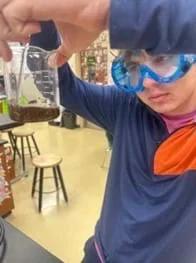 Students design and test plant-based solutions to break down toilet paperCopyright Frances, November 2024
Students tackle a real-world problem by designing and testing plant-based solutions to break down toilet paper. Using the engineering design process, they research, brainstorm, prototype, test, and refine their approaches—just like professional engineers. By experimenting with different plant materials, students develop creative problem-solving skills while considering real constraints faced in global sanitation systems.
Solving the issue of toilet paper disposal and clogging in different environments would require collaboration among multiple engineering disciplines. Environmental engineers would analyze wastewater systems and develop sustainable sanitation solutions. Chemical engineers would study plant-based compounds and chemical reactions to break down toilet paper efficiently. Biomedical engineers might explore biological solutions, such as enzymes or bacteria, to aid in decomposition. Materials engineers would examine the composition of toilet paper and its interactions with various substances. Civil engineers would design and maintain plumbing and sewage infrastructure to handle waste effectively, while sanitation engineers would focus on public health and waste management strategies. Together, these engineers could develop innovative solutions to prevent clogs and improve sanitation worldwide.
After this activity, students should be able to:
- Describe the steps of the engineering design process.
- Understand that there are different bathroom practices across the globe.
- Share basic info about the culture of the Kichwa Indigenous people of Yambiro, Otavalo, Ecuador.
- Develop a broader, more empathetic global mindset.
- HS-ETS1-1 Analyze a major global challenge to specify qualitative and quantitative criteria and constraints for solutions that account for societal needs and wants.
Grades 9-12
This resource focuses on the following Three Dimensional Learning aspects of NGSS:
Science & Engineering Practices- Analyze complex real-world problems by specifying criteria and constraints for successful solutions.Do you agree with this alignment?
Disciplinary Core Ideas- Criteria and constraints also include satisfying any requirements set by society, such as taking issues of risk mitigation into account, and they should be quantified to the extent possible and stated in such a way that one can tell if a given design meets them.Do you agree with this alignment?
- Humanity faces major global challenges today, such as the need for supplies of clean water and food or for energy sources that minimize pollution, which can be addressed through engineering. These global challenges also may have manifestations in local communities.Do you agree with this alignment?
Crosscutting Concepts- New technologies can have deep impacts on society and the environment, including some that were not anticipated. Analysis of costs and benefits is a critical aspect of decisions about technology.Do you agree with this alignment?
Do you agree with this alignment? - Analyze complex real-world problems by specifying criteria and constraints for successful solutions.
- HS-ETS1-2 Design a solution to a complex real-world problem by breaking it down into smaller, more manageable problems that can be solved through engineering.
Grades 9-12
This resource focuses on the following Three Dimensional Learning aspects of NGSS:
Science & Engineering Practices- Design a solution to a complex real-world problem, based on scientific knowledge, student-generated sources of evidence, prioritized criteria, and tradeoff considerations.Do you agree with this alignment?
Disciplinary Core Ideas- Criteria may need to be broken down into simpler ones that can be approached systematically, and decisions about the priority of certain criteria over others (trade-offs) may be needed.Do you agree with this alignment?
Do you agree with this alignment? - Design a solution to a complex real-world problem, based on scientific knowledge, student-generated sources of evidence, prioritized criteria, and tradeoff considerations.
- HS-ETS1-3 Evaluate a solution to a complex real-world problem based on prioritized criteria and trade-offs that account for a range of constraints, including cost, safety, reliability, and aesthetics, as well as possible social, cultural, and environmental impacts.
Grades 9-12
This resource focuses on the following Three Dimensional Learning aspects of NGSS:
Science & Engineering Practices- Evaluate a solution to a complex real-world problem, based on scientific knowledge, student-generated sources of evidence, prioritized criteria, and tradeoff considerations.Do you agree with this alignment?
Disciplinary Core Ideas- When evaluating solutions it is important to take into account a range of constraints including cost, safety, reliability and aesthetics and to consider social, cultural and environmental impacts.Do you agree with this alignment?
Crosscutting Concepts- New technologies can have deep impacts on society and the environment, including some that were not anticipated. Analysis of costs and benefits is a critical aspect of decisions about technology.Do you agree with this alignment?
Do you agree with this alignment? - Evaluate a solution to a complex real-world problem, based on scientific knowledge, student-generated sources of evidence, prioritized criteria, and tradeoff considerations.
Each group needs:
- 3-30 squares of toilet paper, depending on the size of the funnel and whether the toilet paper is thick or thin. (It should be enough to clog in the funnel to represent a clogged toilet.)
- 1 type of plant material (leaves, twigs, stems, flowers, etc.)
- 1 mortar and pestle to crush up plant material
- 1 small funnel
- 1 graduated cylinder or flask that can hold 250 mL of liquid
- 250 mL water
- 1 stopwatch/timer
- 1 laptop/table/computer/device for accessing the internet
- 16 sticky notes, 8 of two different colors
- 1 scissors
- lab safety goggles (for each student)
- 1 Introduction Worksheet (PDF)
- 1 Engineering Design Challenge Sheet (PDF)
- 1 Final Assessment Rubric (PDF)
- 1 Activity Research and Assessment Guidelines (PDF)
- 1 Large Group Research and Share-Out Rubric (PDF)
- 1 Testing Data Tables Worksheet (PDF)
- 1 Self, Peer, and Group Evaluation Form (PDF)
- 1 Group Share-Out Rubric (PDF)
For the entire class to share:
- 1 water heating mechanism such as a Bunsen burner or electric tea kettle
- projector with laptop/computer with internet access to show YouTube videos
- Video List (docx)
- Video List (pdf)
- Introduction Worksheet (docx)
- Introduction Worksheet (pdf)
- Engineering Design Challenge Sheet (docx)
- Engineering Design Challenge Sheet (pdf)
- Testing Data Tables Worksheet (docx)
- Testing Data Tables Worksheet (pdf)
- Self, Peer, and Group Evaluation Form (docx)
- Self, Peer, and Group Evaluation Form (pdf)
- Research and Assessment Guidelines (docx)
- Research and Assessment Guidelines (pdf)
- Final Assessment Rubric (docx)
- Final Assessment Rubric (pdf)
- Group Share-Out Rubric (docx)
- Group Share-Out Rubric (pdf)
- Large Group Research and Share-Out Rubric (docx)
- Large Group Research and Share-Out Rubric (pdf)
Students should know how to measure liquids.
Toilet paper disposal varies widely across the world, and in many countries, it is handled very differently than in the United States. In fact, you might be surprised to learn that in many places, toilet paper is tossed in a trash can—or not provided at all!
So, what happens if you accidentally flush toilet paper in a place where it is not meant to go down the toilet? Will it clog the pipes? Will it disrupt the entire sewage system? Will you get in trouble? More important, if disaster strikes, can you fix it?
You are traveling in Ecuador. After a long day, you head to the baño. You take care of business, but then—uh-oh—your mind drifts for a moment (brain fart, pun intended), and before you realize it, you have flushed the toilet paper. Yikes! The water rises, and the toilet is clogged.
Panic sets in. But then, you remember that the Indigenous Kichwa people of Yambiro, Otavalo, Ecuador have used plants for thousands of years for a variety of purposes, including creating natural remedies. Could there be a plant nearby that contains chemicals capable of breaking down toilet paper?
Your baño is in a wooded area surrounded by trees, shrubs, grasses, fruits, and vegetables. Your mission is to identify a plant that might help dissolve the toilet paper and figure out the best way to extract its useful compounds. Simply tossing an entire plant into the toilet will not do the trick—so how can you get to the active ingredients? Crushing, heating, or squeezing might help release the chemicals you need.
Your task begins with research and brainstorming. Start by investigating plants that may contain useful compounds, such as acids, enzymes, or natural solvents, which could help break down toilet paper. Think about how you can use these plant-based substances to solve the problem.
Next, move on to the planning and preparation stage. Decide how you will extract and apply the compounds from the plant to create a solution that can dissolve toilet paper without causing harm to the plumbing system.
Once your plan is in place, it is time to test your theory. You will receive toilet paper samples and simulate a clogged toilet by using a funnel filled with toilet paper and 250 mL of water. This will allow you to observe how well your plant-based solution works under realistic conditions.
During the testing phase, you will need to observe and measure the results. Every 3 minutes for 15 minutes, measure how much water has passed through the funnel and visually inspect the progress. This data will help you determine whether your approach is effective.
Finally, you will re-evaluate and iterate. Share your findings with your group, refine your approach based on what you have learned, and test again. Can you solve this international bathroom blunder with science? It’s time to find out!
Background
When teaching this activity, it is essential to help students recognize that toilet paper disposal practices vary across cultures, and the way it is handled in the United States is not the global norm. In many countries, flushing toilet paper is not an option due to fragile plumbing infrastructure and sewage systems or environmental concerns. Instead, toilet paper is often placed in a waste bin, or alternative methods of sanitation, such as bidets or water sprays, are used. Understanding these differences fosters cultural awareness and encourages students to approach new experiences with curiosity rather than judgment.
For American travelers, this difference in practice can sometimes lead to accidental mistakes, such as flushing toilet paper in a country where it could clog pipes or damage the plumbing system. It is important to help students put themselves in the shoes of a visitor in an unfamiliar place, acknowledging that adapting to local customs is a sign of respect rather than an inconvenience. This lesson helps them develop problem-solving skills as they engineer potential plant-based solutions, while also reinforcing the idea that different cultures have unique but equally valid ways of addressing sanitation challenges.
To deepen this understanding, students will be encouraged to think critically about how empathy, acceptance, and inclusion play a role in engineering, travel, and daily life. The provided videos on empathy and anti-bullying will help students reflect on how people sometimes face judgment or ridicule for doing things differently. By making connections between these social concepts and global sanitation practices, students will see that respecting cultural differences is a valuable skill—not only in travel, but also in engineering and problem-solving. Ultimately, this lesson encourages students to develop a global mindset, equipping them with both the technical and social skills needed to engineer solutions that work for diverse communities worldwide.
Timing: If your emphasis on this activity is having students present (share out) and produce a polished finished product, plan on 7-11 days, as outlined below. However, this activity can be cut down dramatically by having the students watch videos from the Video List (PDF) prior to the activity or as assigned homework.
Before the Activity
1-2 weeks prior to the activity:
- Ask students to bring in bags of leaves, twigs, stems, and flowers (one type of plant per bag). Alternatively, plan an outdoor collection day or ask for donations from colleagues, friends, and family.
- Optional: Reach out to the Tandana Foundation to ask about guest speakers, a Zoom session, or additional resources.
- Preview all videos from the Video List (PDF) and determine which will be shown on which day.
- Research the foundation’s website and social media for interesting facts, stories, and insights to share with students.
Days before the activity:
- Ensure you have a roll of toilet paper for testing.
- Check that you have one same-sized funnel per group (most high school chemistry labs have what is needed).
- Confirm that any additional materials required for testing are available in your classroom or lab.
- Copy all handouts needed for the activity.
During the Activity
Day 1:
- Consider showing 1-2 videos from the Video List (PDF).
- Put students into groups of 2-3.
- Give each group one Introduction Worksheet (PDF)or display it online.
- Have students pull out their bags of collected leaves, twigs, stems, and flowers.
- Once students have hypothesized their activity, hand out one Engineering Design Challenge Sheet (PDF) to each group.
- Have students read the description on the handout.
- Ask: Host a classroom discussion of students’ predicted activity ideas based on the materials in the Introduction Worksheet and their research on plants.
- Introduce or review the engineering design process, as necessary.
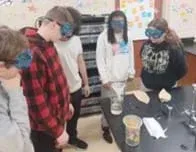 Students evaluating whether their concoction is going to break down the toilet paper.Copyright Kyan Spencer, November 2024
Day 2:
- Optional: Each day, practice the Kichwa language with the students by teaching them to say “Alli punja; alli toutamanda” (AH-lee POON-ja; AH-lee TOOT-uh-MAN-duh), which is “Good morning,” or “Alli chishi” (AH-lee CHEE-she), which is “Good afternoon.”
- Consider showing 1-2 videos from the Video List (PDF) if you have not shown them all already.
- Go over the Activity Research and Assessment Guidelines (PDF), Testing Data Tables Worksheet (PDF), Large Group Research and Share-Out Rubric (PDF), Self, Peer, and Group Evaluation Form (PDF), and Group Share-Out Rubric (PDF).
- If there’s time, review the expectations of the Large Group Research and Sharing-Out Rubric (PDF).
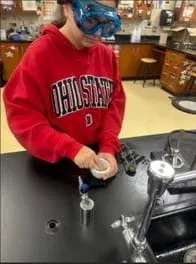 Plant parts being crushed via mortar and pestle.Copyright Kyan Spencer, November 2024
Days 3-4
- Optional: Each day, practice the Kichwa language with the students by teaching them to say “Alli punja; alli toutamanda” (AH-lee POON-ja; AH-lee TOOT-uh-MAN-duh), which is “Good morning,” or “Alli chishi” (AH-lee CHEE-she), which is “Good afternoon.”
- Consider showing 1-2 videos from the Video List (PDF) if you have not shown them all already.
- Research: Give students time to engage in group research. Refer to the research guidelines in the Activity Research and Assessment Guidelines (PDF) if needed.
- Instruct students to research: (Reminder, this is to be a short research and share-out session.)
- Two helpful facts about three different plants to which they have access.
- One way that plants are prepared when used in medicine, cleaning, for pets, or some other helpful purpose.
- Give students time to share their research findings.
- Use the Large Group Research and Sharing-Out Rubric (PDF) to assess each group.
- Hand out one Final Assessment Rubric (PDF) to each group.
- Go over the Final Assessment Rubric (PDF) with the students.
- Have students make their Ask and Research slides.
- Imagine and Plan: Give students time to create their Imagine and Plan slides.
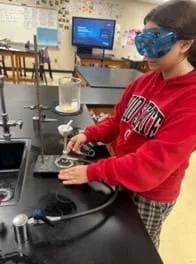 Student in a lab.Copyright Kyan Spencer, November 2024
Days 5-6:
- Optional: Each day, practice the Kichwa language with the students by teaching them to say “Alli punja; alli toutamanda” (AH-lee POON-ja; AH-lee TOOT-uh-MAN-duh), which is “Good morning,” or “Alli chishi” (AH-lee CHEE-she), which is “Good afternoon.”
- Consider showing 1-2 videos from the Video List (PDF) if you have not shown them all already.
- Have students gather activity materials.
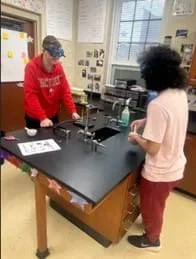 Two science students interacting.Copyright Kyan Spencer, November 2024
- Create: Have students build their designs.
- Test: Give students time to test their designs using a sample of toilet paper. Remind students to take pictures often and log their test data in the Testing Data Tables Worksheet (PDF).
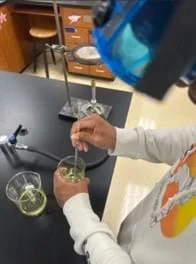 Plant contents being mixed in oil.Copyright Kyan Spencer, November 2024
- Have students make their Test slide.
Science student in the lab.Copyright Frances, November 2024
Days 7-8:
- Optional: Each day, practice the Kichwa language with the students by teaching them to say “Alli punja; alli toutamanda” (AH-lee POON-ja; AH-lee TOOT-uh-MAN-duh), which is “Good morning,” or “Alli chishi” (AH-lee CHEE-she), which is “Good afternoon.”
- Consider showing 1-2 videos from the Video List (PDF) if you have not shown them all already.
- Give each group two packs of different colored sticky notes.
- Tell students that, as a group, they will write a compliment (one color) and a helpful idea (another color) for each group as each group shares.
- Have each group share out using their Test slide (or all the slides they have made so far). Remind them the goal is for everyone to help everyone so that everyone moves forward.
- Allow time for the groups to write on the sticky notes and to give them to you after each presentation.
Days 9-11:
- Optional: Each day, practice the Kichwa language with the students by teaching them to say “Alli punja; alli toutamanda” (AH-lee POON-ja; AH-lee TOOT-uh-MAN-duh), which is “Good morning,” or “Alli chishi” (AH-lee CHEE-she), which is “Good afternoon.”
- Consider showing 1-2 videos from the Video List (PDF) if you have not shown them all already.
- Improve: Have the groups meet again to decide on their redesign plan and complete their Improve slide.
- Have the students retest using another sample of toilet paper, taking pictures and logging their retest data in the Testing Data Tables Worksheet (PDF).
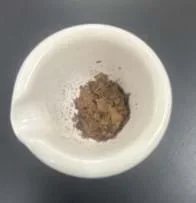 Mortar with crushed up, dried leaves.Copyright Kyan Spencer, November 2024
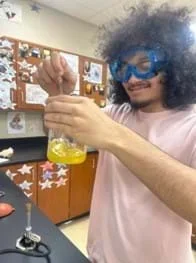 Science student in the lab.Copyright Kyan Spencer, November 2024
- Have the students complete the Retest slide.
- Have students share out again using their Improve and Retest slides.
- Have students complete the Self, Peer, and Group Evaluation Form (PDF).
- biodiversity
- The variety of living things in a particular area, including plants and animals.
- plant identification
- The process of recognizing and naming a plant based on features such as leaves or flowers.
- medicinal plant
- A plant used to treat illness or improve health, often based on traditional practices.
- hypothesis
- An educated guess or prediction that can be tested through experiments.
- engineering design process
- A series of steps used to solve problems: Ask, Imagine, Plan, Create, Test, Improve.
- funnel
- A tool used to guide liquids or materials into containers with small openings.
- prototype
- A first version or model of something built to test an idea.
- redesign
- Making changes to improve a design based on testing and feedback.
- evaluation
- The process of reviewing and judging based on specific criteria or goals.
- cultural knowledge
- Understanding passed down through generations about traditions and ways of living.
Pre-Activity Assessment
Guess the Activity: Students discuss activity ideas based on the materials in the Introduction Worksheet (PDF) and their research on plants.
Activity Embedded (Formative) Assessment
Share-Outs: The students will complete a total of 6 slides and three share-outs (mini presentations), split into embedded (formative) assessments and post-activity (summative) assessments.
Post-Activity (Summative) Assessment
Mini Presentation: Students will complete a total of 6 slides and three share-outs (mini presentations), split into embedded (formative) assessments and post-activity (summative) assessments.
Follow lab safety procedures during the activity.
Each group will need a small amount of toilet paper and about 8 sticky notes each of two different colors (for giving feedback during the presentation), costing less than $1 per group. A standard high school chemistry class will have all the other needed supplies.
Additional notes:
- Ensure that you have enough of the same sized funnels to give one to each group.
- A Bunsen burner can be used instead of a tea kettle.
For lower grades: Time and difficulty can be removed by having just having students:
- Do the Intro Activity, research, and plan steps in pairs or small groups.
- Test in the “clogged toilet” (a funnel with toilet paper stuffed in it).
- Share out.
- Meet with their team to come up with a new plan.
- Skip the Retest step.
This version takes out the creation of the slides, the group feedback sessions, and the presentations.
Contributors
Marjorie Langston; Justin Stout; Vilo Westwood; Chavin Lewis
Supporting Program
Global STEM Research Experience for Teachers (RET) — Appropriate Technology for Developing Communities at Central State University and the University of Dayton
Acknowledgements
This curriculum was developed under National Science Foundation RET EEC grant number: #1855231/1855239 as part of the Global STEM Research Experience for Teachers (RET) — Appropriate Technology for Developing Communities at Central State University and the University of Dayton. Any opinions, findings, and conclusions or recommendations expressed in this material are those of the authors and do not necessarily reflect the views of the National Science Foundation.
We would like to thank the following for their assistance on this work: Margaret Pinnell, Ph.D., Principal Investigator; Leanne Petry, Ph.D., Principal Investigator; Kelly Bohrer; Marjorie Langston; Douglas Picard; Sakthi Kumaran Subburayalu, Ph.D; Marcus Nagle, Ph.D.; KrishnaKumar Nedunuri, Ph.D.; Rydge Mulford, Ph.D.; Denise Taylor, Ph.D.; Sarah McKnight, Ph.D.; and Rajeev Swami, Ph.D. In addition, we would like to thank the Kichwa people of Yambiro, Otavalo, Ecuador with special thanks to Doña Virgiñia, Doña Elena, Doña Rosa, Doña Marta, Doña Concepcíon, and their families. Finally, we would like to thank Anna Taft, Hope Taft, Shelley Kawamura Gaetan Moussa, Omar Flores, Kuri Moreta, and other associates of the Tandana Foundation.
Copyright
2025 by Regents of the University of Colorado; original © 2024 Central State University and University of Dayton