
Zooming In and Out with Scale and Systems Thinking
Student teams act as engineers and learn about systems thinking and scale by reassembling the separated pages of the engaging picture book, “Zoom,” by Istvan Banyai. The book is a series of 31 wordless pictures that start very close-up and then zoom out—from a rooster’s comb to outer space. Like a movie camera, each subsequent page pulls back to reveal the context of the previous scene as something different than what you originally thought. When the 31 un-numbered pages are jumbled, it is a surprising challenge for teams to figure out how the pictures connect. The task prompts students to pause and look closer so as to adjust to new points of view and problem solve to find a logical sequence. It requires them to step back and take a broader view. Students learn that engineers work together as teams and look at things very closely so that they see different things and come up with more than one solution when problem solving. To conclude, students go outside and practice their skills by imagining and then drawing their own Zoom-like small booklet stories inspired by items found in nature. The classic duck/rabbit ambiguous drawing is provided as a kickoff visual aid.
 The cover of a student’s Zoom booklet.Copyright 2017 Ashley Whitehead, MRET Program, College of Engineering, University of Florida
Engineers and scientists often work across widely varying scales—for example, using microscopes to look at individual biological cells and telescopes to look at planets and stars. For very young students, this introductory activity launches a new way to look at objects and solve problems. Students act as engineers by paying attention to details, gaining new perspectives, and realizing that many solutions exist to solving problems. They come to understand that working in a team can help solve a problem—just as engineering teams work together to solve problems. As they solve the logical ordering of the book pages, from micro to macro, they experience the seed of systems thinking—that everything is a part of something else.
After this activity, students should be able to:
- Collaborate by working together as a team to solve a problem.
- Pay attention to the details found in numerous illustrations so as to be able to put a series of images into a logical order.
- Use their five senses to observe the natural world around them.
- Practice “scale” and changing perspectives by creating their own Zoom-like booklets inspired by an item found in nature.
- Explain relative sizes—big and small—laying the foundation to be able to develop an understanding of the nanoscale in later grades.
- Express the idea at the core of systems thinking—that everything is a part of something else.
- Express the idea at the core of perspective—that people see things differently from each other.
- CCSS.Math.Content.2.MD.A.1 Measure the length of an object by selecting and using appropriate tools such as rulers, yardsticks, meter sticks, and measuring tapes.
Grade 2
Do you agree with this alignment? - CCSS.Math.Practice.MP1 Make sense of problems and persevere in solving them.
Grades K-12
Do you agree with this alignment? - CCSS.Math.Practice.MP6 Attend to precision.
Grades K-12
Do you agree with this alignment?
- MAFS.2.MD.1.1 Measure the length of an object to the nearest inch, foot, centimeter, or meter by selecting and using appropriate tools such as rulers, yardsticks, meter sticks, and measuring tapes.
Grade 2
Do you agree with this alignment? - MAFS.K12.MP.1.1 Make sense of problems and persevere in solving them.
Grades K-12
Do you agree with this alignment? - MAFS.K12.MP.6.1 Attend to precision.
Grades K-12
Do you agree with this alignment?
- SC.1.N.1.1 Raise questions about the natural world, investigate them in teams through free exploration, and generate appropriate explanations based on those explorations.
Grade 1
Do you agree with this alignment? - SC.K.N.1.1 Collaborate with a partner to collect information.
Grade 0
Do you agree with this alignment?
- Students will develop an understanding of the role of troubleshooting, research and development, invention and innovation, and experimentation in problem solving.
Grades K-12
Do you agree with this alignment?
- CCC.4.K-2.1 Systems in the natural and designed world have parts that work together.
Grade 0
Do you agree with this alignment? - SEP.2.K-2.2 Ask questions based on observations to find more information about the natural and/or designed world(s).
Grades K-2
Do you agree with this alignment?
To share with the class:
- several copies of the 31-page picture book, Zoom, by Istvan Banyai, one per group; the number of available books determines the number of teams; take each book apart for the activity; keep one intact book as an answer key; paperback for $8 at Amazon;
- (optional) access to a laminator machine and laminating sheets, to laminate the Zoom book pages so as to better withstand handling by students
- Duck/Rabbit Visual Aid (PDF), one printout to show the class; same as Figure 1; also available at https://commons.wikimedia.org/wiki/File:Duck-Rabbit_illusion.jpg
- small blank paper booklets, one per student; each made by the teacher in advance from one to three 4 x 4-inch (~10 x 10-cm) squares of paper folded and stapled in the fold (see Figure 2); provide more pages for higher grades; see instructions in the Procedure section
- pencils, colored pencils or crayons
- measuring tools, such as unifix cubes for younger students and rulers for older students

A basic understanding of how to measure length using a ruler or unifix cubes.
Have you ever seen a picture hiding in the clouds, wallpaper or trees? Maybe you have done this with a friend or family member, but only you could see it. Would you like to share your experience with this? How did this make you feel? (Listen to some student stories.)
I am going to show you a picture. I want you to think about what you see but keep it a secret until I tell you to share with your shoulder partner at the table.
(Show the class a printout of the Duck/Rabbit Visual Aid (PDF) [same as Figure 1]. Then give students some time to share what they see.)
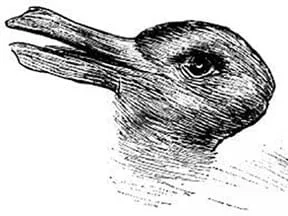 Figure 1. The classic duck/rabbit ambiguous image.Copyright 1892 Fliegende Blätter (German humor magazine), Wikimedia Commons (public domain) https://commons.wikimedia.org/wiki/File:Kaninchen_und_Ente.png
That is so interesting! Some of you saw a duck first and then a rabbit, while some of you saw a rabbit first and then a duck! Why do you think that is? (Listen to student ideas.)
Just like we are doing in our classroom today, engineers and scientists look at things very closely, and because of that, they see different things from each other and discover more than one solution to problems. They must work together as a team to find good solutions to problems. Today you will act as if you are engineers who are solving a problem.
I have a book with all of its pages removed and separated. It has no page numbers or words—just pictures. I need your help to put the book back together.
You will be assigned to a team with the job to work together to put the pages of the book into the correct order. This task requires you to collaborate (work together!), think out loud, and use your brain. The title of the book is Zoom. Also, as you work together to organize the book, think about why the book has that title.
Background
Systems are a natural part of our world. Our bodies, social media, food chains and the planet are all examples of systems. A system is a whole composed of interconnected parts. A system is organized and constantly changing. Systems thinking is seeing the web of relationships among the parts that make up the whole. When part of the system changes, how does it affect the whole?
In this activity, systems thinking is practiced among student teams as they come to realize that parts of the images on the various book pages are interconnected. Not having part of the book changes how you perceive the order of the book.
Scale has many meanings. In this activity, scale refers to size and spatial reasoning.
See the Additional Multimedia Support section for recommended resources on the duck-rabbit optical illusion, online Zoom pages, systems thinking, the benefits of teaching outside, and sketching/scaling.
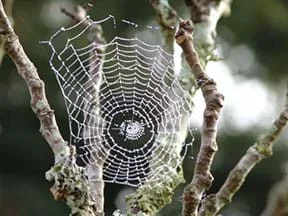 A spider’s web is one example of a living system. What happens in one part of the web affects the other parts of the web.Copyright Chico Antonio Tiago Eduardo, FreeImages.com https://www.freeimages.com/photo/spider-web-and-dew-drops-1512687
Before the Activity
- Purchase (or make) several copies of the book, “Zoom,” by Istvan Banyai, ideally one entire book per group of four or five students. Cut apart and laminate (if possible) the pages of each book. Leave one book intact as an answer key.
- Create a supply of small blank booklets, one per student. For example, make a booklet with a cover and seven (back-to-back) pages by using two 4 x 4 pieces of paper that are folded and stapled (see Figure 2). In general, make the booklets with 6-10 pages each, but feel free to adjust the number of booklet pages to your students’ age and abilities, perhaps 3-5 pages for kindergarteners and 7-9 pages for second graders, and whether you want them to use back-to-back pages or just the right-side pages.
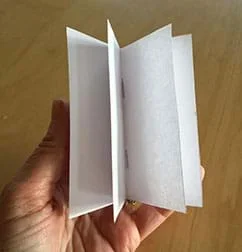 Figure 2. An example small blank booklet prepared in advance by the teacher for students to make their own Zoom books. This one has a cover page and seven back-to-back pages.Copyright 2018 Denise W. Carlson, ITL Program, College of Engineering and Applied Science, University of Colorado Boulder
- Print out one copy of the Duck/Rabbit Visual Aid (PDF) to show the class.
- Review the Teacher’s Zoom Booklet Grading Rubric (PDF) to be prepared to share your expectations with students.
- Decide in advance how to organize the class into teams of four or five students each so as to balance their personalities and social styles to achieve participation by all team members.
With the Students
- Conduct the pre-activity assessment discussion with the class, as described in the Assessment section.
- Present the Introduction/Motivation section content to the class to introduce key concepts and the challenge.
- Divide the class into groups and hand out the materials. Explain to the class that the challenge is to work within their teams to put the contents of a picture book in order.
- Direct students to start working together to solve the problem.
- Expect students to struggle a bit and then realize that there might be more than one way to organize the story! Similar to how some of them saw a duck before a rabbit in the drawing—they will all have different (and evolving) views on the organization of the book.
- During this process, you may want to guide them with prompts such as, “Is that image on another page of the book?” Doing this helps students see that one image is zoomed in and the other is zoomed out and they are related to one another—part of a system.
- Expect the teams to be engaged in discussion and students to be sharing their reasoning with team members.
- As you walk around, ask questions to help motivate and guide any students in need: “How are these pictures related?” “Do you see a pattern?”
- Offer praise for observed engagement and teamwork. Note any behavior and communication that sounds like real engineers working together.
- Show students the intact Zoom book (answer key) and model “think-aloud” to explain any observations they notice on the pages. Ask:
- How is this book like yours? How is it different?
- Does it make more sense to you now?
- How did you feel working in a team instead of by yourself?
- Display teams’ assembled book pages in designated locations in the classroom. Then, group by group, ask students to explain their thinking on why they put the pages in the order they chose. Encourage the listening students to ask questions to fully understand the presenting team’s reasoning. It may help to scaffold to aid students in providing explanations. Suggested prompts:
- Why did you put this picture with this one?
- What was your method for organizing these?
- What did you find challenging?
- Explain to the class that another word for zoom is scale. Tell them that they will get to practice the concept of scale by making their very own Zoom booklets. Engineers make observations from many angles and perspectives and they document the details of what they notice in their journals.
- Take the students outside and direct them to each find one item that is special to them. When they have found that item, have them sit next to it.
- Hand out to each student a small blank booklet, pencil, and ruler/unifix cubes. Tell the students: Use these booklets as your journals. Just like the Zoom book, on each page draw your special object so that on each next page it is more and more zoomed out. That means that your object will look different on each page because of scale.
- If desired (for older students), refer to the grading rubric (PDF) and read the “advanced” column for the criteria so students have some idea of what is expected of them for this work.
- Model for the class what that their journals might look like by using a classroom object. Model how to measure the length of the item using a ruler (or unifix cubes). Ask if they have any questions.
- Tell the students: Start by getting very close to your special item and zooming in on it. Draw what you see. Then, slowly zoom out and draw on the next page how the item looks from some distance away.
- Tell the students: Next, zoom out even farther. Imagine a bird is flying over the item. What would the bird see? The item would look different, wouldn’t it? It will get smaller on each page (and maybe even disappear from view) and you will imagine more items to draw as you scale or zoom out. Keep stepping back and taking a broader view.
- Give students about 15 minutes to think through the project on their own and draw quietly. As necessary, assist with measuring the objects.
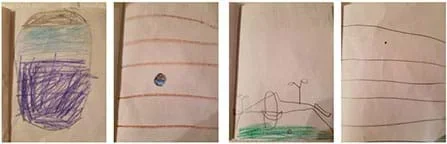 Four pages of a kindergartener’s hand-drawn Zoom book, inspired by a shell.Copyright 2017 Ashley Whitehead, MRET Program, College of Engineering, University of Florida
- To conclude, with the class sitting in a circle, preferably outside, lead a discussion session that gives time for students to share their journals with the rest of the class.
- scale
- To describe or observe an item’s size by shrinking or expanding distances. In this activity, scale involves relative size and spatial reasoning.
- system
- A grouping of interacting things or parts that form a complex, unified whole. Systems help us relearn instinctive mental models about the world. The parts of a system are interrelated and ever-changing.
- systems thinking
- Seeing how things are connected or how things can affect and build on one another. Recognizing how the components of a system are interconnected and part of a dynamic “bigger picture,” as part of defining problems and finding good solutions.
Pre-Activity Assessment
Teamwork Discussion: Lead a casual class discussion with students by using the following prompt. See if students realize how a mix of people help a team come up with more and different ideas and perspectives when problem solving.
- Why do engineers and scientists work together to solve problems?
Activity Embedded Assessment
Zoom Booklets: Write the following questions on the classroom board. After students have finished their Zoom booklets, have them share with another student who has finished his/her booklet their answers and reflections to the questions. Walk around as students discuss amongst themselves.
- Why is it important to look at things closely AND from afar?
- How does your item connect to something?
- How did the length of your item change as you scaled out? Walk around as students discuss.
Post-Activity Assessment
Book Share: Have students share their books with the rest of the class as practice in presenting their work to others. Use the Teachers’s Zoom Booklet Grading Rubric (PDF) to evaluate individual student booklets to gauge student engagement, effort and depth of comprehension.
It is helpful if students have had previous experience learning outdoors. If you have never taken this class outside, considering conducting a separate activity on how to learn outdoors. Refer to tips in the Why Teach Outside? Project Learning Tree link in the Additional Multimedia Support section. Even though this activity could be conducted inside, it is more impactful and meaningful if students can see for themselves how expansive the sky is, and engage all their senses in creating their own visual zoom stories.
Read Mysterious Patterns: Finding Fractals in Nature to students to learn about fractals and encourage them to notice these patterns in nature. Includes a recipe on how to make one, and a real-life story about a boy who dreamed of them.
Have students play Snap!—an interlocking game of strategy. Students try to build the longest dragon, requiring them to look closely at parts and colors.
Read Snowflake Bentley to students, a biography of how one boy’s wonder and passion about the details of snow led to a wonderful discovery—the first photographs of snowflakes.
- For older grades, have students draw detailed drawings to scale and take additional measurements.
- For older grades, have students draw detailed drawings on individual sheets of paper and write the page number on the back of each sheet. Then have them paperclip together their booklets out of order and switch with a partner to see if they can put each book in the correct order.
- For older grades, have students write detailed sentences on each page in their books to show how their chosen items are connected to other things in nature.
A clever video version of the age-old optical illusion: Is it a duck or a rabbit? Duck! Rabbit! by Amy Krouse Rosenthal (1:10-minute video) https://www.youtube.com/watch?v=hPCoe-6RRks
Zoom—An Awesome Book Initiative by Ryan Eller at Paradigm Shift (see images of the book pages; tips about using the book as an activity for all ages) at https://experientialadventure.wordpress.com/2011/02/22/zoom-an-awesome-book-intiative/
What is systems thinking? What are the habits of a systems thinker? Tools, strategies, FAQs and benefits by the Waters Foundation at https://www.watersfoundation.org/systems-thinking-tools-and-strategies/what-is-systems-thinking/
To learn more about systems, living systems, and systems thinking, see Thinking About Systems at http://lindaboothsweeney.net/, including 12 Habits of Mind at http://www.lindaboothsweeney.net/thinking/habits
Systems Literacy by PBS Learning Media, including teaching about systems, at https://florida.pbslearningmedia.org/collection/systemsliteracy/#.WwNF80gvzb1
Why teach outside? by Project Learning Tree at https://www.plt.org/educator-tips/why-teach-outside/
More about sketching and scaling with young students. In this hands-on activity, Build an Approximate Scale Model of an Object, students sketch and create models of objects of their choice, giving them skills and practice in techniques used by professionals.
Banyai, Istvan. Zoom. Penguin Young Readers Group, 1998.
Dawn, Randee. “Rabbit or duck? This 124-year-old drawing has both if you can spot them.” Published February 15, 2016. TODAY. Accessed October 14, 2017. https://www.today.com/pets/rabbit-or-duck-124-year-old-drawing-has-both-if-t73606
Sweeny. Linda Booth. Thinking About Systems. 2017. Accessed October 14, 2017. http://lindaboothsweeney.net
Systems Literacy. Systems Literacy Collection, PBS & WGBH Educational Foundation, PBS Learning Media. 2017. Accessed October 19, 2017. https://florida.pbslearningmedia.org/collection/systemsliteracy/#.WeqoUFK-JsN
Systems Thinking in Education. 2017. Waters Foundation. Accessed October 14, 2017. http://watersfoundation.org
Why Teach Outside? 2017. Project Learning Tree: PLT Sustainable Forestry Initiative, Inc. Accessed October 14, 2017. https://www.plt.org/educator-tips/why-teach-outside/
Contributors
Ashley Whitehead
Supporting Program
MRET Program, College of Engineering, University of Florida
Acknowledgements
This curriculum was based upon work supported by the National Science Foundation under RET grant no. EEC 1711543— Engineering for Biology: Multidisciplinary Research Experiences for Teachers in Elementary Grades (MRET) through the College of Engineering at the University of Florida. Any opinions, findings, and conclusions or recommendations expressed in this material are those of the authors and do not necessarily reflect the views of the National Science Foundation.
Copyright
2018 by Regents of the University of Colorado; original © 2017 University of Florida