
Sea Turtle Eggs: Washed to Sea?
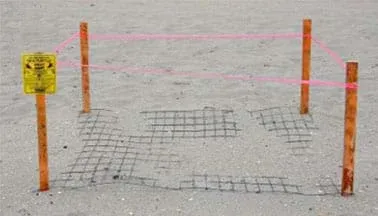 An example of a protected sea turtle nesting bed.Copyright 2009 Ianaré Sévi, CC-BY-SA 3.0, Wikimedia Commons https://commons.wikimedia.org/wiki/File:Protected_Sea_Turtle_Nest_(Boca_Raton_FL).jpg
Students employ the full engineering design process to research and design prototypes that could be used to solve the loss of sea turtle life during a hurricane. During Hurricane Irma, Florida lost a large proportion of its sea turtle nests. Protecting these nests from natural disasters or even human influence is an essential component of conservation in Florida, since only one hatchling in every thousand survives to adulthood. In this activity, students learn about sea turtle nesting behaviors and environmental impacts of hurricanes. Students work collaboratively to build structures that could protect a single sea turtle nest, or an entire beach, in the event of a hurricane or other similar weather disaster. Then, students present their solutions to concerned stakeholders. As an optional extension, students can build prototypes using 3D printers or 3D pens.
In this activity, students work as engineers to design solutions to protect endangered sea turtles. Ecological engineers focus on the design and restoration of natural ecosystems for societal and environmental benefits. Just like engineers, students design and build prototypes. As engineers, the students must consider the impacts of every design, including cost and practical limitations, as well as potential environmental consequences.
After this activity, students should be able to:
- Explain environmental impacts of hurricanes.
- Explain how engineering design process.
- Design a structure that helps protect sea turtle nests.
- Communicate research results to the class.
- CCSS.ELA-Literacy.SL.5.4 Report on a topic or text or present an opinion, sequencing ideas logically and using appropriate facts and relevant, descriptive details to support main ideas or themes; speak clearly at an understandable pace.
Grade 5
Do you agree with this alignment?
- SC.3.N.1.1 Raise questions about the natural world, investigate them individually and in teams through free exploration and systematic investigations, and generate appropriate explanations based on those explorations.
Grade 3
Do you agree with this alignment?
- SC.35.CS-CS.1.4 Create a simple model of a system (e.g., flower or solar system) and explain what the model shows and does not show.
Grades 3-5
Do you agree with this alignment?
- Students will develop an understanding of the attributes of design.
Grades K-12
Do you agree with this alignment? - Students will develop an understanding of engineering design.
Grades K-12
Do you agree with this alignment? - Students will develop an understanding of the role of troubleshooting, research and development, invention and innovation, and experimentation in problem solving.
Grades K-12
Do you agree with this alignment? - Students will develop abilities to apply the design process.
Grades K-12
Do you agree with this alignment? - Students will develop abilities to assess the impact of products and systems.
Grades K-12
Do you agree with this alignment? - STEL-7I Apply the technology and engineering design process.
Grades 3-5
Do you agree with this alignment? - STEL-7J Evaluate designs based on criteria, constraints, and standards.
Grades 3-5
Do you agree with this alignment?
- 3-5-ETS1-1 Define a simple design problem reflecting a need or a want that includes specified criteria for success and constraints on materials, time, or cost.
Grades 3-5
This resource focuses on the following Three Dimensional Learning aspects of NGSS:
Science & Engineering Practices- Define a simple design problem that can be solved through the development of an object, tool, process, or system and includes several criteria for success and constraints on materials, time, or cost.Do you agree with this alignment?
Disciplinary Core Ideas- Possible solutions to a problem are limited by available materials and resources (constraints). The success of a designed solution is determined by considering the desired features of a solution (criteria). Different proposals for solutions can be compared on the basis of how well each one meets the specified criteria for success or how well each takes the constraints into account.Do you agree with this alignment?
Crosscutting Concepts- People's needs and wants change over time, as do their demands for new and improved technologies.Do you agree with this alignment?
Do you agree with this alignment? - Define a simple design problem that can be solved through the development of an object, tool, process, or system and includes several criteria for success and constraints on materials, time, or cost.
- 3-5-ETS1-2 Generate and compare multiple possible solutions to a problem based on how well each is likely to meet the criteria and constraints of the problem.
Grades 3-5
This resource focuses on the following Three Dimensional Learning aspects of NGSS:
Science & Engineering Practices- Generate and compare multiple solutions to a problem based on how well they meet the criteria and constraints of the design problem.Do you agree with this alignment?
Disciplinary Core Ideas- Research on a problem should be carried out before beginning to design a solution. Testing a solution involves investigating how well it performs under a range of likely conditions.Do you agree with this alignment?
- At whatever stage, communicating with peers about proposed solutions is an important part of the design process, and shared ideas can lead to improved designs.Do you agree with this alignment?
Crosscutting Concepts- Engineers improve existing technologies or develop new ones to increase their benefits, to decrease known risks, and to meet societal demands.Do you agree with this alignment?
Do you agree with this alignment? - Generate and compare multiple solutions to a problem based on how well they meet the criteria and constraints of the design problem.
- 3-5-ETS1-3 Plan and carry out fair tests in which variables are controlled and failure points are considered to identify aspects of a model or prototype that can be improved.
Grades 3-5
This resource focuses on the following Three Dimensional Learning aspects of NGSS:
Science & Engineering Practices- Plan and conduct an investigation collaboratively to produce data to serve as the basis for evidence, using fair tests in which variables are controlled and the number of trials considered.Do you agree with this alignment?
Disciplinary Core Ideas- Tests are often designed to identify failure points or difficulties, which suggest the elements of the design that need to be improved.Do you agree with this alignment?
- Different solutions need to be tested in order to determine which of them best solves the problem, given the criteria and the constraints.Do you agree with this alignment?
Do you agree with this alignment? - Plan and conduct an investigation collaboratively to produce data to serve as the basis for evidence, using fair tests in which variables are controlled and the number of trials considered.
- 3-ESS3-1 Make a claim about the merit of a design solution that reduces the impacts of a weather-related hazard.
Grade 3
This resource focuses on the following Three Dimensional Learning aspects of NGSS:
Science & Engineering Practices- Make a claim about the merit of a solution to a problem by citing relevant evidence about how it meets the criteria and constraints of the problem.Do you agree with this alignment?
Disciplinary Core Ideas- A variety of natural hazards result from natural processes. Humans cannot eliminate natural hazards but can take steps to reduce their impacts.Do you agree with this alignment?
Crosscutting Concepts- Cause and effect relationships are routinely identified, tested, and used to explain change.Do you agree with this alignment?
- Engineers improve existing technologies or develop new ones to increase their benefits (e.g., better artificial limbs), decrease known risks (e.g., seatbelts in cars), and meet societal demands (e.g., cell phones).Do you agree with this alignment?
- Science affects everyday life.Do you agree with this alignment?
Do you agree with this alignment? - Make a claim about the merit of a solution to a problem by citing relevant evidence about how it meets the criteria and constraints of the problem.
- 3-LS4-4 Make a claim about the merit of a solution to a problem caused when the environment changes and the types of plants and animals that live there may change.
Grade 3
This resource focuses on the following Three Dimensional Learning aspects of NGSS:
Science & Engineering Practices- Make a claim about the merit of a solution to a problem by citing relevant evidence about how it meets the criteria and constraints of the problem.Do you agree with this alignment?
Disciplinary Core Ideas- When the environment changes in ways that affect a place's physical characteristics, temperature, or availability of resources, some organisms survive and reproduce, others move to new locations, yet others move into the transformed environment, and some die.Do you agree with this alignment?
- Populations live in a variety of habitats, and change in those habitats affects the organisms living there.Do you agree with this alignment?
Crosscutting Concepts- A system can be described in terms of its components and their interactions.Do you agree with this alignment?
Do you agree with this alignment? - Make a claim about the merit of a solution to a problem by citing relevant evidence about how it meets the criteria and constraints of the problem.
Teacher will need:
- sheet of chart paper
- copies of the following books (check availability at your school or local library or through Amazon):
- One Tiny Turtle by Nicola Davies
- Sea Turtle Scientist by Steve Swinburne
- Follow the Moon Home by Phillipe Cousteau
- sticky notes
- copies of attachments, as needed
- "hurricane simulator” materials such as a fan, access to a faucet, watering can and/or bucket, etc.
Each student needs:
- pencil
- science or lab notebook (optional)
- copies of attachments, as needed
Each group needs:
- computer access (laptop or desktop computer)
- Sea Turtle Design Rubric (PDF)
- Stakeholder Proposal Rubric (PDF)
- recyclable materials such as cardboard, paper, toilet paper tubes, aluminum foil, or plastic bottles; a variety of materials allows students to flex their creativity
- For testing, either:
- 1-2 cups of sand
- 8-10 ping-pong balls
OPTIONAL: To share with the entire class:
- 3D printer; 3D pen, available online
- Hurricane Irma News Article (pdf)
- Sea Turtle Read-Aloud Discussion Questions (docx)
- Sea Turtle Read-Aloud Discussion Questions (pdf)
- Design in Different Views (docx)
- Design in Different Views (pdf)
- Final Design Selection (docx)
- Final Design Selection (pdf)
- Stakeholder Proposal Rubric (docx)
- Stakeholder Proposal Rubric (pdf)
- Sea Turtle Design Rubric (docx)
- Sea Turtle Design Rubric (pdf)
- 3D Pen Practice (docx)
- 3D Pen Practice (pdf)
- Testing Reflections (docx)
- Testing Reflections (pdf)
If using a 3D printer, students should have a basic knowledge of Tinkercad or another simple software program that can be used to design 3D objects. If using a 3D pen, students should know the basics of how to operate the device.
Hurricanes cause high winds, lots of rain, and large waves. Have you heard of or even experienced a hurricane that happened recently or in the past? (Let students share their experiences. If students are struggling, mention hurricanes they may have heard of such as Hurricane Katrina in 2005, or Hurricane Harvey in 2017.) What kinds of damage did those hurricanes cause for people? (Expect students to talk about flooding, damage to houses, evacuations, etc.) Hurricanes can be harmful to animals, too. How do you think hurricanes can hurt animals? (Let students discuss ideas. They may mention pets being left homeless, habitats being damaged by flooding or winds, etc.)
One animal that scientists are concerned about during hurricanes is sea turtles. Some species of sea turtles are a threatened species while others are endangered, meaning that there are so few of them left that they likely to become extinct without intervention. But we can help by protecting sea turtle eggs. Since only 1 in 1000 sea turtle hatchlings live to adulthood, it is very important to protect them. Conservationists, or people who protect wildlife, protect eggs by marking and watching them to stop people and animals from harming the eggs.
During a hurricane, sea turtle nests are exposed to high winds and waves that can harm them—and that is where you come in. Today, you are going to play the role of ecological engineers and design a structure that can protect sea turtle eggs during a hurricane. You can build a structure to protect a single nest, a group of nests, or an entire beach! We will follow the engineering design process that engineers use to develop solutions to problems. Now, are you ready to solve the problem of sea turtle nests getting damaged during hurricanes? Let’s get started!
Background
Hurricanes can create high winds that defoliate trees and large waves that erode beaches and damage coral reefs. These environmental effects impact animal life near the coast. For example, environmental effects could disturb sea turtle nests, which may lose a large proportion of eggs due to flooding and beach erosion.
Sea turtles are a threatened species. Their population faces threats including commercial development of coastal nesting areas, coastal erosion, egg poaching, and hazards from commercial fishing, boats, and human debris. Since survival rates are so low, the loss of eggs due to a hurricane storm surge can have a large impact on the species. As a result, flooding and damage can occur. Sea turtle nests can be inundated when water floods the nests, which causes hatchlings to drown, or they can be covered with sand causing hatchlings to suffocate. Additional damage that alters the shoreline topography can prevent hatchlings from reaching the ocean.
Relocation of turtle nests from the beach is not an ideal solution because sea turtles are conditioned to select the best location for their eggs. Sea turtle eggs are sensitive to temperature, and they may lay their eggs in a particular way to maximize egg survival. Current conservation efforts include marking nests to prevent humans from disturbing the nests, covering nests with a wire net to deter predators, monitoring nests near hatching time, and installing tarps around nests to prevent light pollution and deter predators.
The Alabama Sea Turtle Conservation Manual may be of interest for students. It explains how volunteers take data on sea turtle nests, how they know that a nest is present, how they can “read” sea turtle flipper marks to determine movement, and guidelines for moving or relocating sea turtle nests. Students may also be interested in this video from Share the Beach, a part of Alabama’s Sea Turtle Conservation Program, titled “Excavation of a Sea Turtle Nest - Gulf State Park.” on excavating a sea turtle nest, where volunteers examine a nest that turtles have already hatched from to determine the number of eggs that hatched.
Additive manufacturing (such as 3D printing) is a way to create custom solutions to problems. In contrast to traditional (subtractive) manufacturing such as drilling and milling, 3D printing offers greater customization and less waste of resources. While the technology is still being developed, 3D printing offers many opportunities for novel designs, rapid prototyping, and problem-solving. The use of additive manufacturing is optional in this activity, but can be an extension that helps students understand the value of additive manufacturing as it relates to solving a problem on a large scale. 3D printing has been used to create fake eggs that can be tracked to catch egg poachers. Students can learn more about this connection between engineering and sea turtle conservation through this video from PBS titled, “Cracking down on poaching with 3D-printed fake turtle eggs.” Future engineers may use 3D printing to help sea turtles through the fast development of new prototypes for protective structures for nests.
Before the Activity
Students will (ideally) record all of their information and planning into a science notebook. Alternatively, collect information at a group or class level and display it in the room. For example, students can record notes or reflections on sticky notes, which can then be affixed to chart paper and displayed in the room.
A few days before beginning the activity, start collecting recyclable materials such as cardboard, paper, toilet paper tubes, aluminum foil, or plastic bottles. You may also ask students to collect recyclable materials from home and have them bring them in on Day 1 of the activity.
Day 1: Effect of Hurricanes on Sea Turtle Nests
Before the Activity
- Print copies of the Engineering Design Process (PDF) from TeachEngineering and distribute them to each group. You may also display it prominently in the classroom and refer to it at the start of each day.
- Have the books One Tiny Turtle by Nicola Davies and Sea Turtle Scientist by Steve Swinburne on hand, if available, or a different book that describes sea turtle nesting and hatching behaviors. The Sea Turtle Read-Aloud Discussion Questions (PDF) has discussion questions that pair with these books.
- Optional extension: Print articles for students to read; collect other resources about sea turtles and hurricanes from the library or internet, if desired. Suggested resources include Newsla, such as the article “Hurricane Irma nearly wiped out green turtle nests in Florida”.
- Objective: Today’s goal is for students to understand sea turtle nesting behaviors, and understand why sea turtles are an important part of our ecosystem. Students should also have a way to record or reflect on the information they gather.
With the Students
- Read One Tiny Turtle by Nicola Davies and Sea Turtle Scientist by Steve Swinburne out aloud to the students. While reading, pause and record important information about sea turtle behavior on a piece of chart paper or on the board for students to see. As an optional extension, have students take notes in a science journal, on a piece of paper, or on a sticky note.
- After completing the books, have a class discussion about the sea turtle nesting behaviors that the students heard described in the book. Use the questions provided in the Sea Turtle Read-Aloud Discussion Questions (PDF), if desired.
- Ask students to think about the effects of hurricanes on land. Students may be familiar with impacts of hurricanes on buildings and homes, but they may be unaware that hurricanes can also negatively impact ecosystems. One topic of interest for students may be the Puerto Rican parrot, which was nearly wiped out after Hurricane Hugo in 1989, or the Cozumel thrasher, which was also nearly extinct after Hurricane Gilbert in 1989.
- Describe to the students how hurricanes can negatively affect sea turtle nests. Refer to the “Background Information” section. Hand out the Hurricane Irma News Article (PDF). Read the article out loud with the students, or have them read in pairs or alone. Ask students how hurricanes negatively affect sea turtle nests. Students can record notes or reflections on the article.
- Students should be able to provide information about sea turtles and describe how hurricanes can negatively affect turtle nests. Tell the students that their goal during this activity is to design a solution that will protect sea turtle nests from hurricanes. Distribute copies of the Engineering Design Process (PDF) and review the engineering design process with the students. In this first part of the activity, the students have identified the need and researched the problem. Explain to the students that they will start developing possible solutions, planning, and building in the next few days.
Day 2: Brainstorming Solutions
Before the Activity
- Students will be brainstorming today. Based on student needs, have them brainstorm either on pieces of paper or in their science notebooks. Students should be able to brainstorm as many solutions as they can come up with, so ensure that they have enough paper to record ideas.
- Display a copy of the Sea Turtle Design Rubric (PDF) for all students to see, or print enough copies so that each student will have their own.
- Objective: By the end of today’s session, students should have brainstormed solutions that will protect a sea turtle nest in the case of a hurricane.
With the Students
- Review the parts of the Engineering Design Process that the students have done so far (such as identifying the need and constraints and researching the problem) and tell students that today, they will be developing possible solutions.
- Tell students that constraints exist in any design challenge. In this challenge, students will be limited to using recycled materials like cardboard tubes, pieces of cardboard or paper, plastic straws, plastic or glass bottles. Describe the materials that you have collected and what they will have available during the building phase of the activity. Tell students that their designs must also fit either in a pan or small tray (for single nest designs) or on a drop cloth (for multi-nest designs).
- Remind students that they are trying to develop a structure that would protect sea turtle nests from a hurricane’s impact. Students may elect to build a structure that would protect a single nest, or a larger structure that would protect a group of nests, or an entire beach. Display the Sea Turtle Design Rubric (PDF) or give each student a copy to focus their brainstorming session.
- Review brainstorming expectations with the students. For example, tell the students to try to list as many ideas as possible, to listen to each other’s ideas, and to encourage each other to come up with more ideas.
- Students will brainstorm solutions in their groups.
- Ask the students to come up with as many possible solutions as they can think of. Students will record their ideas in their science notebooks or on pieces of paper that they can keep during the activity.
- After the groups have had time to brainstorm, ask groups to share possible solutions with the class. Remind students that scientists and engineers share ideas in order to develop solutions to problems.
Day 3: Evaluating and Selecting Design
Before the Activity
- Have enough copies of the Sea Turtle Design Rubric (PDF) for each student, plus one extra per group. For example, if there are 18 students in 6 groups, print 24 rubrics.
- Ensure that students have their brainstorming session papers or their science notebook available.
- Objective: Today’s goal is for each group to select a final design.
With the Students
- Review the parts of the Engineering Design Process that the students have done so far (such as identifying the need and constraints, researching the problem, and developing possible solutions) and tell students that today, they will be planning and selecting a promising solution.
- Direct students to look back at their brainstorming session from yesterday. Tell students to select their favorite idea individually, and then produce a labeled sketch of that design with a written explanation of why it is their favorite.
- After students are finished with this step, students will get together in their groups to evaluate each design. After evaluating the designs according to the Sea Turtle Design Rubric (PDF), they will decide on a final design.
- Students may determine that one of the individual designs has all the components needed to successfully solve the problem. Alternatively, students may decide to create a new design that uses parts of each individual’s design. If students are creating a new design, they will have to produce a labeled sketch of that design with a written evaluation, and then evaluate that design with the rubric when they are finished.
Day 4: Sketching and Finalizing Design
Before the Activity
- Students will need the labeled sketch of the final design as well as the rubric that evaluated the final design.
- Each student needs a copy of the Final Design Selection (PDF) and Design in Different Views (PDF) attachments.
- At this point in the activity, help students visualize what their prototype is trying to protect by distributing sand and mini ping pong balls.
- Objective: Today’s goal is for each group to have a final design that is ready to be built. Students also will plan how they will test their design.
With the Students
- Students need to complete the Final Design Selection (PDF) worksheet. Students should also sketch their final designs from different angles using the Designs in Different Views (PDF) worksheet.
- Students also need to think about how they will test their designs. Ultimately, students should understand that designs need to be tested with both wind and water. It is up to the teacher to decide whether to explicitly tell the students to use a faucet, watering can, or bucket of water and a fan to simulate hurricane conditions, or whether to allow students more freedom and creativity in developing a “hurricane simulator.”
Day 5: Discussing Importance of Prototypes and Building Prototypes
Before the Activity
- Make sure that students have their final design sketches and design rubrics.
- Set out the recyclable materials that the students will use to create their first prototype.
- The teacher may also want to provide the “turtle nest” (ping pong balls and sand) so that students remain focused on the goal of protecting a sea turtle nest.
- Prepare to show some videos on clay car prototypes, like Inside Ford’s Clay Modeling Studio or BMW Clay Modeling.
- Optional extension: Collect videos, books, or pictures that depict prototypes in preparation for today’s discussion. For example, the book The Story of the Statue of Liberty by Betsy and Giulio Maestro depicts clay prototypes of the Statue of Liberty.
With the Students
- Tell the students that before making a final product to sell or to use, engineers create prototypes, which are models of the actual product.
- Ask students why they think that it’s important for engineers to make prototypes before they make the actual product. Alternatively, tell students that a prototype is a model that engineers use to make final designs, and that iterative prototype designs lets engineers find the best possible final design. Ask students why an engineer would make a prototype first.
- Explain that prototypes are often made of different materials than the actual product.
- Show students example videos of clay car prototypes to prompt discussion.
- In their groups, students will create a first prototype a model of their chosen design using cardboard and other recyclable materials. Have groups record their name or a team name on their prototypes; collect and store the prototypes at the end of class.
Day 6: Testing
Before the Activity
- Have your “hurricane simulator” developed and ready. If the students developed the plan, ensure that those resources are available.
- Students need to have their completed designs and their “turtle nest” available for testing.
- Optional: have enough copies of the Testing Reflections (PDF) sheet available for each student. (Alternatively have students record their reflections on a piece of paper or in their science journals.)
With the Students
- Give the students their designs and access to the “hurricane simulator.”
- If desired, give the students the Testing Reflections (PDF) or have students record their reflections on a piece of paper or in their science journals.
- Students should test their designs by subjecting them to the “hurricane simulator.” Encourage students to maintain a positive attitude if their design fails, and also encourage them to try to think about ways to improve their design, even if it is successful. Prompt students to remember the rubric and keep the goal of protecting sea turtle nests in mind as they test.
- At the end of class, collect prototypes and store them in a secure location.
Day 7: Evaluation and Redesign
Before the Activity
- Students should be completely finished with their initial design and prototype and testing and ready to present their initial designs to the class. If students are not finished, provide additional time.
- Allow students access to their prototypes.
With the Students
- In groups, students present their initial designs to the class. Students should be prompted to explain their design and how they developed it and describe the results of testing their structure.
- Other groups can ask questions and offer suggestions for improvement.
- Students can discuss possible limitations of their designs with each other and develop plans for improvement or re-design.
- After presentations, students should get back into their groups to make improvements and redesign their structure. Additionally, students should begin re-testing their designs if they finish.
Day 8: Creating Proposals for Stakeholders
Before the Activity
- Give students access to their final designs.
- Have the book Follow the Moon Home by Phillippe Cousteau ready to read aloud to the class.
- Each group needs a copy of the Stakeholder Proposal Rubric (PDF).
With the Students
- Read Follow the Moon Home by Phillippe Cousteau.
- Ask students how the “concerned citizens” described in the book helped solve a problem.
- Discuss citizen activism and how it applies to their project.
- Let the students know that they will be producing a proposal to present to stakeholders.
- Stakeholders could include sea turtle biologists, local officials, or other “concerned citizens” (such as other students, teachers, or school administrators).
- Distribute copies of the Stakeholder Proposal Rubric (PDF). Tell students that proposals should include a description of the problem, how the students solved the problem, why their solution was beneficial, and a description of the costs associated with their solution.
- Students may use Microsoft PowerPoint or Google Slides to present their proposal.
- Presentation development and production may take several days, depending on the experience level of the students.
Day 9: Presenting Proposals to Stakeholders
Before the Activity
- Students should be completely finished with their proposal presentations.
- Consider inviting community members such as parents, government officials, environmental activists or groups, etc. Other teachers, students, and administrators could also benefit from listening to the students’ proposals.
With the Students
- Students will present their proposals in groups to stakeholders.
- Stakeholders can ask questions, express concerns, or give suggestions.
Optional extension: 3D pens or 3D printers
Day 10: Producing Final Prototypes
Before the Activity
- Review use of 3D printing software.
- If you are using 3D pens, have enough copies of the 3D Pen Practice (PDF) worksheet made for each student.
- Prepare troubleshooting tips and alternative activities in case of “technical difficulties.”
With the Students
- If students use a 3D printer or 3D printing pens to produce a prototype, they need to be trained on how to use the software and how to use the devices prior to beginning the activity. For using 3D pens, have students complete the 3D Pen Practice (PDF) worksheet.
- Make sure that there are enough computers or tablets for each student. (You may want to consider taking students to the computer lab to work.)
- Students not working with 3D software or design can continue to work on improving the structures that they have made.
Day 11: Testing Final Structures
Before the Activity
- If using 3D pens or a 3D printer, make sure that students have been trained to use that equipment. Provide students ample time to create a prototype using a 3D printer; that is, over the course of several class days.
- Students not using 3D printing should go directly to test their structures.
With the Students
- Students print their structure using the 3D printer or using the 3D pen.
- Students test the structure using the sand, plastic tray, and ping pong ball model described in the Day 6 testing procedure.
- After students have tested, be sure to have a class discussion about successes and failures during the activity.
- 3d printing
- Manufacturing that involves adding material in layers or stacks; contrasted with subtractive (traditional) manufacturing that cuts a model out of sheets of material like wood or steel.
- endangered species
- A species which has been categorized as very likely to become extinct in the near future.
- engineering design process
- An iterative process that includes brainstorming, researching, designing, and re-designing (iteration) that engineers use to solve problems.
- prototype
- A first model or sample to show how a product or device will work.
- relocation
- When humans move a sea turtle nest from one place to another to protect it.
- threatened species
- A species vulnerable to endangerment in the near future. (See endangered species.)
Pre-Activity Assessment
Class Discussion - Science vs. Engineering: Explain that scientists and engineers both investigate the world around them, do research, and share results with peers. However, science focuses on explaining natural phenomena, while engineering focuses on solving problems.
Example questions:
- What is science? (Science is the study of the natural world, or science explains things that happen around us)
- What is engineering? (Engineering is a set of steps or a procedure used to solve a problem)
Activity Embedded Assessment
Sea Turtle Design Rubric: Use the Sea Turtle Design Rubric (PDF) to assess student designs.
Post-Activity Assessment
Stakeholder Proposal Rubric: Use the Stakeholder Proposal Rubric (PDF) to assess student presentations.
- 3D pens can be hot, and students must be trained prior to using them.
- Test 3D pens prior to having the students build with them. Train students how to properly use and store the pens.
- Elementary students learn well in a small group monitored by an adult. The 3D Pen Practice (PDF) leads the students through practicing shapes with the 3D pen.
See Days 10 and 11 in the Procedure section for guidelines on how to incorporate 3D printing or 3D pens into the activity.
- For lower grades, students can draw their structure without creating a prototype.
- For higher grades, students can design, test, and print multiple structures. Students can make larger-scale models, test their structure in a more authentic environment (beach or larger area of sand), or study actual sea turtle nests, if possible.
Alabama Sea Turtle Conservation Manual (pdf). Revised March 2008. US Fish and Wildlife Service. Department of the Interior. Accessed July 23, 2019. http://www.alabamaseaturtles.com/wp-content/uploads/2014/11/ASTConservationManual.pdf
Ecological Engineering. Department of Food, Agriculture, and Biological Engineering. The Ohio State University. Accessed July 23, 2019. https://fabe.osu.edu/future-students/majors/food-agricultural-and-biological-engineering/ecological-engineering
“Ecosystem Perspective: What can a hurricane do to the environment?” Hurricanes: Science and Society. University of Rhode Island. Accessed July 23, 2019. http://www.hurricanescience.org/society/impacts/environmentalimpacts/
Contributors
Mackenzie McNickle
Supporting Program
Multidisciplinary Research Experiences for Teachers of Elementary Grades, Herbert Wertheim College of Engineering, University of Florida
Acknowledgements
This curriculum was based upon work supported by the National Science Foundation under RET grant no. EEC 1711543— Engineering for Biology: Multidisciplinary Research Experiences for Teachers in Elementary Grades (MRET) through the College of Engineering at the University of Florida. Any opinions, findings, and conclusions or recommendations expressed in this material are those of the authors and do not necessarily reflect the views of the National Science Foundation.
Copyright
2019 by Regents of the University of Colorado; original © 2018 University of Florida