
Soil from Spoiled: Engineering a Compost Habitat for Worms
A unique activity for young learners that combines engineering and biology, students design an optimal environment for red wiggler worms in a compost bin using the engineering design process. Students learn about living and non-living things, the habitat of red wigglers, how red wigglers help convert organic waste into soil, as well as composting in nature and as a sustainable practice.
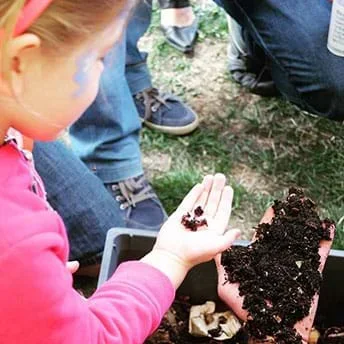 Feeling soil made from composting!Copyright 2015 Max Leszed, CC BY-SA 2.0, Flickr, https://www.flickr.com/photos/leszed/23470958752
Environmental engineers are tasked with innovating ways to combat environmental issues with sustainable, practical solutions. Environmental engineers work towards reducing waste and pollution, protecting and maintaining clean air, water, and soil, as well as finding methods to combat the effects of natural or human activities. Composting, the natural process in which organic waste decomposes into rich fertilizer, offers a sustainable solution for many of these concerns and can be easily performed in local communities and schools.
After this activity, students should be able to:
- Identify and differentiate between living and non-living things.
- Make observations of living things, their environment, and how changes can impact their habitat.
- Identify the basic needs of living things (air, water, food, and space).
- Observe and describe the habitat of red wigglers.
- Understand how soil is formed and that living and non-living things are used as the basis of soil (such as rocks, dead plants and animals, as well as waste from animals, such as castings).
- Explain how compost is found in nature and is also a sustainable practice used to reduce food waste.
- Design a habitat for red wigglers using the steps of the engineering design process.
- CCSS.Math.Practice.MP5 Use appropriate tools strategically.
Grades K-12
Do you agree with this alignment?
- LAFS.1.SL.1.1 Participate in collaborative conversations with diverse partners about grade 1 topics and texts with peers and adults in small and larger groups.
- Follow agreed-upon rules for discussions (e.g., listening to others with care, speaking one at a time about the topics and texts under discussion).
- Build on others' talk in conversations by responding to the comments of others through multiple exchanges.
- Ask questions to clear up any confusion about the topics and texts under discussion.
Grade 1
Do you agree with this alignment? - LAFS.1.SL.2.5 Add drawings or other visual displays to descriptions when appropriate to clarify ideas, thoughts, and feelings.
Grade 1
Do you agree with this alignment? - LAFS.1.W.2.5 With guidance and support from adults, focus on a topic, respond to questions and suggestions from peers, and add details to strengthen writing as needed.
Grade 1
Do you agree with this alignment? - LAFS.1.W.3.7 Participate in shared research and writing projects (e.g., explore a number of "how-to" books on a given topic and use them to write a sequence of instructions).
Grade 1
Do you agree with this alignment?
- SC.1.E.6.1 Recognize that water, rocks, soil, and living organisms are found on Earth's surface.
Grade 1
Do you agree with this alignment? - SC.1.L.14.1 Make observations of living things and their environment using the five senses.
Grade 1
Do you agree with this alignment? - SC.1.L.14.3 Differentiate between living and nonliving things.
Grade 1
Do you agree with this alignment? - SC.1.L.17.1 Through observation, recognize that all plants and animals, including humans, need the basic necessities of air, water, food, and space.
Grade 1
Do you agree with this alignment? - SC.1.N.1.1 Raise questions about the natural world, investigate them in teams through free exploration, and generate appropriate explanations based on those explorations.
Grade 1
Do you agree with this alignment? - SC.1.N.1.2 Using the five senses as tools, make careful observations, describe objects in terms of number, shape, texture, size, weight, color, and motion, and compare their observations with others.
Grade 1
Do you agree with this alignment? - SC.1.N.1.3 Keep records as appropriate - such as pictorial and written records - of investigations conducted.
Grade 1
Do you agree with this alignment? - SC.2.E.6.2 Describe how small pieces of rock and dead plant and animal parts can be the basis of soil and explain the process by which soil is formed.
Grade 2
Do you agree with this alignment?
- Students will develop an understanding of the attributes of design.
Grades K-12
Do you agree with this alignment? - Students will develop an understanding of engineering design.
Grades K-12
Do you agree with this alignment? - Asking questions and making observations helps a person to figure out how things work.
Grades K-2
Do you agree with this alignment? - STEL-1C Demonstrate that creating can be done by anyone.
Grades -1-2
Do you agree with this alignment? - STEL-1Q Conduct research to inform intentional inventions and innovations that address specific needs and wants.
Grades 9-12
Do you agree with this alignment? - STEL-7A Apply design concepts, principles, and processes through play and exploration.
Grades -1-2
Do you agree with this alignment? - STEL-7C Explain that design is a response to wants and needs.
Grades -1-2
Do you agree with this alignment? - STEL-7D Discuss that all designs have different characteristics that can be described.
Grades -1-2
Do you agree with this alignment?
- K-2-ETS1-1 Ask questions, make observations, and gather information about a situation people want to change to define a simple problem that can be solved through the development of a new or improved object or tool.
Grades K-2
This resource focuses on the following Three Dimensional Learning aspects of NGSS:
Science & Engineering Practices- Ask questions based on observations to find more information about the natural and/or designed world(s).Do you agree with this alignment?
- Define a simple problem that can be solved through the development of a new or improved object or tool.Do you agree with this alignment?
Disciplinary Core Ideas- Asking questions, making observations, and gathering information are helpful in thinking about problems.Do you agree with this alignment?
- A situation that people want to change or create can be approached as a problem to be solved through engineering.Do you agree with this alignment?
- Before beginning to design a solution, it is important to clearly understand the problem.Do you agree with this alignment?
Do you agree with this alignment? - Ask questions based on observations to find more information about the natural and/or designed world(s).
- K-ESS3-1 Use a model to represent the relationship between the needs of different plants or animals (including humans) and the places they live.
Grade 0
This resource focuses on the following Three Dimensional Learning aspects of NGSS:
Science & Engineering Practices- Use a model to represent relationships in the natural world.Do you agree with this alignment?
Disciplinary Core Ideas- Living things need water, air, and resources from the land, and they live in places that have the things they need. Humans use natural resources for everything they do.Do you agree with this alignment?
Crosscutting Concepts- Systems in the natural and designed world have parts that work together.Do you agree with this alignment?
Do you agree with this alignment? - Use a model to represent relationships in the natural world.
- K-ESS3-3 Communicate solutions that will reduce the impact of humans on the land, water, air, and/or other living things in the local environment.
Grade 0
This resource focuses on the following Three Dimensional Learning aspects of NGSS:
Science & Engineering Practices- Communicate solutions with others in oral and/or written forms using models and/or drawings that provide detail about scientific ideas.Do you agree with this alignment?
Disciplinary Core Ideas- Things that people do to live comfortably can affect the world around them. But they can make choices that reduce their impacts on the land, water, air, and other living things.Do you agree with this alignment?
- Designs can be conveyed through sketches, drawings, or physical models. These representations are useful in communicating ideas for a problem's solutions to other people.Do you agree with this alignment?
Crosscutting Concepts- Events have causes that generate observable patterns.Do you agree with this alignment?
Do you agree with this alignment? - Communicate solutions with others in oral and/or written forms using models and/or drawings that provide detail about scientific ideas.
Each group needs:
- 4 clear containers, 11.5 L (~ 12 qt.) to serve as compost bins
- soil, leaves, and other organic materials found outside for compost; (if the school environment has limited access to organic materials, teachers can purchase various items at a home improvement store and students can choose which to include as their design challenge (for instance: dirt, topsoil, sand, mulch, rocks, leaves, and peat moss)
- cardboard, newspaper, paper, hay, or pine needles to use as bedding for compost bins (see Troubleshooting Tips)
- reusable or compostable cups; used to scoop organic materials from outside
- large plastic bags, 3.78 L (~1 gal); used to hold organic materials before weighing (can be replaced with a sustainable option, such as plastic or glass containers)
- 450 g (~1 lb.) organic waste; students can also collect organic waste around campus, such as fallen leaves or food scraps
- 2 magnifying glasses
- red wiggler worms, 250 count (~50 worms for each compost bin) available at https://www.amazon.com/Uncle-Jims-Worm-Farm-Composting/dp/B00EZPSSGY
- Recycling, Compost, and Garbage Worksheet (PDF)
To share with the entire class:
- drill to make air holes in compost bins (a heated needle or hot glue gun may be used as an alternative)
- nitrile gloves
- moisture meters, thermometers, and compost turners
- optional: a Worm Farm Accessory Kit with Compost Tools available online is an all-in-one solution that includes a moisture meter, pH meter, thermometer, compost turner, food scrap handling tool, and compost harvesting scraper
- digital scale with tare function that measures in metric and US customary units
- various types of objects to weigh such as gummy bears, sugar, marbles, and blocks
- small plastic bags or containers for objects to be weighed in
- 500 ml beakers for adding water to compost bins when needed (measuring cups or plastic cups can be used as an alternative)
- projector or Smartboard
- tape, glue, or stapler
- scissors
Each student needs:
- chart paper or poster board for presentations
- a lab notebook and pencil
- various colored pencils, crayons, and markers
- Materials List Sheet (PDF)
- Recycling, Compost, and Garbage Sorting Worksheet (PDF)
- Parts of a Worm Worksheet (PDF)
- [optional] Model Habitat Worksheet (PDF)
Literature:
- The Little Yellow Leaf by Carin Berger, available online
- Compost Stew: An A to Z Recipe for the Earth by Mary McKenna Siddals, available online
- Composting: Nature’s Recyclers (Amazing Science) by Robin Koontz, available online
- Yucky Worms: Read and Wonder by Vivian French, available online
- Wiggling Worms at Works by Wendy Pfeffer, available online
- Diary of a Worm by Doreen Cronin, available online
- Optional book that can be used for teacher’s background research or as a class reference - Compost: A Family’s Guide to Making Soil from Scraps by Ben Raskin, available online
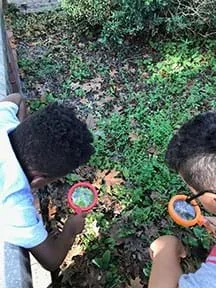 Observing soil with magnifying glasses.Copyright 2019 Andrea Chavez, University of Florida MRET
- Model Habitat (docx)
- Model Habitat (pdf)
- Materials List Sheet (docx)
- Materials List Sheet (pdf)
- Recycling, Compost, and Garbage Sorting Worksheet (docx)
- Recycling, Compost, and Garbage Sorting Worksheet (pdf)
- Recycling, Compost, and Garbage Sorting Answer Key (docx)
- Recycling, Compost, and Garbage Sorting Answer Key (pdf)
- Parts of an Earthworm (docx)
- Parts of an Earthworm (pdf)
- Parts of an Earthworm Answer Key (docx)
- Parts of an Earthworm Answer Key (pdf)
- Presentation and Poster Rubric (docx)
- Presentation and Poster Rubric (pdf)
- Making Sense Assessment (docx)
- Making Sense Assessment (pdf)
Students should be familiar with the main parts of a plant: leaves, flower(s), stem, and roots.
For the start of this activity, let’s do a Think, Pair, and Share activity. Talk about the changes we see and experience during the fall season with a partner. (Potential answers: temperatures get colder, days become shorter, birds fly south, animals are getting ready to hibernate, leaves turn color, leaves fall.) [Allow time for thinking and talking with their partners. Allow students to share their ideas aloud with the class.]
[When a student shares that leaves fall from trees during the fall ask:] Why do leaves fall from the trees during the fall? (Answer: The cold temperatures of the winter would damage the leaves so to protect themselves, trees reduce themselves to their stems, trunks, branches and bark.) [Allow time for thinking and talking with their partners. Allow students to share their ideas aloud with the class.]
Today we’re going to read a story about a leaf who is afraid of falling. [Read The Little Yellow Leaf aloud to the class.]
Why do you think Yellow Leaf was afraid of falling? [Allow time for thinking and discussion with their partners. Allow students to share their ideas aloud with the class.]
Have you ever been worried about a change in your life? Was it scary to try something new? How did you feel once you tried it? [Allow time for thinking and talking with their partners. Allow students to share their ideas aloud with the class.]
What happened to the other leaves during the seasons? [Allow time for thinking and talking with their partners. Allow students to share their ideas aloud with the class.]
[Optional: If possible, bring students outside near a tree that has a variety of leaves on the ground nearby or bring fallen leaves into the classroom. Review the main parts of a plant as a class (stem, roots, leaves, and flowers/fruit if any) to activate background knowledge. Tell students they are going to search for their favorite fallen leaf and maybe they’ll even find Yellow Leaf.]
[Let each student find their favorite leaf and return to the classroom.] Now, use your senses to describe your leaf and write these in your lab notebook – What does it feel like, smell like, look it, and does it make a sound when you touch it or move it? [Allow students to tape or glue their leaf in their lab notebooks. If time permits, students can also write about what they like about their leaf. Provide 10-15 minutes for a group meeting so each student can share their leaf and describe it to their teammates.]
[Regroup with students.] What happens to the leaves after they fall to the ground? If no one picks them up, where do they go? Think back to the story and what we noticed about the leaves during the fall and winter. Did you know that leaves can be recycled, just like plastic and paper? When leaves fall on the ground, they slowly decompose, or rot, and over time become part of the soil. This is called composting. During the next couple of weeks we are going to become environmental engineers and learn how to compost!
Background
The purpose of this activity is for students to learn about composting as a natural process, as well as a sustainable practice that can help to reduce food waste. Students will understand the role of invertebrates, such as red wiggler earthworms, in decomposing organic waste. During this activity, students will explore the natural environment with their five senses and use their knowledge of living things and their needs to create a habitat for red wigglers. Students will work in teams as they design their habitat in a compost bin, collect data using tools such as a moisture meter and thermometer, and learn about the stages of the engineering design process.
All organic matter, such as living or once-alive plants and animals, rot, or decompose over time. The organic matter rots into a nutrient-rich soil called humus. This process is called composting. Composting in nature happens slowly as organic matter collects around a natural environment. For instance, leaves fall to the ground and animals and plants produce waste or die. When designing and using a compost bin in your home or school, you want replicate what happens in nature. As organic waste decomposes, it becomes food for other organisms like invertebrates (such as worms) and microorganisms (such as bacteria and fungi). Red wiggler worms (scientific name: Eisenia foetida) are a common organism introduced into compost bins. Red wigglers feed on food waste and expel nutrient-rich castings (or worm humus). This humus can then be use for gardening and act as a natural, pesticide free fertilizer. Vermicomposting is a sustainable practice that organically enriches soil, increases plant growth, helps water retention in soil, and most importantly, helps reduce food waste in landfills.
Activity Overview
Day 1: Research about composting – Read Composting: Nature’s Recyclers
Day 2: Research about earthworms – Read Diary of a Worm
Day 3: Learning about the habitat of red wigglers – Read Yucky Worms
Day 4: Learning about the life cycle, diet, and anatomy of red wigglers – Read Wiggling Worms at Work
Day 5: Design a model habitat – Read Compost Stew
Day 6-7: Collect materials and build prototype of model habitat
Day 8-12: Explain, observe and collect data (redesign and retest if needed)
Day 13: Observe and collect data and begin working on cumulative presentations
Day 14: Work on cumulative presentations
Day 15: Present results to the class
Day 1
Before the Activity:
- Gather materials: Composting: Nature’s Recyclers, chart paper, copies of the Recycling, Compost, and Garbage Sorting Worksheet (PDF) (one for each group).
- Set up projector. Then load and test Garbology interactive activity: http://www.naturebridge.org/garbology.php (note: it requires Adobe Flash Player)
- Write ‘reduce, reuse, and recycle’ on an anchor chart.
With the Students:
- Describe how environmental engineers help change the world by keeping the air, water, and soil clean from pollution (see Vocabulary/Definitions). Brainstorm, as a class, ways to help keep the Earth healthy. If time permits, watch the video ‘What do Environmental Engineers do?’ https://www.youtube.com/watch?v=MUT8zya53Vg.
- Remind students of the three ways they can help the Earth – ‘reduce’, ‘reuse’, and ‘recycle’. Have students share examples of these actions and write their responses on the anchor chart.
- Use the interactive website, Garbology, a smartboard, or another interactive software to practice sorting waste together as a class. (This interactive online activity introduces students to how bacteria, fungi, and invertebrates help aid compost. Garbology also discusses other forms of waste management, such as what gets recycled and how to recycle items properly.)
- Pass out the Recycling, Compost, and Garbage Sorting Worksheets (PDF) and have each group practice correctly sorting pictures of waste into the categories: Recycle, Compost, or Garbage. Allow students to work together as they sort each item. When they’re finished, have students raise their hand for their work to be checked using the Recycling, Compost, and Garbage Sorting Worksheet – Answer Key (PDF).
- Regroup and discuss what was learned. What can be recycled? What can be composted? What cannot be composted?
- Read Composting: Nature’s Recyclers. Discuss composting– why it is important, how to start and maintain a compost pile, and what animals can help. As a class, work together to create a definition for ‘composting’ and then provide examples of waste that can and cannot be composted.
- Optional – Have students write the definition of composting in their lab notebooks and make a list of waste that can and cannot be composted.
Day 2
Before the Activity:
- Gather materials: Diary of a Worm and chart paper.
- Set up KWL chart – ‘What we know’, ‘want to learn’, and ‘have learned’ about red wigglers.
- Set up anchor chart with the headings: ‘living’ and ‘non-living’.
With the Students:
- Introduce students to the red wiggler worm. Focus on how it helps to decompose food waste by turning it into rich soil which can be used to help new plants grow. Explain that using red wigglers to help decompose food waste is called vermicomposting (see Vocabulary/Definitions). Ask students, what could we do with this rich soil?
- Fill in the KWL chart for red wigglers with ‘what we know’ and ‘want to learn’ sections as a class.
- Read Diary of a Worm aloud. Fill in the ‘what we learned’ section of the KWL chart as a class. Leave space to add to this section for later books/videos about red wigglers.
- Watch the video, ‘Worms are Wonderful!’ https://www.youtube.com/watch?v=l-zc_1vjLnI (4:33). Add to the KWL chart if time and space permits.
- Discuss the difference between living and non-living things. Ask students what makes something living. Provide a list of students’ responses on the anchor chart. (Potential answers: needs air, water, food, takes up space, changes). Ask students what makes something non-living. (Potential answers: doesn’t need air, water, food, doesn’t take up space). Is a red wiggler a living or non-living thing? Why? Compile a list of students’ responses on the anchor chart.
- Optional – Have students list living and non-living things in their lab notebooks. They can use their classroom environment and/or a safe outdoor space to look for living and non-living things.
Day 3
Before the Activity:
- Gather materials: Yucky Worms, the KWL chart of red wigglers from the previous day’s activity and a variety of colored pencils, crayons, and markers.
With the Students:
- Introduce students to the term ‘habitat’ (see Vocabulary/Definitions) and discuss the habitat of red wigglers. Focus on what the worms need in their habitat (i.e., air, water, food, and space).
- Read Yucky Worms. Add to KWL chart if time and space permits.
- Ask students the following questions:
- What three important things does a red wiggler need in its habitat?
- How can we build a habitat for red wigglers?
- What would we need to include?
- Tell students that red wigglers, like other earthworms, need moist soil. How can we make the soil moist?
- What predators would we need to keep our red wigglers away from? (e.g., birds, such as hawks, frogs, toads, fish and rodents.)
- Optional – The educator can compile a list of students’ responses on an anchor chart titled, ‘Red Wiggler Habitat,’ for students to refer to during the next step.
- Watch the video, ‘Make the Most of Compost!’ Ask students to see if they can spot the red wigglers in the video: https://www.youtube.com/watch?v=Q5s4n9r-JGU&t=3s
- Describe the engineering design process to the students and how engineers have to imagine their idea before designing and/or building it:
- Have students draw a model habitat for red wigglers in their lab notebooks. The students should color and label the habitat, including what is needed for the worms survive, and draw in the red wigglers that will be in their habitat. Students will then write 2-3 sentences about what materials they think they should include in their habitat, and why. (Note: Students can work in their lab notebooks or use the provided worksheet, Model Habitat (PDF).)
- Provide time for students to share their habitat drawings and writings with their teammates.
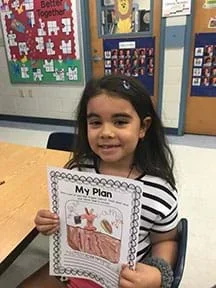 A student shows her written plan for a red wiggler habitat.Copyright 2019 Andrea Chavez, University of Florida MRET
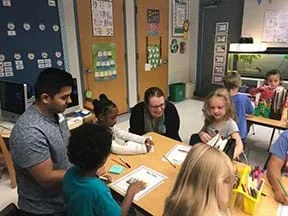 Student engineers at work!Copyright 2019 Andrea Chavez, University of Florida MRET
Day 4
Before the Activity:
- Gather materials: Wiggling Worms at Work, colored pencils, crayons, markers, and Parts of an Earthworm Worksheet (PDF).
With the Students:
- Read Wiggling Worms at Work.
- Pass out the Parts of an Earthworm Worksheet (PDF)and, as a class, label the parts of an earthworm. As each part is labeled, identify the purpose of each. For example, “The segments on a worm’s body help it bend and move.” “The posterior is where the castings leave the body.” “The anterior has the mouth of the earthworm.” Students should then glue, tape or staple the worksheet into their lab notebooks.
- Optional – Teacher can add to previous KWL chart or make a new circle chart about red wigglers. This can be useful for organizing information for students to refer back to during the design process.
Day 5
Before the Activity:
- Gather materials: Compost Stew: An A to Z Recipe of the Earth and compost bedding materials (cardboard, paper, and newspaper).
With the Students:
- Review what a ‘habitat’ is and what red wigglers need in their habitat.
- Read Compost Stew: An A to Z Recipe for the Earth.
- Introduce students to the design challenge: to create a habitat for red wigglers in a compost bin that also decomposes organic waste (see Vocabulary/Definitions). Emphasize that they’re allowed to choose three different ‘ingredients’ from outside to create the perfect compost stew!
- Explain that the bedding helps support the compost, as well as absorb moisture, plus some bedding materials, like cardboard and newspaper, are food for earthworms as well! Individually, have students write down what two types of ‘bedding’ they wish to include in their compost bin, such as cardboard, newspaper, and paper (have multiple options available).
- Have students brainstorm what outdoor materials they wish to include in their bin. Each student should record their three outdoor materials. Have them think back to what an earthworm needs to survive. Students can work in their lab notebooks, or use the provided Materials List Sheet (PDF).
- Tell students that engineers work in groups and so will they! Students will refer to their own materials list but as a team they should decide which five ingredients (i.e., two bedding ingredients and three materials from outside) they will use to create their group compost bin. Have students write down the outdoor and bedding materials they chose as a group.
- Next, tell students that like all engineering designs, there will be controls, or specific things about the bins that will remain the same, and a variable, or the one thing that will be different. Our controls will be: what organic waste is put in the bin, how much organic waste is put in (0.5 kg or 500 g), how many worms each bin gets (50), the amount of water added to the bin (200 mL), 3 types of organic materials from outside and 2 bedding materials, the total weight of materials (3 pounds), how often we turn the compost, the container used as the compost bin, and location of the bins. Tell students the variable will be the materials their group chooses to use.
- Optional - write down controls and variable on a whiteboard, Smartboard/ Interactive board, or chart paper and have students copy them in their lab notebook.
Day 6
Before the Activity:
- Gather materials: nitrile gloves, electronic digital scales, beakers, magnifying glasses, various types of objects to weigh (for example: gummy bears, sugar, marbles, small wooden blocks, or common classroom items), and lab notebook and pencil for every student.
- Find a picture of different scales on Google Images as a reference during the activity.
- Fill the small plastic bags or containers with each object to be weighed.
- Find a safe, accessible outdoor environment around campus.
With the Students:
- Introduce students to tools engineers may use when designing their prototype and collecting data: “Today we will practice using a scale to measure objects, measure liquid in a beaker, and observe objects outside with a magnifying glass. All of these tools will be used when designing our compost bins and collecting data.”
- Discuss weight and weighing things. Ask students if they have ever been on a scale at the doctor’s office to be weighed. Tell students they are going to use a smaller scale to weigh objects.
- Begin by identifying the parts of the scale, such as the platform, units, and tare function.
- Model how to weigh objects – turn on the scale, make sure the unit of measurement is set to grams (g), put the container on the weighing platform, tare the scale, and add different objects to equal 450 g (~1 lb.) each. Stress the importance of watching the scale as you add materials. Ask students, what should I do when I add too much of the material? What if I put too little? Model these situations.
- Students will work in groups to measure each bag of objects. Students will first tare an empty small plastic bag and then measure every object on the scale. Students will record the weights in their lab notebooks.
- Optional – Compare the weights of the objects and discuss why some objects are lighter or heavier than others. For instance, why was sugar packed in a small bag heavier than small wooden blocks in a bag?
- Introduce beakers to the students. Identity the small ‘spout,’ or beak, at the top helps pour liquid. Instruct students how to measure water in milliliters (m).
- Have students work in groups to measure 100 ml of water and then 800 ml of water.
- Introduce magnifying glasses to the students. Give each group a magnifying glass and provide a couple of minutes for them to use it to explore the classroom. Regroup and ask student to describe the function of a magnifying glass.
- Tell students that engineers often use chemicals or materials that they need in an experiment, but that they may not want to touch. Model how to put on and take off the nitrile gloves. Provide time for students to practice.
- Optional - have students draw and label a picture of each tool in their lab notebook.
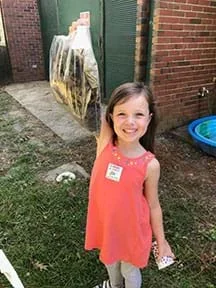 Collecting compostable materials.Copyright 2019 Andrea Chavez, University of Florida MRET
Day 7
Before the Activity:
- Gather materials: Four 11.5 L (~ 12 qt.) clear boxes used as compost bins, electric drill, various soil, leaves, and organic materials found in an outside environment, cardboard, newspaper, paper, and hay/pine needles to use as bedding, plastic cups, clear plastic bags 3.78 L (~1 gal), 450 g (~1 lb.) of organic waste, red wigglers, nitrile gloves, Worm Farm Accessory Kit with Compost Tools – compost turner, electronic digital scales, beakers, and magnifying glasses.
- Make air holes (using an electric drill, glue gun, or heated nail) in each clear box.
- Ensure red wigglers are ready to be placed in their new environment the night before. To save on time, it may be necessary to separate 50 worms in four different small containers or bags with soil, food (such as a banana peel), air holes, and water.
- Shred newspaper, paper, and cut cardboard, have the pine needles or hay accessible for students.
- Identify a safe, accessible outdoor environment for collecting organic materials. You may want to choose more than one location.
- Separate the same type of food waste and the same amount (450 g) for each group. You can store organic waste in the freezer before they’re ready to be used.
- Identify a safe, dark location to store the compost bins.
With the Students:
- Provide each group with a 3.78 L (~1 gal) plastic bag. Remind students that their total materials have to weigh no more or less than 1360 g (~3 lbs) and that their materials should include three from an outside environment and two for the bedding.
- Allow time for students to look back at their list of materials they will be collecting today (from Activity 5).
- Take students outside to the predesignated outdoor environment. Have students wear gloves and use cups to collect their organic materials.
- Return inside and allow students to add bedding materials to their bags.
- Have students weigh their bags to determine if it equals 1360 g (~3 lbs).
- Have students add their materials and organic material to their bin.
- Next, the teacher will add 50 worms to each compost bin. Give students time to observe the worms. Students can use their magnifying glasses as they observe.
- After, students will add 200 ml of water to their bin.
- Model how to turn the compost bin with the compost turner and allow students to turn their compost. Tell students we will turn the compost pile every couple of days to make sure it’s getting enough air. Have students safely remove gloves.
- Teacher can place bins in their designated location.
Day 8
Before the Activity:
- Gather materials: Worm Farm Accessory Kit with Compost Tools – moisture meter and thermometer for data collection, magnifying glasses, nitrile gloves, beakers if adding water to compost (check moisture level), bedding or organic materials for redesigning, lab notebook and pencil for every student.
- Attach each group’s materials list to the outside of their compost bins as a reminder of what materials were used.
- Write materials that were used on the top of the bin next to the picture.
With the Students:
- Tell students that engineers keep detailed notes about their observations and collect data using tools. “During the next week we will observe the behaviors of the red wigglers and changes in our compost bins, and record how much moisture (or water) is in the soil and the temperature of the bin.”
- Have students create a chart with 3 sections in their lab notebooks. Suggested title include ‘moisture’, ‘temperature’, and ‘observations’.
- Tell students that just like we don’t like to be too hot or too cold, the soil in the compost bin has to be between a specific range of temperatures for the red wigglers to stay healthy.
- Show students the thermometer. Tell students the yellow section between 15.5° F and 26.7° F (~60° F and 80° F) is perfect for red wigglers – not to cold and not too hot. Point out that the picture of the worm in this range looks happy and healthy. Identify the red sections on the thermometer mean the temperature of the compost is too hot, and the blue sections indicate the temperature is too cold. Ask students, what could cause the compost bin to get too cold/hot?
- Next, tell students that red wigglers, like all living things, need water to survive. But too much water can hurt the red wigglers. Remind students that earthworms breathe through their skin and too much water will cause a lack of air in the bin. Tell students the green range of moisture is what we want (from 4 to 7). A range of 1-3 means there isn’t enough water in the bin, and a range of 8-10 means there is too much water in the bin. Ask students, what would you do if your moisture meter was at a 2? What if it was at a 9?
- Next, students will put on gloves before they open their compost bins. Then, students will collect their data using the moisture meter and thermometer and use magnifying glasses to observe the soil and red wigglers. Students will record their data in their lab notebooks. Students will create a chart with 3 sections in their lab notebooks, moisture, temperature, and observations, to record their data. The observation section can include words and pictures of what they see in their compost bin. They can also note any changes, problems, or successes.
- Students may need to redesign if they notice a ‘problem’ in their bin (see Troubleshooting Tips). Students can add water or organic materials/bedding if necessary. When finished, students will safely remove gloves.
Day 9-12
Before the Activity:
- Gather materials: Worm Farm Accessory Kit with Compost Tools – moisture meter and thermometer for data collection, magnifying glasses, nitrile Gloves, beakers if adding water to compost if necessary (check moisture level), bedding or organic materials for redesigning, and a lab notebook and pencil for every student.
With the Students:
- Have students create a chart with 3 sections in their lab notebooks: ‘moisture’, ‘temperature’, and ‘observations’. Remind students they will need to make a new chart every time they collect their data. Tell students to write the date on the page every time as well for the next four days.
- When ready, have students put on their gloves and collect data using the moisture meter, thermometer, and magnifying glasses.
- Have students answer the following questions each day: What is happening in your compost bin? Has anything changed? What are the worms doing? What is working and/or not working?
- On day 11 or 12, instruct students to turn their compost in order to aerate their experiment.
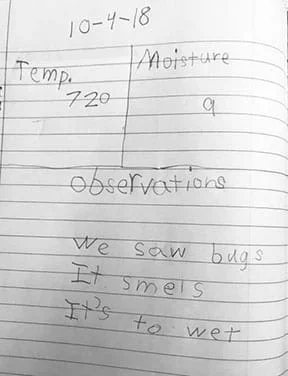 Example of student’s data and observations in his/her lab notebook.Copyright 2019 Andrea Chavez, University of Florida MRET
Day 13
Before the Activity:
- Gather materials: Worm Farm Accessory Kit with Compost Tools – moisture meter and thermometer for data collection, magnifying glasses, nitrile gloves, beakers if adding water to compost if necessary (check moisture level), bedding or organic materials for redesigning, lab notebook and pencil for every student, chart paper or poster board, and various colored pencils, crayons, and markers.
With the Students:
- Tell students that today is the last day for recording data and observations.
- Students will create a chart with 3 sections in their lab notebooks: moisture, temperature, and observations.
- When ready, students will put on their gloves and collect their data using the moisture meter, thermometer, and magnifying glasses.
- When finished, students will safely remove gloves.
- Group meeting - What happened in their compost bin during the week? Was it successful or unsuccessful? How do you know? What materials worked best? How do you know? If you were able to build a new prototype, what would you do differently?
- Tell students that engineers communicate their results with other engineers and scientists. “Today you will start working on your final presentation as a group. In two days, you will present and communicate your results with the rest of the class.”
- Give students a piece of chart paper or poster board. Supply various colored pencils, crayons, and markers.
- Tell students they can organize and decorate their poster any way they’d like, but it must include these four components: Materials (and explanation of why they were chosen), Data Collection, Observations (include any changes, problems, and success), and Redesign (what would you do differently next time? How would you redesign?)
- Allow time for students to work on their presentation as a group.
Day 14
Before the Activity:
- Gather materials: Chart paper or poster board, various colored pencils, crayons, and markers, lab notebook and pencil for every student
With the Students:
- Students will continue to work on presentations as a group.
- Tell students that when engineers present their findings, they often use pictures. Encourage students to include pictures in their poster.
- Remind students to look back in their lab notebooks at their data and observations.
Day 15
Before the Activity:
- Gather materials: Chart paper or poster board, various colored pencils, crayons, and markers, lab notebook and pencil for every student
With the Students:
- Provide time for students to finish their posters.
- Have each group present their poster to the class and the teacher will use the given rubric (see Attachments) to grade each group’s presentation.
- Afterwards, regroup with students and ask the following questions:
- What did we learn about red wigglers during this process?
- What did we learn about composting?
- How does composting help keep our Earth healthy?
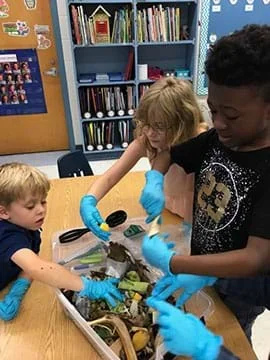 Adding food waste into a compost bin.Copyright 2019 Andrea Chavez, University of Florida MRET
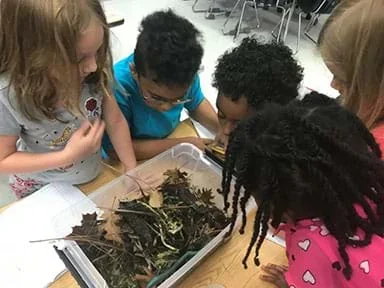 Students observe their compost bin.Copyright 2019 Andrea Chavez, University of Florida MRET
- casting
- Waste produced from earthworms.
- compost
- An organic soil that is created by decomposed organic materials such as food waste, leaves, and grass clippings.
- decomposition
- The process of organic materials breaking down, otherwise known as ‘rotting.’
- habitat
- A natural environment for a living thing that meets its basic needs.
- life cycle
- A series of stages of changes in which an organism undergoes, from birth through reproduction.
- living
- Things that are alive. Living things can grow, change, reproduce, and have basic needs such as air, water, food, and space. The word ‘organic’ can be used to describe living or once-alive things.
- non-living
- Anything that is not alive nor has ever been. Non-living things do not grow or change by themselves. They do not need food, water, air, or shelter.
- organic waste
- Matter that comes from a once-living animal or plant. Examples of organic waste include food and garden or lawn clippings.
- pollution
- Waste, that is introduced into the environment, which is harmful to plants, animals, and the earth.
- red wiggler worm
- A species of earthworms that are adapted to decaying organic matter/waste.
- soil
- The brown or black top layer of the earth that supports life and contains a mixture of organic materials. The three main types of soil are sand, silt, and clay.
- sustainability
- Habits and practices to limit the use of natural resources and improve our natural environment for future generations.
- vermicomposting
- The process of earthworms converting organic waste into compost. Red wigglers break down organic waste into castings.
Pre-Activity Assessment
Warm-Up: Pre-assessments conducted using the Recycling, Compost, and Garbage Sorting Worksheet (PDF) and by making a KWL chart of red wigglers.
Activity Embedded Assessment
Data Collection: Have students conduct research and data collection in their lab notebooks.
Post-Activity Assessment
Poster and Presentation: Each group will make a poster about their compost bins, with the following components: ingredients used, successes, problems, and changes for next time. Each group will present their poster to the class. Use the Presentation and Poster Rubric (PDF)for grading.
Making Sense: Have students reflect on the science phenomena they explored and/or the science and engineering skills they used by completing the Making Sense Assessment (PDF).
- Students should always use gloves when handling food waste, compost, and the worms. Discourage students from handling of red wigglers as much as possible. Ensure students wash their hands before and after.
- Avoid adding dairy, meat products, and/or greasy foods to the compost bin, as it will attract unwanted vermin and pests.
- To ensure the red wigglers stay safe, model how to safely and carefully turn the compost, insert the moisture meter and thermometer, and add the organic material into the bins.
Wait until you are ready to begin the design challenge to buy the red wigglers. Once they arrive, they need to be introduced to their new environment immediately, given food and water, and time to settle into their new home.
The more red wigglers you add to the bin, the more space and organic waste they will need. Due to the size of the clear bins and possible time restrictions, limit each compost bin to 50 worms. You can create a control compost bin with additional worms if necessary.
Ensure the organic materials the students choose from outside have not been treated with pesticides, as they can very harmful to the red wigglers. Watch out for other insects as well!
If students choose to add paper, cardboard, or newspaper to their compost pile, provider paper that is not bleached (white copy paper) or has a glossy finish (flyers, magazines). Most newspapers use soy-ink and should not be an issue for the worms; however, you can soak the shredded newspaper in water before letting students add it to their bins.
Any type of soil or natural material being used should not have synthetic fertilizer (plant food) added to it. The compounds in these fertilizers are not healthy for the red wigglers.
Common issues with compost bins:
- The presence of fruit flies. This is caused by too much organic waste and/or organic waste being added to the top of the surface instead of being buried.
- Unpleasant odors from the bin! This is caused by giving your worms too much food waste or too much water.
- Worms crawling out of the bin. This happens when the environment is not meeting the red wigglers’ basic needs for survival.
If any of the above issues occur, provide students with relevant information and allow them to redesign by adding necessary components or materials to their compost bin design. Encourage students to conduct research, observe the other compost bins, and problem solve with peers. Have students review previous data, observations, and pictures as well. Additionally, have students record the changes in their moisture meter and thermometer, which could reflect the cause of the issue.
- Create a presentation to persuade cafeteria staff, administrators, and/or other teachers and grades levels to start a school compost bin. Students can present their data, what they learned, the importance of composting, and how it would benefit the school community.
- Use pictures and data to create a class book about how to compost with red wigglers. Students can write about their own experiences and include tips for composting success.
- Watch the Magic School Bus Meets the Rot Squad that discusses the process of decomposition and how decomposers recycle once-living things.
- For higher grades (3-5), students can be given a budget for materials and through independent research, determine the best option for their design.
- When collecting data, students can observe and determine the relationship between temperature, humidity, and composting, as well as determine the ratio of water to soil.
- Students can observe compost soil at different stages under a microscope to better understand the role of fungi, bacteria, and invertebrates.
- Students can identify types of natural resources (renewable and nonrenewable) and how they impact the environment, and learn about how compost is used, in local practice and industry, to limit pollution and greenhouse gas emissions.
- Students can write a letter to their local government to discuss how composting can benefit their community, as well as how their city/town/neighborhood can begin a compost program.
“Food Waste Composting: Institutional and Industrial Application.” UGA Cooperative Extension, UGA CAES/Extension News. 2017. Accessed October 25, 2019. extension.uga.edu/publications/detail.html?number=B1189
Raskin, Ben. Compost: A Family Guide to Making Soil from Scraps. Roost Books, 2014.
“The Science and Engineering of Composting.” Worm Composting Basics - Cornell Composting, 1996. Accessed October 25, 2019. compost.css.cornell.edu/science.html
Contributors
Andrea Chavez
Supporting Program
Multidisciplinary Research Experiences for Teachers of Elementary Grades, Herbert Wertheim College of Engineering, University of Florida
Acknowledgements
This curriculum was based upon work supported by the National Science Foundation under RET grant no. EEC 1711543— Engineering for Biology: Multidisciplinary Research Experiences for Teachers in Elementary Grades (MRET) through the College of Engineering at the University of Florida. Any opinions, findings, and conclusions or recommendations expressed in this material are those of the authors and do not necessarily reflect the views of the National Science Foundation.
Copyright
2019 by Regents of the University of Colorado; original © 2018 University of Florida