
Engineering Solutions for a Dry Playground
The school’s playground is flooded again, and the students cannot go out to recess! Students learn about the different states of matter and how water changes. They use this knowledge, along with research about natural disasters, to come up with an engineering solution that prevents playground flooding. They plan and design a model, test it, and share results. After sharing results, they redesign and complete at least two more trials to find the optimal solution.
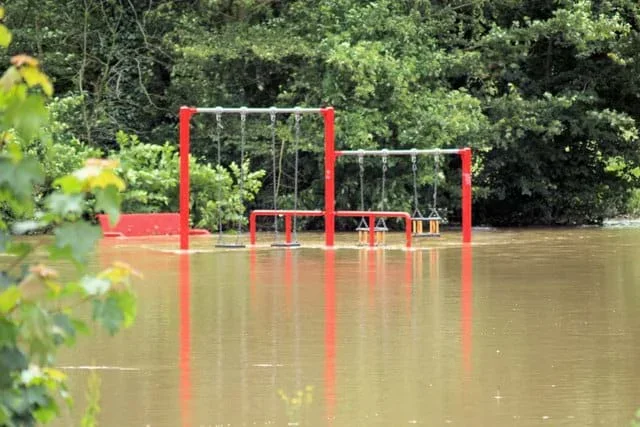 A playground is flooded after a storm.Copyright 2007 Joan Fareham, CC BY-SA 2.0, Wikimedia Commons: https://commons.wikimedia.org/wiki/File:Pinfold_playground_flooded_-_geograph.org.uk_-_480810.jpg
Environmental engineers apply knowledge of engineering technology and science to our natural world and for the efficient use of biological resources. Environmental engineers apply engineering design and analysis to protecting natural resources, develop power systems to support our habitats, and provide environmental controls. Engineers must understand the different states of matter and the changes that water undergoes when thinking about flooding. They must keep detailed notes, plan and test multiple trials. The engineering design process that takes place in the classroom during this activity is an approximation of what engineers do in their profession.
After this activity, students should be able to:
- Understand how water changes depending on the environment.
- Describe the following terms: absorption, evaporation, and erosion.
- Plan a solution to the playground flooding based on research of flooding in other geographical regions.
- Build a model to approximate and test their prevention device.
- Complete multiple trials to find optimal results.
- Present findings to a school board and/or school administration committee (optional).
- SC.3.N.1.4 Recognize the importance of communication among scientists.
Grade 3
Do you agree with this alignment? - SC.3.N.3.2 Recognize that scientists use models to help understand and explain how things work.
Grade 3
Do you agree with this alignment?
- Students will develop an understanding of the attributes of design.
Grades K-12
Do you agree with this alignment? - Students will develop an understanding of engineering design.
Grades K-12
Do you agree with this alignment? - Students will develop abilities to apply the design process.
Grades K-12
Do you agree with this alignment?
- 3-5-ETS1-1 Define a simple design problem reflecting a need or a want that includes specified criteria for success and constraints on materials, time, or cost.
Grades 3-5
This resource focuses on the following Three Dimensional Learning aspects of NGSS:
Science & Engineering Practices- Define a simple design problem that can be solved through the development of an object, tool, process, or system and includes several criteria for success and constraints on materials, time, or cost.Do you agree with this alignment?
Disciplinary Core Ideas- Possible solutions to a problem are limited by available materials and resources (constraints). The success of a designed solution is determined by considering the desired features of a solution (criteria). Different proposals for solutions can be compared on the basis of how well each one meets the specified criteria for success or how well each takes the constraints into account.Do you agree with this alignment?
Crosscutting Concepts- People's needs and wants change over time, as do their demands for new and improved technologies.Do you agree with this alignment?
Do you agree with this alignment? - Define a simple design problem that can be solved through the development of an object, tool, process, or system and includes several criteria for success and constraints on materials, time, or cost.
- 3-5-ETS1-2 Generate and compare multiple possible solutions to a problem based on how well each is likely to meet the criteria and constraints of the problem.
Grades 3-5
This resource focuses on the following Three Dimensional Learning aspects of NGSS:
Science & Engineering Practices- Generate and compare multiple solutions to a problem based on how well they meet the criteria and constraints of the design problem.Do you agree with this alignment?
Disciplinary Core Ideas- Research on a problem should be carried out before beginning to design a solution. Testing a solution involves investigating how well it performs under a range of likely conditions.Do you agree with this alignment?
- At whatever stage, communicating with peers about proposed solutions is an important part of the design process, and shared ideas can lead to improved designs.Do you agree with this alignment?
Crosscutting Concepts- Engineers improve existing technologies or develop new ones to increase their benefits, to decrease known risks, and to meet societal demands.Do you agree with this alignment?
Do you agree with this alignment? - Generate and compare multiple solutions to a problem based on how well they meet the criteria and constraints of the design problem.
- 3-5-ETS1-3 Plan and carry out fair tests in which variables are controlled and failure points are considered to identify aspects of a model or prototype that can be improved.
Grades 3-5
This resource focuses on the following Three Dimensional Learning aspects of NGSS:
Science & Engineering Practices- Apply scientific ideas to solve design problems.Do you agree with this alignment?
- Use a model to test interactions concerning the functioning of a natural system.Do you agree with this alignment?
Disciplinary Core Ideas- Tests are often designed to identify failure points or difficulties, which suggest the elements of the design that need to be improved.Do you agree with this alignment?
- Different solutions need to be tested in order to determine which of them best solves the problem, given the criteria and the constraints.Do you agree with this alignment?
Crosscutting Concepts- A system can be described in terms of its components and their interactions.Do you agree with this alignment?
Do you agree with this alignment? - Apply scientific ideas to solve design problems.
Each group needs:
- all-purpose 23 cm x 33 cm (9” x 13”) aluminum baking pan (the same one may be reused for improved iterations of the design)
- 0.5 L (2 cups) natural decorative sand; the amount may be varied as long as each group gets the same amount; if available, students may also be provided with different types of sand to test which type would be the most absorbent)
- 0.75 L (3 cups) artificial grass and/or moss
- 0.5 L (2 cups) rocks and/or pebbles
- diaper (per group and per iteration)
- 10 toy logs
- 2000 mL of water
Each student needs:
- lab notebook
- pen or pencil
For the class to share:
- 3 spray bottles
- 1 large beaker
- measuring cups or plastic cups of the same size
Students should know how to keep a lab notebook.
Water comes in three different forms. Can you tell me what forms those are? (Let students raise their hands to answer. Answers: solid/ice, liquid, or gas/vapor.) These different forms are called states of matter.
Today we are going to talk about water in liquid form, particularly when there is a whole lot of water! When it rains and our playground floods, we can’t go outside to play! What do you think causes flooding? (Let students discuss with their groups and offer their ideas.)
Flooding is a natural event that occurs all over the world. Floods can occur anywhere that water overflows onto land that is normally dry. Floods can be caused by hurricanes, broken levees or dams, rapidly thawing snow, ice jams, and heavy slow-moving rain or repeated rains. A flood can happen in a few minutes, hours, days, or over weeks.
Although we cannot necessarily stop hurricanes, thawing snow, ice jams or big rainstorms, we can do some things to stop certain areas from being flooded. How do you think we can stop or prevent floods? (Let students discuss with their teammates and offer their ideas.)
Today we will become engineers to figure out ways to save our flooded playground!
Background
Flooding is a natural phenomenon that occurs all over the world. A flood occurs when a large amount of water, that has no place to go, overflows onto what is normally dry land. Floods can be caused by hurricanes, broken levees or dams, rapidly thawing snow, ice jams, and heavy slow-moving rain or repeated rains. A flood can happen in a few minutes, hours, days, or over weeks.
Although we cannot necessarily stop hurricanes, thawing snow, ice jams or big rainstorms, we can do some things to prevent, stop, and/or minimize floods in certain areas. These measures are called flood control. Flood control refers to actions taken to protect cities and towns, people and property from flooding.
Some flood control measures include the following:
- Not building in flood plains or building above flood levels: A flood plain is an area that is subject to natural flooding from an adjoining waterway. The flood level is the elevation of the maximum flood level. Building structures not in the flood plain and above flood levels help mitigate risks from floods.
- Building on higher ground: Water naturally fills in low areas first, so building structures on higher ground helps mitigate flood risks.
- Protect and/or create more wetlands: Wetlands, including bogs, swamps, and marshes, act like sponges, soaking/absorbing up large amounts of water and then release it gradually. Each acre of wetland can typically absorb a million gallons (3.8 million liters) of water or more.
- Protect and/or create more woodlands: Woodland encourage water infiltration and reduce overland flow. Root growth in soils can lead to increased soil porosity, enhancing infiltration and therefore reducing overland flow.
- Introduce water storage ideas: Water can be stored in flood plains and in overflow areas for rivers.
- Improve soil conditions: Soil can become compacted by inappropriate soil management, machinery, animal hooves, etc. so that instead of absorbing moisture, holding it and slowly letting it go, water runs off it immediately. Well drained soil can absorb huge quantities of rainwater, preventing it from running into rivers.
- Put up flood barriers: River flooding is commonly controlled with levees. Levees are low mounds or embankments typically made of dirt. They are built along the edges of a river or other body of water to prevent water from spilling over onto the surrounding land.
- Put up diversion channels: Floodways, or diversion channels, are artificial channels built to divert excess water from a river channel and carry it off by a different route. These channels can also divert water underground.
- Improve river/ocean channels: Engineers can make a variety of changes to water channels to make them less likely to flood. They may widen and deepen a channel to increase its water-carrying capacity. They made straighten a winding channel—usually by cutting off a loop— to shorten the river, speed its flow, and lower water levels upstream.
Students will try to stop flooding (this could be in a different area at school or within the community) by building a model and testing different materials and methods. They need to know what engineers do including their materials and constraints and how to keep a lab notebook. They may work in groups of 4 students and share their findings with their peers.
Throughout the activity they will learn about water as a solid, liquid and gas. They will also be able to describe absorption, evaporation, and erosion.
Activity Overview:
- Day 1: Introduce activity, state the problem, and research the problem.
- Day 2: Continue KWL Chart (PDF) and Floods Reading Passage (PDF). Review the problem and constraints, students split into groups to design and test their first model.
- Day 3: Redesign and retest, present results and complete evaluation.
With the Students
Day 1 - Playground models
- Introduce the concepts of flooding and flood prevention to the students.
- Introduce the activity vocabulary.
- Introduce the activity by writing on the board.
- The real-life problem: The rain has flooded our playground, which means we cannot go outside to play!
- Objective/Challenge: Create a playground model and use materials to engineer a flood prevention device.
- Constraints of the challenge/problem: Students can only use the materials provided. They also have a limited amount of time each day to research, design, build, test, and reiterate their designs.
- Tell students what materials they can use to build their playground model, including the toy logs, sand, moss, rocks, and diaper (for additional absorption.)
- Set and display a timer and allow students to plan in their science notebooks for 15 minutes.
- Pass out materials for the last 15 minutes for students to construct their playground models while recording steps to construct the model. (Tip: label the aluminum pans beforehand with numbers or names of each group.)
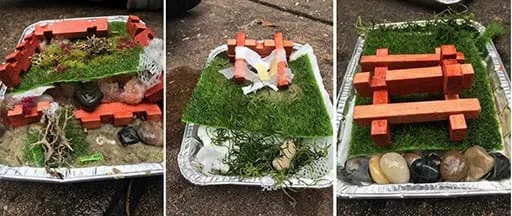 A creative approach toward engineering design can yield a lot of exciting solutions!Copyright 2019 Marlina Romano, University of Florida MRET
Day 2 – Flood prevention
- Review the problem, objective/challenge and constraints. Remind students to record each step in their science notebooks when engineering their flood prevention device.
- Set and display a timer for 30 minutes. Monitor student work and remember to encourage but not assist or direct them. Students will have the full 30 minutes to work on their flood prevention mechanism/device. If a team finishes early, encourage them to pre-assess their work. What do you think will work well to stop flooding? Is there anything that can be improved?
Day 3 - Test and redesign
- Set and display a timer. Give students 5 minutes to put any final touches on their flood prevention mechanism/device.
- Allow each team to create a flood using the beaker/pitcher to test their design.
- Students should record the results of each test in the attached their lab notebooks.
- As a team, students can redesign their device based on their testing.
- Students can test redesigns within the 30-minute allotted time.
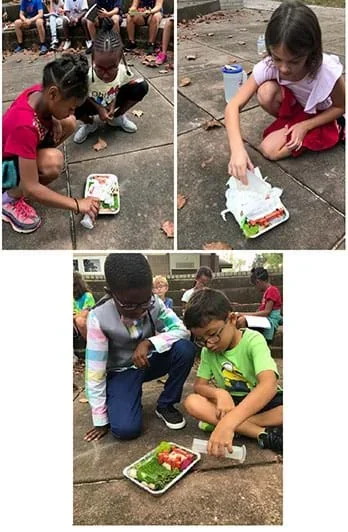 Students iterate upon and test their designs.Copyright 2019 Marlina Romano, University of Florida MRET
- absorption
- The process of water being taken in by another object or matter.
- erosion
- The slow scraping away, grinding away, or weathering of something.
- evaporation
- The process of liquid water turning into vapor.
- flood
- Overflowing of a large amount of water beyond its normal confines, especially over what is normally dry land.
- flood control
- Flood control is a term that refers to all measures that protect settlements, people and property against flooding.
- flood level
- The elevation of the maximum flood level.
- flood plain
- An area of low-lying ground adjacent to a river, formed mainly of river sediments and subject to flooding.
- natural disaster
- An event occurring in nature, such as a flood or an earthquake.
- precipitation
- Water that falls to the ground from the sky.
- states of matter
- Forms in which matter can exist; most commonly solids, liquids, and gas (less common, plasma).
- thunderstorm
- A rainstorm with thunder and lightning.
Pre-Activity Assessment
KWL: Have students fill in the “What I Know” and “What I Want to Know” columns of the KWL Chart (PDF).
Activity-Embedded Assessment
Class monitoring: Take time to evaluate the construction process among each group and provide feedback when necessary, particularly if a group is struggling.
Lab notebook: Review student designs and iterations in their lab notebooks. This is a good opportunity to provide feedback to students during the course of the design process.
Post-Activity Assessment
Ask each team: “Do you need to redesign and build your prevention device again? What would you do differently? What would you keep the same?”
KWL: Have students fill in the “What I Learned” column of the KWL Chart (PDF).
(Optional) Team Presentations and evaluations: Have each team present what they did and if it solved the problem.
Making Sense: Have students reflect on the science concepts they explored and/or the science and engineering skills they used by completing the Making Sense Assessment (PDF).
Have the students design models of other parts of the community and test their flood prevention structures.
Contributors
Marlina Romano
Supporting Program
Multidisciplinary Research Experiences for Teachers of Elementary Grades, Herbert Wertheim College of Engineering, University of Florida
Acknowledgements
This curriculum was based upon work supported by the National Science Foundation under RET grant no. EEC 1711543— Engineering for Biology: Multidisciplinary Research Experiences for Teachers in Elementary Grades (MRET) through the College of Engineering at the University of Florida. Any opinions, findings, and conclusions or recommendations expressed in this material are those of the authors and do not necessarily reflect the views of the National Science Foundation.
Copyright
2020 by Regents of the University of Colorado; original © 2019 University of Florida