
Roll ‘n’ Roller Coaster
Roller coasters are one of the most thrilling ways to feel engineering in action! In this activity, students act as mechanical, civil, and structural engineers as they design and build a roller coaster with their teammates that allows a table tennis ball to roll through the entire model unassisted. As students design and build their roller coaster, they will learn about kinetic and potential energy. Students explain that when the ball is placed at the top of the ramp, it has potential energy (stored energy). Once the ball is released, the potential energy is changed into kinetic energy (energy of motion). Students also identify the role that friction plays in stopping the ball. As students experience the engineering design process and create multiple iterations of their design, they will discover the key to allow the table tennis ball to gain enough momentum to cycle through the roller coaster unassisted is to create an initial slope that’s steep enough to allow the ball to cycle through.
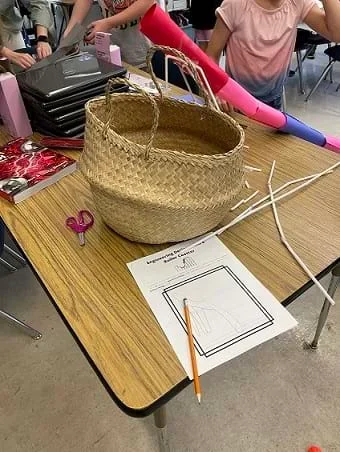 Students sketch their design and build their projects.Copyright 2022 Binta Moncur, University of Florida MRET
Roller coaster engineers typically work with a team of mechanical, civil, and structural engineers. Mechanical engineers design the roller coasters and spend time calculating safety and performance and supervising construction. Civil and structural engineers build, test, and maintain infrastructure. Mechanical engineers work closely with civil and structural engineers. Together they plan the layout for the roller coaster which takes about 10 months to build.
After this activity, students should be able to:
- Explain how kinetic and potential energy are related to the movement of the ball through the roller coaster.
- Discuss how gravity affects the movement of the ball and what causes the ball to stop.
- Relate the steepness of angles in a roller coaster to how fast/slow the roller coaster travels.
- Identify areas for improvement and create future iterations based on those observations.
- CCSS.Math.Content.4.MD.C.5 Recognize angles as geometric shapes that are formed wherever two rays share a common endpoint, and understand concepts of angle measurement:
Grade 4
Do you agree with this alignment?
- SC.4.P.10.1 Observe and describe some basic forms of energy, including light, heat, sound, electrical, and the energy of motion.
Grade 4
Do you agree with this alignment? - SC.4.P.10.2 Investigate and describe that energy has the ability to cause motion or create change.
Grade 4
Do you agree with this alignment? - SC.4.P.12.1 Recognize that an object in motion always changes its position and may change its direction.
Grade 4
Do you agree with this alignment? - SC.4.P.12.2 Investigate and describe that the speed of an object is determined by the distance it travels in a unit of time and that objects can move at different speeds.
Grade 4
Do you agree with this alignment?
- STEL-7H Illustrate that there are multiple approaches to design.
Grades 3-5
Do you agree with this alignment? - STEL-7J Evaluate designs based on criteria, constraints, and standards.
Grades 3-5
Do you agree with this alignment?
- 3-5-ETS1-1 Define a simple design problem reflecting a need or a want that includes specified criteria for success and constraints on materials, time, or cost.
Grades 3-5
This resource focuses on the following Three Dimensional Learning aspects of NGSS:
Science & Engineering Practices- Define a simple design problem that can be solved through the development of an object, tool, process, or system and includes several criteria for success and constraints on materials, time, or cost.Do you agree with this alignment?
Disciplinary Core Ideas- Possible solutions to a problem are limited by available materials and resources (constraints). The success of a designed solution is determined by considering the desired features of a solution (criteria). Different proposals for solutions can be compared on the basis of how well each one meets the specified criteria for success or how well each takes the constraints into account.Do you agree with this alignment?
Crosscutting Concepts- People's needs and wants change over time, as do their demands for new and improved technologies.Do you agree with this alignment?
Do you agree with this alignment? - Define a simple design problem that can be solved through the development of an object, tool, process, or system and includes several criteria for success and constraints on materials, time, or cost.
- 4-PS3-4 Apply scientific ideas to design, test, and refine a device that converts energy from one form to another.
Grade 4
This resource focuses on the following Three Dimensional Learning aspects of NGSS:
Science & Engineering Practices- Apply scientific ideas to solve design problems.Do you agree with this alignment?
Disciplinary Core Ideas- Possible solutions to a problem are limited by available materials and resources (constraints). The success of a designed solution is determined by considering the desired features of a solution (criteria). Different proposals for solutions can be compared on the basis of how well each one meets the specified criteria for success or how well each takes the constraints into account.Do you agree with this alignment?
- Energy can also be transferred from place to place by electric currents, which can then be used locally to produce motion, sound, heat, or light. The currents may have been produced to begin with by transforming the energy of motion into electrical energy.Do you agree with this alignment?
- The expression "produce energy" typically refers to the conversion of stored energy into a desired form for practical use.Do you agree with this alignment?
Crosscutting Concepts- Science affects everyday life.Do you agree with this alignment?
- Energy can be transferred in various ways and between objects.Do you agree with this alignment?
- Engineers improve existing technologies or develop new ones.Do you agree with this alignment?
- Most scientists and engineers work in teams.Do you agree with this alignment?
Do you agree with this alignment? - Apply scientific ideas to solve design problems.
Each group needs:
- 30 plastic straws
- 10 pipe cleaners (or chenille stems)
- table tennis ball
- Engineering Design: Build a Roller Coaster Worksheet (PDF)
For the entire class to share:
- laptop/tablet/computer with projector and access to the Internet
- scissors
- paper
- tape
- Pre-Activity Assessment (docx)
- Pre-Activity Assessment (pdf)
- Pre-Activity Assessment Answer Key (docx)
- Pre-Activity Assessment Answer Key (pdf)
- Post-Activity Assessment (docx)
- Post-Activity Assessment (pdf)
- Post-Activity Assessment Answer Key (docx)
- Post-Activity Assessment Answer Key (pdf)
- Engineering Design: Build a Roller Coaster Worksheet (docx)
- Engineering Design: Build a Roller Coaster Worksheet (pdf)
Roller coasters do not have engines. How do they operate (speed up and slow down)? What makes a roller coaster work without having an engine propel it forward? What causes them to stop once they have started?
We will watch a video clip from the point of view of a passenger in the front seat of a roller coaster. As you watch the video, think about the fact that the roller coaster operates without an engine. How does it move? Play close attention to the speed. When does it speed up? When does it slow down? Finally, what makes the roller coaster come to a stop?
[Show the following video clip: https://www.youtube.com/watch?v=eCNgirpykkk&t=2s]
[Prompt students to think about how the roller coaster changed speed and have them brainstorm reasons they think the roller coaster changed speeds.]
What did you notice about the speed of the roller coaster? Was the speed constant (the same) throughout the ride? (No. When the ride began, the roller coaster was much slower. Once the roller coaster traveled downhill, it sped up considerably. The roller coaster would go a little slower inside loops as well.)
What made the roller coaster speed up or slow down throughout the ride? (Any time the roller coaster went uphill it would go a little slower. Once the roller coaster traveled downhill, it would go much faster.)
Many of these questions will be tested and answered this week.
This week, you will act as roller coaster engineers as you design and build a roller coaster. Roller coaster engineers are typically mechanical, civil, and structural engineers who work together to design, build, and test roller coasters. It typically takes these engineers 10 months go through the entire process of building the roller coaster. These engineers often work in teams. You, too, will work on a team (of 3-4) to design and build your roller coaster.
Roller coaster engineers are constrained to use materials best suited for the rides they design. You will be challenged to build a roller coaster using only the materials provided (plastic straws, construction paper, chenille stems, tape, scissors, and a table tennis ball (which represents the ride). Additionally, you will need to build a roller coaster that has at least two hills. Your ball must be able to travel the full length of your roller coaster unassisted. You will need to think about the best way to get your ball to travel through your entire ride.
As you think about your design, you want to consider two types of mechanical energy that we’ve studied in class: kinetic and potential energy. Remember that kinetic energy is the energy of motion, while potential energy is the energy of position (review these terms with students and administer the pre-assessment activity to ensure a basic understanding).
Throughout the design and build process, you will have time to reflect on what’s working and what you may need to change. You will have the opportunity to iterate on your previous designs, whether it means adding advanced features such as loops, or creating a more aesthetically pleasing design. Remember to have fun!
Background
Students will need to have a basic understanding of kinetic and potential energy. Kinetic energy is the energy of motion, while potential energy is the energy of position. Students can relate their understanding of kinetic and potential energy to roller coasters. For example, when a roller coaster car is uphill, it had built up potential energy, when the car is released, gravity pulls the car downhill and the speed of the car as well as the kinetic energy of the car increases. As the car travels back uphill, the kinetic energy is being transferred into potential energy. At the end of the rides, brakes are applied to slow the ride to a stop. For the car to come to a stop, it experiences friction. Friction is a force that acts against the direction of motion.
Before the Activity
- Place students in group of 3-4.
- Gather and sort materials and make copies of worksheets for groups. Feel free to substitute materials.
- Have the following video (https://www.youtube.com/watch?v=eCNgirpykkk&t=2s) of the roller coaster ready to play for students.
With the Students
- Reveal the student groups of 3-4 to students.
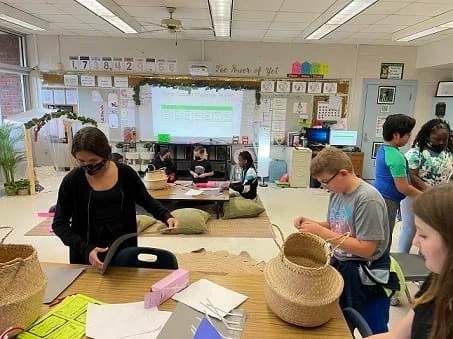 Students just received their team assignments and are busy planning and constructing their roller coasters.Copyright 2022 Binta Moncur, University of Florida MRET
 - Give each group a copy of the Engineering Design: Build a Roller Coaster Worksheet (PDF).
- Review the activity with students and their challenge.
- Post the constraints for students to see. Review them with students.
- Give each group their materials (30 plastic straws, 10 pipe cleaners/chenille stems, and one table tennis ball).
- Let students know where they can access shared materials (construction paper, scissors, tape).
- Have students complete the first page of the Engineering Design: Build a Roller Coaster Worksheet (PDF). Students will need to first draw their design there.Students sketch their design and build their projects.Copyright 2022 Binta Moncur, University of Florida MRET
- Once students have drawn their design, they will begin building their design.
- Have students test their designs as they go; if they discover they need to redesign, they will use the “Iteration #2” page of the Engineering Design: Build a Roller Coaster Worksheet (PDF).
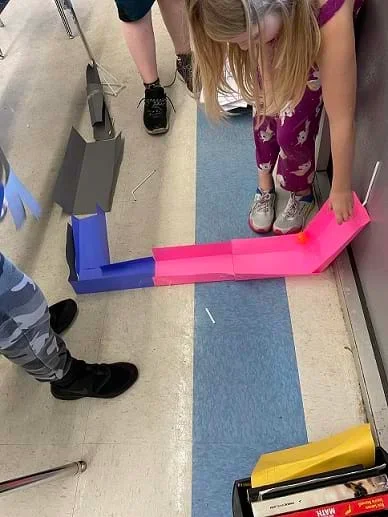 A student testing out the initial ramp of her team’s roller coaster.Copyright 2022 Binta Moncur, University of Florida MRET
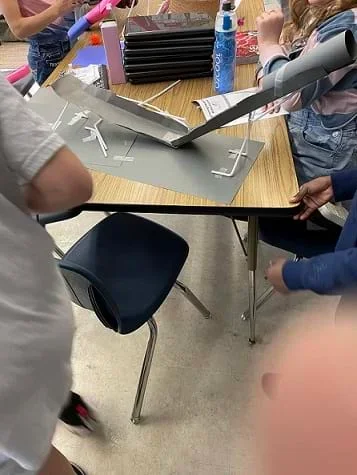 Students work with the materials given to create two ramps on their roller coaster.Copyright 2022 Binta Moncur, University of Florida MRET
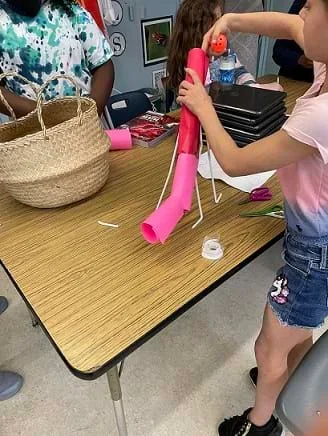 Students attempt to build a high ramp to give their ball enough kinetic energy to make it through their entire roller coaster.Copyright 2022 Binta Moncur, University of Florida MRET
- Once all students have completed their design and build, as a class test each roller coaster to see if it meets all criteria.
- On the final day of the activity, allow students to test one another’s roller coasters and complete the Post-Activity Assessment (PDF).
- constraints
- Limitations or restrictions.
- friction
- A force that acts directly against the direction of motion.
- gravity
- A force that pulls objects down to Earth.
- iteration
- A step where some action is repeated.
- kinetic energy
- The energy of motion.
- potential energy
- The energy something has because of its position or condition.
Pre-Activity Assessment
Students label diagrams with either “p” for potential energy if the image shown is high in potential energy, or “k” if the image shown has more kinetic energy (see Pre-Activity Assessment (PDF)).
Activity Embedded (Formative) Assessment
Students complete the Engineering Design: Build a Roller Coaster Worksheet (PDF) as they work (see worksheets attached). Students are asked:
- Were you successful in getting your ball to travel throughout your entire roller coaster unassisted? Why or why not? (If students answer yes, they would have needed to come to the realization that the initial hill/ramp of the roller coaster would need to be steep enough to allow the ball to travel the entire course. If the student was not successful in their attempt, they may acknowledge that friction played a part in having the ball stop prematurely.)
- How long did it take your ball to travel through your roller coaster (in seconds)? (Answers vary)
- What caused your ball to stop? (Possible answers: Friction, or poor design causing the ball to fall off course)
Students are also asked to label various paths a roller coaster car takes and tell whether the car in that spot has more kinetic or potential energy.
Post-Activity (Summative) Assessment
Students explain how kinetic and potential energy, as well as gravity and friction are related to building and designing a roller coaster. Students also reflect upon their various designs, pinpointing what worked, what did not work, and why (see Post-Activity Assessment (PDF)).
Contributors
Binta Moncur; Sarah Furtney; Kevin Li; Peyton Turinetti; Andres Rubiano; Chelsey Simmons; Renee Simmons; Marlina Romano; Kayla Sutcliffe
Supporting Program
Multidisciplinary Research Experiences for Teachers in Elementary Grades, College of Engineering at the University of Florida
Acknowledgements
This curriculum was based upon work supported by the National Science Foundation under RET grant no. EEC 1711543— Engineering for Biology: Multidisciplinary Research Experiences for Teachers in Elementary Grades (MRET) through the College of Engineering at the University of Florida. Any opinions, findings, and conclusions, or recommendations expressed in this material are those of the authors and do not necessarily reflect the views of the National Science Foundation.
Special thanks to Sarah Furtney, Kevin Li, Peyton Turinetti, Andres Rubiano, Chelsey Simmons, Renee Simmons, Marlina Romano, Kayla Sutcliffe
Copyright
2023 by Regents of the University of Colorado; original © 2022 University of Florida