
Animal Adaptations Fashion Show
Students will use what they have learned about animal survival and habitation to design and build their own “animals.” Students will be assigned a particular habitat and asked to determine what physical features would best help a living creature survive in that environment. They will first draw out their design and then face their next challenge; building a wearable model of their animal for our adaptation fashion show out of recyclable materials.
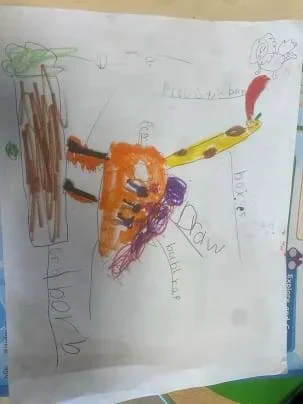 An example of a student design.Copyright 2022 Rebecca Butler, University of Florida MRET
Animals are studied for many different reasons by engineers. Often, environmental engineers are observing animals and their survival methods to see whether they will withstand growing ecological pressures. Animal adaptation is often also adopted and studied by biomedical engineers and materials engineers when thinking of ways to improve upon things such as tissue engineering, materials design, and ways to improve upon the human condition. Animals and their physical features have created many innovations in human history such as materials that imitate shark skin to shuck off unwanted barnacles or growth, cooling systems developed by observing termite habitats, and kingfisher bird beaks that inspired the shape of bullet trains.
After this activity, students should be able to:
- Define how an animal’s habitat affects its physical structure.
- Summarize how an animal's physical features help it meet its needs such as food and water.
- Analyze and measure data to design an animal suited to its assigned habitat.
- Identify which environment to which an animal is suited based on its identifying features.
- Employ the engineering design process to critically evaluate their creation.
- Use their creative and analytical skills to design their very own animal designed to meet the needs of their assigned habitat.
- Evaluate how animal adaptations can help humans design better ways to survive in harsh habitats.
- 1-LS1-1 Use materials to design a solution to a human problem by mimicking how plants and/or animals use their external parts to help them survive, grow, and meet their needs.
Grade 1
This resource focuses on the following Three Dimensional Learning aspects of NGSS:
Science & Engineering Practices- Use materials to design a device that solves a specific problem or a solution to a specific problem.Do you agree with this alignment?
Disciplinary Core Ideas- All organisms have external parts. Different animals use their body parts in different ways to see, hear, grasp objects, protect themselves, move from place to place, and seek, find, and take in food, water and air. Plants also have different parts (roots, stems, leaves, flowers, fruits) that help them survive and grow.Do you agree with this alignment?
- Animals have body parts that capture and convey different kinds of information needed for growth and survival. Animals respond to these inputs with behaviors that help them survive. Plants also respond to some external inputs.Do you agree with this alignment?
Crosscutting Concepts- The shape and stability of structures of natural and designed objects are related to their function(s).Do you agree with this alignment?
- Every human-made product is designed by applying some knowledge of the natural world and is built using materials derived from the natural world.Do you agree with this alignment?
Do you agree with this alignment? - Use materials to design a device that solves a specific problem or a solution to a specific problem.
- K-2-ETS1-2 Develop a simple sketch, drawing, or physical model to illustrate how the shape of an object helps it function as needed to solve a given problem.
Grades K-2
This resource focuses on the following Three Dimensional Learning aspects of NGSS:
Science & Engineering Practices- Develop a simple model based on evidence to represent a proposed object or tool.Do you agree with this alignment?
Disciplinary Core Ideas- Designs can be conveyed through sketches, drawings, or physical models. These representations are useful in communicating ideas for a problem's solutions to other people.Do you agree with this alignment?
Crosscutting Concepts- The shape and stability of structures of natural and designed objects are related to their function(s).Do you agree with this alignment?
Do you agree with this alignment? - Develop a simple model based on evidence to represent a proposed object or tool.
Each group needs:
- Animal Planning and Design Sheet (PDF)
- crayon, markers, or colored pencils
- a box or bag to keep their design material in if it is not built in one day.
For the entire class to share:
Some suggestions for recycled materials:
- cardboard
- paper towels or toilet paper rolls
- Popsicle sticks
- straws
- paper
- ping pong balls
- rubber bands
- plastic spoons
- cups
- clothespins
- masking tape
- aluminum foil
- paper plates
- balloons
- recycled containers
- recycled bottles
- Styrofoam
- magnets
For the catwalk:
- A long roll of paper or a bunch of papers taped together
Before completing this activity, students must have studied animal adaptations and habitats and understand the different physical adaptations that are common amongst species. They will have a knowledge of features typical to carnivores, omnivores, and vegetarians. They will also have a general knowledge of animals that typically live in each environment.
We have been learning about different habitats and the animals that live there (pull up the Pre- Assessment Chart Activity (PPTX)) who can tell me some of the habitats they see on the board? (Have students read out the different habitats). Who can remember some of the adaptations for each of those environments on our chart? (Allow for 6-7 responses).
Since all of these adaptations offer us cool insight into how animals survive in the wild, let’s take it a step further and have an animal adaptation fashion show to show off how wonderful animals can be! First, we will get in groups and each group will be assigned a habitat. Then, you will think like engineers! Engineers use the Engineering Design Process to find solutions to problems or to reach a certain goal. Our goal is to show off how wonderful animal adaptations can be by creating an animal costume.
The Engineering Design Process starts with doing research or learning about the problem. You will have to fill out the information about your habitat and use that to help you design adaptations for your animal. You will get to brainstorm, or imagine, different adaptations for your animal, just like engineers!
Once you have decided on these you will draw a prototype of your animal. Engineers draw their designs, too! Drawing the design helps you create it. You will think about what materials you might want to use and the different constraints for your design. Constraints are things that might make it difficult to create your costume, like time, materials you might not have, or something about your design. Do you think engineers also think about constraints? Engineers think about constraints a lot! They make sure their designs can work even with the constraints; you will also think about the constraints for your costume.
Finally, you will act like engineers and follow the Engineering Design Process steps, which include building a prototype. You are going to make that drawing of a prototype into a real costume that one of your teammates will wear to walk the red carpet at our fashion show and show off your new animal creation! Are you ready to act like engineers and use the Engineering Design Process to create animal adaptation fashion?
Background
Animal adaptations are one method that animals use to help them survive and reproduce in the wild. These are usually based on where they live and what their needs are. Adaptations can be both physical and behavioral and an example of a physical adaptation may be a rabbit’s large ears that allow it to better hear approaching prey. A behavioral adaptation could be a bear hibernating for the winter to conserve energy. Engineers and scientists alike study how animals adapt to their environment for many reasons. Sometimes watching them can help us learn how to an environment better or can lead to new inventions that improve our society.
Before the Activity
- Make sure that you have gathered enough recycled materials for your students to use and preferably organize or sort them in a way that makes it easy for students to find objects.
- Optional: A few days before the activity, send a note home with students asking for materials.
- Print the Animal Planning and Design Sheet (PDF) (enough for one sheet per group)
- Optional: Print the Environments Sheet (PDF) (enough for one sheet per group)
- If you want, complete the Pre- Assessment Chart Activity (PPTX) with your students.
With the Students
Day 1
- Put students into groups however you choose. You can use the recommended Animal Adaptation Groups (PPTX) slide or do it your own way.
- Each group is going to be assigned information on one habitat (see Environments Sheet (PDF)). With their group, they are going to design an animal with adaptations for the habitat they were given. Their animal can look like a real animal or be completely different, but they must be able to justify why their adaptations make sense. Consider using the following guide to explain to students their jobs for today:
- First, read about your habitat. (Project the Environments Sheet (PDF) to the class or distribute copies to each group. You may need to read these to students or choose one of your advanced students in each group to be the reader.) Remember, when you learn about the habitat, you are following the Engineering Design Process! When you have done that, raise your hand and I will give you a paper. (Distribute copies of the Animal Planning and Design Sheet (PDF).)
- The paper asks questions like “where could my animal live, what does it have to eat, how hot or cold is the environment?” You need to answer those questions and then brainstorm with your group adaptations that will help your animal survive each of these problems and write them down on your paper. Brainstorming is an important of the Engineering Design Process. Go wild and think of lots of adaptations! Note: Before you begin your design you must get your paper approved.
- Next, you need to use your ideas to sketch your animal. Engineers sketch their designs, too! Drawing your prototype Is an important part of the Engineering Design Process; it will help you build your animal costume tomorrow. In your drawings, make sure you use color and label each adaptation. Think of how you are going to make it into a costume and what materials you might want to use. You must also think about constraints or things that might be difficult to make on your costume this could be things like time, materials you might not have, or something about your design. When you are all done, you need to show me and get your design approved, I may make you go back and do a second iteration. Engineers often go through many iterations of their designs, it’s all part of the Engineering Design Process! Iterating a design helps engineers learn what works and what doesn’t work so that they end up with the best possible design.
- While students are designing and brainstorming, the teacher can walk around and monitor, and offer suggestions if necessary.
- When students are finished, you may collect their papers and assign other work or allow them to begin their design.An example of a student design.Copyright 2022 Rebecca Butler, University of Florida MRET
Day 2
- Now everyone should have a design and a plan for their animal costume for the fashion show ready.
- Tell students, “Your job today is to build your animal costume. Just like engineers, you will use the drawings you made of your prototypes yesterday to help you build your costumes. Here are some things to remember before you build:”
- You must choose one person from your group to be your model and wear the costume (or teachers can use my assigned roles slides).
- Your person must be able to move in the costume and walk down our catwalk.
- Make safe choices! Make sure your model can see!
- You only have 45 minutes to make your costume, so use your time wisely.
- Again, while the students are working make sure to monitor them and offer suggestions if needed.
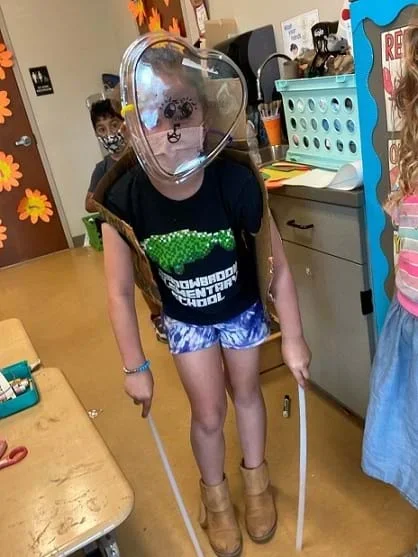 A student displays their prototype.Copyright 2022 Rebecca Butler, University of Florida MRET
 - At the end make sure all costumes are completed and organized, ready for the next day.
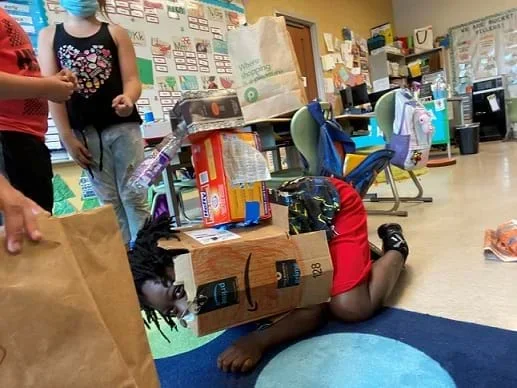 A student displays a finished costume inspired by biomimicry.Copyright 2022 Rebecca Butler, University of Florida MRET
Day 3
On this last day, students get to present their animals.
- Take a long roll of paper or tape a bunch of papers together to create a catwalk for your students to walk down.
- Give the groups about five minutes to get their models dressed and ready.
- Have each group go up one by one, and have their model walk up and down the catwalk. The students will then tell what their environment was and why they chose each adaptation.
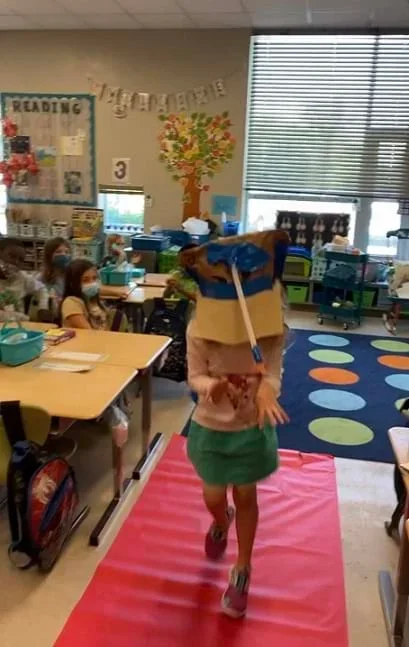 An “animal” walking down the catwalk.Copyright 2022 Rebecca Butler, University of Florida MRET
 - At the end of each group’s presentation, allow at least three questions from the rest of the class about their design.
- After the show is over, bring your students together to reflect upon their designs. Tell students that engineers reflect upon their designs to learn from them and make future designs even better. Some possible questions could be:
- What do you think you could have improved upon in your design?
- What constraints did you face while building?
- What parts of your design would you not change?
- Why is it important to learn about animal adaptations?
- How do you think knowing about animal adaptations could help humans?
- At this point, show one of the videos linked below in the Multimedia Support or Technology Integration section.
- You can then do the optional Make Sense Activity (PDF) with your students during that lesson or on another day.
- adaptation
- A special skill which helps an animal to survive and do everything it needs to do.
- camouflage
- A way of hiding something by covering or coloring it so that it looks like its surroundings.
- habitat
- A place where an animal lives.
- migration
- The travelling of long distances in search of a new habitat.
- mimicry
- A type of protection from predators in which one animal resembles the coloring, form, or behavior of another animal that is harmful or bad tasting.
- omnivore
- An animal that eats both plant and meat-based food.
- physical adaptation
- Special body parts that help a plant or animal survive in an environment.
Pre-Activity Assessment
Chart: Have students write or draw about one adaptation from each environment, desert, mountain, ocean, arctic, jungle, or savannah. Then briefly discuss some of these adaptations and why they help animals in that environment.
Activity Embedded (Formative) Assessment
Worksheet: Have students complete the Animal Planning and Design Sheet (PDF).
Post-Activity (Summative) Assessment
Discussion: Discuss with students which adaptations they thought were most useful for their animals in their environment. How could that help us know how to survive in that environment?
Make Sense Activity: Complete the Make Sense Activity (PDF) with students.
Writing connection: Have students choose an environment and write about how they would use their invented animal adaptions to survive there. How could they mimic those adaptions with clothing or other already made materials such as boots, sunglasses, etc.
To support the assembly of student designs, you can buy some more heavy-duty tape or allow the use of hot glue guns. Optional: Use cool shot guns so you don’t have to worry about burnt fingers!
To extend upon this activity you could delve further into how animals have inspired technology and have students be inspired by their own animal adaptation or feature to create an invention. Look into people like George de Mestral who discovered Velcro by observing his dog and doing a scientist study. Or you can have students focus on one animal and explore their adaptations in depth.
For lower grades/younger students,
- Have pictures instead of written descriptions of the environment to give students.
- Have specific examples of animals from each habitat to reference.
For upper grades/older or more advances students,
- Create more parameters for them to consider when designing their creature (such as protecting their young, landforms, etc.).
- Create an additional constraint by limiting the materials available.
- Have students learn sewing and engineer a costume with fabric.
Some cool videos to get your students inspired.
- 5 Inventions Inspired by Animals: https://www.youtube.com/watch?v=lPdMQFHCfEM
- 11 Awesome Technologies Inspired by Animals: https://www.youtube.com/watch?v=aQacm4BkOvA
- 11 Technologies Inspired by Animals: https://www.youtube.com/watch?v=kTL-Hkf6R5s
Contributors
Rebecca Butler
Supporting Program
Multidisciplinary Research Experiences for Teachers of Elementary Grades, Herbert Wertheim College of Engineering, University of Florida
Acknowledgements
This curriculum was based upon work supported by the National Science Foundation under RET grant no. EEC 1711543— Engineering for Biology: Multidisciplinary Research Experiences for Teachers in Elementary Grades (MRET) through the College of Engineering at the University of Florida. Any opinions, findings, and conclusions or recommendations expressed in this material are those of the authors and do not necessarily reflect the views of the National Science Foundation.
Copyright
2023 by Regents of the University of Colorado; original © 2022 University of Florida