
Oil Spill Clean-Up
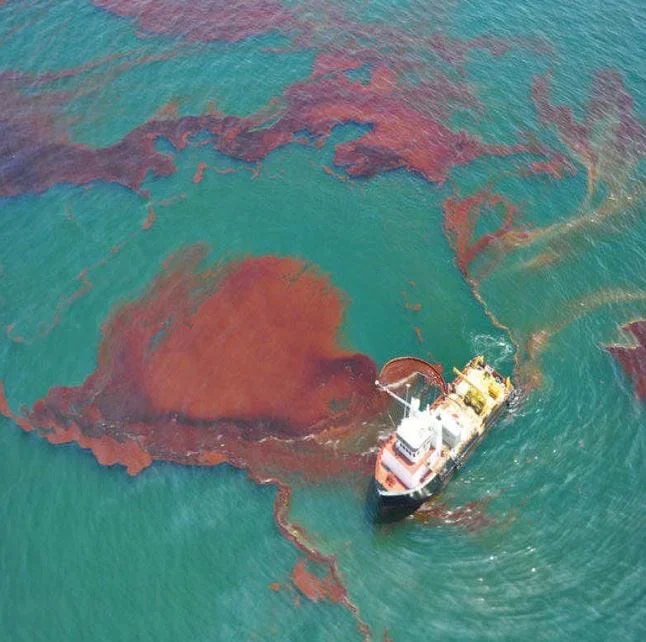 Cleaning up oil spills uses essential elements of the engineering design process.Copyright 2010 National Oceanic and Atmospheric Administration (NOAA), Public Domain
Students are introduced to oil spills and what exactly happens when oil is spilled onto the ocean’s surface. Students are shown real images of major oil spills as a phenomenon. The class discusses the effects of oil spills have on oceans and marine life, including plant and animal populations such as birds, otters, and ducks. They take on the role of an environmental engineering company and are tasked to clean up a major oil spill disaster. Students use a variety of materials that absorb oil. Certain constraints will be put upon the students to mimic an engineering atmosphere.
Environmental engineers develop solutions to combat pollution; oil spills are an extreme type of pollution in bodies of water, particularly oceans. Environmental engineers help clean up oil spills and improve a polluted environment so that it is once again able to provide food, water, space, and essential nutrients for its population of plants and animals.
After this activity, students should be able to:
- Test a variety of materials to determine which absorbs and removes the most oil.
- Use a ruler to measure how much oil has been collected.
- Create a class double bar graph to document and display data.
- Present their knowledge and findings to the class.
- CCSS.ELA-Literacy.W.2.7 Participate in shared research and writing projects (e.g., read a number of books on a single topic to produce a report; record science observations).
Grade 2
Do you agree with this alignment?
- CCSS.Math.Content.2.MD.A.1 Measure the length of an object by selecting and using appropriate tools such as rulers, yardsticks, meter sticks, and measuring tapes.
Grade 2
Do you agree with this alignment? - CCSS.Math.Content.2.MD.A.4 Measure to determine how much longer one object is than another, expressing the length difference in terms of a standard length unit.
Grade 2
Do you agree with this alignment? - CCSS.Math.Content.2.MD.D.10 Draw a picture graph and a bar graph (with single-unit scale) to represent a data set with up to four categories. Solve simple put-together, take-apart, and compare problems using information presented in a bar graph.
Grade 2
Do you agree with this alignment? - CCSS.Math.Practice.MP2 Reason abstractly and quantitatively.
Grades K-12
Do you agree with this alignment? - CCSS.Math.Practice.MP4 Model with mathematics.
Grades K-12
Do you agree with this alignment? - CCSS.Math.Practice.MP5 Use appropriate tools strategically.
Grades K-12
Do you agree with this alignment?
- SC.2.N.1.2 Compare the observations made by different groups using the same tools.
Grade 2
Do you agree with this alignment? - SC.2.N.1.6 Explain how scientists alone or in groups are always investigating new ways to solve problems.
Grade 2
Do you agree with this alignment? - SC.2.P.8.1 Observe and measure objects in terms of their properties, including size, shape, color, temperature, weight, texture, sinking or floating in water, and attraction and repulsion of magnets.
Grade 2
Do you agree with this alignment?
- 2-PS1-1 Plan and conduct an investigation to describe and classify different kinds of materials by their observable properties.
Grade 2
This resource focuses on the following Three Dimensional Learning aspects of NGSS:
Science & Engineering Practices- Plan and conduct an investigation collaboratively to produce data to serve as the basis for evidence to answer a question.Do you agree with this alignment?
Disciplinary Core Ideas- Different kinds of matter exist and many of them can be either solid or liquid, depending on temperature. Matter can be described and classified by its observable properties.Do you agree with this alignment?
Crosscutting Concepts- Patterns in the natural and human designed world can be observed.Do you agree with this alignment?
Do you agree with this alignment? - Plan and conduct an investigation collaboratively to produce data to serve as the basis for evidence to answer a question.
- 2-PS1-2 Analyze data obtained from testing different materials to determine which materials have the properties that are best suited for an intended purpose.
Grade 2
This resource focuses on the following Three Dimensional Learning aspects of NGSS:
Science & Engineering Practices- Analyze data from tests of an object or tool to determine if it works as intended.Do you agree with this alignment?
Disciplinary Core Ideas- Different properties are suited to different purposes.Do you agree with this alignment?
Crosscutting Concepts- Simple tests can be designed to gather evidence to support or refute student ideas about causes.Do you agree with this alignment?
- Every human-made product is designed by applying some knowledge of the natural world and is built using materials derived from the natural world.Do you agree with this alignment?
Do you agree with this alignment? - Analyze data from tests of an object or tool to determine if it works as intended.
Each pair needs (be sure to use the same exact materials and amounts of liquid for each pair to ensure constant variables):
- tubs or foil baking pans with water (x2 for each pair when they would like to choose different materials)
- water
- vegetable oil: amount depends on tray; use a 1:4 oil to water ratio
- 2-3 different brands of cotton balls
- 2-3 different brands of sponges
- 2-3 different brands of paper towels
- cotton swabs (such as Q-Tips)
- eyedroppers
- cocoa powder
- spoons
- 500 mL beakers
- ruler
- Oil Spill Clean-Up Worksheet (PDF)
- chart paper
- blue food coloring (optional)
For the entire class to share:
- poster paper
- markers
Students should have a basic understanding of reading and making a one column bar graph. They should be familiar with words such as title, axis, vertical, horizontal, scale, and legend when referring to bar graphs.
- Watch this video (2:11) https://www.youtube.com/watch?v=iiDw68JgUng on how to create a double bar graph in Google Sheets.
Let us look at these pictures (show the Oil Spill Cleanup PowerPoint (PPTX)). While looking at them, I want you to write down on a piece of paper what you notice and wonder. (Pass out one piece of paper separated into 5 sections.) Feel free to use sentences, words, or pictures to explain what you notice and wonder. I will give you 30 seconds – 1 minute for each image. (After each image is shown, have students talk about each image with each other, but do not tell them what is occurring.)
What do you think is happening in these pictures? (Possible answers: the water is dirty; the animals look sad or hurt because they have something on them.) Cleaning up oil spills uses essential elements of the engineering design process.Copyright 2010 National Oceanic and Atmospheric Administration (NOAA), Public Domain
Has anyone ever heard of or used oil before? (Elicit student responses.) Oil is used across the world for many things, including making plastic items and for people’s cars. Because so many people use oil across the world, oil is moved in huge boats called tankers. These tankers can leak, crash, or explode, which accidentally spills all its oil into the ocean.
Have you heard of environmental engineers before? Environmental engineers develop solutions to problems in the environment, like our oceans. Based on our conversation so far, what do you think the problem we are going to solve is today? How are we going to act as environmental engineers?
The Environmental Protection Agency (EPA) has contacted us to investigate the best way to clean up an oil spill. We are going to act as an environmental engineering company to solve this problem: how can we effectively absorb and remove the most oil in the ocean that has spilled from a giant tanker to protect marine life?
Before the Activity
- Gather materials (x2) for each set of pairs. Put several drops of blue food coloring in the water. Mix cocoa powder with vegetable oil and pour mixture into water. Make sure to use a 1:4 ratio of oil to water in each tub or pan every time. Example ratio: 2 cups of oil and 8 cups of water.
- Separate and label different brands of cotton balls, sponges, and paper towels as “Brand A, Brand B, and Brand C.”
- (Optional) Before Day 3, prepare the students’ posters depending on student ability. For younger grades, set up their poster ahead of time so that they only have to write in the details. Include sections of Problem, Materials, What We Learned, and How We Acted Like Environmental Engineers. For upper-level grades, leave their paper blank.
With the Students
Day 1
- Present the Introduction/Motivation content (show the Oil Spill Clean-up PowerPoint (PPTX)). As a class, discuss that engineers find practical solutions to problems by engaging in the Engineering Design Process.
- Divide the class into pairs and pass out the Oil Spill Clean-Up Worksheets (PDF).
- Remind students of the goal: clean up the most oil and place it in the beakers within the 10-minute time limit. Tell students that engineers have constraints, or limits, on things that they can do, especially with time. It is important to quickly clean up an oil spill because of the dangerous effects it can have on plant and marine life.
- Give students time to brainstorm what materials they would like to try first to absorb the oil. Have them record their hypothesis on their worksheets.
- Have each pair come up one at a time and take the materials they would like first. Ask students to explain why they are choosing those materials. Have students record their thinking on their Oil Spill Clean-Up Worksheets (PDF) in the “Round 1 material and why” section.
- Guide students on how to get their materials to absorb the liquid and squeeze into their beakers.
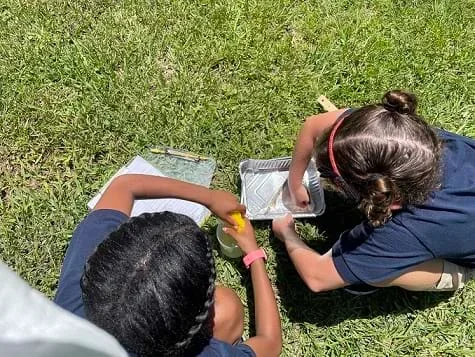 Students work in pairs to remove the oil from the water.Copyright 2022 Kayla SutcliffeDepending on the students’ ages, you might want to demonstrate first. Circulate amongst the pairs while they are working. Set a 10-minute timer and display for everyone to see.
 - After time is up, with rulers, students will measure and record on their Oil Spill Clean-up Worksheet (PDF) the amount of oil (not water) in the beakers in centimeters. Circulate and double check students’ measurements. Have pairs fill out the rest of the Round 1 section.
- Afterwards, give students a reset of the initial materials (pans, oil, and water) to try again, but with different absorbing materials. Pour out the water and oil in their beakers. Ask students to record what they are choosing next on their worksheets in the “Round 2 material and why” section. Repeat the activity. Have students record their answers to the final two questions on their Oil Spill Clean-Up Worksheets (PDF).
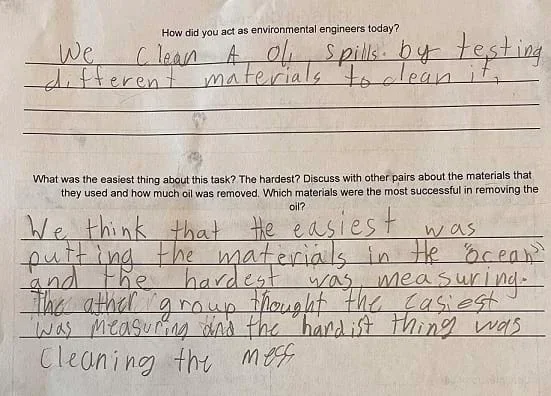 Students explain how they acted as environmental engineers.Copyright 2022 Kayla Sutcliffe, University of Florida MRET
Day 2
- Gather students together and discuss what was easy and what was difficult. Ask each pair how many centimeters of oil each group collected, and display data on the board in a table. Ask students if they have ever heard of a double bar graph. Show examples found on the web. Tell students that they are going to make a double bar graph based on the data collected from the class shown here in the table on the board. Ask students what they think the title, axis titles, and scale should be.
- Give each pair of students a piece of chart paper and markers to create their double bar graphs. Leave examples of double bar graphs on the board along with the data. Consider creating one through Google Sheets.
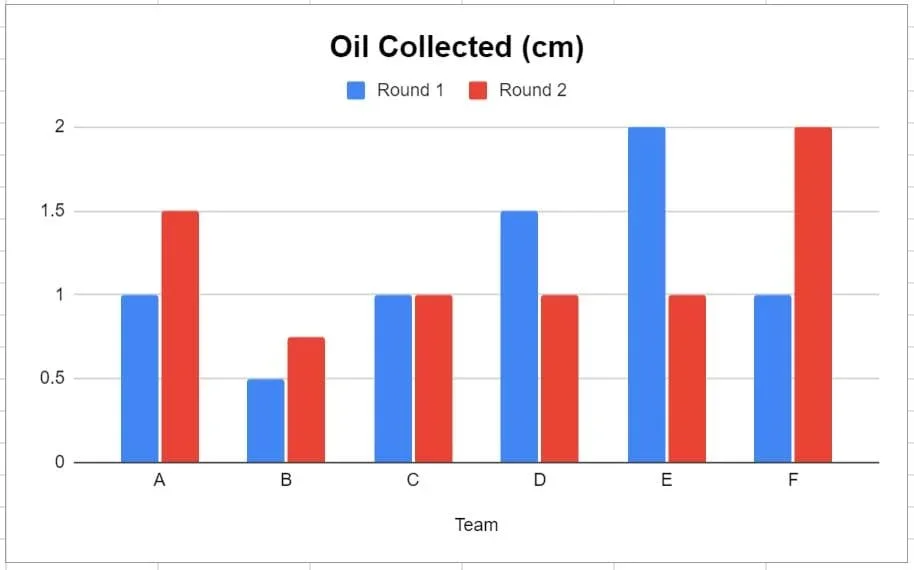 Class data represented in a double bar graph.Copyright 2022 Kayla Sutcliffe, University of Florida MRET
Day 3
- Tell students that they will present their findings because engineers always share their data and information that they find. Give each group one piece of poster paper and markers to present their design process. Students should include the following on their poster:
- Problem: can we successfully clean the ocean from an oil spill?
- What brands of cotton balls, paper towels, and/or sponges they chose first, second, and why?
- What they learned from certain materials (what kind of materials absorbed the oil the best).
- How they acted as environmental engineers.
Day 4
- Have students present their posters!
- absorb
- To take in or soak up.
- environment
- The things and conditions that are all around one.
- environmental engineer
- An engineer who applies various scientific principles and ideas to help provide clean water, minimize pollution, and improve the environment.
- marine life
- Plants and animals that live in the sea.
- pollution
- Harmful or poisonous things that people put into the environment.
Pre-Activity Assessment
Discussion: Before the activity begins, ask students what an oil spill is or if anyone has ever heard of one. Also ask students what brand(s) of cotton balls, paper towels, and sponges (show students all brands and label as “Brand A, Brand B, and Brand C”) they think will absorb the most oil; ask students to justify their answers.
Activity Embedded (Formative) Assessment
Worksheet: As partners, have students complete the Oil Spill Clean-Up Worksheet (PDF).
Post-Activity (Summative) Assessment
Presentation: Each group will present their findings to the class.
Discuss/think-pair-share: Have students discuss the following questions in the style of “Think-Pair-Share:” Which materials met our goal today of absorbing the most oil from the water? (Student answers may vary.) How did you act as environmental engineers today? (Example answer: we helped clean the oceans so that animals could live there, got rid of ocean pollution, etc.) What does the double bar graph that you made show us? (Example answer: that team x collected the most, team y and team z collected this much, etc.)
Making Sense Assessment: Have students reflect on the science concepts they explored and/or the science and engineering skills they used by completing the Making Sense Assessment (PDF).
Although some materials are edible, make sure younger students are not ingesting the oil or cocoa powder.
- The water and oil can be messy. Consider doing the activity outdoors or placing plastic mats/tarps underneath the students. Have dish soap ready to wash hands with to remove oil easier.
- Since oil can stain clothes, consider using plastic gloves and aprons.
- When students are to record data on their worksheets, some might need more help than others depending on age. Encourage students to help each other record. Pictures are also acceptable forms of recording.
- Ensure students are measuring in centimeters, not inches.
- Consider adding dish soap to the water/oil mixture and discuss what occurs. Discuss how soap might be useful to the clean-up process.
- As a class, research oil spill response techniques that engineers actually use, including containment, using chemicals, and using physical methods.
- Watch https://www.youtube.com/watch?v=ZIjB5c_N5ME: a cartoon on how oil harms marine environments (4:32).
- Have students also find the best materials to clean a bird feather (bird feathers can be found here). Discuss the importance of cleaning up oil spills.
- For upper grades, require a scaled bar-graph.
- For upper grades, consider adding more rounds of material testing.
- For upper grades, discuss how the oil does not mix with the water and floats on top of the surface; make a connection to water/oil density and molecules.
- For more advanced students, have them write their own one- and two-step word problems having to do with the bar graph. Example: “How many more inches of oil did group 1 collect than group 2 and group 3 combined?” Have them present their questions to the class to solve.
"Oil Spill Facts: Lesson for Kids." Study.com, 16 June 2017, study.com/academy/lesson/oil-spill-facts-lesson-for-kids.html. Accessed 06/07/2022.
Wordsmyth Illustrated Learner’s Dictionary. Accessed 06/07/2022. (Source of some vocabulary definitions, with some adaptation) https://kids.wordsmyth.net/we/
Contributors
Kayla Sutcliffe
Supporting Program
Multidisciplinary Research Experiences for Teachers of Elementary Grades, Herbert Wertheim College of Engineering, University of Florida
Acknowledgements
This curriculum was based upon work supported by the National Science Foundation under RET grant no. EEC 1711543— Engineering for Biology: Multidisciplinary Research Experiences for Teachers in Elementary Grades (MRET) through the College of Engineering at the University of Florida. Any opinions, findings, and conclusions or recommendations expressed in this material are those of the authors and do not necessarily reflect the views of the National Science Foundation.
Copyright
2023 by Regents of the University of Colorado; original © 2022 University of Florida