
The Power in Prosthetics
Prosthetics are a unique combination of science and engineering that help create a better quality of life for those in need of artificial limbs. Students create a functional prosthetic hand that will be useful for day-to-day tasks. The prototype will need to include moveable fingers that bend to pick up a small Styrofoam cup, a large foam die, and a whiteboard eraser. Students will be paired into groups of two to begin planning, designing, and building their prototype. Each group will then test and evaluate their prototype by using it to pick up materials as listed above. Students will improve their prototype as needed.
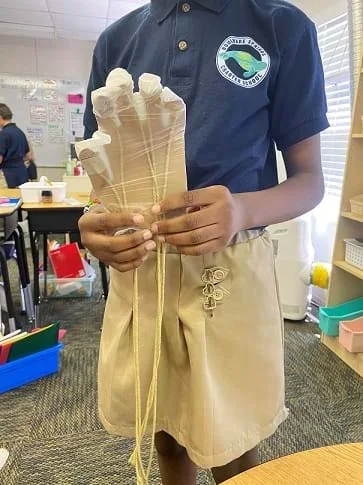 A student demonstrates how their prosthetic hand works.Copyright 2022 Shaci Davis, University of Florida MRET
Biomedical engineers help design prosthetics for people with various disabilities. They also work on artificial tissues and organs, implantable devices (such as a pacemaker for the heart), and orthopedic implants (materials that are used to replace bones and joints). A biomedical engineer solves problems by looking for solutions to different medical challenges. They look for ways to improve a patient’s quality of life.
After this activity, students should be able to:
- Explain and demonstrate the engineering design process.
- Use a science and engineering notebook for notetaking and recording observations.
- Calculate and demonstrate sizes of measurement units using a ruler.
- CCSS.Math.Content.4.MD.A.1 Know relative sizes of measurement units within one system of units including km, m, cm; kg, g; lb, oz.; l, ml; hr, min, sec. Within a single system of measurement, express measurements in a larger unit in terms of a smaller unit. Record measurement equivalents in a two column table.
Grade 4
Do you agree with this alignment?
- SC.4.N.1.1 Raise questions about the natural world, use appropriate reference materials that support understanding to obtain information (identifying the source), conduct both individual and team investigations through free exploration and systematic investigations, and generate appropriate explanations based on those explorations.
Grade 4
Do you agree with this alignment? - SC.4.N.1.8 Recognize that science involves creativity in designing experiments.
Grade 4
Do you agree with this alignment?
- 3-5-ETS1-1 Define a simple design problem reflecting a need or a want that includes specified criteria for success and constraints on materials, time, or cost.
Grades 3-5
This resource focuses on the following Three Dimensional Learning aspects of NGSS:
Science & Engineering Practices- Define a simple design problem that can be solved through the development of an object, tool, process, or system and includes several criteria for success and constraints on materials, time, or cost.Do you agree with this alignment?
Disciplinary Core Ideas- Possible solutions to a problem are limited by available materials and resources (constraints). The success of a designed solution is determined by considering the desired features of a solution (criteria). Different proposals for solutions can be compared on the basis of how well each one meets the specified criteria for success or how well each takes the constraints into account.Do you agree with this alignment?
Crosscutting Concepts- People's needs and wants change over time, as do their demands for new and improved technologies.Do you agree with this alignment?
Do you agree with this alignment? - Define a simple design problem that can be solved through the development of an object, tool, process, or system and includes several criteria for success and constraints on materials, time, or cost.
- 3-5-ETS1-2 Generate and compare multiple possible solutions to a problem based on how well each is likely to meet the criteria and constraints of the problem.
Grades 3-5
This resource focuses on the following Three Dimensional Learning aspects of NGSS:
Science & Engineering Practices- Generate and compare multiple solutions to a problem based on how well they meet the criteria and constraints of the design problem.Do you agree with this alignment?
Disciplinary Core Ideas- Research on a problem should be carried out before beginning to design a solution. Testing a solution involves investigating how well it performs under a range of likely conditions.Do you agree with this alignment?
- At whatever stage, communicating with peers about proposed solutions is an important part of the design process, and shared ideas can lead to improved designs.Do you agree with this alignment?
Crosscutting Concepts- Engineers improve existing technologies or develop new ones to increase their benefits, to decrease known risks, and to meet societal demands.Do you agree with this alignment?
Do you agree with this alignment? - Generate and compare multiple solutions to a problem based on how well they meet the criteria and constraints of the design problem.
- 3-5-ETS1-3 Plan and carry out fair tests in which variables are controlled and failure points are considered to identify aspects of a model or prototype that can be improved.
Grades 3-5
This resource focuses on the following Three Dimensional Learning aspects of NGSS:
Science & Engineering Practices- Plan and conduct an investigation collaboratively to produce data to serve as the basis for evidence, using fair tests in which variables are controlled and the number of trials considered.Do you agree with this alignment?
Disciplinary Core Ideas- Tests are often designed to identify failure points or difficulties, which suggest the elements of the design that need to be improved.Do you agree with this alignment?
- Different solutions need to be tested in order to determine which of them best solves the problem, given the criteria and the constraints.Do you agree with this alignment?
Do you agree with this alignment? - Plan and conduct an investigation collaboratively to produce data to serve as the basis for evidence, using fair tests in which variables are controlled and the number of trials considered.
Each group will need:
- pre-cut hand tracing from pre-cut cardboard pieces (or any other sturdy material)
- 5 different colored drinking straws (each straw will be cut into 3 pieces, approximately 1 inch long)
Optional: students can use their hand as a reference point to cut straw pieces OR teacher can pre-cut for students (straws will be used to mimic the “joints” of the hand)
- 3 in. large diameter straw (straw will be used to connect the strings from each finger together)
- 4 pieces of masking tape (approximately 6 inches per piece)
- scissors
- small Styrofoam cup
- large foam die (available online) or any 3D shape or any similar object available in your classroom
- whiteboard eraser
- 5 pieces of string, twine, yarn or similar sturdy material (approximately 12 inches per piece)
- ruler
- notebook paper or a science notebook
- 2 pencils
- A variety of materials to facilitate critical thinking and the engineering design process
- cardstock
- glue (or glue stick)
- thread
- construction paper (cardstock and construction paper will also be used for hand tracings)
- latex glove (to cover the hand for easier gripping—students should make the connection that the glove represents the human skin that covers and protects the inner parts of the hand)
**To maximize instructional time, consider placing all core materials (straws, string, and hand tracings) into plastic bags for groups prior to students beginning the activity. This allows groups to spend more time on building their prototype and less time collecting materials.
For the entire class to share:
- robot hand grabber toy (available online)
- an option to this would be to speak with your school custodian to borrow a trash picker for this activity
- poster paper or chart paper
- laptop/tablet and projector
- Teacher Rubric (docx)
- Teacher Rubric (pdf)
- Student Rubric (docx)
- Student Rubric (pdf)
- Reflection Sheet (docx)
- Reflection Sheet (pdf)
- Materials and Planning Worksheet (docx)
- Materials and Planning Worksheet (pdf)
- Exit Ticket (Engineering Design Process) (docx)
- Exit Ticket (Engineering Design Process) (pdf)
- Exit Ticket Answer Key (Engineering Design Process) (docx)
- Exit Ticket Answer Key (Engineering Design Process) (pdf)
- Power in Prosthetics Presentation (pptx)
- Power in Prosthetics Presentation (pdf)
Students should have a basic understanding of how to cooperatively work in groups and a basic knowledge of accountable talk. Students should also have a basic understanding of the purpose of using a science notebook.
Today, we will begin our lesson by watching a video clip. As you are watching the video, I want you to think about at least one wondering question you have. A wondering question is a question that you may have that the video may not have answered. After the video, I will give you a few moments to write your question down in your science notebooks. You will share your questions as I write them down.
Patients of Courage | Rayna Dubose Story (from American Society of Plastic Surgeons)
What is a “wondering question” that you may have after watching this video? (Listen to students’ responses).
Rayna’s quality of life improved after her amputation because of prosthetics. A prosthetic is a model replacement of a defective or missing body limb (such as the arms or legs) with an artificial substitute. A person may receive a prosthetic for several reasons. This may include amputations due to an accident or an injury, (known as traumatic amputations) or a surgical amputation (due to a disease, infection, excessive tissue damage, etc.). A part of a person’s body may be missing before they are born, known as a congenital amputation. In Rayna’s case, the lack of blood flow in her body and caused the tissues in her to no longer function.
Using the engineering design process, we will try and come up with a solution for Rayna and others who need prosthetics. We will brainstorm, design, and iterate upon our ideas to help find a solution to this unique biomedical problem!
Background: (For the teacher—or refer to The Power in Prosthetics Presentation (PPTX) for students)
Prosthetics are important because they help to improve the lives of individuals that have lost their original limbs due to a birth defect, injury, or disease. The goal of prosthetics is to restore as function of the lost limb as much as possible. Prosthetics should enhance the individual’s quality of life by helping them complete their normal, day to day routine and activities, such as walking, grooming themselves, eating, and brushing their teeth.
The two main types of prosthetics are electric-powered and body-powered. Electric-powered prosthetic hands, for example, also known as myoelectric prosthetics, use the energy of the nerves and muscles in the residual arm (or the stump) in training the prosthetic on how to move. This involves the prosthetic understanding signals from the contracted muscles in the residual limb. This is important because it helps the prosthetic to correctly correspond. The more modernized electric-powered prosthetic hand uses rechargeable batteries to charge transmitters. Body-powered prosthetic hands use the individual’s movement to work. The make-up of this prosthetic includes a harness and cable system. Voluntary opening prosthetic hands, one type of body-powered prosthetic hand, permits the hand to open when pressure is placed on the cable system. It closes independently once the pressure has stopped. Voluntary closing prosthetic hands, another type, are open, and pressure must be placed on the hand for it to close.
Materials to make prosthetics are carefully selected. Engineers must consider many properties of the materials, such as strength, compatibility, toughness, resistance, and absorption. Materials that are commonly used to make prosthetics include metals, polymers, carbon fibers, and other supporting materials. Our hands have bones and other moving parts that work together to allow us to accomplish many different tasks. There are a total of 27 bones in one human hand.
Prosthetics are custom made to fit the patient’s body. Biomedical engineers carry the role of researching, designing, and developing prosthetics. They may create a new design or make improvements on an existing design. Biomedical engineers use impressions and measurements of a human limb to make a cast out of the stump using plaster material. The cast is used as a prototype for the prosthetic. Engineers then create a socket, which allows the prosthetic to connect to the stump.
It is important that prosthetics are lightweight, long-lasting, and can easily attach to the body.
Before the Activity
- Gather and prepare materials:
- Prepare the materials pre-cut cardboard, card stock, and construction paper hand tracings
- Pre-cut straws (small colored straws cut into 1-inch pieces, large diameter straws cut into 3-inch pieces)
- Pre-cut string (12 inches per piece)
- Pre-cut tape (approximately 6 inches per piece)
- Display and label materials on table students to refer to.
- Make copies of the Planning and Materials Sheet (PDF), Exit Ticket (PDF), and rubrics (there will be two separate rubrics: the Student Rubric for students to use as a guideline and the Teacher Rubric (PDF) for the teacher to use to check the components of the students’ prototype).
With the Students
- Present the introduction/motivation. As a class, discuss possible solutions to the problem as presented in the introduction (phenomenon). Students write their “wondering” questions down in their notebooks.
- Have students share their “wondering” questions (or questions that may still have even after watching the video) with the class. The teacher records the students’ responses on chart paper.
- Review the “student targeted vocabulary” (listed below) with students.
- Distribute grabber toys for students to manipulate to foster problem solving and critical thinking skills.
- Explain to the class that they will build a prototype for a prosthetic hand (“Today, you will be placed into pairs to build a prototype for a prosthetic hand. I will go over the constraints of the activity as well as the materials that will be available for you to use to build your prototype, but it will be up to each group to decide what materials you will need.”)
- Hand out the Planning and Materials Sheet (PDF) with the listed constraints and materials.
- Review the materials available to build their prototype. Have students refer to listed materials on the Planning and Materials Sheet (PDF) as you discuss materials. Hold up each material as it is being discussed. (For example: “For the hand portion of your prototype, you may use only cardboard, cardstock, or construction paper. You may not use all three materials.”)
- Explain to the students that constraints are limitations or conditions that are put in place for a project to be successful.
- Instruct students to take notes on their Planning and Materials Sheet (PDF).
- Explain to the students that they should use their notebook to write down any discoveries or observations they have while building their prototype.” (For example, “When using the tape, I noticed that if I tear it into smaller pieces, the tape lasts much longer.”
- Divide class into pairs.
- Have pairs discuss which materials they want to use to build their prototype.
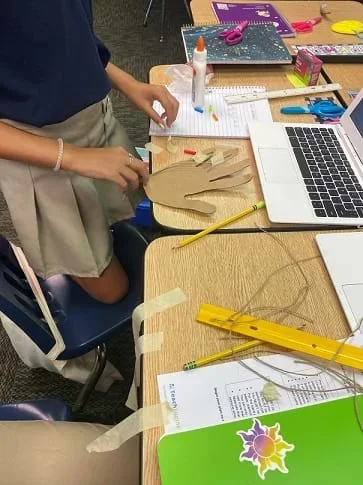 Students use materials to build their prototype.Copyright 2022 Shaci Davis, University of Florida MRET
 - Have each group make a prediction about which materials would work best. Pairs should record their predictions in their notebooks (for example, “I feel the twine string would work best because_____.”
- Have each group begin to plan their prototype. (This could be in the form of a discussion, a drawing, manipulating the materials, or thinking). Students will need to show evidence of planning using the Planning and Materials Sheet (PDF).
- Review each pair’s plan before letting them collect their materials to start building their prototype. If plans are incomplete, the teacher provides feedback and encourage them to go back and complete their planning before gathering their materials.
- Emphasize to the groups that they must refer to their planning sheet as they build their prototype.
- Circulate the room to informally observe each group and ask probing questions (i.e., What made you choose the materials that you chose? How will you use the string?).
- Remind students to record their observations in their notebooks as they are building their prototype. If a group discovers that a selected material will not work and would need to make corrections to plan, it must be documented in their notebooks. Corrections must be justified (after discussion with the teacher) before the group can make changes to their plan and prototype. (This includes selecting any new materials that were not in the original plans).
- Have groups test their prototype by attempting to pick up a Styrofoam cup, a large die, and a whiteboard eraser.
- Have students record the results of their test in their notebooks.
- If prototype fails, groups will make improvements to prototype to make it functional (students will record why they believe their prototype failed and what improvements they can make to make it successful)
- If prototype was a success, group will discuss what made their prototype a success (what worked well in building their prototype). Students will record in their notebooks what they believe made their prototype successful.
- Allow time for all groups to complete their prototype (including those groups that needed to make corrections) and to complete their notetaking in their notebooks. For the groups that do not need to make corrections to their prototype, they may continue to test their prototype using heavier objects (such as filling the Styrofoam cup halfway with water). For those pairs that continue to test their prototype using heavier objects, those observations will be recorded in their notebooks.
- Have each group present their final prototype to the class and discusses their successes and/or failures. Teacher will ask each group probing questions to prompt critical thinking (i.e., Why do you think your prototype was successful? If you were to rebuild your prototype, what might you do differently?)
- Use the Teacher Rubric (PDF) to evaluate each group’s prototype.
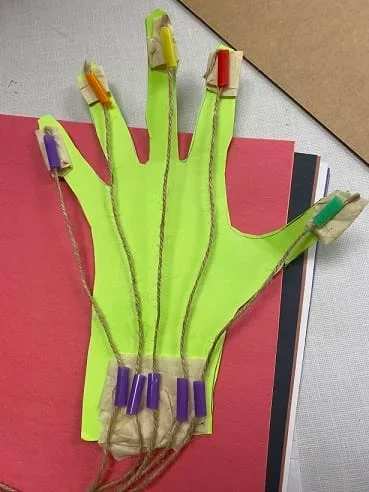 A student-designed prosthetic hand prototype.Copyright 2022 Shaci Davis, University of Florida MRET
A student demonstrates how their prosthetic hand works.Copyright 2022 Shaci Davis, University of Florida MRET
- amputation
- Surgical removal of all or part of a limb.
- biomedical engineer
- An engineer who studies, designs, develops, and evaluates biological and medical systems and products, such as artificial organs, prostheses, medical instruments and information systems.
- cast
- A protective shell to hold a limb in place.
- constraint
- Something that constrains, a restriction.
- engineering design process
- A common series of steps that engineers use in creating functional products and processes.
- functional
- In good working order.
- impressions
- The indentation or depression made by the pressure of one object on or into another.
- joints
- The connection made between the bones, ossicles, or other hard structures in the body which link the skeletal system into a functional whole.
- ligaments
- Fibrous connective tissue that connects bones to other bones.
- prototype
- An early sample or model built to test a concept or process.
- quality of life
- The general well-being of something or someone.
- socket
- The receptacle in which a tapered tool is inserted; an opening in any fitting that matches the outside diameter of a pipe or tube.
- stump
- The remains of something that has been cut off.
- surgical amputation
- The surgical removal of part of the body, such as an arm or leg.
- tendon
- A tough band of flexible but inelastic fibrous collagen tissue that connects a muscle with its bony attachment and transmits the force which the muscle exerts.
Pre-Activity Assessment
Brainstorming: Students think of and record one “wondering question” in their science notebook after they view the video. (A “wondering question” would be a lingering question the student may still have after the video that may not have been addressed.) The teacher will then encourage students to share their questions with the class. The teacher will record the students’ responses on chart paper. Students then have a class discussion of possible solutions to the problem. All ideas will be heard.
Activity Embedded (Formative) Assessment
Worksheet/Recording Observations: Using the Planning and Materials Worksheet (PDF), the teacher reviews the materials and constraints with the students as they follow along using the worksheet. Student pairs plan their prototype using the worksheet. After each pair complete their planning, it will be shown to the teacher.
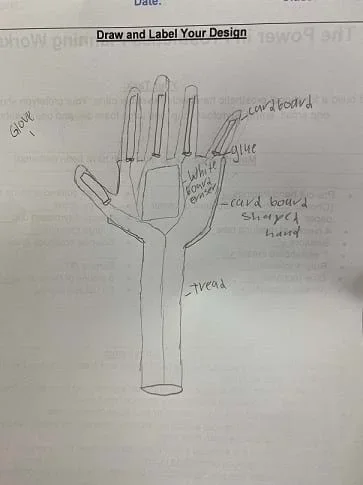 Students use a planning worksheet to design their prototype.Copyright 2022 Shaci Davis, University of Florida MRET
Informal Observations/Pairs Check: The teacher will informally walk around to observe pairs and ask critical thinking questions (i.e., “Why did your group choose cardboard instead of the other available materials? What do you think made your prototype successful/unsuccessful?”)
Post-Activity (Summative)
Reflection: Have students complete the Reflection Sheet (PDF).
Presentations/Evaluating: After completing their prototypes, pairs share their results and experiences with the class. Each pair is evaluated by their peers using the Student Rubric (PDF). All pairs are evaluated by the teacher using the Teacher Rubric (PDF). Students will be given an Exit Ticket (PDF) on the engineering design process for a self-evaluation.
- Use all materials appropriately.
- Use scissors appropriately. Do not place scissors in or near your mouth or use them as a weapon (even if you are pretending!)
- Use the grabber toys appropriately. Do not misuse the handle, or the toy will break.
If the fingers will not move after prototype has been built, check that students have pre-folded the “joints” in the hand cut-outs. This will be important to make their prototype functional.
Latex gloves will work best for testing the prototype, as it helps with gripping objects (acts as the “skin” of the hand). Encourage groups to use latex gloves if they did not originally opt to use them in their original plan.
- Have students create a prosthetic arm to attach to their prototype. Students will collaborate within their groups to determine the length of their arm. The arm extension should improve the function and the mobility of the original prototype. Students can also explore making a sleeve to cover the prosthetic arm.
- Have students test their prototype using heavier objects, such as a cup of water (filled halfway) or a tennis ball. Prosthetic hands should be able to lift items of various weights to complete day-to-day tasks.
- This activity can be done with various materials, so it would be fun to have students create another prototype using different resources (for example, rubber bands, paper clips, toothpicks, paper towel roll, paper plate hand cut-outs, etc.)
For lower grades, the teacher can pre-select the materials each group would need to build their prototype (such as only using cardstock instead of providing several options). The teacher can pre-fold the joints on the hand cut-outs to guide students on where to tape the straws for the joints of the hand. The teacher should reference the students’ real hands when explaining the pre-folded joints on the hand cut-outs.
For upper grades, have students complete their own hand tracings and cut them out. Students can also use a ruler to measure the appropriate amount of straw and twine string they would need to build their prototype. Students can also create the joints on their hand cut-out by marking the finger joints, then drawing straight or curved lines across it. Students should be able to use their real hand as a reference point.
For more advanced students, they can begin their task by first, studying the anatomy of the human hand to understand the various parts and how they work together to allow people to accomplish various tasks (i.e., tendons, bones, muscles, etc.). Students can then use that knowledge to make connections to how the materials they selected to build their prototype compares to the parts and functions of the human hand (For example, “The twine string that I used to build my prototype closely resembles the muscle’s pull in the human hand.”)
- Building A Bionic Hand: This video provides a different outlook to the prosthetic hand and focuses on building a bionic hand with a different selection of materials.
- Hand Facts For Kids: This website provides additional facts on the human hand that can be shared with students
- Human Body Hand Song: a song that focuses primarily on the bones of the hand that students may enjoy.
California State Polytechnic University. Last modified March 10, 2017. Mechanical Engineering Department. “Materials of Prosthetic Limbs”. (source of some teacher background knowledge on materials used for prosthetics). Materials of Prosthetic Limbs (calstate.edu)
Hawkins, S. “Sepsis Survivor Overcomes Illness, Amputation.” The Oklahoman. September 15, 2020. (Source of teacher motivation). Sepsis survivor overcomes illness, amputation (oklahoman.com)
National Library of Medicine. Last modified July 26, 2018. Accessed June 22, 2022. (Source of much teacher background knowledge on how the hands work). How do hands work? - InformedHealth.org - NCBI Bookshelf (nih.gov)
National Academy of Engineering. Last modified date unknown. Accessed June 23, 2022. “Prosthetics-Biomedical Engineering”. (Source of some teacher introduction on the history of prosthetics). EngineerGirl - Prosthetics-Biomedical Engineering
Horton’s Orthodontics and Prosthetics. Last modified August 4, 2016. Accessed June 20, 2022. (Source of some background knowledge). The Science Behind How Prosthetic Hands Work (hortonsoandp.com)
Scheck and Siress. Last modified date unknown. Accessed June 22, 2022. (Source of some teacher background knowledge). How to Make Prosthetics (Step-by-Step Process) | Scheck & Siress (scheckandsiress.com)
The Canadian Medical and Biological Engineering Society. Last modified date unknown. Accessed June 23, 2022. “What is a Biomedical Engineer?” Accessed June 20, 2022. (Source of some teacher introduction and background knowledge). What is a Biomedical/Clinical Engineer? | CMBES
Contributors
Shaci Davis
Supporting Program
Multidisciplinary Research Experiences for Teachers of Elementary Grades, Herbert Wertheim College of Engineering, University of Florida
Acknowledgements
This curriculum was based upon work supported by the National Science Foundation under RET grant no. EEC 1711543—Engineering for Biology: Multidisciplinary Research Experiences for Teachers in Elementary Grades (MRET) through the College of Engineering at the University of Florida. Any opinions, findings, and conclusions or recommendations expressed in this material are those of the authors and do not necessarily reflect the views of the National Science Foundation.
Copyright
2023 by Regents of the University of Colorado; original © 2022 University of Florida