
Design a Collapsible Barrier to Save the Snails!
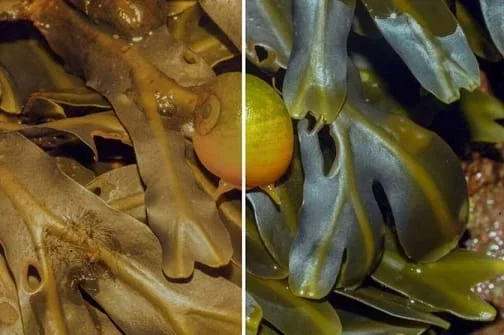 The periwinkle snail cannot camouflage successfully under LED lights (right) compared to when it is under a low exposure light (left).Copyright 2022 Cristen Hemingway Jaynes, “Modern Streetlights Disrupt Camouflage of Coastal Species, Exposing Them to Predators”, EcoWatch, https://www.ecowatch.com/artificial-lighting-animals-camouflage-survival.html
Periwinkle snails are in trouble! They cannot camouflage themselves at night because the LED streetlights are way too bright. Students design and build a collapsible barrier, using everyday materials, to block the light from reaching the snail. As they design and build, students learn about the effects of placing various objects in the path of a beam of light. Students must also be mindful that the barriers are only needed at night. Thus, students must also make their design collapsible so that the barrier can be moved out of the way during the day.
Structural engineers analyze and design all types of structures, including walls and barriers. They focus on the materials used for the construction and its ability to withstand its intended role. Meanwhile, ecological engineers design and create to improve and maintain the environment for both humans and nature. In the situation provided, structural and ecological engineers would work together to build a barrier that improves the coastal areas that littorinid (periwinkle) snails and humans live in.
After this activity, students should be able to:
- Ask questions about the natural world and create designs to solve real-life problems.
- Plan and conduct an engineering design process to understand the effects of placing an object between the target and the light beam.
- Develop a simple sketch, drawing, or physical model to illustrate how the shape of an object helps it function as needed to solve a given problem.
- CCSS.Math.Content.1.G.A.2 Compose two-dimensional shapes (rectangles, squares, trapezoids, triangles, half-circles, and quarter-circles) or three-dimensional shapes (cubes, right rectangular prisms, right circular cones, and right circular cylinders) to create a composite shape, and compose new shapes from the composite shape.
Grade 1
Do you agree with this alignment?
- 1-PS4-2 Make observations to construct an evidence-based account that objects can be seen only when illuminated.
Grade 1
This resource focuses on the following Three Dimensional Learning aspects of NGSS:
Science & Engineering Practices- Make observations (firsthand or from media) to construct an evidence-based account for natural phenomena.Do you agree with this alignment?
Disciplinary Core Ideas- Objects can be seen if light is available to illuminate them or if they give off their own light.Do you agree with this alignment?
Crosscutting Concepts- Simple tests can be designed to gather evidence to support or refute student ideas about causes.Do you agree with this alignment?
Do you agree with this alignment? - Make observations (firsthand or from media) to construct an evidence-based account for natural phenomena.
- 1-PS4-3 Plan and conduct an investigation to determine the effect of placing objects made with different materials in the path of a beam of light.
Grade 1
This resource focuses on the following Three Dimensional Learning aspects of NGSS:
Science & Engineering Practices- Plan and conduct investigations collaboratively to produce data to serve as the basis for evidence to answer a question.Do you agree with this alignment?
Disciplinary Core Ideas- Some materials allow light to pass through them, others allow only some light through and others block all the light and create a dark shadow on any surface beyond them, where the light cannot reach. Mirrors can be used to redirect a light beam. (Boundary: The idea that light travels from place to place is developed through experiences with light sources, mirrors, and shadows, but no attempt is made to discuss the speed of light.)Do you agree with this alignment?
Crosscutting Concepts- Simple tests can be designed to gather evidence to support or refute student ideas about causes.Do you agree with this alignment?
Do you agree with this alignment? - Plan and conduct investigations collaboratively to produce data to serve as the basis for evidence to answer a question.
- K-2-ETS1-1 Ask questions, make observations, and gather information about a situation people want to change to define a simple problem that can be solved through the development of a new or improved object or tool.
Grades K-2
This resource focuses on the following Three Dimensional Learning aspects of NGSS:
Science & Engineering Practices- Ask questions based on observations to find more information about the natural and/or designed world(s).Do you agree with this alignment?
- Define a simple problem that can be solved through the development of a new or improved object or tool.Do you agree with this alignment?
Disciplinary Core Ideas- Asking questions, making observations, and gathering information are helpful in thinking about problems.Do you agree with this alignment?
- A situation that people want to change or create can be approached as a problem to be solved through engineering.Do you agree with this alignment?
- Before beginning to design a solution, it is important to clearly understand the problem.Do you agree with this alignment?
Do you agree with this alignment? - Ask questions based on observations to find more information about the natural and/or designed world(s).
- K-2-ETS1-2 Develop a simple sketch, drawing, or physical model to illustrate how the shape of an object helps it function as needed to solve a given problem.
Grades K-2
This resource focuses on the following Three Dimensional Learning aspects of NGSS:
Science & Engineering Practices- Develop a simple model based on evidence to represent a proposed object or tool.Do you agree with this alignment?
Disciplinary Core Ideas- Designs can be conveyed through sketches, drawings, or physical models. These representations are useful in communicating ideas for a problem's solutions to other people.Do you agree with this alignment?
Crosscutting Concepts- The shape and stability of structures of natural and designed objects are related to their function(s).Do you agree with this alignment?
Do you agree with this alignment? - Develop a simple model based on evidence to represent a proposed object or tool.
- K-ESS2-2 Construct an argument supported by evidence for how plants and animals (including humans) can change the environment to meet their needs.
Grade 0
This resource focuses on the following Three Dimensional Learning aspects of NGSS:
Science & Engineering Practices- Construct an argument with evidence to support a claim.Do you agree with this alignment?
Disciplinary Core Ideas- Things that people do to live comfortably can affect the world around them. But they can make choices that reduce their impacts on the land, water, air, and other living things.Do you agree with this alignment?
- Plants and animals can change their environment.Do you agree with this alignment?
Crosscutting Concepts- Systems in the natural and designed world have parts that work together.Do you agree with this alignment?
Do you agree with this alignment? - Construct an argument with evidence to support a claim.
Each student needs:
- Science Journal Page (PDF), one per student
Each group needs:
- 4 wooden paint paddle stirrer sticks 22.9cm (9 in.)
- 5 to 7 jumbo popsicle sticks with holes
- snail photograph or drawing of a snail
- piece of green construction paper (substitution for algae)
- plastic cups
- paper plates
- scissors, one per student
- pencils, one per student
For the entire class to share:
- clear tape or masking tape
- yarn 170 m (186 yd)
- LED light source (a desk light with a LED light bulb would work)
- construction paper and/or printer paper
- laptop or computer with projector (to display Animal Camouflage Presentation (PPTX))
Basic understanding that animals camouflage to protect themselves from their predators.
We are going to play a game. I am going to show you a picture for 3 to 5 seconds and then you will find the animal that is hiding in the picture as fast as you can!
[Show students the Animal Camouflage Presentation (PPTX). Click through slides 1-19 of the presentation, showing the “Find the animal!” slide for about 3 to 5 seconds before moving on to the “Did you find it?” page. Students will try their best to find where the animal is hiding within that time. Then, the teacher clicks to the next slide with the same image, this time with the answer circled.]
[Show slide 20. This image shows a periwinkle snail exposed and unsuccessfully camouflaging on seaweed. It should be easier for students to find the animal on this slide.]
Why did we find the snail in this picture a lot quicker than the other animals? (Possible answers: the snail stands out from the background; the snail is yellow and nothing else is yellow; other animals were the same color as the objects around it.) In nature, animals try to blend into the background and make it hard to find them. What would happen if these animals did not blend in, and other animals found them?” (Possible answers: They could get caught/eaten/attacked.)
Who knows what the word camouflage means? (Answer: Camouflage means to blend in the surroundings. This is a trait animals use to disguise their appearance. It is especially important for animals to camouflage, so they are not caught by predators.)
[Show students slide 24.] This is a picture of the periwinkle snail. The left side shows the snail on the seaweed when it is dark. What do you see? (Answer: The snail is the same color as the seaweed; the snail is camouflaged.) On the right side, we see the periwinkle snail but this time a bright LED light is shining on it. What do you see? (Answer: The snail is yellow, but the seaweed is green. The snail is not camouflaged.) Why do you think this is a problem for the snail? (Answer: Other animals can find the snail easily and eat it.)
So, we have a problem: The periwinkle snail used to be wonderful at camouflaging. Unfortunately, people built LED light posts by the coast where the snails live. These lights are so bright that the snail’s camouflage does not work anymore! Today we are going to be engineers and help the snails out by designing barrier that can block the LED light at night but then be collapsible during the daytime. Engineers design and build to solve problems.
Background
Periwinkles (part of a family of called “littorinid snails”) are sea snails who live in tidal environments on rocky coasts throughout the world. These snails are hardy species because they must survive long periods out of the water and higher temperatures fluctuations than other species.
The periwinkle snail’s common predators are herring gulls, certain types of fish, and shore crabs. Periwinkle snails are commonly yellow, brown or olive in color which help them blend into their habitats.
Periwinkle snails depend on their coloration to camouflage themselves from their predators. In addition, to avoid exposure, periwinkle snails are active at night while still using camouflaging coloration to their advantage.
Recent research has shown that species that rely on darkness to safely forage and feed are losing the use of their camouflage abilities due to advances in the lighting used to illuminate the world’s cities and coastlines. These new light sources are most commonly LEDs, and they have the potential to disrupt an array of visually guided ecological processes, significantly improving a predator’s ability to discriminate prey species against a natural background.
Why do LED lights affect periwinkles? Research shows when the snails were exposed to certain LEDs, their camouflage was exposed, and they were more likely to be captured by their predators. However, when periwinkle snails were exposed to 20th century lighting, sunlight and moonlight, their camouflage blended them into their environment.
As technology advances, our quality of life enhances. However, some of these improvements can affect the nature around us. While changing coastal light posts to LED lights makes it easier for humans to see, this change makes it harder for some living organisms to survive. Ecology engineers design and problem solve to protect the ecosystem and to find ways to have humans coexist with nature.
During this hands-on activity, students will become ecology and structural engineers to build a barrier as a solution for this real-life problem. Students will also use structural engineering skills to mimic building structures like walls.
Before the Activity
- Gather materials and make copies of the Science Journal Page (PDF)
- Set up the LED light source on one side of the classroom.
- Place and glue the snail picture/model on top of the green construction paper (substitution for algae) and set it up on the other side of the classroom but still fully exposed to the LED light.
- If needed, move desks, chairs or any other objects that could block the light and create shadows over the snail models.
- Distribute group materials to each group table.
- Designate a “share station” where students can grab other materials that need to be shared.
With the Students
Day 1
- Present the Introduction and Motivation section to the students.
- Using slides 26-28 of the Animal Camouflage Presentation (PPTX) in a whole group setting, brainstorm and research real-life examples of collapsible barriers and collapsible objects plus nonexamples. (Note: Example images are included in slide 27-28 of the PowerPoint). During this whole group session, discuss how types of materials that could be used in their prototypes. Guide students to look back at the real-life examples of collapsible barriers and objects.
- Divide the class into groups of three students each.
- Present the materials available to each group for designing and building their prototype.
- Demonstrate the testing station to the students. Show them the location of the LED light and the location of the “snail and algae.” Demonstrate how the light shines on the “snail” when the light is on. Answer any questions the students may have.
- Pass out the Science Journal Page (PDF) to all students.
- Before the groups begin, talk to students about having a growth mindset and not giving up. Let them know that creating the perfect design on their first try is not their goal. Their goal is to think like an engineer and improve their designs through iterations. Let them know that failure is not only okay, it is expected.
- Have students talk in their groups and draw/write their initial collapsible barrier design including which materials they will use. (Each student should be drawing or writing on their individual Science Journal Page (PDF).)
- Students then decide which prototype to create first.
Day 2
- Have students build their collapsible barrier prototype using the materials they indicated in their design/prototype drawing. Remind them that the barrier must completely block the LED light when placed between the light and the snail. Also, the barrier must collapse into a smaller size to be put away.
- Once their barrier is ready, have each group test their designs and check with the teacher that it (a) blocks the light and (b) collapses into a smaller size.
- If both requirements are not met, students should iterate and improve their designs to test again.
- If both requirements are met, the teacher can guide the group through the extension activity.
- Note: Every time the group makes an iteration, have them draw/write their new designs on their Science Journal Page (PDF). Students can use the backside of the paper if they need more room.
- Once all groups have tried making at least one iteration, bring everyone back for the whole group discussion.
- Have students take turns and present their designs. It is important that students talk about their failures along with their successes.
- As a class, think about constraints that they could change to improve their designs in the future.
- Connect the group discussion to real-life and talk about what materials and tools engineers use to make barriers and help the environment.
- Discuss what students learned about light. What happens when an object, such as a barrier, is put in front of the light? Where can we use this knowledge in our daily lives?
- barrier
- A structure that blocks passage.
- camouflage
- To hide or disguise something by covering it up or changing the way it looks.
- collapsible
- Can be folded into a smaller size.
- engineer
- A scientist that designs and builds a solution to a problem.
- engineering design process
- Steps that engineers take to solve a problem.
- light emitting diode (led)
- A semiconductor device that emits light when current flows through it.
Pre-Activity Assessment
Turn and Talk: Students turn to a neighbor and answer the question “what can we do to stop the light from getting to the snails?” During this assessment, the teacher walks around and listens in to decipher whether students have the general idea that lights can be blocked when an object interrupts it.
Activity Embedded (Formative) Assessment
Build and iterate: Students design, build and improve their collapsible barrier. A successful structure should (1) completely block the light when placed between the light source and the snail model and (2) collapse into a smaller size when not in use (i.e., during the daytime.) . If students do not build a successful structure within the time scheduled, they should (1) verbally explain the design trials they have tried so far and (2) brainstorm two ideas they could have done instead to make the design work.
Science Journal recordings: Students write or draw their designs for each iteration and write down whether each iteration worked on the Science Journal Page (PDF).
Post-Activity (Summative) Assessment
Whole class discussion: Each group of students will present their designs and discuss what other improvements could be made in real life: they could mention changing materials, tools, design of the structure, etc.
Making Sense Assessment: Have students reflect on the science concepts they explored and/or the science and engineering skills they used by completing the Making Sense Assessment (PDF).
Give students an added constraint and then have them brainstorm, plan, design build and test their barrier. Here are some suggestions for possible constraints that you can add:
- Weight constraint: Provide a weight limit to how heavy the barrier can be. Students can weigh their barrier using a balance beam or a scale. If using the balance beam, make sure to provide the object that represents the maximum weight.
- Materials constraint - make it waterproof: These barriers are meant to be used by the coast. It would be a real-life application to make the barrier waterproof, so that it would be durable even when in contact with salt water. Have students brainstorm what materials they would need to make it waterproof.
- Height constraint: Provide a height limit to how tall the barrier can be. Students can measure their barriers using rulers. Remind students to measure from the base to the tallest point of their barrier.
- Make it blend into the environment: These barriers are meant to be out in the coast areas where other living organisms coexist. It would be a real-life application to have a barrier that could blend into the natural habitat.
- Size constraint: Measure the dimensions small enough to fit into a box of the teacher's choice. Then, have students create a barrier that would fit into that box.
- Durability constraint: Provide a weather condition, such as strong wind, and have students create a barrier that could last through this extreme weather condition.
- For younger students, the teacher could change the constraints. For instance, instead of making a “collapsible” barrier, students could make a “large” barrier with the minimum or the maximum heights decided by the teacher. Even if the “collapsible” part is replaced, students would not have any problem performing the engineer design process.
- Older students could brainstorm a list of constraints that they should follow for their barriers. By giving students the freedom to design their personal engineering design process, students feel ownership of their work. The list of constraints can be brainstormed during a whole class discussion or in small groups.
- For more advanced students, the teacher could require students to explore biomimicry by having the barrier imitate a function of another object. For example, students may design a barrier that mimics the functions of a chair. This would allow students to create a barrier that could be used for another purpose as well.
- As a replacement for the camouflage game included in the beginning of the PowerPoint slides, the teacher could play this YouTube video: https://youtu.be/kGZX1_Zy-74
- To help assist students in understanding that an object can block the beam of light from passing through by watching this YouTube video: https://youtu.be/YuUJCNzfoBw
- Instead of getting an LED light source, teachers can use this website to create a white light from the computer screen: https://www.whitescreen.online/
Jaynes, Cristen. Modern Street Lights Disrupt Camouflage of Coastal Species, Exposing Them to Predators. March 28, 2022. EcoWatch.
Williams, Alan. Losing the Cover of Darkness. March 26, 2022. University of Plymouth.
McMahon, et al. “Broad spectrum artificial light at night increases the conspicuousness of camouflaged prey.” British Ecological Society Journal of Applied Ecology. (2022) Vol. 59, Issue 5, pp. 1324-1333. https://doi.org/10.1111/1365-2664.14146
Contributors
Hah Kim
Supporting Program
Multidisciplinary Research Experiences for Teachers of Elementary Grades, Herbert Wertheim College of Engineering, University of Florida
Acknowledgements
This curriculum was based upon work supported by the National Science Foundation under RET grant no. EEC 1711543— Engineering for Biology: Multidisciplinary Research Experiences for Teachers in Elementary Grades (MRET) through the College of Engineering at the University of Florida. Any opinions, findings, and conclusions or recommendations expressed in this material are those of the authors and do not necessarily reflect the views of the National Science Foundation.
Copyright
2023 by Regents of the University of Colorado; original © 2022 University of Florida