
And the Award Goes to…
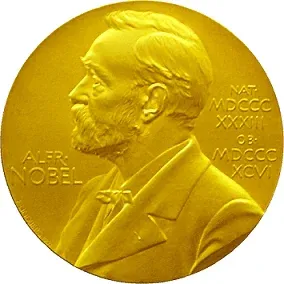 Figure 1. The Nobel Prize medalCopyright 2008 David Monniaux, (CC BY-SA 3.0) Wikimedia Commons: https://en.wikipedia.org/wiki/File:Nobel_medal.png
Who was Alfred Nobel, why is a prize named after him, and why they are given out? In this activity, students learn about this prestigious award and the types of people who receive them. Students then design and create a structure that can hold and display the Nobel Prize (or a medal similar in weight (200 g) and diameter (66 mm). Students research the specifications of the Nobel Prize and then research different materials engineers might use to build a structure like this. Students act as engineers as they test and re-test different types of structures to determine which one displays the medal the best. Findings are shared with each other via group presentations.
Structural engineering, which is a specialty within civil engineering, involves the analysis and design of safe structures to be used by the public. Normally, structural engineers are used when designing large things such as machines, cars, medical equipment, buildings, and bridges, but the same concepts apply when designing a structure to hold a delicate award, such as a Nobel Prize. Structural engineers must ensure their designs meet codes, or constraints.
After this activity, students should be able to:
- Test a variety of materials to determine which provides a sturdy structure that displays an item.
- Think and outline design iteration suggestions.
- Present their knowledge and findings to the class.
- CCSS.ELA-Literacy.W.2.7 Participate in shared research and writing projects (e.g., read a number of books on a single topic to produce a report; record science observations).
Grade 2
Do you agree with this alignment?
- CCSS.Math.Practice.MP2 Reason abstractly and quantitatively.
Grades K-12
Do you agree with this alignment? - CCSS.Math.Practice.MP4 Model with mathematics.
Grades K-12
Do you agree with this alignment? - CCSS.Math.Practice.MP5 Use appropriate tools strategically.
Grades K-12
Do you agree with this alignment?
- 2-PS1-2 Analyze data obtained from testing different materials to determine which materials have the properties that are best suited for an intended purpose.
Grade 2
This resource focuses on the following Three Dimensional Learning aspects of NGSS:
Science & Engineering Practices- Analyze data from tests of an object or tool to determine if it works as intended.Do you agree with this alignment?
Disciplinary Core Ideas- Different properties are suited to different purposes.Do you agree with this alignment?
Crosscutting Concepts- Simple tests can be designed to gather evidence to support or refute student ideas about causes.Do you agree with this alignment?
- Every human-made product is designed by applying some knowledge of the natural world and is built using materials derived from the natural world.Do you agree with this alignment?
Do you agree with this alignment? - Analyze data from tests of an object or tool to determine if it works as intended.
Each group needs (give groups unlimited access to each, but they will not be using all materials at once. These are suggestions):
- A variety of materials for students to build their structure with:
- cardboard
- construction paper
- felt
- toilet paper or paper towel rolls
- a variety of consumable recycled materials
- different kinds of tape (Scotch, duct, painters)
- glue
- Popsicle sticks
- a ruler
- Design a Structure Worksheet (PDF)
For the entire class to share:
- poster paper
- markers
- a circular medal (preferably similar in size to the Nobel Prize—about 200 g and a diameter of 66 mm) or an item that will serve as a proxy: a roll of coins, a small weight, etc.
Let’s watch this video. Pay close attention to what is happening. While watching, write down on paper what you notice and what you wonder. Afterwards, we will discuss any wonderings you may have. (Give each student one piece of paper.)
Show students this video: https://www.youtube.com/watch?v=XggxeuFDaDU.
What did you notice about the video? What do you wonder? (Record students’ responses on the board or on chart paper.)
We have a problem that we must engineer a solution: our class was given an award for being the “most creative engineers!” We were given this medal (show medal to students) and we need a safe way to display it for everyone to see. However, we will have a few constraints, like real engineers do. Constraints are something that limits something that we can do. For this task, we have 3 constraints:
- We can’t go over a $20 budget
- The structure must hold the medal for at least 5 minutes
- We have a “time constrain” which means we must build the structure in 20 minutes
We will be acting as structural engineers to solve a problem. What do you think structural engineers do? (Elicit student responses.) Structural engineers make sure things like bridges and roads are safe for people to use. In the video we just watched, do you think that the structural engineers did their jobs? What do you think happened? (Allow for student discussion.)
Has anyone ever heard of the Nobel Prize? (Elicit student responses.) The Nobel Prize is one of the most important awards that anyone can receive. Nobel Prizes are given each year in six subject areas: physics, chemistry, medicine, literature, peace, and economics. Has anyone ever heard of these areas? (Allow for discussion) The prizes honor people anywhere in the world who have done outstanding work in one of these areas. For example, Dr. Martin Luther King, Jr. won a Nobel Peace Prize! Here is what the Nobel Prize looks like (show students Figure 1). How much do you think it weighs? How big do you think it is? (Do research as a class and share that it is about 200 grams and 66 millimeters in diameter. Compare the weight and diameter to common things students would know. For example, 200 g is about the weight of a cup of sugar or a roll of nickels. 66 mm is about 2.5 inches; show on a ruler. Make sure to tell students that diameter is the measurement across a circle.)
Figure 1. The Nobel Prize medalCopyright 2008 David Monniaux, (CC BY-SA 3.0) Wikimedia Commons: https://en.wikipedia.org/wiki/File:Nobel_medal.png
The story of Alfred Nobel and how he created the Novel Prize is actually very interesting! While you’re watching the next video: https://www.youtube.com/watch?v=uZLK_J2NfX0.
Before the Activity
- Gather materials and make copies of the Design a Structure Worksheet (PDF).
- Measure the medal and display weight and circumference to students.
- Assign costs to each material and decide how much each group will get. For example, each group gets $20 to spend on their design and each material costs anywhere from $1.00 - $3.00. Display the costs to students.
- Example of costs:
- $1 per toilet paper tube
- $1 per glue bottle
- $2 per 30 cm of tape
- For younger students, consider setting up the Day 2 posters ahead of time with labeled sections: Problem, Drawing of Design, Changes for Second Design, What We Learned About Materials, Budget.
With the Students
Day 1
- Present the Introduction/Motivation content. As a class, discuss that engineers find practical solutions to problems by engaging in the engineering design process.
- Allow students to research what materials will sturdily hold things the best. Have them come up and inspect all the materials and allow for group discussion. Research what the Nobel Prize looks like as well.
- Divide the class into groups of three to four. Display the materials and costs to students in a common area. Hand out the Design a Structure Worksheet (PDF).
- Give students the following constraints:
- Must not go over $20 budget.
- Structure must hold and display the medal for at least 5 minutes.
- 20-minute time limit (can vary based on students’ age, class size, etc.)
- Direct groups to brainstorm and decide what materials they would like to try first to build their structure. Remind them to think about the research they did in step 2. After imagining different ideas, each group plans by selecting their most promising solution and which materials they want to use.
- On the back of their worksheets, they must write what materials they would like to purchase, how much they are, and add the costs for a final cost to present to you.
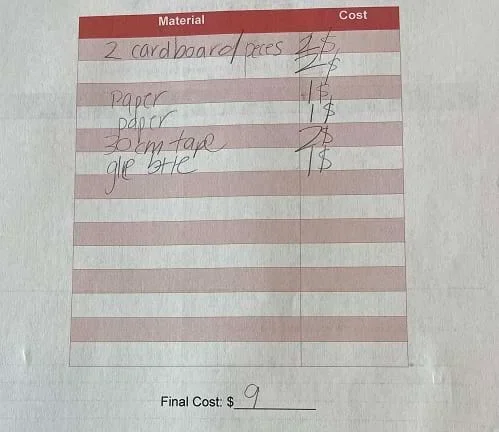 Students record the materials they are using and the prices.Copyright 2022 Kayla Sutcliffe, University of Florida MRET
 - Once you have checked their work, have one student from each group take the materials they need. Start the timer. Guide students to build, test, and evaluate their structure and be available to each group with the medal to test their structures. Remind students to record their design on their worksheets.
- After round 1, remind them that they should learn from their failures and encourage them to use new materials to alter their solutions and record what materials they will want for the next iteration on their worksheets (question #3). Each time they change their designs, they may come up to the material area, and receive an extra $2 and an extra 7 minutes (may vary based on time available). Continue to circulate and help groups as needed.
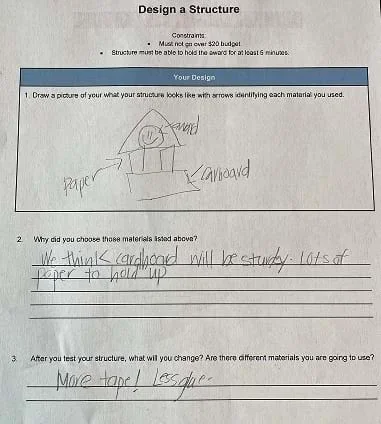 Students record their thinking on their worksheets.Copyright 2022 Kayla Sutcliffe, University of Florida MRET
Day 2
- Tell students that they will present their findings because engineers always share their data and information that they find. Give each group one piece of poster paper and markers to present their design process. Students should include the following on their poster (for younger grades, set up their poster ahead of time so that they only must write in the details. For older grades, leave their paper blank):
- Problem: can we design a structure that can sturdily hold an award without going over budget?
- Drawing of their final design.
- What they changed in the second design phase.
- What they learned from certain materials.
- How much money they spent and why budgeting matters in engineering.
Day 3
- Have students present their posters to each other. Consider inviting stakeholders, such as the school’s principal, assistant principal, other classes, etc.
- constraint
- A limitation or restriction.
- structure
- A whole made up of distinct parts.
- structural engineering
- A discipline of civil engineering in which structural engineers are trained to design the frameworks that create the form and shape of human-made structures.
Pre-Activity Assessment
Quick Poll: Before the activity begins, ask students what material(s) they think will act as the best structure for the award and why. Ask students if they have ever heard of the Nobel Prize.
Activity Embedded (Formative) Assessment
Worksheet: Have students complete the Design a Structure Worksheet (PDF) with their group.
Post-Activity (Summative) Assessment
Presentation: Each group will present their devices and findings to the class.
Discuss/think-pair-share: Ask students the following question:
- Which materials met our goal today of providing a sturdy structure for our award? (Answers may vary based on students’ designs)
- How did you act as materials engineers today? (Example answer: we used materials to solve a problem, designed something for someone to use, etc.)
- If we had to create one class structure that held the award based on everyone’s findings, what materials should we use?
Making Sense Assessment: Have students reflect on the science concepts they explored and/or the science and engineering skills they used by completing the Making Sense Assessment (PDF).
- When students are to record data on their worksheets, some might need more help than others depending on age. Encourage students to help each other record. Pictures are also acceptable forms of recording.
- To add a math component, have students determine what their change would be to purchase the materials. They can use fake bills and coins as manipulatives, if necessary.
- Example: “What is your change if your materials cost $17.98 and you paid with a $20 bill?”
- Allow students to research (or as a class) famous people who have won a Nobel Prize and see if they recognize anyone.
- Ask students who they think deserves a Nobel Prize and why.
- For upper grades or more advanced students:
- Make each material a specific amount of money to match grade level math standards. For example, changing $2 to $2.17.
- Have students find what the change would be from their $20 budget.
- Have them create their own poster presentation from scratch instead of giving them a template.
- Alfred Nobel resources:
- Use the image on this website to display to students to describe the Nobel Prize:
“Nobel Prize.” Encyclopædia Britannica, Encyclopædia Britannica, Inc., https://kids.britannica.com/kids/article/Nobel-Prize/353538#. Accessed 06/30/2022.
Contributors
Kayla Sutcliffe
Supporting Program
Multidisciplinary Research Experiences for Teachers of Elementary Grades, Herbert Wertheim College of Engineering, University of Florida
Acknowledgements
This curriculum was based upon work supported by the National Science Foundation under RET grant no. EEC 1711543— Engineering for Biology: Multidisciplinary Research Experiences for Teachers in Elementary Grades (MRET) through the College of Engineering at the University of Florida. Any opinions, findings, and conclusions or recommendations expressed in this material are those of the authors and do not necessarily reflect the views of the National Science Foundation.
Copyright
2022 by Regents of the University of Colorado; original © 2022 University of Florida