
Operation Airdrop: Designing a Solution to Protect Cargo
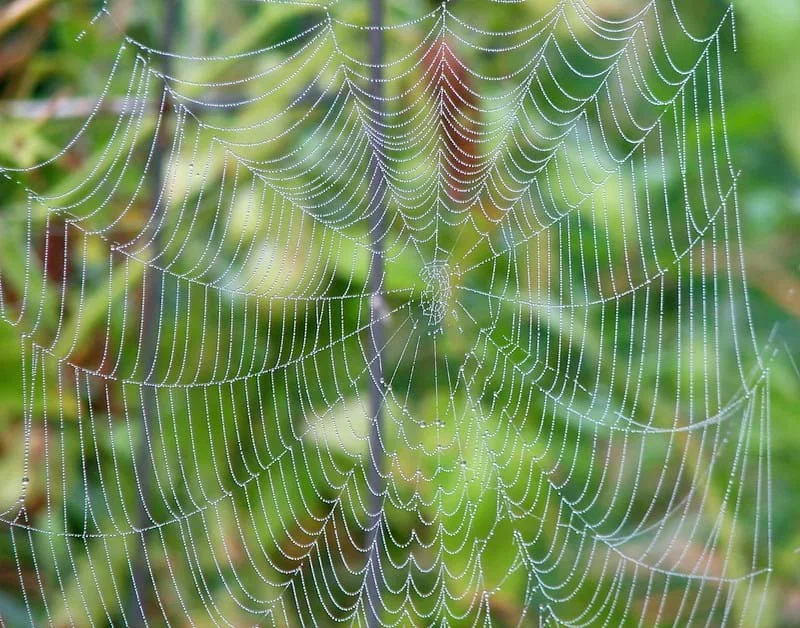 An example of a spider web from an orb-weaver spider.Copyright 2016 James St. John, CC-BY-2.0, Flickr: https://www.flickr.com/photos/jsjgeology/31539594265
Introduce students to engineering design through this unique scenario—an airdrop! In this activity, students design and build a mechanism that can airdrop food aid and supplies to a county (or country) that is cut off from access via land, due to a natural disaster. The small design teams must work together to create the equipment needed to keep the resources intact after the airdrop, using the techniques of an orb-weaver spider in their design that successfully transports the food once it has landed and present their findings.
Cargo in aircrafts is subject to forces such as high altitudes, rough landings, and even rough air. The characteristics of materials used to develop devices to support airdrops are created by engineers who are responsible for innovating products that are durable, reliable, and functional from start to finish. Mechanical engineers possess an understanding of materials principles, physics, engineering, biomimetics and mathematics.
After this activity, students should be able to:
- Apply the engineering design process.
- Design and construct a prototype.
- Test and refine their designs.
- Communicate their design process and results.
- SC.1.E.5.2 Explore the Law of Gravity by demonstrating that Earth's gravity pulls any object on or near Earth toward it even though nothing is touching the object.
Grade 1
Do you agree with this alignment? - SC.1.N.1.1 Raise questions about the natural world, investigate them in teams through free exploration, and generate appropriate explanations based on those explorations.
Grade 1
Do you agree with this alignment?
- 1-LS1-1 Use materials to design a solution to a human problem by mimicking how plants and/or animals use their external parts to help them survive, grow, and meet their needs.
Grade 1
This resource focuses on the following Three Dimensional Learning aspects of NGSS:
Science & Engineering Practices- Use materials to design a device that solves a specific problem or a solution to a specific problem.Do you agree with this alignment?
Disciplinary Core Ideas- All organisms have external parts. Different animals use their body parts in different ways to see, hear, grasp objects, protect themselves, move from place to place, and seek, find, and take in food, water and air. Plants also have different parts (roots, stems, leaves, flowers, fruits) that help them survive and grow.Do you agree with this alignment?
- Animals have body parts that capture and convey different kinds of information needed for growth and survival. Animals respond to these inputs with behaviors that help them survive. Plants also respond to some external inputs.Do you agree with this alignment?
Crosscutting Concepts- The shape and stability of structures of natural and designed objects are related to their function(s).Do you agree with this alignment?
- Every human-made product is designed by applying some knowledge of the natural world and is built using materials derived from the natural world.Do you agree with this alignment?
Do you agree with this alignment? - Use materials to design a device that solves a specific problem or a solution to a specific problem.
- 2-PS1-2 Analyze data obtained from testing different materials to determine which materials have the properties that are best suited for an intended purpose.
Grade 2
This resource focuses on the following Three Dimensional Learning aspects of NGSS:
Science & Engineering Practices- Analyze data from tests of an object or tool to determine if it works as intended.Do you agree with this alignment?
Disciplinary Core Ideas- Different properties are suited to different purposes.Do you agree with this alignment?
Crosscutting Concepts- Simple tests can be designed to gather evidence to support or refute student ideas about causes.Do you agree with this alignment?
- Every human-made product is designed by applying some knowledge of the natural world and is built using materials derived from the natural world.Do you agree with this alignment?
Do you agree with this alignment? - Analyze data from tests of an object or tool to determine if it works as intended.
- K-PS2-2 Analyze data to determine if a design solution works as intended to change the speed or direction of an object with a push or a pull.
Grade 0
This resource focuses on the following Three Dimensional Learning aspects of NGSS:
Science & Engineering Practices- Analyze data from tests of an object or tool to determine if it works as intended.Do you agree with this alignment?
Disciplinary Core Ideas- A situation that people want to change or create can be approached as a problem to be solved through engineering. Such problems may have many acceptable solutions.Do you agree with this alignment?
- Pushes and pulls can have different strengths and directions.Do you agree with this alignment?
- Pushing or pulling on an object can change the speed or direction of its motion and can start or stop it.Do you agree with this alignment?
Crosscutting Concepts- Simple tests can be designed to gather evidence to support or refute student ideas about causes.Do you agree with this alignment?
Do you agree with this alignment? - Analyze data from tests of an object or tool to determine if it works as intended.
For the entire class to share: (Example for a class of 20 students)
- brown rice
- dried black beans
- balloons
- spider webs
- straws (approximately 22 straws per group)
- pipe cleaners/chenille sticks (approximately 22 chenille sticks per group)
- rulers
- scotch or general-purpose tape
- cellophane bags
- scissors
- fishing line
- Operation Airdrop Pre-Assessment (docx)
- Operation Airdrop Pre-Assessment (pdf)
- Operation Airdrop Pre-Assessment Answer Key (docx)
- Operation Airdrop Pre-Assessment Answer Key (pdf)
- Operation Airdrop Formative Assessment (docx)
- Operation Airdrop Formative Assessment (pdf)
- Operation Airdrop Summative Assessment (docx)
- Operation Airdrop Summative Assessment (pdf)
- Operation Airdrop Engineering Design Notebook (docx)
- Operation Airdrop Engineering Design Notebook (pdf)
Students should have a basic understanding force, mass, push, pull, and demonstrate curiosity in questioning why objects that exist in the sky do not fall to earth.
Can you imagine a world where there is a limited supply (scarcity) of every natural resource? Think about it: a world with little to no food, fuel, building materials, water… the list goes on and on.
Recently the United States experienced a year where we saw grocery stores with empty shelves as there was a shortage of goods. This was hard on a lot of people but eventually the supply lines increased, and our shelves were filled again.
However, there are some places in the world that have it far worse that just sporadically empty store shelves. In situations such as these, other organizations may try to provide support (i.e., food and water). But how do these other organizations get food and water to places that are not accessible by roads because of a natural event?
Today you all will become engineers and create a solution to a relevant problem: being able to provide humanitarian aid via an airdrop. You will apply the engineering design process and have the following constraints for your design: It must slow the speed of the cargo once released, the design must be able to float on water, and the design must be in the form of a spider’s web which will act as a buffer.
Before the Activity
- Make copies of the Engineering Design Notebook (PDF), Operation Airdrop Pre-Assessment (PDF), Operation Airdrop Formative Assessment (PDF), Operation Airdrop Summative Assessment (PDF)
- Load videos used in this activity to present to students.
- Inform students that they will be working in their science notebooks and for the purposes of collecting data, students should have their notebooks on their desks.
With the Students
- Have each student individually complete the five-question pretest.
- Explain that students have been tasked by the Mechanical Engineering Department of the United Nations to get food aid to the people of Ayod county, South Sudan who are cut off from access via land, due to conflict. Show the students the following video that explains why this task is necessary. Behind the scenes: WFP humanitarian airdrops: https://m.youtube.com/watch?v=Rt8N4NnomVA.
- Explain that students will be using biomimicry to solve their problem. Biomimicry is the creating materials, structures, and systems that are modeled on biological entities and processes. An example of biomimicry:
Perhaps the most famous example of biomimicry is Velcro. In 1941, engineer George de Mestral was walking his dog when he noticed burrs sticking to his legs. When he studied the burrs under magnification, he found their clinging property was the result of hundreds of tiny hooks. His observation sparked the idea for the very useful invention we know as Velcro fastening!
- Show the following videos:
- Beautiful Spider Web Build Time-lapse by BBC Earth: https://www.youtube.com/watch?v=zNtSAQHNONo
- The world is poorly designed. But copying nature helps: https://www.youtube.com/watch?v=iMtXqTmfta0
- Inertia: forces and motion: https://www.youtube.com/watch?v=qBjmO8w-QqU
- Divide students into groups of 4.
- Provide a set of materials to each group.
- Explain that students must design and build a solution to protect cargo during an air drop from a minimum of 4 ft. They will have three constraints:
- Design must slow speed of cargo once released.
- Design must be able to float on water in case food accidentally travels near it.
- Design must be in the form of a spider’s web which will act as a buffer to protect the cargo.
- Have students choose a team name.
- In their teams, have students discuss and agree on the materials they will use for their spider web design.
- Have student teams brainstorm a design for their spider web prototype. They should sketch their design and label the materials they will use on their sketch.
- Once students sketch their design and have the teacher okay it, let them start to build their prototype using the materials they specified.
- Once built, have each team fill their cellophane bags with 50 grains of rice and 50 dried beans and close it with a twist tie. This will be the cargo.
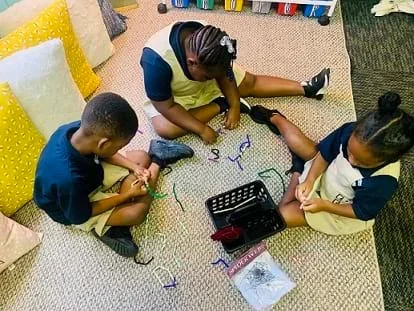 An example of students designing their prototypes.Copyright 2022 Tamiera N. Jones, University of Florida MRET
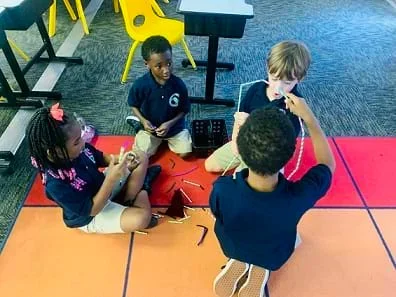 An example of students designing their prototypes.Copyright 2022 Tamiera N. Jones, University of Florida MRET
- Next have each time wrap their allotted spider web string around the cargo for the airdrop.
- Once wrapped, the students will use fishing wire to place on the ends of their chenille sticks.
- Once each team has a prototype of their design, have students test their design by dropping it from at least a height of four feet.
- During this time students may want to rethink their plan, trade materials with other teams, or start over.
- Give students time to improve their prototype and retest.
- When student groups have their final design gather everyone together for a final test.
- Randomly select groups to test their prototype.
- Have each group present their design to the class before demonstrating how their prototype does in the test.
- Have students record their observations of the test.
- Have students individually record what happens when their drop their prototype by completing the 5-question posttest. Encourage them to think and analyze the results from their test.
- Once students finish testing, give each team an opportunity to debrief and discuss their findings with the classroom.
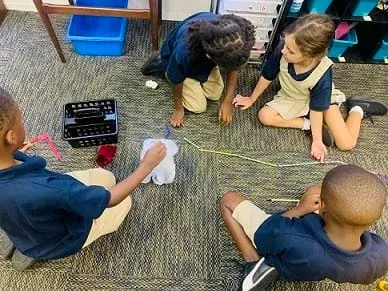 An example of students designing their prototypes.Copyright 2022 Tamiera N. Jones, University of Florida MRET
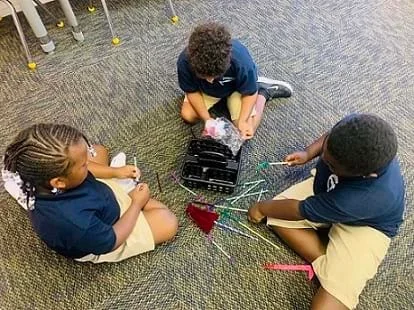 An example of students designing their prototypes.Copyright 2022 Tamiera N. Jones, University of Florida MRET
- force
- A push or pull of an object to create motion.
- mechanical engineer
- A type of engineer that uses machinery to provide solutions to problems.
- motion
- The changing of location or position of an object.
- natural resources
- Include air, water, soil, minerals, plants, and animals that are found within nature. All things we need to survive such as air, water, food, and shelter come from natural resources.
- observe
- To see, watch, perceive or notice.
- phenomenon
- An observable event.
- problem solving
- A process in which a problem is identified, broken down, and an effective set of actions to address the challenges are developed.
- product
- The result of an action or process.
- prototype
- An original model built to test a concept or process.
- pull
- A force felt when moving an object towards you.
- push
- A force felt when moving an object away from you.
Pre-Activity Assessment
Pre-Quiz: Students answer five questions in the Operation Airdrop Pre-Assessment (PDF)which will serve as their “admissions assessment” into the government program.
Activity Embedded (Formative) Assessment
Students use the Operation Airdrop Formative Assessment (PDF) to check their work throughout the engineering design process.
Post-Activity (Summative) Assessment
Students use the Operation Airdrop Summative Assessment (PDF) to answer questions as a whole class.
Use caution with pipe cleaners chenille sticks as they possess sharp points or edges.
For grades K-2, you can divide this activity into five thirty-minute periods which can include a day to research/brainstorm, a day to engineer the prototype, a day to focus on testing their prototype, a day for iteration, and a day that focuses on communicating the results of the experiment. (This presents the opportunity for students to break down the engineering design process further in a systematic yet interconnected way).
For lower grades, you can prep all materials for the students in advance to the desired length and/or quantity. (For example: straws and chenille sticks are cut to a specific length, the amount of rice and beans inside of the bag are prepared, all balloons have been blown up, etc. This can help support students who may have sensory issues or other special educational needs.)
For upper grades, students are given a time constraint to gather their materials. (For example: A timer can be set for 2 minutes to gather materials, a student from each team is blindfolded and gathers materials from the designated materials area to take back to their group. Students can also barter with one another, but only after their initial test.
For more advanced students, additional constraints can exist; students will only be allowed to utilize recycled materials from this list: straws, polyester spiderweb filament, and microfilament fishing line. (The brand highlighted in the materials section is microfilament, which is a recycled material.) A spiderweb must be formed using the straws cut in the same length, the same number of rice and beans must be secured for the airdrop and finally, as a twist, students must also create a slingshot from recycled materials to be verified by teacher to test their drop from a minimum of 16 ft. in the air.
Kang, Soyoung. Biomimetics: Engineering spider silk. Accessed on 20 June 2022. https://illumin.usc.edu/biomimetics-engineering-spider-silk/ (Explains the concept of biomimetics and the processes of replication in spider silk.)
Behind the scenes: WFP humanitarian airdrops: https://m.youtube.com/watch?v=Rt8N4NnomVA
Beautiful Spider Web Build Time-lapse by BBC Earth: https://www.youtube.com/watch?v=zNtSAQHNONo
The world is poorly designed. But copying nature helps: https://www.youtube.com/watch?v=iMtXqTmfta0
Inertia: forces and motion: https://www.youtube.com/watch?v=qBjmO8w-QqU
Contributors
Tamiera N. Jones
Supporting Program
Multidisciplinary Research Experiences for Teachers of Elementary Grades, Herbert Wertheim College of Engineering, University of Florida
Acknowledgements
This curriculum was based upon work supported by the National Science Foundation under RET grant no. EEC 1711543— Engineering for Biology: Multidisciplinary Research Experiences for Teachers in Elementary Grades (MRET) through the College of Engineering at the University of Florida. Any opinions, findings, and conclusions or recommendations expressed in this material are those of the author and do not necessarily reflect the views of the National Science Foundation.
Copyright
2023 by Regents of the University of Colorado; original © 2022 University of Florida