
What’s Your Angle? Assessing Wave Refractions
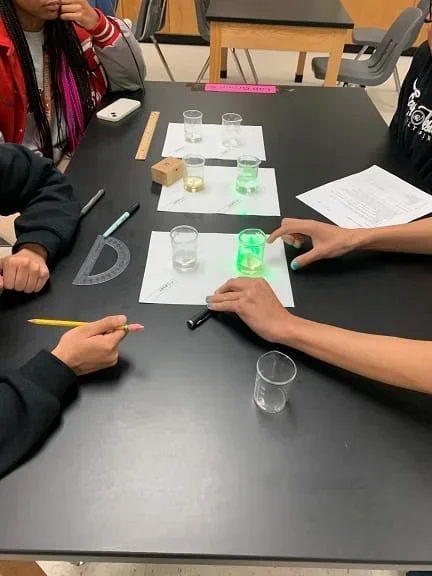
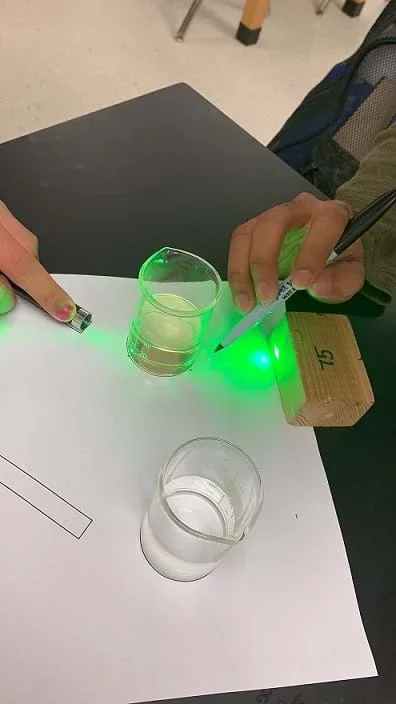 Students shine the laser light as part of the experiment.Copyright Gunjan Gupta, 2023. Picture taken in the classroom during the lab activity.
Students observe wave refraction in different mediums. They trace the path of light waves of a laser entering a medium and exiting the medium. Then they measure the angle of the refracted ray using a protractor to get an understanding of the concepts of how refraction works in different mediums. By the end of the lesson, students will be able to identify which substance refracted light the most and hypothesize a pattern of refraction based on the densities of the substance.
In engineering, it is not enough to merely understand the concepts or ideas behind physical phenomena such as refraction. If engineers want to take a physical law of the universe and turn it into a product that performs a task, then the phenomenon must be quantifiable—they must be able to assign a mathematical function or equation to it that accurately predicts an outcome if the input parameters are manipulated purposefully. In a way, engineers are dictating the setup and letting nature take its course to a conclusion that the engineers can foresee from the start. Similarly, students play the role of engineers in this lesson when they use an equation for refraction (Snell's law) to predict what light will do given a specific scenario. They further act as engineers when they use this equation to define what a biosensor can be made to do under given conditions. In order to create workable products, engineers need more than basic information about physical concepts and how to manipulate them to perform tasks. More specifically, the information must be quantified or measurable in numerical form through precise analysis in order to ensure that exact inputs produce exactly the same outputs every time a task is performed. In this activity, students tackle this aspect of engineering as they solve problems for precise angles and speeds, and predict data output when samples are altered.
After this activity, students should be able to:
- Explain that light refracts differently in different mediums.
- Accurately measure the angle of refraction in different mediums.
- Find the index of refraction using Snell’s law.
- CCSS.Math.Practice.MP5 Use appropriate tools strategically.
Grades K-12
Do you agree with this alignment? - CCSS.Math.Practice.MP6 Attend to precision.
Grades K-12
Do you agree with this alignment?
- HS-PS4-1 Use mathematical representations to support a claim regarding relationships among the frequency, wavelength, and speed of waves traveling in various media.
Grades 9-12
This resource focuses on the following Three Dimensional Learning aspects of NGSS:
Science & Engineering Practices- Use mathematical representations of phenomena or design solutions to describe and/or support claims and/or explanations.Do you agree with this alignment?
Disciplinary Core Ideas- The wavelength and frequency of a wave are related to one another by the speed of travel of the wave, which depends on the type of wave and the medium through which it is passing.Do you agree with this alignment?
Crosscutting Concepts- Empirical evidence is required to differentiate between cause and correlation and make claims about specific causes and effects.Do you agree with this alignment?
Do you agree with this alignment? - Use mathematical representations of phenomena or design solutions to describe and/or support claims and/or explanations.
- CCC.4.9-12.10 Models (e.g., physical, mathematical, computer models) can be used to simulate systems and interactions—including energy, matter, and information flows—within and between systems at different scales.
Grades 9-12
Do you agree with this alignment?
- investigate behaviors of waves, including reflection, refraction, diffraction, interference, resonance, and the Doppler effect;
Grades 9-12
Do you agree with this alignment?
Each group needs:
- 100-ml beakers (6 per group)
- 20 ml water
- 20 ml ethyl alcohol
- 20 ml clear dish soap
- 20 ml corn syrup
- 20 ml vegetable oil
- What’s Your Angle? Worksheet (PDF)
- What’s Your Angle? Placemats (PDF) (3 per group)
- one laser (prefer green laser)
- one protractor
- one ruler
- a dry-erase marker or masking tape (to label beakers)
- safety goggles (one pair per student)
Student are expected to know:
- The basic properties of light, such as reflection, refraction, absorption, transmission and scattering.
- How to plot data points and determine the slope from the graph.
- How to use a protractor to measure angles.
(To get started, show students Figure 1 and ask them whether the pencil is really broken. Ask them to google the reason why the pencil looks broken. Ask them which behavior of the light phenomenon is demonstrated in this example. (Answer: Refraction) 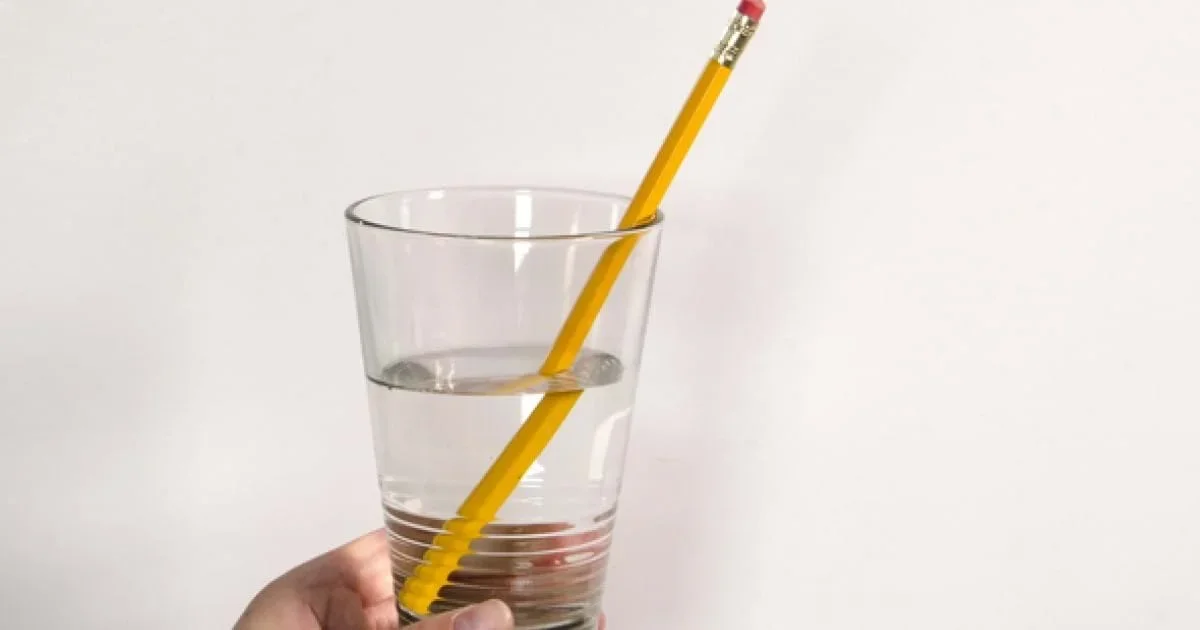 Figure 1. A pencil looks broken when placed in a glass of water.Copyright Canada Science and Technology Museum, https://ingeniumcanada.org/scitech/education/try-this-out/broken-pencil-illusion
Then show one of these videos:
(2:35 minutes long): https://www.youtube.com/watch?v=lkv0uZTP_zo&t=82s
(4:52 minutes long): https://www.youtube.com/watch?v=zarxpu43-ls
(2:25 minutes long): https://www.youtube.com/watch?v=sv8-y7N0Ryw
(1:40 minutes long): https://www.youtube.com/watch?v=dPjvgYXJjzw)
When light passes from one medium to another, it changes speed. For example, when light passes from air to glass, it slows down. If light strikes a sheet of glass at a 90° angle, or perpendicular to the glass, it slows down but still passes straight through the glass. However, if light enters the glass at an angle other than 90°, the light bends as it slows down. The bending of light as it changes speed in a new medium is called refraction.
(Then show the students Figure 2.)
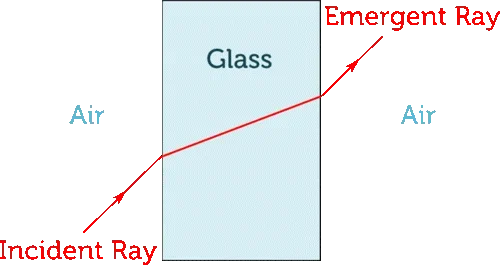 Figure 2. Light bends as it travels through different mediums.Copyright Canada Science and Technology Museum, https://ingeniumcanada.org/scitech/education/try-this-out/broken-pencil-illusion
Figure 2 shows how refraction occurs. Notice that the speed of light changes again as it passes from the glass back to the air. In this case, the speed increases, and the ray of light resumes its initial direction.
But do you know that light bends differently in different mediums?
If I experiment in two different beakers, where in one light travels from air to water and in another light travels from air to corn syrup, where do you think light will bend more: the corn syrup or the water? Let’s find out!
Before the Activity
- Gather materials and make copies of What’s Your Angle? Worksheet (PDF), one per group. Place materials in a central area in the classroom.
- Make three copies of the What’s Your Angle? Placemats (PDF) per group.
With the Students
- Divide the class into groups of three or four students each.
- Introduce the activity using the Introduction/Motivation section.
- Give class instructions for the activity. Distribute copies of the What’s Your Angle? Worksheets (PDF) and What’s Your Angle? Placemats (PDF).
- Remind everyone to follow lab safety precautions since chemicals and glassware will be used.
- Give each group lab materials. Have students mark the beakers with the liquid name and carefully place them on the placemats.
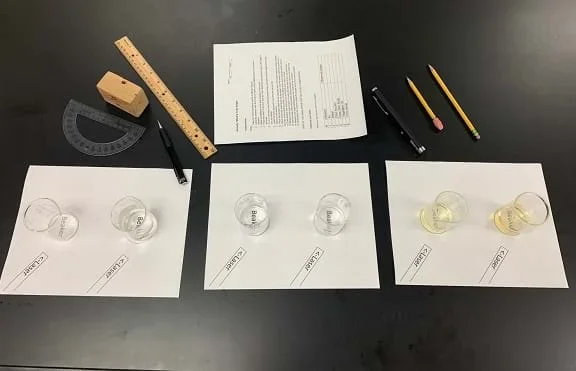 These are placeholders for the beakers to guide students where to place beakers and the lasers. It also shows which direction they should project the laser light.Copyright Gunjan Gupta, 2023. Picture taken in the classroom during the lab activity.
 - As students work through the What’s Your Angle? Worksheet (PDF), walk around and check on their progress. Ensure that students are working together and discussing their findings as a group. As appropriate, ask students the Investigating/Essential Questions to check on their understanding. The instructions on the worksheet are reproduced below for reference.
Instructions: Refraction Lab
 Students shine the laser light and mark the angles as part of the experiment.Copyright Gunjan Gupta, 2023. Picture taken in the classroom during the lab activity.
Steps:
- Take six 100-ml beakers.
- Label the beakers with the medium name using masking tape or dry-erase markers as described below.
i) Beaker 1 - air (leave the beaker empty)
ii) Beaker 2 - water
iii) Beaker 3 - ethyl alcohol
iv) Beaker 4 - clear dish soap
v) Beaker 5 - vegetable oil
vi) Beaker 6 - corn syrup
- Add 20 ml of the labeled liquid to beakers 2 through 6.
- Keep the six beakers in the circles on the placemats.
- Search for the densities of the known liquids online.
- Place the laser on the placemat. Note the laser should always stay flat on the table.
- Turn on the laser and aim it toward beaker 1 at an angle.Students shine the laser light as part of the experiment.Copyright Gunjan Gupta, 2023. Picture taken in the classroom during the lab activity.
- Using a protractor, measure the angle the light from the beaker makes with the normal line (horizontal line).
- On the opposite side, ask one member to measure the angle of the refracted light with the normal line.
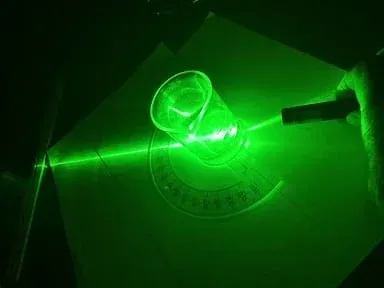 Students use the marked points to draw the lines and record their angles using protractors as part of the experiment.Copyright Gunjan Gupta, 2023. Picture taken in the classroom during the lab activity.
 - Enter your data into the data table.
- Repeat the procedure for the rest of the beakers, pointing the laser toward the liquid. Use the same angle of entry for each liquid.
- Compute the index of refraction for each liquid using the angles from the data using the following formula:
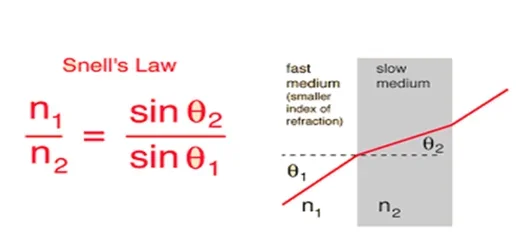
- Find the indices of refraction of the liquids used and enter them into the data table. Remember, because air is the first medium, the index of incidence (n1) will be 1.00.
- electromagnetic wave
- A wave that does not require a medium to travel; for example, it can travel through a vacuum. Also called an EM wave.
- incident ray
- A ray of light falling on the surface separating two mediums.
- index of refraction
- The value calculated from the ratio of the speed of light in a vacuum to that in a second medium of greater density.
- medium
- The material through which a wave travels. Gas (such as air), liquids (such as water), and solids (such as ropes) all act as mediums.
- refracted ray
- A ray of light traveling in another medium, with a change in direction.
- refraction
- The bending of waves as they enter a new medium at an angle, caused by a change in speed.
- snell’s law
- A scientific equation that relates the index of refraction of a substance to the angle at which light bends in that substance. The mathematical form is n1sinθ1 = n2sinθ2, where n is the index of refraction (for substances 1 and 2) and θ is the angle at which light is refracted, as measured from a line perpendicular to the surface of the material (again for substances 1 and 2).
- transverse wave
- A wave that moves the medium at right angles to the direction in which the wave travels.
- wave
- A disturbance that carries energy from one place to another.
- wavelength
- The distance between one point on a wave and the exact same place on the next wave.
Pre-Activity Assessment
Open-class discussion: Open the discussion by asking questions related to the wave phenomenon. Ask students to think about why a straw looks bent or broken in water and why objects viewed through a glass bottle appear distorted. Remind them that no idea is “silly.” All thoughts should be respectfully heard.
Activity Embedded (Formative) Assessment
Group Activity: Have students work in groups of three or four on the lab activity. Have them spread the What’s Your Angle? Placemats (PDF) (three copies per group) on the desk and place the beakers on the spots. Each placemat has a spot for two beakers, and thus makes space for a total of six beakers. These placemats give a visual of where to place beakers but are optional to use.
Recording Data: Then students will take and record the data as per the instructions given in the What’s Your Angle? Worksheet (PDF).
Post-Activity (Summative) Assessment
Compare and Summarize: Students will utilize the What’s Your Angle? Worksheet (PDF) to compare their data and observations. Then they will write the summary of the experiment as a conclusion.
- Use safety goggles during this activity.
- Be extra careful while using lasers.
- Never stare directly into a laser, and never aim a laser beam at people.
- Write the following safety reminder on the board: Do not look directly into the laser.
- Wash hands with soap and water after the experiment.
As needed, explain the Snell’s law formula and the diagram to students.
It may be necessary to briefly turn off the lights so students can see the path of the laser’s light through different mediums.
A prism is a great example to demonstrate refraction application. When light passes from air to the glass of the prism, the change in speed causes the light to change direction and bend. Because of the differences in the refraction index between the air and the glass, light bends once it enters the prism.
Prisms are made in many different forms and shapes, depending on the application. Have students search for the type of prisms used in binoculars, monoculars, periscopes etc., and how each affects the movement of light.
https://ingeniumcanada.org/scitech/education/try-this-out/broken-pencil-illusion
“What is Refraction of Light” video (2:35-min long): https://www.youtube.com/watch?v=lkv0uZTP_zo&t=82s.
Possible other videos:
https://www.youtube.com/watch?v=zarxpu43-ls
The Physics Classroom, “The Direction of Bending,” https://www.physicsclassroom.com/class/refrn/Lesson-1/The-Direction-of-Bending
Wikipedia, “Refraction,” https://en.wikipedia.org/wiki/Refraction
Canada Science and Technology Museum, “Broken Pencil Illusion,” https://ingeniumcanada.org/scitech/education/try-this-out/broken-pencil-illusion
FlexBooks CK-12 Physical Science For Middle School, 2019, “19.7 Refraction,” https://flexbooks.ck12.org/cbook/ck-12-middle-school-physical-science-flexbook-2.0/section/19.7/primary/lesson/refraction-ms-ps/
Britannica, 2023, “Prism,” https://www.britannica.com/technology/prism-optics
Contributors
Gunjan Gupta
Supporting Program
National Science Foundation GK-12 and Research Experience for Teachers (RET) Programs, University of Houston
Acknowledgements
This curriculum was developed under National Science Foundation RET grant no. 1855147— Research Experience for Teachers in Advanced Design and Manufacturing at the University of Houston. Any opinions, findings and conclusions or recommendations expressed in this material are those of the authors and do not necessarily reflect the views of the National Science Foundation.
Copyright
2024 by Regents of the University of Colorado; original © 2023 University of Houston