
Using Biodegradable Leaves as Nontoxic Packing Material
 Students investigate what happens to plastic packaging material after it is used and thrown away.Copyright Sanjay Gupta, 2021
Students investigate what happens to plastic packaging material after it is used and thrown away. They then explore what types of materials biodegrade in the soil and how they can be used in place of plastic. Students test various packaging materials that can handle various amounts of weight. They then explore which materials could optimally be used in packaging.
This activity focuses on testing the strengths and weaknesses of different materials for packaging purposes. This activity falls under materials engineering or mechanical engineering, specifically within the subfield of materials testing or packaging engineering.
Materials engineers are concerned with the structure, properties, and performance of materials, including plastics, paper, and natural materials such as banana leaves and corn husks. They study how materials behave under different conditions, such as stress and strain, and how they interact with other materials.
Packaging engineers, on the other hand, specialize in designing packaging solutions that protect products during storage, transportation, and use. They consider factors such as material strength, durability, environmental impact, and cost-effectiveness.
Both materials engineers and packaging engineers design experiments to test the strength of different materials, determine material suitability for specific packaging applications, and develop biodegradable packaging solutions.
After this activity, students should be able to:
- Describe how plastic is a real-world environmental problem.
- Explain the strengths and weaknesses of biodegradable materials.
- Investigate and create the lab to resolve the issue by using leaves and paper for packaging the products while working on testing to improve the quality and strength of our product.
- Recognize the importance of working as part of a team to achieve academic growth.
- HS-LS2-1 Use mathematical and/or computational representations to support explanations of factors that affect carrying capacity of ecosystems at different scales.
Grades 9-12
This resource focuses on the following Three Dimensional Learning aspects of NGSS:
Science & Engineering Practices- Use mathematical and/or computational representations of phenomena or design solutions to support explanations.Do you agree with this alignment?
Disciplinary Core Ideas- Ecosystems have carrying capacities, which are limits to the numbers of organisms and populations they can support. These limits result from such factors as the availability of living and nonliving resources and from such challenges such as predation, competition, and disease. Organisms would have the capacity to produce populations of great size were it not for the fact that environments and resources are finite. This fundamental tension affects the abundance (number of individuals) of species in any given ecosystem.Do you agree with this alignment?
Crosscutting Concepts- The significance of a phenomenon is dependent on the scale, proportion, and quantity at which it occurs.Do you agree with this alignment?
Do you agree with this alignment? - Use mathematical and/or computational representations of phenomena or design solutions to support explanations.
- SEP.12.9-12.4 Use mathematical representations of phenomena or design solutions to describe and/or support claims and/or explanations.
Grades 9-12
Do you agree with this alignment? - SEP.1.9-12.1 Analyze data using tools, technologies, and/or models (e.g., computational, mathematical) in order to make valid and reliable scientific claims or determine an optimal design solution.
Grades 9-12
Do you agree with this alignment?
Each group needs:
- 1 banana leaf
- 3-4 dried corn husks
- 1 plastic grocery store bag (students can bring from home; preferably a used bag)
- construction paper or newspaper
- 1 Biodegradable Packaging Worksheet (PDF)for each student
- 2 clamps or 2-4 binder clips
- 1 trash can or box (with an opening such that banana leaves, corn husks, and plastic can be placed over the top and secured to the edges with clamps or binder clips)
For the class to share:
- weights (be able to measure from 1 to 25 lbs. or 0.5 to 15 kg)
- 1 laptop computer
- (optional) access to Microsoft Excel
- Weight Conversion Chart (PDF)
- Students must be capable of lifting small weights (up to 15 lbs.)
- Students should have a basic knowledge of converting SI units via mathematical operations.
Plastic is everywhere. Let’s make a list of places we see plastic in our everyday life. (Let students offer answers. Write ideas on board or somewhere all students can see.)
What is good about plastics? What are the strengths of plastics? (Potential answers: Plastics are durable, low cost, water resistant, lightweight, bioinert, nontoxic, corrosion resistant, have a high strength-to-weight ratio, high thermal/electrical insulation, etc.)
We can see that plastic is very useful; however, it is also a huge problem for the environment. Did you know there is enough plastic thrown away every year to circle the earth four times? It can take plastic up to 1,000 years to break down, so when it is discarded, it builds up in the environment. This pollution chokes marine wildlife, damages soil, and poisons groundwater, and it can cause serious health impacts.
(Show this 2:08-minute video: https://education.nationalgeographic.org/resource/reality-plastics.)
What does biodegradable mean? Biodegradable describes a material that can decay and become absorbed by the environment. Bacteria and other living organisms work on biodegradable materials to decompose them.
Today, we are going look at one particular type of plastic and its potential substitutions. You all are going to become materials and packaging engineers and learn about plastics and biodegradable and nontoxic material used in the packaging industry.
Who knows what a materials engineer does? (Answer: Materials engineers are concerned with the structure, properties, and performance of materials, including plastics, paper, and natural materials such as banana leaves and corn husks. They study how materials behave under different conditions, such as stress and strain, and how they interact with other materials.) What do you think a packaging engineer does? (Answer: Packaging engineers specialize in designing packaging solutions that protect products during storage, transportation, and use. They consider factors such as material strength, durability, environmental impact, and cost-effectiveness.)
In this activity, you are going to learn about plastics and then investigate the strength of different materials. Let’s get started!
Background
Plastic is very useful, but it is also a huge problem for the environment. Enough plastic is thrown away every year to circle the earth four times! It can take plastic up to 1,000 years to break down, so when it is discarded, it builds up in the environment until it reaches a crisis point. This pollution chokes marine wildlife, damages soil, and poisons groundwater, and it can cause serious health impacts.
A bar graph is a pictorial representation of grouped data, in the form of vertical or horizontal rectangular bars. The lengths of the bars are equivalent to the measure of data. Bar charts consist of the following:
- Title: Informs the reader of the graph’s purpose.
- Labeled vertical axis: Indicates the data of each bar.
- Labeled horizontal axis: Indicates the categories of the data that is shown on the y-axis.
Note: The primary feature of any bar graph is its length or height. If the length of the bar graph is more, then the values are greater than any given data.
Other important features:
- All of the bars should have a common base.
- Each column in the bar graph should be of equal width.
- The height of the bar should correspond to the data value.
- The distance between each bar should be the same.
To visually represent the data using a bar graph, follow the steps below.
- Decide on the title of the bar graph.
- Draw the horizontal axis and vertical axis.
- Label the horizontal axis.
- Write the category names on the horizontal axis.
- Label the vertical axis.
- Finalize the scale range for the data.
- Draw the bar graph, representing each category with their respective numbers.
Before the Activity:
- Make copies of the Biodegradable Packaging Worksheet (PDF). (one for each student)
- Ensure that students have access to the following resources/videos, such as by providing links to the webpages in Google Classroom or similar.
- Collect all necessary materials.
- Make sure students know the safety rules and procedure for the activity.
During the Activity
Day 1
- Introduce the activity using the Introduction and Motivation section.
- Divide students into groups of 3-4.
- Give each student their own Biodegradable Packaging Worksheet (PDF).
- Have students view these resources/videos:
- Give students 5 minutes to answer the questions in the “Research” section of the Biodegradable Packaging Worksheet (PDF).
- Give students 5 minutes to complete the “Brainstorm” section of the Biodegradable Packaging Worksheet (PDF).
- Hand out materials to each group.
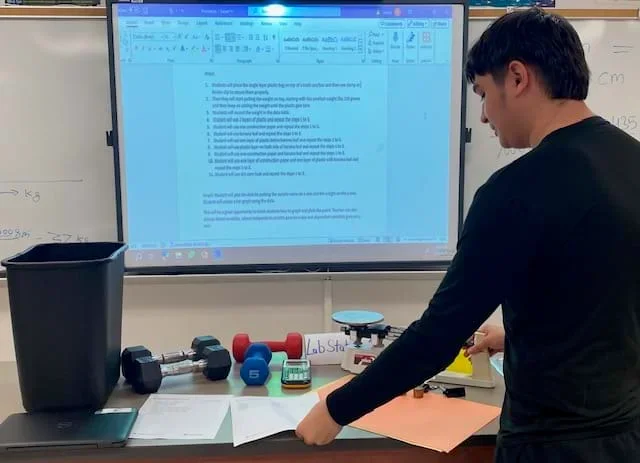 Collecting lab material.Copyright Sanjay Gupta, 2021
 - Describe the materials testing procedure (below) to the class.
- For each material, place it over the top of the trash can or box and secure it to the edges with clamps or binder clips. (Note: One team member can also hold the material while another student applies weights on top.)
- Once the material is placed securely, have one team member place the lightest weight on top.
- Keep adding weight in increments until the material tears.
- Record the last weight the material could hold without tearing on the Biodegradable Packaging Worksheet (PDF).
- Have students convert the recorded weights from lbs. to kg or kg to lbs. (Note: This is a good opportunity to remind students how to mathematically convert between units. Students may use the Weight Conversion Chart (PDF)to help.)
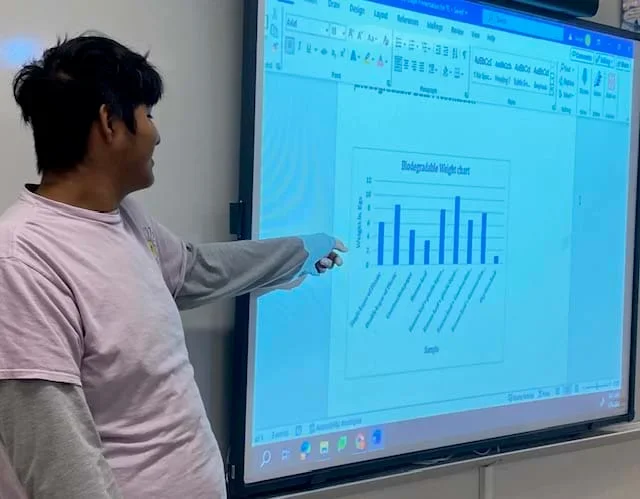
- Have students create a bar graph of the data by putting the sample name on the x-axis and the weight on the y-axis. Depending on the level of students, this can be done by hand or via Microsoft Excel. (Note: This is a great opportunity to teach students how to graph data and create a bar chart. It is also an opportunity to discuss variables, such as how the independent variable goes on the x-axis and the dependent variable goes on the y-axis.) Graph presentation.Copyright Sanjay Gupta, 2021
Day 2
- Give students time to answer the questions in the “Reflection” section of the Biodegradable Packaging Worksheet (PDF)(or have students answer these questions as homework after Day 1).
- Have students Think-Pair-Share the following questions:
- How did the testing experiment go? What worked and didn’t work? (Answers will vary. Potential answers: It was hard to keep the layers together; it was hard to clamp the layer to the box or trash can; etc.)
- Which layer held the most weight? (Answer: Most weight = banana leaf with a plastic layer on both sides.)
- Which layer held the least weight? (Answer: least weight = dry corn husk.)
- How would you run the experiment if you redid this activity? (Answers will vary.)
- What combination of layers would you test that didn’t get tested? (Answers will vary.)
- (optional) Remind students that materials and packaging engineers use the engineering design process to develop solutions. If time allows, have student groups use the engineering design process to do one of the following:
- Redo the experiment by testing different orders of the materials provided to find the combination that is the strongest and most durable packaging material with the least amount of plastic.
- Test other materials that they come up with on their own or through research; these could include plastic board, cardboard, etc.
- Create and implement a similar experiment to test packaging materials that can hold liquids. Make sure they test what happens if the liquid leaks.
- biodegradable
- The ability for a material to be broken down naturally by organisms in an ecosystem.
- strength
- The capacity of an object or substance to withstand force or pressure.
- pollutant
- A substance that pollutes something, especially water or the atmosphere.
- degradation
- The act or process of degrading.
- plastic pollution
- The accumulation of plastic in the environment.
Pre-Assessment
Students watch the video(s), read article(s), and do internet research about the real-world plastic problem. Lead students through a formal discussion to assess student knowledge before doing the lab.
Activity Embedded Assessment
Students conduct the material testing and fill out the Biodegradable Packaging Worksheet (PDF). Ensure that student groups are working together to test the materials and that they are accurately recording data.
Post-Assessment
Students answer the “Reflection” questions in the Biodegradable Packaging Worksheet (PDF). Check that students complete the questions and explain their answers.
Ensure that students wash their hands after handling the banana leaves and corn husks.
For younger grades, use the following activity to explore biodegradation:
- Bury Your Trash Experiment - Students create their own experiment to see what materials biodegrade after being buried. Have them bury all disposable lab materials such as the banana leaves, plastic, corn husks, other kinds of leaves, and construction paper in the soil outside for a few months (e.g., bury in a school garden, with permission) and see which materials are biodegradable.
Brown, Tyson. “The Reality of Plastics.” National Geographic. 19 October 2023. Accessed 23 October 2024: https://education.nationalgeographic.org/resource/reality-plastics
Oceana. “POWERFUL VIDEO: Why We Need to Stop Plastic Pollution in Our Oceans FOR GOOD | Oceana.” YouTube. 9 October 2019. Accessed 23 October 2024: https://www.youtube.com/watch?v=Yomf5pBN8dY
van der Hoeven, Diederik. “Processed banana leaves, an eco-friendly packaging solution,” Bio Based Press. 19 September 2019. Accessed 23 October 2024: https://www.biobasedpress.eu/2019/09/processed-banana-leaves-an-eco-friendly-packaging-solution
Wilson, Michael. “Can Banana Leaves Replace Traditional Plastic Packaging?” Afflink. 14 August 2019. Accessed 23 October 2024: https://www.afflink.com/blog/can-banana-leaves-replace-traditional-plastic-packaging
Contributors
Sanjay Gupta (The Summit High School, Pasadena ISD, TX)
Supporting Program
RET Site: High School Teacher Experience in Engineering Design and Manufacturing, College of Engineering, University of Houston
Acknowledgements
This curriculum was developed under National Science Foundation RET grant no. 1855147— Research Experience for Teachers at College of Technology in the University of Houston. Any opinions, findings and conclusions or recommendations expressed in this material are those of the authors and do not necessarily reflect the views of the National Science Foundation.
Copyright
2024 by Regents of the University of Colorado; original © 2021 University of Houston