
Clean Enough to Drink: Making Devices to Filter Dirty Water
Students act as engineers contracted by NASA to create water filtration devices that clean visible particulates from teacher-prepared "dirty water." They learn about the worldwide need for potable water and gain appreciation for why water quality is an important issue for people on Earth as well as on the International Space Station. Working in groups, students experience the entire engineering design process, including a read-aloud book about the water cycle; a visiting water engineer presentation; their own online research about filter methods and designs; group brainstorming of designs (using ordinary household materials); filter construction and testing; redesign and retesting; lab book documentation of their notes, research, plans and results; and a summary poster presentation at a mini-engineering fair. Two design planning worksheets, a poster layout suggestion sheet and a grading rubric are provided.
 Copyright U.S. Environmental Protection Agency http://www2.epa.gov/learn-issues/learn-about-water
Environmental, chemical and civil engineers must fully understand the science and math pertaining to water quality, contaminants and filtration materials in order to design filtration systems capable of providing potable water to the masses. Like engineers, students work in teams to brainstorm, research and problem solve as they design, test and revise filtration systems to clean visible particulates from contaminated water.
After this activity, students should be able to:
- Use teamwork to solve a problem.
- Research, design and build a prototype water filtration device.
- Describe the need to conserve and protect water sources.
- Explain a problem and a solution to others.
- Students will develop an understanding of the attributes of design.
Grades K-12
Do you agree with this alignment? - Students will develop an understanding of engineering design.
Grades K-12
Do you agree with this alignment? - Students will develop an understanding of the role of troubleshooting, research and development, invention and innovation, and experimentation in problem solving.
Grades K-12
Do you agree with this alignment? - STEL-7I Apply the technology and engineering design process.
Grades 3-5
Do you agree with this alignment?
- 3-5-ETS1-1 Define a simple design problem reflecting a need or a want that includes specified criteria for success and constraints on materials, time, or cost.
Grades 3-5
This resource focuses on the following Three Dimensional Learning aspects of NGSS:
Science & Engineering Practices- Define a simple design problem that can be solved through the development of an object, tool, process, or system and includes several criteria for success and constraints on materials, time, or cost.Do you agree with this alignment?
Disciplinary Core Ideas- Possible solutions to a problem are limited by available materials and resources (constraints). The success of a designed solution is determined by considering the desired features of a solution (criteria). Different proposals for solutions can be compared on the basis of how well each one meets the specified criteria for success or how well each takes the constraints into account.Do you agree with this alignment?
Crosscutting Concepts- People's needs and wants change over time, as do their demands for new and improved technologies.Do you agree with this alignment?
Do you agree with this alignment? - Define a simple design problem that can be solved through the development of an object, tool, process, or system and includes several criteria for success and constraints on materials, time, or cost.
- 3-5-ETS1-2 Generate and compare multiple possible solutions to a problem based on how well each is likely to meet the criteria and constraints of the problem.
Grades 3-5
This resource focuses on the following Three Dimensional Learning aspects of NGSS:
Science & Engineering Practices- Generate and compare multiple solutions to a problem based on how well they meet the criteria and constraints of the design problem.Do you agree with this alignment?
Disciplinary Core Ideas- Research on a problem should be carried out before beginning to design a solution. Testing a solution involves investigating how well it performs under a range of likely conditions.Do you agree with this alignment?
- At whatever stage, communicating with peers about proposed solutions is an important part of the design process, and shared ideas can lead to improved designs.Do you agree with this alignment?
Crosscutting Concepts- Engineers improve existing technologies or develop new ones to increase their benefits, to decrease known risks, and to meet societal demands.Do you agree with this alignment?
Do you agree with this alignment? - Generate and compare multiple solutions to a problem based on how well they meet the criteria and constraints of the design problem.
- 3-5-ETS1-3 Plan and carry out fair tests in which variables are controlled and failure points are considered to identify aspects of a model or prototype that can be improved.
Grades 3-5
This resource focuses on the following Three Dimensional Learning aspects of NGSS:
Science & Engineering Practices- Plan and conduct an investigation collaboratively to produce data to serve as the basis for evidence, using fair tests in which variables are controlled and the number of trials considered.Do you agree with this alignment?
Disciplinary Core Ideas- Tests are often designed to identify failure points or difficulties, which suggest the elements of the design that need to be improved.Do you agree with this alignment?
- Different solutions need to be tested in order to determine which of them best solves the problem, given the criteria and the constraints.Do you agree with this alignment?
Do you agree with this alignment? - Plan and conduct an investigation collaboratively to produce data to serve as the basis for evidence, using fair tests in which variables are controlled and the number of trials considered.
- plan and implement descriptive investigations, including asking and answering questions, making inferences, and selecting and using equipment or technology needed, to solve a specific problem in the natural world;
Grade 3
Do you agree with this alignment? - communicate valid conclusions supported by data in writing, by drawing pictures, and through verbal discussion.
Grade 3
Do you agree with this alignment?
Each group needs:
- computer with Internet access
- 2-liter clear plastic beverage bottle, cut in half by instructor
- 300 ml of "dirty water," made by the instructor by adding to water small bits of plant material, soil and paper; see the Procedure section for instructions
- measuring cup or graduated beaker, to measure dry materials (amounts to be determined by group)
- Water Filtration Planning Worksheet 1 (PDF)
- Water Filtration Planning Worksheet 2 (PDF) (may not be needed)
- Suggested Poster Design Layout (PDF)
- Water Filtration Project Rubric (PDF)
- lab book/journal/notebook (or paper), one per student, to keep track of research, design ideas, sketches, materials lists, notes, etc., throughout the activity
- pencil or pen, one per student
- poster board
- colored pencils
To share with the entire class:
- a copy of the book, The Magic School Bus at the Water Works by Joanna Cole
- half-gallon jug filled with water, to show the class during the introduction
- clear pitcher, in which to show the class the "dirty water" during the introduction
- assorted filtration materials, such as top soil, sand (fine and coarse), gravel, coffee filters, cheese cloth, rubber bands, cotton balls, napkins, paper towels; because groups select which filtration materials and amounts to use in their designs, the quantities needed will vary; suggested quantities to have on hand for the class to share: ~3 liters of top soil, 2 liters of sand (fine and coarse), 2 liters of gravel, 20 coffee filters, 20 4 x 4-inch (~10 x 10-cm) squares of cheese cloth, 20 rubber bands, 50 cotton balls, 20 napkins or paper towels
- scissors, to cut the plastic bottles
- paper towels, for clean-up
- sink with water and drain
- Water Filtration Planning Worksheet 1 (docx)
- Water Filtration Planning Worksheet 1 (pdf)
- Water Filtration Planning Worksheet 2 (docx)
- Water Filtration Planning Worksheet 2 (pdf)
- Suggested Poster Design Layout (docx)
- Suggested Poster Design Layout (pdf)
- Water Filtration Rubric (docx)
- Water Filtration Rubric (pdf)
- Making Sense Assessment (docx)
- Making Sense Assessment (pdf)
Water is essential to life. The human body can only survive about three days without water. How can we keep people hydrated? (Listen to a few student ideas.) About 71% of the Earth is covered with water, but just 1% of all water is fresh, drinkable water. Let's put those numbers into something we can visualize—a pizza! Imagine that you have a whole pizza cut into four equal parts; about three of those four pieces represent the amount of the Earth that is covered in water, while just one small bite of pizza represents the amount of that water that is drinkable (not salty!).
Every day, chemicals, pharmaceuticals (human-made chemicals used for medical purposes), fossil fuels (gasoline, coal), bacteria, plastics, and other contaminants enter our drinking water sources. Water quality is important to animals, agriculture and aquatic life. We have about seven billion people inhabiting the Earth, and each person needs to consume about a half a gallon of water per day. (Show the class a half-gallon jug of water.)
People in space need clean water, too! At one point in 2016, according to the National Aeronautics and Space Administration (NASA), six men were traveling 249 miles above the Earth's surface in the International Space Station (ISS). This distance is about as far as from Houston to Dallas. (Give students a tangible reference for this distance based on cities close to you.) Have you ever heard of the ISS? The ISS a space station in orbit around our planet that is operated by a few countries working together to continually run experiments related to life in space, such as airway monitoring, and measuring humidity, temperature and pressure within the ISS. In space, humans need 0.43 gallons of water per person per day. (Show the class a half gallon jug of water, not quite full.) That's a little less than a half-gallon of water per person. Just as people on Earth have a limited drinking water supply, the ISS has limited storage capacity for drinking water!
Whether on Earth or in space, life-threatening illnesses may occur if the water we drink is of poor quality. It must be clean water! Because it is expensive and so much trouble to send up clean water, and the space station has so little storage space, the ISS provides potable water—that's water that is safe to drink—by recycling humidity (that's water in the air) and waste water (that's water from cleaning and body waste). Even though clean drinking water is stored in tanks and brought up during resupply missions, the water must be recycled during the time between those shipments. The water is decontaminated by physical and chemical means as well as filtered and treated with high temperature to make sure it is safe to drink.
Have you ever recycled or cleaned dirty water? (Show the class a pitcher of pre-made "dirty water." Listen to a few student experiences. Expect some children to have stories from camping or traveling outside the U.S.)
Water filtration is the process of removing unwanted contaminants from water to make it cleaner. One technique is physical filtration, in which large particulates are strained from the water. Water is naturally filtered during the hydrologic (water) cycle when precipitation (rain, snow) infiltrates the soil. The layers of vegetation, soil, sand and gravel clean physical particulates from the water as it trickles deep enough to replenish groundwater (which is what we call underground water that supplies wells and springs).
Today, you will act as engineers who are given the challenge to filter visible particulates from dirty water. As engineers, if NASA needed your help to research and create a water filtration device for the ISS, what information would you need to know? (Expected possible answers: How is water filtered naturally? What contaminants can be removed physically? What materials are available for use?) How could you filter visible contaminants? (Possible answer: Pour water through layers of materials, such as fabric and some kind of strainer.)
Background
On Day 2, read aloud to the class The Magic School Bus at the Waterworks. This picture book depicts a class field trip to the "waterworks," which the kids are sure will be boring, but turns out to be fantastical, fun and informative. After driving through a tunnel, the bus enters the water cycle with students experiencing being rain in a cloud, collected in a river, going through a town's water purification system, into a pipe back to the school, and out a faucet in the girl's bathroom. Includes 10 "water facts" presented by different students.
Before the Activity
- Invite a civil and/or environmental engineer from the local water authority or university to describe and discuss with students the water treatment process and your community's water treatment system. Additional topics might include water uses, the need for good water quality, water treatment methods, water filtration plants and water conservation. Make sure the engineer is comfortable speaking to students using age-appropriate language and explanations. Schedule this visit for Day 2 of the activity.
- Ask parents to donate empty and clean two-liter clear plastic beverage bottles. Cut the bottles in half horizontally and discard the caps.
- Gather materials and make copies of the Water Filtration Planning Worksheet 1 (PDF), Water Filtration Planning Worksheet 2 (PDF), Suggested Poster Design Layout (PDF) and Water Filtration Rubric (PDF).
- Make a supply of "dirty water." Instructions: Pull a half-liter of plant material from the school grounds and some paper from the recycling bin. Into 2 liters of tap water, mix top soil, two large leaves torn to bits and small pieces of paper. Adjust the quantities to make sure you have enough for 300 ml of dirty water per group. Before divvying up the dirty water supply for the groups, pour it into a clear container so that you can show the "contaminated water" to the class during the introduction.
- For Day 8 (the last day), arrange for a mini-engineering fair or design expo so student groups can show their filter designs and explanatory posters to an invited audience of guests and stakeholders beyond the class, such as families, administrators, school board members, other classes and community leaders.
With the Students—Day 1: Introduction, Design Challenge & Brainstorming
- As a class, review the vocabulary words.
- Present the Introduction/Motivation content to the class. Lead a class discussion about water uses, desired qualities and unwanted contaminants, including the need for potable water on Earth as well as in the International Space Station.
- Show the class the pre-made supply of "dirty water." Remind students of the engineering challenge: To filter the dirty water so that it is visibly cleaner. Ask: Can we clean this water so that it is suitable for plant, animal or human consumption? Then explain that although they will get to practice environmental engineering in this challenge and see their water getting visibly cleaner, professional engineers must ensure that water meets specific and strict regulations before it is declared safe for consumption; and sometimes water that looks clean is still quite contaminated!
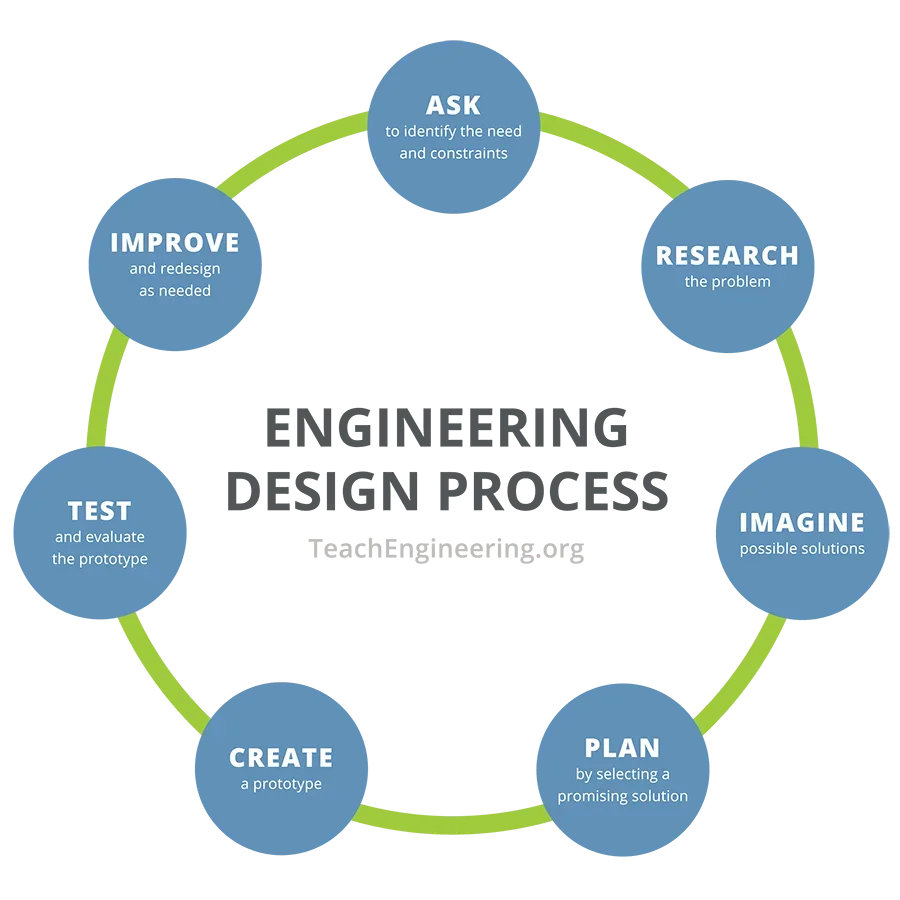
- As necessary, and as time permits, review with the class the seven basic steps of the engineering design process.
- As a class, brainstorm ways to clean water, such as filtering through layers of soil and stone; filtering through cloth, cotton balls and/or coffee filters; using a strainer or sieve. Write suggestions on the classroom board and have students take notes for future reference.
With the Students—Day 2: Understanding the Problem, Brainstorming & Designing
- Read aloud to the class The Magic School Bus at the Waterworks. Possible follow-up discussion questions: What is alum? (Answer: Alum is a chemical compound used to coagulate, or clump together solid particles, making them easier to filter out by sinking to the bottom or floating to the top of a settling tank before water moves on to the next step in the filtration process.) How is water filtered? (Answer: Water passes through sand and gravel to remove tiny particles.)
- Have the visiting water engineer make a presentation to the class, including some question/answer time. Remind students to listen attentively and ask relevant questions. Suggest that students take notes for future reference.
- Divide the class into groups of four students each. Assign each student within each group a specific job, such as material manager/engineer, researcher, graphic designer, and recorder/scribe. Explain that material managers/engineers obtain and handle the necessary building materials and determine the best device design with the input of other team members; researchers are responsible for the research; graphic designers design the promotional posters; and recorders/scribes write the text for the planning worksheets and posters. Although each student is responsible for his or her job, all students within the group must participate in and contribute to all components of the activity.
- Direct the groups to begin brainstorming. Require them to prepare lists of the materials (such as soil, gravel, sand, cheese cloth, coffee filters, cotton balls, etc.) they want to use in their filtration devices and specific quantities for each material.
With the Students—Days 3-4: Researching & Designing
- Explain to the class that they have learned about large-scale community water filtration systems, and now they will research small-scale or individual filtration systems, including how to create them and what materials they require. Tell students that based on their research findings, each group will be responsible for planning, building and testing its own filtration system.
- Show students the provided materials that will be available for them to create their water filters, including the halved plastic bottles as well as the various filtration materials. Not all materials need to be used in their designs. Knowing the available materials prepares students to use their research to inform how to use the materials and which materials they want to use.
- As student groups get started to conduct Internet research, give them the following advice:
- Use Internet search engines, such as Google, to research keywords, such as "water filtration systems for kids," looking for how to create water filters and what materials to use.
- Reliable research sites often end in org, edu, and gov.
- Take notes for future reference.
- Based on new research information gathered, have groups revise their best brainstormed ideas and supply lists, filling in planning worksheet 1. Remind students to also note in their lab books their design ideas, sketches, and materials lists.
With the Students—Days 5-7: Building & Testing
- Have groups design and build their filtration systems using the provided materials.
- Give students the freedom to design systems of their own imaginings and refrain from giving explicit instruction. In other words, act as a facilitator, encouraging innovation. With the given materials, expect most designs to place the top of the plastic bottle upside-down as a funnel inside the bottom half of the bottle with cheese cloth or coffee filters in the funnel near the neck of the bottle, and then layers of soil, sand and gravel resting on the cloth or coffee filters to serve as a natural filtration system.
- Let students know that their prototype filter designs will be tested by pouring the dirty water through them to see if the water quality visually changes.
- Permit students to choose the types and amounts of the provided materials, measuring and recording material amounts. They may choose to place the inverted bottle top in the bottle bottom half to form a funnel. They may choose to layer varying amounts of gravel and/or sand on top of coffee filters, cheese cloth and/or cotton balls to form a filter.
- Advise the groups to measure the materials in metric units.
- Remind them to take notes and record materials measurements throughout the process.
- Walk around to each group, asking them the suggested probing questions listed in the Assessment section.
- Direct the groups to test their filters by pouring 100 ml of dirty water from the original contaminated sample through their filters and visually comparing the end products (hopefully cleaner water) with the original sample. Remind students to document their test results in writing and sketches.
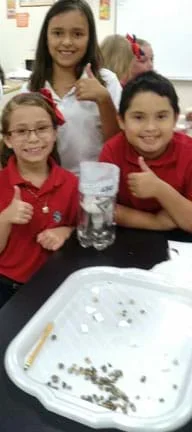 Students test their water filters in a lab setting.Copyright 2015 Mary M. Revia, St. Mary Catholic School and University of Houston
 - If the water is not clear of particulates, have groups redesign, rebuild and retest their filters, aiming for improvement. If a second design is needed, have groups fill in planning worksheet Again, have students measure the material amounts, adding or subtracting materials as revisions are made. Remind them to include their revisions and new plans and sketches in their lab books.
- As a class, have students share their results and discuss what they learned. Discuss overall water quality, such as such as whether the water is clean enough for plant, animal or human consumption. Remind students that although their water became visibly cleaner, professional engineers make sure that water meets specific and strict regulations before it is considered safe for consumption, and that sometimes water that looks clean still contains contaminants that are too small to see!
- Direct the groups to make posters that explain the steps they took to design and test their water filtration systems, referring to the Suggested Poster Design Layout (PDF). Set up a hypothetical scenario in which posters are presented to NASA as proposed filtration systems for the ISS. Require the posters to include at a minimum all elements described on the poster design handout: background, objective, method, results, conclusion, and future work and improvements.
With the Students—Day 8: Presenting the Results/End Product
- At a mini-engineering fair, have student groups present their filtration systems and posters. Have students take turns explaining the challenge question, and the team's research, design and outcome, as well as answering visitor questions.
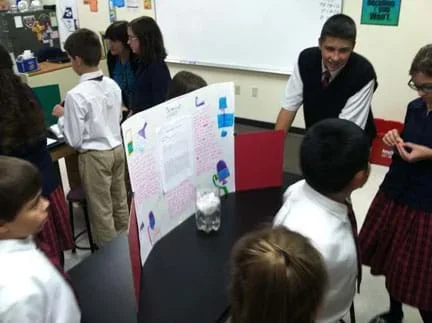 Hold an engineering fair to showcase student-made water filter designs.Copyright 2015 Mary M. Revia, St. Mary Catholic School and University of Houston
 - Direct students to answer some concluding questions, as provided in the Assessment section, writing their answers in their lab books.
- Have students hand in their lab books, planning worksheets and posters for review, and use the rubric to determine student grades.
- contaminant
- Something that makes a place or a substance, such as water, air or food, unfit for use; something harmful or unwanted that makes a place or substance dangerous, dirty or impure.
- engineering design process
- A series of steps used by engineering teams to guide them as they develop solutions, products and systems. The basic steps are: define the problem, generate ideas (brainstorming), select a solution, test the solution(s), make the item, evaluate it, and present the results.
- filter
- A device that removes something unwanted from a liquid or gas that is passed through it.
- international space station
- (ISS) A habitable artificial satellite in low-Earth orbit that is operated as a multinational collaborative research lab.
- nasa
- Acronym for the National Aeronautics and Space Administration. A U.S. federal agency responsible for the civilian space program, as well as aeronautics and aerospace research.
- particulate
- (as relates to water quality) A very small piece or fragment of assorted solid materials that are present in a water supply.
- physical filtration
- The process of removing solid particulates from fluids.
- potable
- Water that is safe to drink. Also known as drinking water.
- prototype
- A first attempt or early model of a new product or creation. May be revised many times.
Pre-Activity Assessment
Brainstorming: During Day 1, as a class, have students discuss possible ways to clean contaminated water, such as using strainers, sieves, mesh, cloth, coffee filters and/or layers of soil, sand and gravel. Remind students that during a brainstorming session, all ideas are welcomed and encouraged and should be accepted respectfully. Have students raise their hands to respond and encourage them to "think outside the box." Write all ideas on a class chart and have students take notes in their lab books.
Activity Embedded Assessment
Lab Books: Assess students individually on the contents of their lab books. Expect each to contain vocabulary words, research notes, design ideas, materials lists, prototype sketches, filter descriptions, and the functionality and results of each prototype test.
Verbal Assessment: As groups are building on Days 5 and 6, and prior to testing, ask students to describe to you their team's best design. Example probing questions to ask:
- Why is water filtration so important? (Answer: Water filtration is important to provide healthy potable water for plants, animals and human consumption.)
- Which materials do you expect to remove which visible contaminants? Why? (Example answer: Gravel is good at filtering out larger materials, but smaller particulates can sneak through, so we're using cloth, coffee filters and soil to remove the smaller visible particulates because they have tighter spaces that water can still get through, while the little solid bits cannot.)
- Why did you choose your design? (Expect answers to indicate that design ideas came from research information, guest speaker information and/or the available materials.)
Post-Activity Assessment
Concluding Questions & Summary Grading: After testing their designs, have students reconsider and answer in their journals the verbal assessment questions (above), as well as the following concluding questions.
- Did your team's design work as well as expected? Explain. (Answers will vary.)
- Is the water clean enough for plant, animal or human consumption? (Answer: Water with a lot of particulates may be suitable for plants, a few particulates may be suitable for animals, and no particulates may be suitable for human consumption.) Do NOT drink the water!
- What would you change to further improve the design? (Possible answers might include modifications to the choice of materials used, the numbers/amount of materials used, the order the materials are layered, desire for entirely different materials, etc.)
Complete the Water Filtration Project Rubric (PDF) to determine grades. Take into consideration student participation, planning worksheets, lab book content, filter success and poster presentation.
Making Sense: Have students reflect about the science phenomena they explored and/or the science and engineering skills they used by completing the Making Sense Assessment (PDF).
- Remind students not to drink any water from the activity!
- Consider having students wear eye protection while working with loose materials, as particles may fly into their eyes.
- Advise students to handle glass beakers with care.
To extend the activity into chemistry, have students build model water molecules using gumdrops and toothpicks. For each water molecule, you'll need two toothpicks, two white gumdrops and one red gumdrop. The white gumdrops represent hydrogen atoms and the red one represents an oxygen atom. Place the two toothpicks into the red gumdrop at a 45° angle from each other; then place the white gumdrops at the other ends of the toothpicks.
To extend the activity into social studies, have students participate in a modified H2O Project. Challenge them to give up all beverages except water for a short period of time. Then donate the money they would have spent on juice, milk, sodas, etc., to build a freshwater well in a developing country. For more information, see http://www.theh2oproject.org/.
- For lower grades, provide example websites for research including, but not limited to the PBS Kids Zoom Water Filter page at http://pbskids.org/zoom/activities/sci/waterfilter.html, and these U.S. EPA web pages for kids at https://www3.epa.gov/safewater/kids/ and https://www3.epa.gov/safewater/kids/flash/flash_filtration.html.
- For higher grades, have students bring in their own supplies, such as sieves, strainers or carbon-based aquarium filters to test the effectiveness of different filter designs.
Learn more about your drinking water supply, how to monitor its quality and how to keep it clean at the U.S. EPA's Drinking Water website at: http://water.epa.gov/drink/tour.
Closing the Loop: Recycling Water and Air in Space. NASA. Accessed November 23, 2015. (Educator reference) http://www.nasa.gov/pdf/146558main_RecyclingEDA(final)%204_10_06.pdf
Cole, Joanna. The Magic School Bus at the Waterworks. New York, NY: Scholastic, Inc., 1986.
Merriam-Webster.com. Merriam-Webster. Accessed July 16, 2015. (Source of some definitions, with some modifications.)
Water Filter. Last updated 2010. PBS Kids. Zoom, for Kids, by Kids, Activities from the Show. Accessed July 14, 2015. http://pbskids.org/zoom/activities/sci/waterfilter.html
Water Filtration Lesson, Grades 4-6. Published June 2004. Kids' Stuff, Ground Water & Drinking Water, Water, U.S. Environmental Protection Agency. Accessed July 16, 2015. (Includes a teacher demonstration that inspired this activity.) https://www3.epa.gov/safewater/kids/pdfs/activity_grades_4-8_waterfiltration.pdf
Water Treatment Process. Last updated March 6, 2012. U.S. Environmental Protection Agency. Accessed July 14, 2015. http://water.epa.gov/learn/kids/drinkingwater/watertreatmentprocess.cfm
Contributors
Mary M. Revia; Hanadi Rifai; Emily Sappington; Mila Taylor
Supporting Program
National Science Foundation GK-12 and Research Experience for Teachers (RET) Programs, University of Houston
Acknowledgements
This digital library content was developed by the University of Houston's College of Engineering under National Science Foundation GK-12 grant number DGE 0840889. However, these contents do not necessarily represent the policies of the NSF and you should not assume endorsement by the federal government.
Copyright
2016 by Regents of the University of Colorado; original © 2015 University of Houston