
Rock Candy Your Body: Exploring Crystallization
Students see and learn how crystallization and inhibition occur by making sugar crystals with and without additives in a supersaturation solution, testing to see how the additives may alter crystallization, such as by improving crystal growth by more or larger crystals. After three days, students analyze the differences between the control crystals and those grown with additives, researching and attempting to deduce why certain additives blocked crystallization, showed no change or improved growth. Students relate what they learn from the rock candy experimentation to engineering drug researchers who design medicines for targeted purposes in the human body. Conduct the first half of this activity one day before presenting the associated lesson, Body Full of Crystals. Then conduct the second half of the activity.
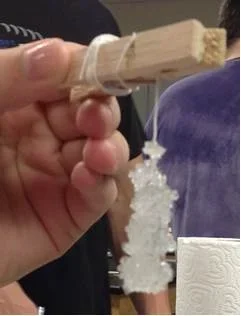 Sugar crystals made from a supersaturated solution of sugar in water after three days.Copyright 2014 Megan Ketchum, University of Houston
Crystals are present in many forms in the human body, with certain ones causing damage, such as kidney stones and cataracts. When a person breaks a bone at a joint, the casted (immobile) bone begins to calcify at some point. Calcification is the crystallization of calcium salts occurring when bone forms. This calcification can cause bony deposits on the joints, limiting the body's capability for motion. Engineers and doctors have studied this process and developed an improved method of treatment: remove the cast early and use physical therapy to maintain mobility. To understand this process, examine how crystallization occurs and how impurities and inhibitors affect crystallization.
After this activity, students should be able to:
- Explain how crystallization is affected when inhibitors are introduced.
- Determine the properties of the additives that cause inhibition, no change or improved crystal growth.
- Students will develop an understanding of the role of troubleshooting, research and development, invention and innovation, and experimentation in problem solving.
Grades K-12
Do you agree with this alignment?
- HS-PS1-6 Refine the design of a chemical system by specifying a change in conditions that would produce increased amounts of products at equilibrium.
Grades 9-12
This resource focuses on the following Three Dimensional Learning aspects of NGSS:
Science & Engineering Practices- Refine a solution to a complex real-world problem, based on scientific knowledge, student-generated sources of evidence, prioritized criteria, and tradeoff considerations.Do you agree with this alignment?
Disciplinary Core Ideas- Criteria may need to be broken down into simpler ones that can be approached systematically, and decisions about the priority of certain criteria over others (trade-offs) may be needed.Do you agree with this alignment?
- The structure and interactions of matter at the bulk scale are determined by electrical forces within and between atoms.Do you agree with this alignment?
- In many situations, a dynamic and condition-dependent balance between a reaction and the reverse reaction determines the numbers of all types of molecules present.Do you agree with this alignment?
Crosscutting Concepts- Much of science deals with constructing explanations of how things change and how they remain stable.Do you agree with this alignment?
Do you agree with this alignment? - Refine a solution to a complex real-world problem, based on scientific knowledge, student-generated sources of evidence, prioritized criteria, and tradeoff considerations.
- in all fields of science, analyze, evaluate, and critique scientific explanations by using empirical evidence, logical reasoning, and experimental and observational testing, including examining all sides of scientific evidence of those scientific explanations, so as to encourage critical thinking by the student;
Grades 9-12
Do you agree with this alignment? - evaluate models according to their limitations in representing biological objects or events; and
Grades 9-11
Do you agree with this alignment?
Each group needs:
- half-pint Mason jar
- 150 ml water
- ~ 2 pounds sugar
- 1 additive; give each group a different additive and one group no additive; such as liquid food coloring (a few drops), salt, Kool-Aid powder (2-3 packets), brown sugar, powdered sugar, milk, apple juice, liquid cinnamon extract, JELL-O powder (one box is enough for 3 groups)
- 6-inch dowel rod; such as 3/16 inch x 36 inch (~0.5 cm x 90 cm) hardwood dowel for 30¢ each at hobbylobby.com, each rod is enough for 6 groups; alternatives: wooden skewer or chopstick
- clothespin
- hot plate (borrow from a chemistry lab or purchase at sears.com for $20 each)
- glass stir rod
- 500-ml or larger glass beaker
- Rock Candy Worksheet (PDF)
- Rock Candy Procedure Handout (PDF)
To share with the entire class:
- digital scale, to measure in grams
- graduated cylinder, to measure water
- heat-resistant gloves, one pair per group or share a few pairs among groups
- safety glasses
- aluminum foil, to cover the hot plates
- permanent marker and masking tape, to label jars
- computers, tablets or iPads with Internet access, for research
- water, soap, paper towels, sink and drain
A familiarity with the human body's urinary system. For Day 2, a basic understanding of crystallization, inhibition and drug design, which can be obtained by presenting the associated lesson, Body Full of Crystals, after Day 1 of the activity.
The human body encounters many types of bacteria, some that are helpful and necessary to its functioning and others that can cause infection and illness. To help to relieve symptoms associated with harmful bacteria and to eradicate the bacteria from the body, engineers and doctors design drugs. The body also produces crystals, some of which can result in illnesses, such as kidney stones. To prevent this, engineers and doctors design targeted crystallization inhibitors that prevent growth by binding to the crystal surface. These bio-researchers take many factors into consideration when designing drugs, including their effectiveness and potency in solving the target medical issues, their safety and toxicity to the human body, the best delivery method into the body, and their manufacturing processes and cost.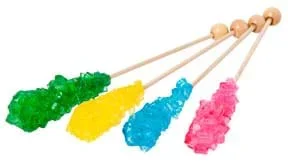 Various flavors and colors of rock candy.Copyright 2012 Evan-Amos, Wikimedia Commons http://commons.wikimedia.org/wiki/File:Rock-Candy-Sticks.jpg
Rock candy is candy made of large sugar crystals. To make rock candy, a supersaturated solution of sugar in water is created and left undisturbed for a few days. The driving force behind crystallization is supersaturation. So the crystallization of sugar occurs in the solution, but what happens if we add other cooking ingredients to the solution? Might it change the shape of the crystals? Might the crystallization process be halted or disturbed? Put yourself in the shoes of engineers who perform assays to determine if drug molecules are capable of inhibition to specific crystals.
Timing
Plan on two 50-minute class periods to conduct this activity. Time this activity so that its first class period is conducted one day before the associated lesson, Body Full of Crystals and its PowerPoint® presentation is taught to the class. Then conduct the second day of the activity three days after the first day so that the rock candy has sufficient time for crystallization.
Background
The driving force of crystallization is supersaturation of a solute in a solvent. To reach high levels of supersaturation, the solution must be heated. The solubility of sugar increases as temperature increases. Thus, the higher the temperature, the higher degree of supersaturation capable for crystallization.
Before the Activity
- Depending on class size, determine how many groups of two or three students to divide the class into.
- Gather materials and make copies of the Rock Candy Procedure Handout (PDF) and Rock Candy Worksheet (PDF).
- Cut the dowel rods into pieces, each six inches in length.
- Cover the tops of the hot plates with foil for easier cleanup, in case students spill sugar on them.
- At a lab station for each group, set out a hot plate, beaker and glass stir rod plus a specific additive. Have one work space with no additive (control).
- Set up an area with the clothespins, dowel rod pieces, Mason jars and sugar.
- Prepare an example of the Mason jar, clothespin and dowel rod setup. Rest a clothespin across the mouth of a Mason jar and thread a dowel piece through the clothespin so that it stands vertically with the dowel positioned about one-inch above the bottom of the jar.
With the Students—Day 1
- Direct the students to organize themselves into groups and assemble at the lab stations.
- Give each group a procedure handout and briefly go over the procedure as the class.
- Have student groups predict what they expect the additives will do to the growth of the sugar crystals, filling in the predictions table on the worksheet (top of page 1). Next, have groups weigh their dowel rods and Mason jars and record these masses in the worksheet table on the top of page 2. After completing the two worksheet tables (top of page 1, top of page 2), have groups turn in their worksheets to the teacher for safekeeping since they will not be able to complete the tables at the bottom of page 1 or the bottom of page 2 until Day 2. Make sure the worksheets have student names on them.
- Direct student teams to begin by boiling 150 ml of water in the beakers.
- Have students add sugar to the boiling water while stirring with a glass rod. Add the sugar incrementally until no more sugar is able to be dissolved. Monitor students as they perform this lab work. (Expect that a lot of sugar is dissolved, in about a water-to-sugar ratio of 1-to-3.)
- After the sugar has been added, direct the teams to thoroughly mix the additive into their solutions (except for the group that has no additive, the control group).
- Using heat-resistant gloves, have students pour the sugar solution from the beaker into the Mason jar without the dowel rod. If only one pair of gloves is available, have groups wait for a turn to complete this step. While groups are waiting:
- Have groups wet the dowel rod with water and roll it in regular granulated sugar. Set it aside to dry. The sugar on the rod helps to nucleate the crystals to grow faster.
- Have teams label their jars with their names and the additive they used.
- Use a clothespin to suspend the dowel rod in the solution in the Mason jar, making sure that the rod does not touch the jar bottom or side.
- Once students have completed the experiment setup, provide a safe and undisturbed location for the jars to sit for the next three days.
- Clean up the soiled glassware while it is still warm by adding water and soap.
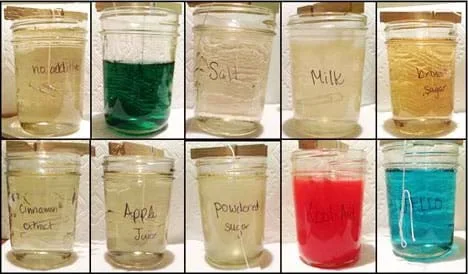 These jars contain supersaturation sugar solutions to make rock candy (sugar crystals) plus various additives to test for their impacts on crystal growth. The solutions have only been crystallizing for 30 minutes.Copyright 2014 Megan Ketchum, University of Houston
With the Students—Day 2 (three days after Day 1)
- Have students assemble in their Day 1 teams with their Mason jars and worksheets from Day 1.
- Explain to students how to remove their rods and clothespins from the solutions. To remove a rod, break the solid layer on top of the solution (expect it to still be liquid underneath it). Pull the rod up and out of the solution and jar. Carefully lay the rod with crystals on paper towels to dry. Blot the crystals dry. Pour into the sink drain the extra liquid sugar solution from the Mason jar, letting the tap run to make the liquid sugar solution less viscous.
- Direct teams to compare the crystals that formed from the solutions with additives to the crystals that formed with no additive in order to determine if less, more or the same amount of growth occurred. Record these observations in the worksheet table on the bottom of page 1.
- Have each group measure the mass of its dowel rod and Mason jar with crystals and calculate the mass of the crystals formed. Record these measurements and calculations in the worksheet table at the top of page 2.
- Have groups share their information with the class so that all groups have this data for all experimental setups. Use the worksheet table on the bottom of page 2 to record this information.
- Give students some time to compare the growth of the crystals and fill in the worksheet tables.
- Give groups some time to research online the ingredients and/or properties of the various additives compared to the sugar, so they are able to explain for each additive why it affected crystallization the way it did. Have students fill in the worksheet table on page 3 to provide this information.
- Conclude with a class discussion so students can share and compare their results, conclusions and questions. Go through the worksheet table 3 answers.
- assay
- A bulk measurement procedure to determine how crystallization is affected by drug concentrations.
- crystal
- A solid material that consists of an ordered pattern in all directions.
- efficacy
- A measure of how much a drug is able to inhibit. For example, causing 100% inhibition is high efficacy.
- face
- A side of a crystal.
- growth
- The third phase of crystallization during which more molecules attach to the stable nuclei, causing the crystal to grow in size.
- inhibition
- The disruption of normal crystal growth, or blockage of further growth.
- kidney stone
- A crystalline structure that forms in the kidney due to supersaturation, causing blockages to waste removal.
- kink
- A position on a crystal surface where molecules are most likely to attach.
- nucleation
- The second phase of crystallization during which clusters of molecules become a stable nuclei. The molecules arrange themselves into an ordered pattern, which is the basic building structure of the crystal.
- potency
- A measure of how much of a drug produces a large amount of inhibition.
- solubility
- The maximum amount of solute that can be dissolved into a solvent.
- solute
- In a solution, the component that is being dissolved into another.
- solvent
- In a solution, the component that another component is dissolved into.
- step
- In a crystal, a layer or sheet of molecules stacked on top of each other.
- supersaturation
- A condition in which the amount of solute dissolved in a solvent is above the solubility.
- terrace
- On a crystal face, the flat surface between steps.
- toxicity
- A measure of the degree of harmfulness of a molecule to humans.
Pre-Activity Assessment
Predictions: In their groups, have students predict what types of effects (more growth, less growth, same growth) they think the various additives will have on crystallization compared to the sugar solution with no additives (control), recording their predictions on the group's Rock Candy Worksheet (PDF).
Activity Embedded Assessment
Comparison: In their groups, have students examine the differences in crystal growth across all additive experiment results by comparing the measured crystal growth to the no additive/control crystal growth. Have them record their observations in the worksheet table on the bottom of page 1. How do the results compare to their predictions? What explanations are suggested by these results?
Post-Activity Assessment
Concluding Discussion: Lead a class discussion so students can share and compare their results, conclusions and questions—especially their researched and analyzed explanations as to why each additive affected crystallization the way it did. To do this, go through the worksheet table 3 answers. Clarify any misconceptions.
- The boiling water and sugar solution could burn if spilled or splashed onto the body. Use heat-resistant gloves to handle the hot beakers.
- Do not permit students to eat the sugar crystals since they were made in beakers that are used for other potentially harmful chemicals.
Even though some of the pictures and videos show cotton crochet thread used instead of wooden dowel rods, we recommend using the rods because the weight of the crystals often breaks the thread (especially with the increased growth from the brown sugar additive), making it hard to remove the crystals from the jars. The rods are more reliable and make for easier crystal removal from the jars.
Have students use blocks or LEGO pieces to model and explain how crystal growth is affected by additives.
For lower grades, use blocks to model crystal growth. Use square blocks to represent sugar molecules and round or triangular blocks to represent additives.
For lower grades, conduct the experiment as a class with the teacher making one large batch of sugar solution in a cooking pot that is further divided into smaller Mason jars to which groups mix in additives.
How to Make Rock Candy Science Experiment (2:36 minutes) https://www.youtube.com/watch?v=4uXQ2Uoaa_M
Making Rock Candy Revisited!!! (6:49 minutes) https://www.youtube.com/watch?v=DKJT42X3ue0
How to Grow Rock Candy or Sugar Crystals (2:12 minutes) https://www.youtube.com/watch?v=tV_JaJBkvWU
Sugar Crystal Procedure (6:12 minutes) https://www.youtube.com/watch?v=8MmMi-W_dsw
How to Make Rock Candy (13 steps plus tips). WikiHow. Accessed October 29, 2014. http://www.wikihow.com/Make-Rock-Candy
Science Bob. Make Your Own Rock Candy. Accessed October 29, 2014. (Includes a photograph showing a clothespin holding a dowel over a jar) http://www.sciencebob.com/experiments/rockcandy.php
- Body Full of Crystals
- Rock Candy Your Body: Exploring Crystallization
- Kidney Stone Crystallization
Contributors
Andrea Lee; Megan Ketchum
Supporting Program
National Science Foundation GK-12 and Research Experience for Teachers (RET) Programs, University of Houston
Acknowledgements
This digital library content was developed by the University of Houston's College of Engineering, based upon work supported by the National Science Foundation under GK-12 grant no. DGE 0840889. Any opinions, findings and conclusions or recommendations expressed in this material are those of the authors and do not necessarily reflect the views of the National Science Foundation.
Copyright
2014 by Regents of the University of Colorado; original © 2014 University of Houston