
Estimating the Storage Capacity of a CD/DVD
 Figure 1: Experimental setup.Copyright 2012 Lars Seemann, University of Houston
Students estimate the storage capacity of CDs and DVDs by assessing diffraction patterns of green and red laser beams.
Optical science engineers and materials science engineers design and create devices that satisfy the ever increasing demand for digital storage. The advancement from CDs to DVDs allows more storage per disk but also provides challenges for engineers because the physical structures ("pits") that store data on the disks become smaller and the CD/DVD players' lasers operate at the diffraction limit (resolution) of light.
After this activity, students should be able to:
- Describe how a CD or DVD stores information.
- Explain that the laser's wavelength limits how small the pits on a CD or DVD can be.
- Explain why a Blu-ray disc can store more information than a CD or DVD.
- CCSS.Math.Content.HSA-REI.B Solve equations and inequalities in one variable
Grades 9-12
Do you agree with this alignment? - CCSS.Math.Content.HSN-Q.A.1 Use units as a way to understand problems and to guide the solution of multi-step problems; choose and interpret units consistently in formulas; choose and interpret the scale and the origin in graphs and data displays.
Grades 9-12
Do you agree with this alignment? - CCSS.Math.Practice.MP2 Reason abstractly and quantitatively.
Grades K-12
Do you agree with this alignment?
- Students will develop an understanding of the relationships among technologies and the connections between technology and other fields of study.
Grades K-12
Do you agree with this alignment? - STEL-1P Analyze the rate of technological development and predict future diffusion and adoption of new technologies.
Grades 9-12
Do you agree with this alignment?
- HS-PS4-2 Evaluate questions about the advantages of using a digital transmission and storage of information.
Grades 9-12
This resource focuses on the following Three Dimensional Learning aspects of NGSS:
Science & Engineering Practices- Analyze data using tools, technologies, and/or models (e.g., computational, mathematical) in order to make valid and reliable scientific claims or determine an optimal design solution.Do you agree with this alignment?
Disciplinary Core Ideas- Information can be digitized (e.g., a picture stored as the values of an array of pixels); in this form, it can be stored reliably in computer memory and sent over long distances as a series of wave pulses.Do you agree with this alignment?
Crosscutting Concepts- Modern civilization depends on major technological systems.Do you agree with this alignment?
- Engineers continuously modify these technological systems by applying scientific knowledge and engineering design practices to increase benefits while decreasing costs and risks.Do you agree with this alignment?
Do you agree with this alignment? - Analyze data using tools, technologies, and/or models (e.g., computational, mathematical) in order to make valid and reliable scientific claims or determine an optimal design solution.
- AI.9.12.E solve mathematic and scientific formulas, and other literal equations, for a specified variable.
Grade 9
Do you agree with this alignment?
- describe the role of wave characteristics and behaviors in medical and industrial applications.
Grades 9-12
Do you agree with this alignment?
Each group needs:
- DVD
- CD (compact disc)
- red or green laser pointer; red ones cost less than $10 each; green ones cost ~$30 each
- protractor
- small spacers to place under protractor (such as cardboard pieces)
- plain white sheet of paper
- calculator
- Estimating Storage Capacity Worksheet (PDF), one per person
To share with the entire class:
- tape
Familiarity with the wave nature of light, as well as with interference and diffraction.
(optional: Show students the Estimating Storage Capacity Presentation (PPTX) [a PowerPoint® file] as you go over the following information)
Previously, you studied light, its interaction with matter, and the behavior of light waves. Today we will see how these concepts apply to our everyday lives through engineering and nanotechnology.
(Hold up a CD in one hand, a DVD in the other hand.) Here I have one CD and one DVD. Can you tell which one is which? (Listen to students answers.) What is the difference between a CD and DVD? (Answer: The amount of storage capacity.) The rate of technological development is quickly increasing. Now we have Blu-rays, which are optical disc storage media just like CDs and DVDs, but can even store more information. However, Blu-ray players require a blue laser. After this activity you will understand why Blu-ray discs only work with blue lasers and not with lasers of higher wavelengths, such as red or green lasers. Who knows how we will store information cheaply in a few years!
So now we know that the difference between CDs and DVDs is storage capacity. But how do we measure the size of digital data? (Answer: Digital data is measured in bytes, which is usually used with a prefix giga (109) or mega (106)) A byte is a unit of digital information. One byte consists of eight bits. One bit only has two states: 0/1, which can be regarded as on/off. All digital information is stored in the form of bits. You can think off it as huge lines of zeros and ones. Your cell phone, computer, TV, and iPod store your data in the form of long sequences of zeros and ones.
To understand the difference between a CD and DVD, let's look at the details. (Show slide 2.) CDs and DVDs store large amounts of binary data (those patterns of 0s and 1s), which a CD/DVD player can read using a laser, optical devices and sophisticated electronics. CDs and DVDs are made mostly of plastic (polycarbonate) and can store more information by having multiple recording layers. The data is stored in a series of tiny pits, arranged in a spiral, tracking from the center of the disk to the edge. (Show slide 3.) The data layer is coated with a thin layer of aluminum or silver, making it highly reflective. If stretched out, this spiral of pits would be about 5 km long! The pit length and the distance between pits define the digital data. The depth of a pit is 0.11 μm and the width is 0.5 μm. Its length varies between 0.83 and 3.56 μm.
The spiral of pits is a periodic structure that diffracts light into multiple beams. Such a periodic structure is called diffraction grating. The microscopic diffraction grating is the reason why you see beautiful rainbow colors when white light illuminates a CD.
When a laser beam is reflected off the disc, a diffraction pattern is formed. (Show slide 4.) Remember that the angle of incidence is the angle of the incoming laser beam with respect to the normal of the CD surface. If the angle of incidence is close to the normal, the condition for constructive interference is identical to that for a transmission diffraction grating, which is given by the following equation: (Students should already be familiar with this equation; see Pre-Requisite Knowledge section.)
dsin(θ)=mλ
where m is the diffraction order, d is distance between the rows of pits, and θ is the angular position of the mth maximum. The wavelength of the laser determines its color. The red laser has a higher wavelength than the green laser. You will find the wavelength on the laser. Blue lasers have even shorter wavelengths, but are more expensive. The distance between the rows of pits, d, can be estimated by: (Write the equation on on the classroom board. Point out "d" on the slide.)
d=mλ/sin(θ)
By measuring θ and using the given value of λ, you can use this equation to calculate the distance between rows of pits.
As compared to printed media (books, newspapers, photographs), using digital media offers many advantages. This includes the ability to reliably store an exorbitant amount of information in small – and often portable – devices such as computer hard drives, flash drives, and compact discs. Other advantages are that information can be copied and shared easily, such as over the internet. However, this ease of data transfer does not come without drawbacks; digital files can be easily deleted (imagine your collection of photographs or music being instantly erased!). Theft of digital information is also a growing problem.
Before the Activity
- Gather materials and make copies of the Estimating Storage Capacity Worksheet (PDF), one per student.
- Demonstrate the setup and the activity in front of the entire class.
With the Students
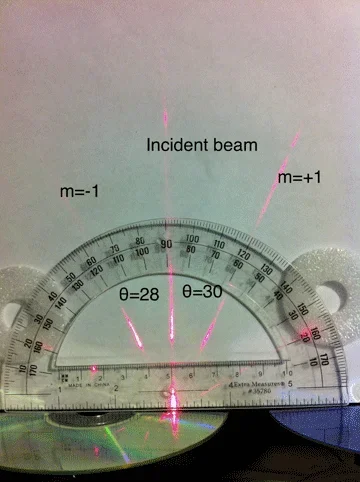 Figure 2: Protractor measuring diffraction angles.Copyright 2012 Lars Seemann, University of Houston
- Have each student group complete the following steps. Use tape to attach the CD and DVD next to each other on the edge of a table (see Figure 1). Face the label sides away from the table. Make sure that the centers of the CD and DVD are placed on the table edge.
- Place a piece of white paper on the table, and align it along the CD.
- Explain that students will use the protractors to measure diffracted laser beam angles, and that the protractors will be lifted off the table using spacers (see Figure 1). The spacers create a distance between the protractor and the table, and thereby allow the laser beam to go in the space between the sheet of paper and the protractor.
- Before students turn on their laser pointers, remind them to make sure no one is in the path of the diffracted beams, and never shine the laser pointers in anyone's eyes!
- Have students turn on the laser pointers, and direct the beams towards their CDs. Align the beam with the 90° mark and the center of the protractor. The laser beam should be aligned with the normal of the CD surface (perpendicular to the CD). Students may need to adjust their laser pointers slightly before seeing diffraction patterns shown in Figure 2.
- When the incident and diffracted beams are clearly visible, direct students to measure the angles of the diffracted beams (the angle between the incident beam and diffracted beam) and record them in their worksheet tables. Remember that angles are measured from the normal (the 90° mark on the protractor). It might be easier for students to mark the beam positions on the white sheet of paper with a pencil and then measure the angle using their marks.
- angle of incidence
- Angle between an incident light ray and the normal of the surface.
- constructive interference
- Phenomenon in which two wavers superimpose to form a resultant wave of greater amplitude.
- diffraction grating
- Optical component with a periodic structure that diffracts light into multiple beams. Transmission diffraction gratings are light-transmissive, like lenses; reflective diffraction gratings are light-reflecting, like mirrors.
- diffraction order
- Integer corresponding to a diffracted beam.
- bit
- Binary digit. Basic unit of information. One bit can be represented by 0/1 or on/off. Eight bits correspond to one byte.
- byte
- Unit of digital information. Often used with a prefix, such as MB (megabyte) or GB (gigabyte). One byte consists of eight bits.
- pit
- Microscopic indentation on CD/DVD that store on bit.
- pitch
- Distance between two neighboring spiral tracks.
Pre-Activity Assessment
Question & Answer: Gauge students' prior knowledge about CDs and DVDs by posing the questions in the Introduction/Motivation section.
Activity Embedded Assessment
Student Engagement: While students work through the activity procedure, circulate by workstations to observe and ask questions to assess their understanding of what they are doing.
Post-Activity Assessment
Worksheet: Have students complete and hand in the Estimating Storage Capacity Worksheets (PDF). Examine their numerical results to see how well they understood the concepts. The results for the spacing ("d") might vary, but should be within a reasonable range.
Never point lasers directly towards other people. Be especially careful not to point lasers towards someone's eyes.
It is important to line up the edge of the table along the diameter of the CD. Line up the center of the protractor midway between the center and the rim of the CD.
The angles are measured from the normal. For calculations, have students make sure their calculators are set to enter angles in degrees.
Extend the activity by varying the angle of incidence. The activity described above uses an incoming laser beam that is perpendicular to the surface (such that the angle of incidence is zero). If the angle of incidence is not zero, the diffraction equation from above generalizes to:
d(sin(θi)+sin(θm))=mλ
where θi is the angle of incidence. Note that if θi is set to zero, we get the equation outlined above. In the extended activity, have students measure the angle of incidence in addition to all other quantities described above.
Contributors
Lars Seemann; Mila Bersabal
Supporting Program
National Science Foundation GK-12 and Research Experience for Teachers (RET) Programs, University of Houston
Acknowledgements
This digital library content was developed by the University of Houston's College of Engineering under National Science Foundation GK-12 grant number DGE 0840889. However, these contents do not necessarily represent the policies of the NSF and you should not assume endorsement by the federal government.
Copyright
2013 by Regents of the University of Colorado; original © 2012 University of Houston