
Would You Drink That?
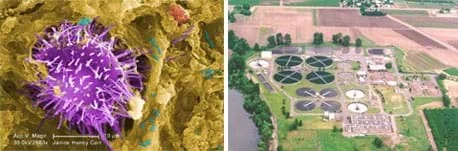 A microscopic photo shows unidentified microorganism, algae, protozoa and bacteria found in untreated water (left). An aerial view of a water treatment plant in South Dakota.Copyright Janice Haney Carr, Centers for Disease Control and Prevention, Department of Health and Human Services (left), South Dakota Department of Environment and Natural Resources (right) http://phil.cdc.gov/phil/details.asp http://denr.sd.gov/des/sw/MunicipalWastewaterTreatmentPlantAnatomy.aspx
This activity focuses on getting students to think about bacteria, water quality and water treatment processes. Students develop and test their hypotheses about the "cleanliness" of three water samples prepared by the teacher. Then they grow bacteria in Petri dishes from the water samples. They learn how private septic systems and community sewage and wastewater treatment plants work, the consequences to the surrounding environment and wildlife from human wastewater, and what measurements of the released "clean" water are monitored to minimize harm to receiving rivers and lakes.
Engineers are responsible for treating all of the water coming in and going out of our homes, schools and places of business every day—it's a process in which civil, environmental and chemical engineers are all involved. These engineers design small private septic systems and large urban water treatment plants and the processes employed to meet the crucial societal need for clean drinking water and wastewater disposal, while minimizing harm to the natural environment. Without water treatment local ecosystem would be completely changed. It is important for engineers to understand the delicate balance of an ecosystem so as not to destroy it.
After this activity, students should be able to:
- Correctly collect and plate a bacterial smear.
- Describe how wastewater is treated.
- Explain the importance of wastewater treatment.
- Describe the reasoning, thought process and requirements behind the design of wastewater treatment facilities.
- Explain environmental impact considerations associated with human wastewater treatment.
- Understand why each water treatment system is unique to each location.
- The management of waste produced by technological systems is an important societal issue.
Grades 6-8
Do you agree with this alignment? - STEL-2N Illustrate how systems thinking involves considering relationships between every part, as well as how the system interacts with the environment in which it is used.
Grades 6-8
Do you agree with this alignment? - STEL-4L Analyze how the creation and use of technologies consumes renewable and non-renewable resources and creates waste.
Grades 6-8
Do you agree with this alignment?
- HS-LS2-6 Evaluate the claims, evidence, and reasoning that the complex interactions in ecosystems maintain relatively consistent numbers and types of organisms in stable conditions, but changing conditions may result in a new ecosystem.
Grades 9-12
This resource focuses on the following Three Dimensional Learning aspects of NGSS:
Science & Engineering Practices- Evaluate the claims, evidence, and reasoning behind currently accepted explanations or solutions to determine the merits of arguments.Do you agree with this alignment?
- Scientific argumentation is a mode of logical discourse used to clarify the strength of relationships between ideas and evidence that may result in revision of an explanation.Do you agree with this alignment?
Disciplinary Core Ideas- A complex set of interactions within an ecosystem can keep its numbers and types of organisms relatively constant over long periods of time under stable conditions. If a modest biological or physical disturbance to an ecosystem occurs, it may return to its more or less original status (i.e., the ecosystem is resilient), as opposed to becoming a very different ecosystem. Extreme fluctuations in conditions or the size of any population, however, can challenge the functioning of ecosystems in terms of resources and habitat availability.Do you agree with this alignment?
- Humans depend on the living world for the resources and other benefits provided by biodiversity. But human activity is also having adverse impacts on biodiversity through overpopulation, overexploitation, habitat destruction, pollution, introduction of invasive species, and climate change. Thus sustaining biodiversity so that ecosystem functioning and productivity are maintained is essential to supporting and enhancing life on Earth. Sustaining biodiversity also aids humanity by preserving landscapes of recreational or inspirational value.Do you agree with this alignment?
Crosscutting Concepts- Much of science deals with constructing explanations of how things change and how they remain stable.Do you agree with this alignment?
Do you agree with this alignment? - Evaluate the claims, evidence, and reasoning behind currently accepted explanations or solutions to determine the merits of arguments.
- design and implement investigative procedures, including making observations, asking well-defined questions, formulating testable hypotheses, identifying variables, selecting appropriate equipment and technology, and evaluating numerical answers for reasonableness;
Grades 9-12
Do you agree with this alignment? - communicate valid conclusions supported by the data through various methods such as lab reports, labeled drawings, graphic organizers, journals, summaries, oral reports, and technology-based reports; and
Grades 9-12
Do you agree with this alignment? - demonstrate safe practices during laboratory and field investigations; and
Grades 9-10
Do you agree with this alignment?
Each group needs:
- 3 cotton-tipped swabs (Q-tips)
- 1 Petri dish, already plated with nutrient agar
- marker
- masking tape
- Wastewater Treatment Laboratory Investigation Worksheet (PDF), one per student
- How Septic and Sewer Systems Work Article (PDF), one per group
- Septic and Sewer Systems Question Sheet (PDF), one per student
To share with the entire class:
- incubator, large enough to hold all Petri dishes (see ideas for incubator alternatives in the Troubleshooting Tips section)
- computer with internet connection to show online video
- (optional) projector to show video
- bleach, for ensuring all bacteria are destroyed, and for clean-up
- bucket, to hold bleach/water solution for soaking/cleaning Petri dishes
- soap and water, for clean-up
For teacher to prepare liquids for Jars A, B and C:
- two 500-ml beakers
- 1/4 raw chicken breast
- graduated cylinder, to measure water
- 3 clear glass jars with lids, each large enough to hold ~ 100 ml
- masking tape and marker, to label jars
- broken twigs, pebbles, grass blades
- liquid food coloring (for drops of blue, yellow, green, red)
- 3 spoons or glass stirrers
- tap water
- hot plate, for boiling water
- timer, to measure boiling time
- Water Treatment Laboratory Investigation Worksheet (doc)
- Water Treatment Laboratory Investigation Worksheet (pdf)
- How Septic and Sewer Systems Work Article (doc)
- How Septic and Sewer Systems Work Article (pdf)
- Septic and Sewer Systems Question Sheet (doc)
- Septic and Sewer Systems Question Sheet (pdf)
- Septic and Sewer Systems Question Sheet Answers (doc)
- Septic and Sewer Systems Question Sheet Answers (pdf)
(In advance, prepare the liquids for Jars A, B and C, as described in the Procedure section.)
From where does the water you drink, shower and cook come? (Listen to student answers; expected answers: the ground, a pipe, the faucet, a well, a reservoir, etc.)
Why is it important to have water treatment facilities? (Answer: So we can have clean water to use. Also to protect the local ecosystems that uses the water)
What may happen to an ecosystem if water is not treated properly? (Answer: The ecosystem balance would change and certain organisms would not be able to survive therefore ruining the entire food chain of that ecosystem.)
How do you know that the water you are drinking is clean? (Possible answers: It is clear, not smelly, etc.)
What does clean water look like? (Possible answers: It is clear, not smelly, nothing floating in it, etc.)
Why do you trust that the water that comes from your faucet is clean enough to drink, shower with, cook with, etc.? (Expected answers: Someone said so; it looks clean, etc.)
(Show students Jars A, B and C. Jar A looks like clear water. Jar B looks like clear water dyed bright blue. Jar C looks like brown, dirty water with sticks, rocks and dirt floating in it.) From which one of these jars would you drink? Why? (Expected answers: Jar A because it looks clean and does not smell bad; Jar B because it looks pretty, etc.)
How can we be sure that the water in Jar A is cleaner than the water in Jar C? How does water go from looking like Jar C to Jar A? Today, you will learn how!
Before the Activity
- At least 36-48 hours in advance, prepare Jars A and B, following these instructions:
- Put 22 ml of tap water into a beaker.
- Place ¼ raw chicken breast in the water.
- Place it in the sun if possible, and let the chicken soak for 36-48 hours.
- Then remove the chicken parts and any small floating chicken particles (strain if necessary). Dispose of the raw chicken.
- Transfer about half the water from the beaker into a jar with a lid, labeled A.
- Transfer the other half into a jar with a lid, labeled B.
- Add 4 drops of blue food coloring into Jar B and stir.
- Prepare Jar C, following these instructions:
- In a beaker, boil 200 ml of tap water that includes broken twigs, pebbles and grass blades for 7 minutes. After 7 minutes, expect ~100 ml left.
- Then, add the following amounts of food coloring: 2 drops yellow, 1 drop blue, 1 drop green and 1 drop red, to give the water a brown color.
- Boiling the water should kill all bacteria, but if you want make sure, add 5 ml bleach.
- The day before the activity, have all Petri dishes plated with agar, enough for one per team.
- Gather all materials and make copies of the Water Treatment Laboratory Investigation Worksheet (PDF), and Septic and Sewer Systems Question Sheet (PDF), one each per student, and How Septic and Sewer Systems Work Article (PDF), one per group.
- Queue up the online video "Dirty Jobs with Mike Rowe: Sewage Treatment Pump," found online at the Discovery website at http://dsc.discovery.com/videos/dirty-jobs-sewage-treatment-pump.html. If you wait to bring it up during the activity, you may not have the right video player installed or the buffering may cause a delay.
With the Students: Day 1
- After conducting the Introduction/Motivation section to ask students the initial engage questions, divide the class into groups of three students each.
- Hand out the worksheets.
- Have students answer the first two worksheet questions as well as their predictions (hypotheses) on which jars they expect to contain the cleanest and dirtiest water and why.
- Assign the groups a team name or team number and instruct them to use markers to write that on the lid of their Petri dishes.
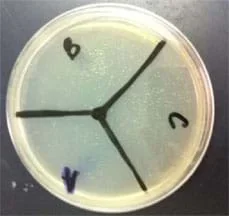 Figure 1. Preparation of the plated agar Petri dish, with sections marked and labeled on the exterior bottom.Copyright 2011 Jennifer Dietz, Galena Park High School and University of Houston
 - Tell students to flip over their Petri dishes and draw dividing lines on the bottom to create what looks like three large and equally-sized pie-piece sections. (It should look like a Mercedes Benz logo; see Figure 1).Then label each section as A, B and C, as shown in Figure 1.
- Within the groups, have students decide which team member is in charge of each letter (sample).
- Have Team Member A bring his/her Q-tip to Jar A and swirl it in the water to collect a sample.
- Have Team Member A return to his/her group's Petri dish and transfer the liquid from the Q-tip to the agar in section A of the Petri dish. Dispose of the Q-tip.
- After each student takes a water sample, the teacher stirs the water in the jar to make sure that the water has equal bacteria in each sample.
- Repeat steps 7-9 with Team Members B and C, transferring Jars B and C samples to the correct Petri dish sections.
- After all three samples have been transferred into the Petri dish sections, have the groups use masking tape to seal closed the sides of their Petri dishes.
- Instruct all students to thoroughly wash their hands using soap.
- Have groups place their sealed Petri dishes in the incubator to be left overnight.
With the Students: Day 2
- Have students sit at tables in their same three-person groups.
- Hand out copies of the article, one per group.
- Instruct students to take turns, by paragraph, reading the article out loud while the other group members follow along.
- When they have completed reading, have them turn in the article to the teacher and get copies of the question sheets, one per student. Have them answer the questions in complete sentences.
- Give students 30 minutes to write their answers; whatever questions they do not finish become homework for the night. Connect the reading to the activity by pointing out that primary treatment would remove the debris in Jar C. Secondary and tertiary treatment would remove any bacteria in all three jars.
- After 30 minutes, play the 6:23-minute "Dirty Jobs with Mike Rowe: Sewage Treatment Pump" video for the class.
- After watching the video, direct students to retrieve their group Petri dishes from the incubator, reminding them NOT to open the Petri dish lids.
- Instruct students to carefully examine their bacterial cultures and complete the lab worksheets with their observations and drawings.
- Have students turn in their lab worksheets by the end of the period. Have them also turn in their question sheets—unless they need to take them home to finish.
- Conclude with a discussion comparing class results to evaluate the cleanliness of the water in Jars A, B and C. Were students' hypotheses correct? Based on their experimental results, which jar(s) of water are clean and safe to drink? From which jar(s) of water would they not drink? (Reveal to students how the teacher prepared the three water samples.)
- bod
- Abbreviation for bio-chemical oxygen demand. A measure of how much oxygen in the water is required to finish digesting organic material left in the water treatment plant effluent.
- chlorine
- A pungent greenish-yellow, water-soluble, poisonous gas that is highly irritating to human respiratory organs. This chemical is used in water purification to kill bacteria, and as a disinfectant and bleaching agent. Symbol: Cl.
- coliform bacteria count
- A measure of fecal bacteria in water.
- dissolved oxygen
- The measure of the amount of oxygen in water as it leaves a water treatment plant. Water containing no oxygen will kill any aquatic life that comes into contact with it.
- effluent
- An outflow or discharge of liquid waste, as from a sewage system, factory, or nuclear plant.
- suspended solids
- The small solid particles found in suspension in water. Measurements of the solids remaining in water after treatment is one indicator of water quality.
Pre-Activity Assessment
Brainstorming: Before beginning the activity, encourage students in groups or partners to brainstorm the ways that water gets cleaned. Encourage open dialogue and all ideas, no matter how unusual.
Activity Embedded Assessment
Lab Worksheet: During the activity, have students write hypotheses, record observations and answer questions on the Water Treatment Laboratory Investigation Worksheet (PDF). Review their answers to gauge their mastery of the subject.
Post-Activity Assessment and/or Homework
Read & Answer: With students in groups, hand out copies of the How Septic and Sewer Systems Work Article (PDF), one per group (also available online at http://home.howstuffworks.com/home-improvement/plumbing/sewer.htm). Instruct students to take turns, by paragraph, reading out loud within their groups. When done, turn in the article to the teacher and receive the Septic and Sewer System Question Sheet (PDF), one per student. Have students individually answers the questions, using complete sentences; complete as homework, if necessary. Point out that primary treatment would remove the debris in Jar C. Secondary and tertiary treatment would remove any bacteria in all three jars.
- The bacteria that grow in the Petri dishes can be potentially hazardous to human health. Ensure all safety procedures are followed. Petri dishes are NOT to be opened by students.
- Require that students wash their hands with soap and water after handling the Q-tips and Petri dishes.
- For clean-up, soak the Petri dishes in a bucket prepared 40/60 with bleach and water to ensure that the bacteria are destroyed.
If you want more bacteria to grow, let the chicken soak longer than 36-48 hours.
Incubator temperatures vary, so follow the manufacturer's recommendations. About 95º F (35º C), close to body temperature, is a good temperature for most bacterial growth. If you do not have an incubator, try warm places behind a refrigerator, next to a radiator or inside a turned-off oven. Alternatively, make an incubator by using a small 15-watt desk lamp to warm up a small space (such as a wooden or metal box, or overturned Styrofoam cooler). If you use any of these alternatives, test it with a thermometer before using it for the activity.
If you do not have enough agar to set up the total number of Petri dishes, set up one Petri dish for the class and conduct the activity as a demonstration.
If your computer will not play the video with flash player, search to find and access the video through other websites.
Arrange for a class field trip to tour the local water treatment facility.
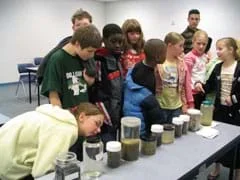 Students examine samples at a water treatment facility.Copyright City of Lincoln, NE http://lincoln.ne.gov/city/pworks/waste/wstwater/treat/
Brain, Marshall. "How Sewer and Septic Systems Work" Last updated April 1, 2000. HowStuffWorks.com. Accessed March 28, 2011. (source of article attachment) http://home.howstuffworks.com/home-improvement/plumbing/sewer.htm
Study Household Microbes (Bacteria and Fungi). MiniScience.com. Accessed February 22, 2012. (incubator and culture media information) http://www.miniscience.com/projects/bacteriagrowth/index.html
Contributors
Jennifer Dietz (Galena Park High School); Hanadi Rifai; Emil Helfer; Marissa H. Forbes
Supporting Program
National Science Foundation GK-12 and Research Experience for Teachers (RET) Programs, University of Houston
Acknowledgements
Created through the University of Houston's Cullen College of Engineering's NSF Research Experience for Teachers (RET) Program, grant no. 1130006. However, these contents do not necessarily represent the policies of the National Science Foundation and you should not assume endorsement by the federal government.
Copyright
2013 by Regents of the University of Colorado; original © 2011 University of Houston