
Keep It Moving! from Electrons to Electric Motors
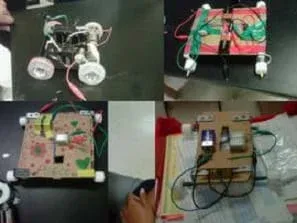 Motorized vehicles designed by student teams.Copyright 2011 Duane Turner, Mechanical Engineering Department, University of Houston
Students act as engineers to apply what they know about how circuits work in electrical/motorized devices to design their own battery-operated model motor vehicles with specific parameters. They calculate the work done by the vehicles and the power produced by their motor systems.
Electrical and mechanical engineers apply what they know to solve real-world problems, such as the design of cars that operate via gasoline engines or battery cells—or both. Hybrid electric engine technology is attractive as a creative fuel conservation, "green" energy alternative. Electrical engineers design the circuits, chips and wiring used in vehicles, cell-phones, TVs, computers, MP3 players, and other electronic items that we rely upon. Mechanical engineers design materials, moving parts and mechanisms used in all sorts of devices, from monster trucks to pacemakers.
After this activity, students should be able to:
- Design and construct simple motorized vehicle models using the most basic components to obtain movement.
- Explain how electric current is formed within a battery and how it powers a simple motor.
- Describe the energy conversions that take place in the model car's operation.
- Calculate the work energy produced by the movement of the designed vehicle over a specific distance.
- Observe, calculate and compare the velocities of the designed vehicles to others by measuring the time elapse to travel a certain distance.
- Calculate and compare the power of their vehicles' motor systems in comparison to other vehicles.
- CCSS.Math.Content.HSA-REI.B.3 Solve linear equations and inequalities in one variable, including equations with coefficients represented by letters.
Grades 9-12
Do you agree with this alignment?
- Energy cannot be created nor destroyed; however, it can be converted from one form to another.
Grades 9-12
Do you agree with this alignment? - Power systems must have a source of energy, a process, and loads.
Grades 9-12
Do you agree with this alignment?
- HS-PS3-3 Design, build, and refine a device that works within given constraints to convert one form of energy into another form of energy.
Grades 9-12
This resource focuses on the following Three Dimensional Learning aspects of NGSS:
Science & Engineering Practices- Design, evaluate, and/or refine a solution to a complex real-world problem, based on scientific knowledge, student-generated sources of evidence, prioritized criteria, and tradeoff considerations.Do you agree with this alignment?
Disciplinary Core Ideas- Criteria and constraints also include satisfying any requirements set by society, such as taking issues of risk mitigation into account, and they should be quantified to the extent possible and stated in such a way that one can tell if a given design meets them.Do you agree with this alignment?
- At the macroscopic scale, energy manifests itself in multiple ways, such as in motion, sound, light, and thermal energy.Do you agree with this alignment?
- Although energy cannot be destroyed, it can be converted to less useful forms—for example, to thermal energy in the surrounding environment.Do you agree with this alignment?
Crosscutting Concepts- Energy cannot be created or destroyed—it only moves between one place and another place, between objects and/or fields, or between systems.Do you agree with this alignment?
- Modern civilization depends on major technological systems. Engineers continuously modify these technological systems by applying scientific knowledge and engineering design practices to increase benefits while decreasing costs and risks.Do you agree with this alignment?
Do you agree with this alignment? - Design, evaluate, and/or refine a solution to a complex real-world problem, based on scientific knowledge, student-generated sources of evidence, prioritized criteria, and tradeoff considerations.
- Scientific processes. The student uses a systematic approach to answer scientific laboratory and field investigative questions. The student is expected to:
Grades 9-12
Do you agree with this alignment? - design, construct, and calculate in terms of current through, potential difference across, resistance of, and power used by electric circuit elements connected in both series and parallel combinations;
Grades 9-12
Do you agree with this alignment? - investigate and describe the relationship between electric and magnetic fields in applications such as generators, motors, and transformers; and
Grades 9-12
Do you agree with this alignment? - calculate the mechanical energy of, power generated within, impulse applied to, and momentum of a physical system;
Grades 9-12
Do you agree with this alignment? - evaluate the transfer of electrical energy in series and parallel circuits and conductive materials;
Grades 9-10
Do you agree with this alignment? - understand energy and its forms, including kinetic, potential, chemical, and thermal energies;
Grades 10-12
Do you agree with this alignment? - The student, for at least 40% of instructional time, conducts laboratory and field investigations using safe, environmentally appropriate, and ethical practices. These investigations must involve actively obtaining and analyzing data with physical equipment, but may also involve experimentation in a simulated environment as well as field observations that extend beyond the classroom. The student is expected to:
Grades 9-12
Do you agree with this alignment?
Each group needs:
- battery(ies): 9 volt, D-cell, AA, etc.
- 4 wheels or disks (wheels must be firmly fastened to axle or the body of the vehicle, but must be able to rotate freely)
- 2 axles (that is, plastic, metal, wooden dowel rod or like material)
- 2-3 alligator clip wires
- electric, DC powered motor (at least one): 1.5V- 9V
- driving gear (to fit axle) and gears for motor, or one sewing spool (to fit axle) rubber-band.
Vehicle Body:
- sturdy cardboard, wood, Styrofoam, or plastic
To share with the entire class:
- double-sided tape
- electrical and/or regular tape
- glue gun(s) with glue sticks
- rulers
- construction paper
- markers
- scissors
- computer with Internet access and classroom projector, for a teacher demo
- a toy car or a constructed model, for a teacher demo
For the teacher 's lemon demo:
- 1-2 lemons,
- 2 copper wires
- 2 zinc wires
- 1 small LED. bulb
- 3 alligator clip wires
Students require an understanding of the sub-atomic particles of the atom and the importance of valence electrons in performing chemical reactions, the formation of charged ions, and the movement of electrons in metals. Students should also have an understanding the law of conservation of energy, energy forms and sources, and energy transformations. Also, they should have a background understanding of concepts and equations pertinent to velocity, acceleration, and force (including the force of gravity).
How does electricity work? (Expect students to say that electricity flows through electrical wires or cords). What type of material is within the electrical cords that allows electricity to flow through it? (Make sure students have an understanding of insulators and conductors, and know that the metal inside of electrical cord conducts the electricity.)
Metals are cations that lose electrons and transfer their electrons to other metals. They form a "current," or a flowing sea of electrons. (As necessary, review this topic with students; (optional) show the pertinent slides from the Keep it Moving! Presentation (PDF).)
(Show students a piece of metal wiring.) Is this metal conducting electricity? (Of course, they will say no.) What is needed to make electricity? (Expect students to say: a power source, an outlet, batteries, etc.)
Online Circuit-Building Demo
(Use a computer and projector to show the following website to the class: phet.colorado.edu/en/simulation/circuit-construction-kit-dc. Have students work as a class to complete the challenge. The purpose is to challenge the students to create an electrical circuit. Allow students to figure out the components needed in order to create a circuit that produces a successful circuit. Expect students to discover that the simplest means of creating a circuit is to have a power-supply [batteries], wires and a device, [in this case, a light]. You can also review the concept of series [in which all wires are connected so that electricity can only flow from anode to cathode in one path] and parallel circuits [in which electricity can flow in multiple paths to reach the cathode].)
Energy Transformation with a Lemon Demo
What types of energy do we use every day? (Listen to student answers; expect them to say electrical, thermal, radiant, mechanical, etc. Refer to the circuit produced on the Phet website (http://phet.colorado.edu/en/simulation/circuit-construction-kit-dc.) What type of energy transformation took place? (Expect students to say electrical to light energy.)
(Demonstrate the point that the first energy transformation that takes place is converting the energy from chemical to electrical by conducting the following demo using supplies listed in the Materials List. Connect the three alligator clip wires in series to the copper and zinc wires placed in the lemons, and clip one side to the other prong of the LED light.)
What role does the lemon play in the circuit? (Answer: The lemons serve as the batteries.) What type of energy is contained in the lemon? (Listen to student answers. Make sure they understand that any battery, whether a car battery or a piece of fruit, contains chemical energy, because of the positive and negative charged ions contained in the fluids within. Students need to understand this very simple concept of a circuit, which overlaps the sciences of chemistry and physics, and circuits are involved in all apparatus that use the principle of electricity to produce work, whether that is an electric toothbrush to a car.)
Work and Power Demo (see Keep it Moving Presentation)
A motor receives electrical power to do work. (Show students the pertinent attached presentation slides. Use a toy car or a constructed model handy as a great visual.) Work is the amount of force applied to an object for a certain distance. More powerful engines, like V6s or V8s, are able to do more work in a specified amount of time. (Introduce the concept of power = work/time.)
Background
This activity requires that the teacher has a basic understanding of general physics and chemistry concepts, including: the general movement of electrons within metals, ionic solutions, and chemical cells; the basic components needed to form electrical circuits; and how to manipulate and solve for variables in the equations for speed, force, work and power.
Before the Activity
- Gather materials and make copies of the worksheet.
- Build a prototype electric model car so as to: 1) have the ability to foresee any possible limitations or construction problems with the supplied materials, and 2) create a demonstration model to help students initiate the planning and construction of their own vehicles.
- Unlimited ways exist to design and build model electrical vehicles. Below are some basic steps for how to build one. (Not all steps are shown by images.)
- Cut out a rectangular piece of cardboard.
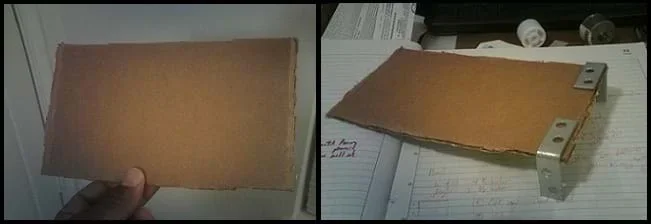 Figure 1: Cardboard to be used as a base for the vehicle (left). Shelf brackets glued to the cardboard (right).Copyright 2011 Duane Turner, RET Program, Mechanical Engineering Department, University of Houston
 - Glue or tape down (use mounting tape) the L-shaped shelf brackets to each corner, as shown in Figure 1.
- Place a wooden dowel (stick) through the loops of the L-shaped brackets.
- Put regular tape around each end of the wooden dowel, until the wheels fit snuggly around the wooden dowel, and glue the edges.
- On the drive-train dowel (the one that will be connected to the motor), wrap the middle with tape and place a spool in the middle of the dowel.
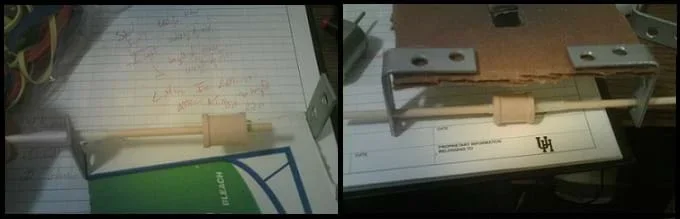 Figure 2. Wooden dowel is being inserted through a bracket into a spool in order to produce the drive-train (left). Cut-out in the cardboard body for the drive-train connection (right).Copyright 2011 Duane Turner, RET Program, Mechanical Engineering Department, University of Houston
 - Place a rubber band around the spool.
- Cut out a square or rectangle in the cardboard, above the spool axle, about 1-2 inches back.
- Position your motor on top of the cardboard base.
- Pull the rubber band through the opening, place it around the needle, and pull back far enough so the rubber band is tight. (The power-train mechanism shown in Figure 3 is a belt system. Alternative ideas: Attach gears to the motor and axles to turn the wheels, or attach a fan-blade to the motor, to create a wind-propelled vehicle.
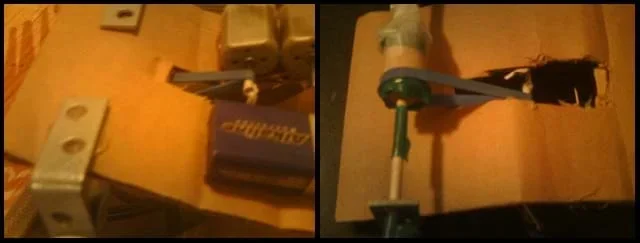 Figure 3: Top view of the motor connection on vehicle (left). Bottom view of the motor connection (right).Copyright 2011 Duane Turner, RET Program, Mechanical Engineering Department, University of Houston
 - Glue or tape down the motor.
- Glue or tape down the battery (or batteries). (Note: If using batteries such as D or C cells, then create electrodes for the "+"/ "-"terminals. Use small pieces from two different metals, like aluminum and copper, and tape the copper to the "+" terminal; aluminum to the "-"terminal.)
- Place alligator clips on each end of the battery to each prong on the motor.
- If everything is set up correctly, the car should move!
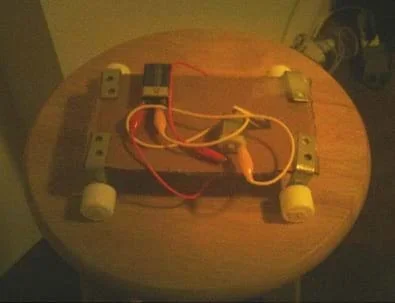 An example completed battery-operated car.Copyright 2011 Duane Turner, RET Program, Mechanical Engineering Department, University of Houston
Expect students to use their creativity and understanding of how cars work by altering body styles, wheel dimensions, increasing battery voltage, increasing the number of motors (to create a "four wheel drive" effect) , etc.
With the Students
- Present the Introduction/Motivation section to the students including the engaging demos and review/background material, as outlined above.
- Hand out the Keep it Moving Challenge Worksheet (PDF) and explain the project details. Specifically, state how this project involves engineering principles, including the basics of all engineering: applying what you know to solve real-world problems. In this project, they must apply what they know about electricity and motorized devices to design a car that moves. The design parameters include materials available and time constraints. Explain to the students that engineers often have to design their solutions to accommodate for material specifications and time constraints.
- Assign student groups, with no more than four students per group.
- Assign materials to be selected by group members and have them divide the responsibility of purchasing the items among themselves: (that is, group member 1 – car body material; group member 2 – batteries and wires; group member 3 - motor, gears, and axle; group member 4 – wheels and fastening materials.) Note: be prepared to purchase the base supplies or offer students extra credit to buy general supplies for the class.
During the Activity
- Ask students why they are making certain design decisions and prompt them to justify their design decisions by employing what they know about electrons, electrical circuits, and transfer of energy forms.
- Guide students in basic design principles of the car and how to modify these aspects, such as choosing different batteries, wheel spacing, car weight, and other variables that students may alter.
- atom
- Basic unit of matter, which contains a nucleus surrounded by an electron cloud.
- battery
- One or more electrochemical cells that convert stored chemical energy into electrical energy.
- circuit
- A pathway (or series of paths) in which electrons are routed through a loop.
- commutator
- A rotary electrical switch in certain types of electric motors that reverses the current direction between the rotor and the external circuit.
- direct current
- The singular direction of flow of electric charge. Direct current is produced by such sources as batteries and solar cells.
- electric current
- The flow of electric charge through a conductor, such as a metal wire.
- electrical motor
- Converts electrical energy into mechanical energy; operates through interacting magnetic fields and current-carrying conductors to generate force.
- electrical power
- Rate at which an electric energy is transferred through an electric circuit.
- electrolysis
- A chemical reaction that is produced from the separation of chemical compounds by electric current.
- force
- A force (N – Newton) is that which can cause an object with mass to change its velocity (which includes to begin moving from a state of rest), that is, to accelerate concerning its movement, direction or geometrical construction. F = m x a
- ion
- Atoms or compounds that become positively or negatively charged, when they either lose electrons (cations) or gain electrons (anions).
- joules
- A derived unit SI (International Systems of Units) for energy, work, or power. (J)
- mechanical power
- The rate (time) at which work is performed (such as, how quickly a car moves). P = W/t
- resistance
- The resistance within an element or material to the flow electrons.
- terminal
- A point of connection in a conductor to external circuits or wires.
- torque
- The tendency of a force to rotate an object about an axis.
- valence electron
- Electrons in an atom's outermost valence shell and are responsible for the chemical bonds formed with other atoms.
- voltage
- The electrical potential energy that is stored with an electrical cell (such as a battery).
- watt
- The SI unit for power, derived as defined as one joule per second (Watt).
- work
- The work done by a constant force (magnitude F) on a point that moves a distance (d) in the direction of the force is applied. W = f x d
Pre-Activity Assessment
Engagment Questions: Test students' prior knowledge by ask students the following questions and discussing as a class:
- What type of energy transformation occurs to run a battery-powered toy car? (Have a toy car or a constructed model vehicle handy as students discuss.)
- What components would be needed to get it to work,? (Guide students to brainstorm ideas as a class.)
Activity Embedded Assessment
Activity/Lab Implementation: After the activity introduction, have students work in groups and brainstorm ideas for the construction of their vehicles by using the basic lab instructions as a template or by looking at the example model made by the teacher in order determine how their vehicles could be made (the latter is more of a reverse engineering approach).
Questions for groups to think about as they construct their cars:
- How does the design (car body) support the weight of motor, battery (ies), and wires that will be added? How will this affect the car's speed?
- Which type of motor and/or battery would be most effective and efficient for my vehicle?
- What kind of benefit/impairments would be added to my vehicle if additional batteries and/or motors were added? (Think about question 1 again). What additional materials would be needed?
- What other components (like body material, wheels, etc.) could be added in addition to or in place of provided base materials, to allow for creativity and/or design improvement?
After construction, groups present their model vehicles to the class. Give them space to "test-run" their vehicles. As groups are completing test runs, have students record their vehicle's mass and time of travel for one meter.
Post-Activity Assessment
Follow-up Presentation and Post-Lab Questions: Have groups calculate the weight, speed, work and power produced by their vehicles and record and compare these results as a class. After observing how their vehicles perform and gathering data, have students answer the post-lab questions on the back of their lab papers.
- If glue guns are used, warn students that the nozzle tips get very hot and could burn skin and clothing.
- This activity is designed without power tools, but if power tools are used, advise extreme caution and/or have students use the tools with adult supervision.
To maximize car functioning, remind students to bring fresh, new batteries.
Wire clips can be connected directly from 9-volt batteries to the motor, but see the Procedure section if any other type of battery (D,C, AA, etc.) is being used.
Students need to realize that the battery(ies) they use for the model car must supply enough voltage to power its motor. If the car does not move, suggest increasing the battery supply by connecting more batteries in series additional wires required).
Organize a class run-off by having groups race their model vehicles against each other for extra points or a prize.
- For more advanced students, increase the challenge level by eliminating the example instructions so that they must start from "scratch."
- Make the activity more or less challenging by altering the materials and/or design constraints.
Adams, Wendy; Dubson, Micheal; Perkins, Kathy; Reid, Sam; Weiman; Carl. Circuit Construction Kit (DC Only). Last updated 2011. University of Colorado Boulder, Interactive Simulations. Accessed November 23, 2012. http://phet.colorado.edu/en/simulation/circuit-construction-kit-dc
Nave, C.R. How Does an Electric Motor Work? ©2011Georgia Statue University. Hyper Physics. Accessed April 30, 2011.http://hyperphysics.phy-astr.gsu.edu/hbase/magnetic/mothow.html#c1.
Wikipedia. Last updated May 15, 2011. Accessed June 7, 2011. (Source of most definitions, with some adaptations). http://en.wikipedia.org.
Woodford,Chris. Batteries. Created April 30, 2011.explainthatstuff.com. Accessed May 28, 2011. http://www.explainthatstuff.com/batteries.html.
Contributors
Duane Turner; Mark Bulger; Christiana Chang; Gangbing Song; Eduardo Guevera
Supporting Program
National Science Foundation GK-12 and Research Experience for Teachers (RET) Programs, University of Houston
Acknowledgements
Created through the University of Houston's Cullen College of Engineering's NSF Research Experience for Teachers (RET) Program, grant no. 1130006. However, these contents do not necessarily represent the policies of the National Science Foundation and you should not assume endorsement by the federal government.
Copyright
2013 by Regents of the University of Colorado; original © 2011 University of Houston