
Insulation Materials Investigation
Students test the insulation properties of different materials by timing how long it takes ice cubes to melt in the presence of various insulating materials. Students learn about the role that thermal insulation materials can play in reducing heat transfer by conduction, convection and radiation, as well as the design and implementation of insulating materials in construction and engineering.
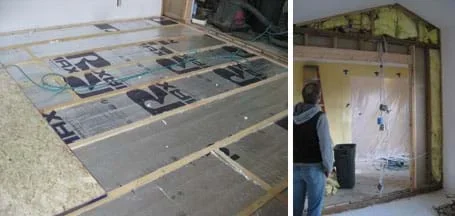 Adequate insulation protects the inside of a home from unwanted energy gain and loss.Copyright 2011 Denise W. Carlson. Used with permission.
Engineers, architects and contractors take insulation into account in the design and construction of any building. Engineers create materials that prevent the transfer of heat by conduction, convection and radiation in order to keep cool things cool or warm things warm. We don't want the cold air sneaking into our homes in the winter, and we don't want it escaping in the summer! These materials are installed in homes and other buildings to help lower the energy costs of heating and cooling. Engineers also design thermal insulation for countless other products and purposes, including pipe insulation (so water does not freeze in the pipes or heated water does not lose heat), handling food and beverages, space travel, and even your clothing!
After this activity, students should be able to:
- Describe the purpose of insulation materials as they relate to heat transfer.
- Describe the basic attributes that are common to insulation materials.
- Describe how engineers make decisions about insulation materials.
- Structures are constructed using a variety of processes and procedures.
Grades 9-12
Do you agree with this alignment? - The design of structures includes a number of requirements.
Grades 9-12
Do you agree with this alignment?
- HS-PS3-4 Plan and conduct an investigation to provide evidence that the transfer of thermal energy when two components of different temperature are combined within a closed system results in a more uniform energy distribution among the components in the system (second law of thermodynamics).
Grades 9-12
This resource focuses on the following Three Dimensional Learning aspects of NGSS:
Science & Engineering Practices- Plan and conduct an investigation individually and collaboratively to produce data to serve as the basis for evidence, and in the design: decide on types, how much, and accuracy of data needed to produce reliable measurements and consider limitations on the precision of the data (e.g., number of trials, cost, risk, time), and refine the design accordingly.Do you agree with this alignment?
Disciplinary Core Ideas- Energy cannot be created or destroyed, but it can be transported from one place to another and transferred between systems.Do you agree with this alignment?
- Uncontrolled systems always evolve toward more stable states—that is, toward more uniform energy distribution (e.g., water flows downhill, objects hotter than their surrounding environment cool down).Do you agree with this alignment?
- Although energy cannot be destroyed, it can be converted to less useful forms—for example, to thermal energy in the surrounding environment.Do you agree with this alignment?
Crosscutting Concepts- When investigating or describing a system, the boundaries and initial conditions of the system need to be defined and their inputs and outputs analyzed and described using models.Do you agree with this alignment?
Do you agree with this alignment? - Plan and conduct an investigation individually and collaboratively to produce data to serve as the basis for evidence, and in the design: decide on types, how much, and accuracy of data needed to produce reliable measurements and consider limitations on the precision of the data (e.g., number of trials, cost, risk, time), and refine the design accordingly.
- contrast and give examples of different processes of thermal energy transfer, including conduction, convection, and radiation; and
Grades 9-12
Do you agree with this alignment?
Each pair of students needs:
- small glass laboratory beakers (1 or 5 or more, depending on the chosen set-up)
- ice cubes
- stopwatch or a similar timing device
- low-temperature hot plate
- Insulation Materials Investigation Worksheet (PDF)
- blank paper and pencils
To share with the entire class:
- assortment of materials to test as possible insulation materials, such as tissues, newspaper, cotton balls, Styrofoam, aluminum foil, cloth, shaving cream, petroleum jelly, snack foods (such as cheese curls), etc.
A basic understanding of temperature and heat is required. Students should know that heat is a form of energy that flows from hot to cold objects. Students must also understand the three methods of heat transfer: conduction, convection, and thermal radiation.
How many of you have ever crawled around your attic (or a crawl space) before? Can you describe some things that you saw there? (Wait for responses, expect students to mention insulation.)
What does the insulation do? (Listen to student responses.) How does the insulation keep the house cool (or warm)? (Listen to student ideas.) Have you seen insulation used in other places, for other purposes?
It may surprise you to find out that a lot of science and engineering go into designing insulation—it's much more than just pink fiberglass fluff strewn about. One of the main things that engineers focus on is making sure that buildings are correctly insulated. Reducing energy consumption is always a hot topic. Using insulation is a great way to reduce energy expenditures; without it, we would quickly find ourselves in an energy crisis across the U.S. In fact, sometimes that still happens when prolonged heat waves or severe frigid weather overwhelms the electric grid with energy demands for air conditioning or heating, especially in large cities!
So, what makes a good insulator? That's where the physics of heat transfer comes in. Today, we will talk about the three types of heat transfer: conduction, convection, and thermal radiation, and see how they relate to our insulating materials experiment.
Let's first talk about the science that relates to heat transfer, so we can understand why insulating materials are so important in the first place. In short, when heat is applied to an object, one of two things occurs: either the temperature of the object rises or it goes through a phase transition. For today's activity, we will focus primarily on the heat added to change the phase for H20 from solid (ice) to liquid (water).
A thermal insulator is a material that conducts heat poorly. Can you think of a good example? (Listen to student ideas.) Well, Styrofoam is a good example. You can comfortably hold a hot cup of coffee or a piece of metal surrounded by just a centimeter of Styrofoam. Heat flows very slowly through it so that the temperature of your hand does not rise very much. Styrofoam gets its insulating ability by trapping spaces of air in bubbles. We use thermal insulators to maintain temperature differences by not allowing much heat to flow. What is the purpose of insulation? Well, heat always flows from a hot body to a cold body, and so the purpose of insulation to slow the flow. That is important for both comfort and survival.
Now, what about the engineering? When engineers design insulation, they are working against heat transfer, trying to stop it as best they can. Insulation is rated in terms of thermal resistance, which is called the R-value of the insulation. The higher the R-value, the higher the resistance to heat flow and the more effective the insulator.
Physicists create all kinds of amazing insulators, but it is the job of engineers to design practical, cost-effective and safe materials that can be put to everyday use into homes or other buildings. What types of insulation materials have you seen? (Listen to student suggestions.) Here are some different types of common insulation materials:
- Blankets, in the form of batts or rolls, are made from mineral fibers, fiberglass or rock wool.
- Blown-in loose-fill insulation is made from cellulose, fiberglass or rock wool. It is often used to fill in wall cavities or unfinished attic floors.
- Foam insulation is typically sprayed using professional equipment. It comes in two forms: open-cell and closed-cell. Open-cell allows water vapor to move through more easily, but has a lower R-value.
- Rigid insulation is made from fibrous materials or plastic foams, and manufactured in board-like forms and molded pipe-coverings.
- Reflective insulation systems are fabricated from aluminum foils with various backings.
- Radiant barriers are installed to reduce summer heat gain and winter heat loss. Radiant barriers have low emittance and high reflectance.
So—what is the purpose of insulating materials? (Wait for students to answer.) Yes—they are designed to slow down heat transfer. Today, you are going to compare different materials to see which prevents the most heat transfer between an ice cube and a glass beaker!
Background
During this activity, students test the insulation properties of various materials by using ice cubes. The purpose of the experiment is to get students to think about heat transfer and how that relates to the insulation properties of different materials, and why engineers take this into account.
Each set-up includes five (or more) different insulating materials placed in glass beakers. Students time how long it takes a single ice cube to melt in each beaker. You can run the experiment two different ways:
- Each group prepares and oversees a set of five beakers and four different insulation materials. Students record the time it takes for ice cubes to melt for each of the materials in its set-up. (One beaker is a control.) Or:
- Minimize the time and materials required by using only one set-up of five beakers (or more, depending on class size) and different materials for the entire class, and give each group one beaker from the set-up. Each group measures the time it takes for its ice cube to melt and data is pooled for analysis. (One beaker is a control.)
Regardless of the scenario, students write-up lab reports that include initial hypotheses about which material they expect to make the best insulator, a data table, and conclusions drawn from the data.
Before the Activity
- Make sure that you have a method of producing identical ice cubes. Ice trays work as long as each cube is filled to the same depth prior to freezing. Leave the ice cubes in the freezer until you are ready to pass them out.
- Gather materials for each group, including an assortment of materials to use as "insulators."
- Make copies of the Insulation Materials Investigation Worksheet (PDF), one per group.
With the Students
- Have students examine each material that you have available. Ask the class to be silent for two minutes while each student writes down a prediction about which material will turn out to be the best insulator. Require they write one-sentence explanations, defending their choices.
- Divide the class into groups of two students each.
- Give each group five small glass beakers. Have each group choose four different insulating materials they want to test. Direct each group to leave the fifth beaker empty to serve as a control. Ask students to think about what is flawed about using a beaker as a control, and ask them about it when the experiment is over. (See answer at end of Procedure section).
- Have students fill the bottom of each beaker with exactly 1 in (2.25 cm) of a test insulating material. Instruct students to pack the insulating material tightly into the beaker, minimizing the presence of air in the insulation (this applies to materials such as newspaper, cotton balls, junk food, etc., which can be compressed). Explain that the presence of air between insulation materials could skew the results because air has insulating properties of its own! Also explain that students must be precise about the volume of insulating materials placed in each beaker so that the trial results can be fairly compared based on the volume of insulating material used.
- Have students turn their hot plates on low, and place all five beakers onto the hot plate at the same time. It is important that a group's beakers are placed onto the same hot plate at the same time so that each beaker receives the same amount of heat.
- Retrieve the ice cubes from the freezer and give five cubes to each group, instructing them to immediately put one cube into each beaker, and make sure that the cube is resting on top of the material in the bottom of the beaker. Emphasize that groups must keep the temperatures on the hot plates low! Explain that the reason they placed the insulators on the bottom of the beaker was to keep the heat source (hot plate) from reaching the ice cube, in order to assess the effectiveness of the insulating material.
- Depending on the amount of class time available, let the ice cubes melt and collect data by either timing or weighing them. Two options.
- If you have 30+ minutes of class time, have students time how long it takes for the ice cubes in each set-up to melt. The resulting data collected is the melting times for each material. The material in the beaker with the cube that has the longest melting time is considered the best insulator.
- If you are short on time, let the ice cubes melt for at least 20 minutes, then take them out and have the students use triple beam balances to measure the mass of the cubes. If the cubes started close to identical, then the cube with the largest final mass is considered the best insulator.
- While groups are waiting for the ice cubes to melt, have them begin discussing the worksheet questions and composing their answers.
- Instruct students to check back on their ice cubes regularly to increase data accuracy. If conducting one experiment set-up per class, have students share their data on the board so students can compare them and judge the best insulator.
- Have students draw conclusions based on their data and results, and use the worksheet and extra paper to write up lab reports that include their initial hypotheses of the best insulator, data tables with the different times, and their conclusions based on the data. Or, see the alternative and additional concluding activities described in the Assessment section.
- Bonus Question: What is flawed about using a beaker as a control? (Answer: The material of the beaker also has slight insulating properties, and a true control would be a set-up that utilized no insulating materials whatsoever. If we wanted to be more scientific about this experiment, we would place the control ice cube directly on a hot plate, and place the other insulating materials directly on the hot plate as well. But, for this activity, we are mindful of the fire-hazard that some of the insulating materials would become if placed directly on hot plates, so we used beakers.)
- conduction
- The transfer of heat through a substance by direct contact of atoms or molecules.
- convection
- The transfer of heat by circulation of a gas (such as air) or liquid (such as water).
- radiation
- Heat radiated in the form of rays or waves (such as rays from the sun).
- r-value
- A measure of the resistance of an insulating or building material to heat flow (its thermal resistance). The higher the R-value, the greater the resistance to heat flow and the more effective the insulator.
- thermal insulator
- A material that conducts heat poorly.
Worksheets: During the activity, have student teams use the attached Insulation Materials Investigation Worksheet (PDF)to record their initial hypotheses about which material they expect to make the best insulator, data (ice cube melting times or, alternatively, ice cube masses), and conclusions drawn from the data. After the experiment is over, have them discuss with teammates the questions on the worksheets. Then have one teammate write-up the odd-numbered answers and the other write-up the even-numbered answers. The questions (and answers) are also listed below, as follow-up questions.
Follow-Up Questions: As an alternative to students writing up answers to the worksheet questions, lead a concluding class discussion, asking them to contribute from their results to answer the following questions.
- Based on your data, which material turned out to be the best insulator? Why? (Answer: The ice cube with the longest melting time indicates the best insulator. Or, alternatively, the ice cube with the largest final mass.)
- Based on your data, which material turned out to be the worst insulator? Why? (Answer: The ice cube with the shortest melting time was the worst insulator. Or, alternatively, the ice cube with the smallest final mass.)
- As an engineer, what conclusions might you draw from your data? (Possible answers: Insulators that did a good job of protecting the ice cube from melting would be appropriate for use in cold climates, and could protect people and their homes during cold weather. Conversely, insulators that did a poor job of preventing the ice cube from melting would be suitable for warmer climates.)
- How did your results differ from the predictions you made before conducting the experiment?
- What were some controls in this experiment? (Possible answers: beaker size, ice cube volume, insulation material volume, hot plate temperature.)
- What method of heat transfer caused the ice to melt? (Answer: Conduction)
- What heat processes (convection, conduction, radiation) do you think are most prevalent in and around the beaker? (Answer: Conduction is heat transfer that occurs between substances that are in direct contact with each other, such as a beaker on a hot plate. Therefore, conduction is the main method of heat transfer at work in this experiment. However, if we look hard enough, we might find evidence of convection or radiation as well. Radiation is heat transfer by electromagnetic waves traveling through space, so if you feel warmth on your hands as they hover above the hot plate you are experiencing warming through radiation. Convection occurs when gases or liquids begin to move via convective currents due to heat transfer. As the ice is heated, in cases of poor insulation it may have turned entirely to water, in which case, convection may have begun.)
- How does this experiment help us determine the best insulator? (Answer: The best insulator is the one that does the best job of protecting the ice cube from heat transfer. Therefore, this experiment reveals the best insulator through data collection on the length of time it takes the ice cubes to melt, or by comparing the masses of the ice cubes at the end of a given amount of time.)
- How might you improve upon this experiment? (Possible answer: The beaker has its own insulation properties, and therefore, impacted the data in this experiment. To better test the effectiveness of various materials for insulation, we would need to place the material being tested for insulation properties directly on the heat source. That way, the beaker would not impact the data.)
- What else could you test using this experiment? (Possible answer: We could measure the mass of the ice cubes at various time intervals to compare the rate of heat transfer between various insulation materials.)
- What are some causes of error from the hot plates? (Answer: The hot plates may not have uniform temperatures; the inside of a hot plate might be warmer than its outer edge. Additionally, each hot plate is different, so data cannot be confidently compared across hot plates.)
- In engineering, why is it useful to know the insulation properties of different materials? (Answer: Understanding the insulation properties of different materials helps engineers meet the varying needs of their clients. In some cases [perhaps depending on the clients' location or project constraints or requirements], engineers employ materials with poorer insulation properties, whereas in other cases, engineers are looking to create thermal envelopes with excellent insulation.)
- List at least three attributes that insulating materials have in common. (Possible answer: Insulating materials 1] conduct heat poorly, 2] have high R-values, and 3] slow the flow of heat transfer.)
Recommendations: Provided students (or show the class with an overhead projector) the US Recommended Insulation Levels Chart (PDF)(or print the same chart from this Energy Star website: https://www.energystar.gov/index.cfm?c=home_sealing.hm_improvement_insulation_table). Referring to the chart, have students answer the following questions:
- Why are different R-levels recommended based on geographic location? Why does the tip of Florida have a recommended R-value of 1, while Michigan is recommended at 5 or 6? (Possible answer: Different levels of insulation are needed based on climate. In colder regions, more insulation is needed to keep homes warm. The website states that, "Insulation levels are specified by R-value. R-value is a measure of insulation's ability to resist heat traveling through it. The higher the R-value the better the thermal performance of the insulation." Therefore, an R-level of 5 or 6 in Michigan requires better insulation performance than the low R-level in Florida, where air temperatures are warmer.)
- As an engineer, based on your answer to the first question as well as the data you gathered, which insulator from your experiment would you recommend for use as insulation for a home in Florida? (Use your imagination—obviously real engineers would not recommend cotton balls or Cheetos as the new popular insulating material for homes!) What about in Michigan? (Good answers are based on the length of time it took the ice cube to melt. For example, a set-up in which the ice cube melted most quickly indicates a poor insulator, and therefore would be more suitable for Florida).
- Have students examine the map and chart information to discuss and compare what they know to the information provided. Find locations where they have lived and share whether or not the map verifies the type of insulation they have seen in those regions.
Even though students should be using low-temperature hot plates, they should take care in allowing any of the insulation test materials to touch the plates.
While fiberglass has been used as home insulation for a long time, newer, more efficient, safer and greener alternatives are now widely available. Have students research these alternative insulation materials that have been designed by engineers. Examples: new types of batting (such as recycled denim), foam, and loose-fill (recycled paper cellulose). Require reports to describe R-factors, cost, durability and environmental impact. Discuss other issues, such as indoor air quality, sealing the thermal envelope, and adding rigidity to a structure.
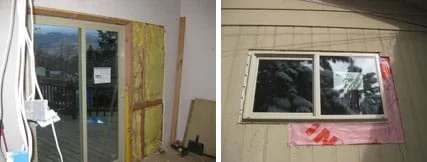 Examples of home insulation: dual-paned insulating glass with a gas layer, fiberglass batting between studs, and high-tech material to seal the "thermal envelope" of a home.Copyright 2011 Denise W. Carlson. Used with permission.
Show students the 5:39-minute "Mainstream Green: Insulation" video to learn about the many different insulation products now available: http://www.fanboyreport.com/article/category/videos/517150696/
Hewitt, Paul G. Conceptual Physics, 10th Edition. San Francisco, CA: Pearson Addison Wesley, 2006. Chapters 15-18: Heat. pp. 289-360.
How Insulation Works. Energy Savers. Last updated February 9, 2011. Energy Efficiency & Renewable Energy, U.S. Dept. of Energy. Accessed March 1, 2011. http://www.energysavers.gov/your_home/insulation_airsealing/index.cfm/mytopic=11330
How Insulation Works. Tech-FAQ, TopBits.com. Accessed March 1, 2011. (Includes a photo showing many different types of insulation products: batting, rigid foam, chips, etc.) http://www.tech-faq.com/how-insulation-works.html
Hsu, Tom. Foundations of Physics. First edition. Teaching & Learning Systems, School Specialty, Science, CPO Science. 2009, pp. 521-538.
Insulation. Howstuffworks.com. Accessed March 1, 2011. http://www.howstuffworks.com/dictionary/chemistry-terms/insulation-info.htm
Insulation Fact Sheet. Last updated on January 15, 2008. Building Envelope Research, Oak Ridge National Laboratory. DOE/CE-0180 2008. Accessed March 1, 2011. http://www.ornl.gov/sci/roofs+walls/insulation/ins_01.html
Insulation—The Stuff on the Fluff. Last updated April 9, 2010. Building Energy Codes Program, Energy Efficiency & Renewable Energy, U.S. Dept. of Energy. Accessed March 1, 2011.
Contributors
Robert McKinney; Marissa H. Forbes
Supporting Program
National Science Foundation GK-12 and Research Experience for Teachers (RET) Programs, University of Houston
Acknowledgements
Created through the University of Houston's Cullen College of Engineering's NSF Research Experience for Teachers (RET) Program, grant no. 1130006. However, these contents do not necessarily represent the policies of the National Science Foundation and you should not assume endorsement by the federal government.
Copyright
2013 by Regents of the University of Colorado; original © 2011 University of Houston