
What Works Best in a Radiator?
Students learn the importance of heat transfer and heat conductance. Using hot plates, student groups measure the temperature change of a liquid over a set time period and use the gathered data to calculate the heat transfer that occurs. Then, as if they were engineers, students pool their results to discuss and determine the best fluid to use in a car radiator.
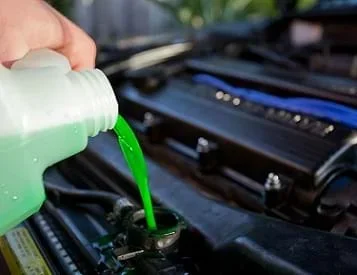 Choosing an appropriate coolant fluid, based on properties of heat transfer, is one aspect of designing engine radiators.Copyright 2009 Fir0002/Flagstaffotos, Wikimedia Commons http://commons.wikimedia.org/wiki/File:Engine_coolant.jpg
Heat is a concept that is used throughout most all engineering fields. It is particularly important for civil, mechanical and chemical engineers, for which heat transfer plays an important role in material selection, machinery efficiency and reaction kinetics, respectively. In this activity, students play the role of engineers by measuring and determining the best fluid for cooling a car's engine.
After this activity, students should be able to:
- Explain the process of conduction as it relates to heating a liquid.
- Use their experimental findings to perform calculations.
- Explain why certain specific heat capacities are desirable in fluids used as heat exchangers.
- CCSS.Math.Content.HSA-CED.A.4 Rearrange formulas to highlight a quantity of interest, using the same reasoning as in solving equations.
Grades 9-12
Do you agree with this alignment? - CCSS.Math.Content.HSF-LE.B.5 Interpret the parameters in a linear or exponential function in terms of a context.
Grades 9-12
Do you agree with this alignment? - CCSS.Math.Content.HSN-Q.A.1 Use units as a way to understand problems and to guide the solution of multi-step problems; choose and interpret units consistently in formulas; choose and interpret the scale and the origin in graphs and data displays.
Grades 9-12
Do you agree with this alignment? - CCSS.Math.Content.HSS-ID.B Summarize, represent, and interpret data on two categorical and quantitative variables
Grades 9-12
Do you agree with this alignment? - CCSS.Math.Content.HSS-ID.B.6 Represent data on two quantitative variables on a scatter plot, and describe how the variables are related.
Grades 9-12
Do you agree with this alignment? - CCSS.Math.Practice.MP4 Model with mathematics.
Grades K-12
Do you agree with this alignment?
- Students will develop an understanding of the relationships among technologies and the connections between technology and other fields of study.
Grades K-12
Do you agree with this alignment? - Energy cannot be created nor destroyed; however, it can be converted from one form to another.
Grades 9-12
Do you agree with this alignment? - Energy can be grouped into major forms: thermal, radiant, electrical, mechanical, chemical, nuclear, and others.
Grades 9-12
Do you agree with this alignment? - STEL-1O Assess how similarities and differences among scientific, mathematical, engineering, and technological knowledge and skills contributed to the design of a product or system.
Grades 9-12
Do you agree with this alignment?
- HS-PS3-4 Plan and conduct an investigation to provide evidence that the transfer of thermal energy when two components of different temperature are combined within a closed system results in a more uniform energy distribution among the components in the system (second law of thermodynamics).
Grades 9-12
This resource focuses on the following Three Dimensional Learning aspects of NGSS:
Science & Engineering Practices- Plan and conduct an investigation individually and collaboratively to produce data to serve as the basis for evidence, and in the design: decide on types, how much, and accuracy of data needed to produce reliable measurements and consider limitations on the precision of the data (e.g., number of trials, cost, risk, time), and refine the design accordingly.Do you agree with this alignment?
Disciplinary Core Ideas- Energy cannot be created or destroyed, but it can be transported from one place to another and transferred between systems.Do you agree with this alignment?
- Uncontrolled systems always evolve toward more stable states—that is, toward more uniform energy distribution (e.g., water flows downhill, objects hotter than their surrounding environment cool down).Do you agree with this alignment?
- Although energy cannot be destroyed, it can be converted to less useful forms—for example, to thermal energy in the surrounding environment.Do you agree with this alignment?
Crosscutting Concepts- When investigating or describing a system, the boundaries and initial conditions of the system need to be defined and their inputs and outputs analyzed and described using models.Do you agree with this alignment?
Do you agree with this alignment? - Plan and conduct an investigation individually and collaboratively to produce data to serve as the basis for evidence, and in the design: decide on types, how much, and accuracy of data needed to produce reliable measurements and consider limitations on the precision of the data (e.g., number of trials, cost, risk, time), and refine the design accordingly.
- G.9-12.1.D communicate mathematical ideas, reasoning, and their implications using multiple representations, including symbols, diagrams, graphs, and language as appropriate;
Grades 9-12
Do you agree with this alignment? - ISM.9-12.1.1 apply mathematics to problems arising in everyday life, society, and the workplace;
Grades 9-12
Do you agree with this alignment?
- describe how the macroscopic properties of a thermodynamic system such as temperature, specific heat, and pressure are related to the molecular level of matter, including kinetic or potential energy of atoms;
Grades 9-12
Do you agree with this alignment? - contrast and give examples of different processes of thermal energy transfer, including conduction, convection, and radiation; and
Grades 9-12
Do you agree with this alignment? - analyze and explain everyday examples that illustrate the laws of thermodynamics, including the law of conservation of energy and the law of entropy.
Grades 9-12
Do you agree with this alignment?
Each group needs:
- hot plate
- beaker (600–750 ml)
- (non-mercury) thermometer
- stopwatch or wrist watch
- Measuring Heat Transfer Worksheet (PDF), one per student
To share with the entire class: (liquid amounts depend on how many groups)
- 2 liters tap water
- 35 g (1 oz) sea salt
- 1 liter vegetable oil
- 1 liter corn syrup
- 1 liter maple syrup
- hot mitt or towel to handle hot glassware
Students should be familiar with the concept of energy and the law of conservation of energy. Students should know how to use a thermometer.
Heat transfer is an important concept in both science and engineering. Who can describe for me a situation in which you felt extremely hot, maybe on a summer day or when playing sports? (Allow a few students to respond; avoid storytelling and sidetracking conversations.) During those times what were some ways that you cooled yourself? (Expected answers: Jumped in a swimming pool, drank a cold drink.) Good, so you already know the basics of heat transfer! For example, when you are hot, jumping in a pool cools your body because the water is cooler (less hot) than your body, and thus thermal energy moves from your body to the water.
In order to better understand heat transfer let's look at a way that we can calculate it mathematically. For conduction specifically, the equation for heat transfer is,
Q = m*C*ΔT,
where Q is heat, m is the mass of material, C is the specific heat capacity of the material, and ΔT is the change in temperature of the material (write the equation on the board).
Before we move any further, let's talk a little bit about specific heat capacity. We know that conductance is a material's ability to transfer heat throughout its body. For example, a good conductor transfers heat quickly throughout its body and a poor conductor transfers heat slowly throughout its body. Specific heat capacity is a measurement used to quantify how good a conductor a material is. Precisely, specific heat capacity is the amount of heat required to raise one unit mass of material one degree. For example, the specific heat capacity of fresh water is 4.19 kJ/kg-K, which means that it takes 4.19 kJ of heat to raise 1 kg of water 1 K.
It is important that engineers understand the specific heat capacity of the materials that they work with, especially if they are using them for applications in which heat is involved. Today we are going to look at five different fluids, all with different heat capacities, and calculate how much heat is added to the liquids over a 10-minute period. Once we generate the results, each one of you is going to be the engineer that chooses which fluid would work best in a car's radiator.
Background
Determining the amount of heat transferred in each of the liquids helps students see that some liquids resist the transfer of heat more than others. This helps explain the concept of specific heat capacity and provide some experience for students to base their discussion on choosing which fluid to use in a car radiator.
In Advance
- Determine the necessary number of stations to accommodate two to four students at each. Depending on the availability of hot plates and space, adjust how many students at each station.
- Gather materials and make copies of the Measuring Heat Transfer Worksheet (PDF), one per student.
Right Before the Activity
- At each station, place a hot plate, thermometer and beaker.
- Turn on the hot plates. The temperature of each hot plate should be between 150 ⁰C to 200 ⁰C. It is important that all the hot plates are close to the same temperature, because otherwise the resulting calculations are not comparable.
- (optional) Place a sign in front of each hot plate with the warning, "Hot!"
- Make the salt water by adding 35 g (1 oz) of sea salt to a liter of water.
- At each station, put 500 ml of one of the five liquids into a beaker. It is okay to have multiple stations with the same liquid. Indicate at the station which liquid is in the beaker (A, B, C, D or E).
- Make sure all liquids are at room temperature or cooler. If the activity is started with liquids that are already heated, the liquid may reach its boiling point, which is undesirable
- Draw a two-column table on the board with the headers, "Liquid" and "Heat Transferred (kJ)."
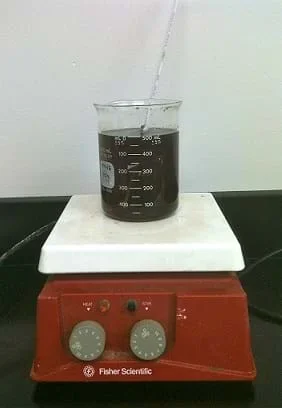 Figure 1: Example activity setup with maple syrup in the beaker.Copyright 2012 Bradley Beless, University of Houston
With the Students
- Hand out the worksheets and direct students to answer the first question pertaining to their thoughts about what type of fluid would work the best to be used in a radiator to cool a car's engine.
- Review and clarify all the activity procedures and safety instructions.
- Divide the class into groups of two to four students each.
- Direct the groups to take initial temperature readings, start their stopwatches, and place their beakers of liquid on the hot plate (as illustrated in Figure 1).
- Instruct student groups to stir the liquid gently every minute with the thermometer for 10 seconds and then take and record a temperature reading.
- For each temperature reading, have students rotate who takes the temperature measurement.
- After 10 minutes, have all groups take their final measurement and turn off the hot plate.
- Direct student groups to leave the beaker on the hot plate and go back to their seats to fill out the worksheet. The worksheet requires students to graph temperature vs. time, calculate the heat transferred into the liquid, and answer some questions about the activity. Note: The quantity of heat transfer over time should remain constant; therefore, the graphs of temperature vs. time should be close to linear for all the liquids. If students' graphs are not linear, potential causes are: not enough mixing, the hot plate temperature was changing, or the liquid reached its boiling point, which suggests the liquid may have been warmer than room temperature when the experiment began.
- Go around to all of the stations and use a hot mitt to remove beakers from the hot plates.
- Have a student from each group write its results in the table on the classroom board so the class can see all results.
- Lead a class discussion to share group results and conclusions, as described in the Assessment section. Which fluid is best for use in a radiator to cool a car engine? Reveal the identities of the five "unknown" liquids.
- conduction
- The transfer of heat by atomic movement due to direct contact from systems of high temperature to systems of low temperature.
- heat
- The transfer of thermal energy across systems or within a single system.
- specific heat capacity
- The amount of heat required to raise one unit mass of material one degree.
Pre-Activity Assessment
Prediction: On the Measuring Heat Transfer Worksheet (PDF), have students answer the first question pertaining to their thoughts about what type of fluid would work best in a radiator to cool a car engine.
Activity Embedded Assessment
Group Check: Move about the room to each group and ask what types of heat transfer students think are taking place during this activity. (Answer: Mainly conduction, but some convection as well, as the fluid at the bottom on the beaker rises to the top. Some students may say radiation because of the lights in the room, but explain that while that is true, the amount of radiation energy compared to conduction and convection is negligible.)
Post-Activity Assessment
Worksheet: Have students complete the Measuring Heat Transfer Activity Worksheet (PDF). If students are not able to complete all of the worksheet questions, assign the remainder as homework. Review their data, graphs and answers to gauge their comprehension of the material
Concluding Discussion: Upon completion of the experiment and worksheet, lead a class discussion to share results and conclusions.
- Which fluid do you consider to be the best for use in a radiator to cool a car engine? (After students share their conclusions and choices, reveal the identities of the five different "unknown" liquids.)
- Why does fresh water work the best of these five options? (Water works great in a radiator because of its high specific heat capacity, which means it has a high potential to adsorb heat from the engine.)
- Is the specific heat capacity of a fluid the only consideration? What other considerations might go into an engineer's decision on the best fluid to use? (While the specific heat capacity of a fluid is an important component in choosing a heat exchange fluid, it is not the only factor. Other requirements and/or factors must be taken into consideration, such as how well the liquid would flow in the engine, if the liquid would leave any residues, if we want the liquid to help prevent rust, or if freezing in cold weather would be an issue. For example, in cold climates the water in a radiator can freeze and ruin the radiator when the engine is not running. That is why a certain ratio of antifreeze is added even though it decreases the specific heat capacity of water.)
- Caution students to be careful not to spill or touch the beakers or liquids.
- The hot plates get very hot so warn students to be careful when working near them.
- Depending on school or classroom policy, have students wear safety goggles.
In case any group spills a beaker, have some extra of all of the liquids so that students can quickly restart the activity.
Have cleaning materials ready in case of any spills. Some of the oils and syrups are difficult to clean up without soap.
Hot plates pull a large amount of watts, so be careful not to overload your classroom circuits by putting too many hot plates on one circuit. A classroom designed for lab work should not have a problem with this, but be aware of this possibility.
Explain to students that using water to cool a radiator is an example of the second law of thermodynamics. This law tells us that when two components of a system (water and the radiator) at different temperatures are combined, the result is a uniform energy distribution in the system. This energy can be measured as temperature. Ask students to brainstorm and design an experiment that uses the same materials as those in this activity to test this law. Allow students to work in their groups. After providing students time to develop a plan, allow each group to share ideas. One option is to heat the same volume of two different liquids on separate hot plates as they did in the previous experiment. After a few minutes, students should turn off the hot plates, remove each beaker of liquid from the hot plate and measure the temperature of each liquid. From the previous experiment, students should recognize these temperatures should not be equal. Then students carefully pour one liquid into the beaker with the other liquid, gently stir them together and take the temperature of the combined liquids. The resulting temperature should be between the temperature of the two liquids before mixed, and therefore represent the uniform distribution of energy in the system.
Have students actually conduct this second experiment. If any group has a different, yet safe and feasible, plan for an experiment, allow them to try their experiment. Make sure that all students are exercising caution while working with hot surfaces and/or liquids, and require that students write out all procedural steps for this new experiment and have the steps approved before conducting their experiment. If you use the recommended experiment option, you may choose to combine groups, so that there are a sufficient amount of materials, specifically hot plates and beakers.
For lower grades, have students measure the temperature in larger intervals and remove the graphing portion. Also simplify the worksheet questions.
Liquids and Fluids – Specific Heat. The Engineering ToolBox. Accessed December 7, 2012. (Source for specific heat capacities of the fluids.) http://www.engineeringtoolbox.com/specific-heat-fluids-d_151.html
Sonntag, Richard. E., Claus Borgnakke, and Gordan J. Van Wylen. Fundamentals of Thermodynamics. 7th edition. Hoboken, NJ: John Wiley & Sons, Inc., 2008.
- Heat Transfer: No Magic About It
- What Works Best in a Radiator?
Contributors
Bradley Beless; Jeremy Ardner
Supporting Program
National Science Foundation GK-12 and Research Experience for Teachers (RET) Programs, University of Houston
Acknowledgements
This digital library content was developed by the University of Houston's College of Engineering under National Science Foundation GK-12 grant number DGE 0840889. However, these contents do not necessarily represent the policies of the NSF and you should not assume endorsement by the federal government.
Copyright
2013 by Regents of the University of Colorado; original © 2012 University of Houston