
Battle of the Beams
Students explore the properties of composites using inexpensive materials and processing techniques. They create beams using Laffy Taffy and water, and a choice of various reinforcements (pasta, rice, candies) and fabricating temperatures. Student groups compete for the highest strength beam. They measure flexure strength with three-point bend tests and calculations. Results are compared and discussed to learn how different materials and reinforcement shapes affect material properties and performance.
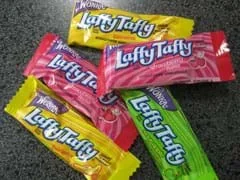 Students use taffy to provide a sugar matrix for their own composite beam designs that they test for strength.
While composite materials have been around for decades, they are now heavily researched by materials engineers who design property combinations that are not achievable with monolithic or alloyed materials. New composites are important in aerospace and defense applications in severe engineering environments. Next-generation re-entry vehicles, hypersonic flight applications, ballistics, building construction, material processing equipment, energy and energy production industries are a few applications that use composite materials because of their unique property combinations. Such composites include metal matrix composites, ceramic composites, fiber composites and polymer composites. Within each of these vastly different material systems, material scientists have found unique property behaviors that are somewhat similar. These material behaviors revolve around the reinforcement phase quantity, shape, orientation, size distribution, strength and toughness. Materials engineers and scientists explore these reinforcement quantities, and qualitatively rank them for performance under standardized experimental conditions.
After this activity, students should be able to:
- Explain how composite materials work.
- Use solubility principles to select the best processing temperature to yield optimized sugar solution.
- Describe how composite reinforcements affect material properties.
- Form conclusions based on observations and qualitative assessments.
- CCSS.Math.Content.HSA-REI.B.3 Solve linear equations and inequalities in one variable, including equations with coefficients represented by letters.
Grades 9-12
Do you agree with this alignment? - CCSS.Math.Practice.MP2 Reason abstractly and quantitatively.
Grades K-12
Do you agree with this alignment?
- Students will develop an understanding of the attributes of design.
Grades K-12
Do you agree with this alignment? - Students will develop an understanding of engineering design.
Grades K-12
Do you agree with this alignment? - Students will develop an understanding of the relationships among technologies and the connections between technology and other fields of study.
Grades K-12
Do you agree with this alignment?
- HS-ETS1-3 Evaluate a solution to a complex real-world problem based on prioritized criteria and trade-offs that account for a range of constraints, including cost, safety, reliability, and aesthetics, as well as possible social, cultural, and environmental impacts.
Grades 9-12
This resource focuses on the following Three Dimensional Learning aspects of NGSS:
Science & Engineering Practices- Evaluate a solution to a complex real-world problem, based on scientific knowledge, student-generated sources of evidence, prioritized criteria, and tradeoff considerations.Do you agree with this alignment?
- Use a model to predict the relationships between systems or between components of a system.Do you agree with this alignment?
Disciplinary Core Ideas- When evaluating solutions it is important to take into account a range of constraints including cost, safety, reliability and aesthetics and to consider social, cultural and environmental impacts.Do you agree with this alignment?
Do you agree with this alignment? - Evaluate a solution to a complex real-world problem, based on scientific knowledge, student-generated sources of evidence, prioritized criteria, and tradeoff considerations.
- HS-PS2-6 Communicate scientific and technical information about why the molecular-level structure is important in the functioning of designed materials.
Grades 9-12
This resource focuses on the following Three Dimensional Learning aspects of NGSS:
Science & Engineering Practices- Communicate scientific and technical information (e.g. about the process of development and the design and performance of a proposed process or system) in multiple formats (including orally, graphically, textually, and mathematically).Do you agree with this alignment?
Disciplinary Core Ideas- Attraction and repulsion between electric charges at the atomic scale explain the structure, properties, and transformations of matter, as well as the contact forces between material objects.Do you agree with this alignment?
Crosscutting Concepts- Investigating or designing new systems or structures requires a detailed examination of the properties of different materials, the structures of different components, and connections of components to reveal its function and/or solve a problem.Do you agree with this alignment?
Do you agree with this alignment? - Communicate scientific and technical information (e.g. about the process of development and the design and performance of a proposed process or system) in multiple formats (including orally, graphically, textually, and mathematically).
- AI.9.12.E solve mathematic and scientific formulas, and other literal equations, for a specified variable.
Grade 9
Do you agree with this alignment?
- Science concepts. The student knows that relationships exist between the structure and properties of matter. The student is expected to:
Grades 9-10
Do you agree with this alignment? - design and implement investigative procedures, including making observations, asking well-defined questions, formulating testable hypotheses, identifying variables, selecting appropriate equipment and technology, and evaluating numerical answers for reasonableness;
Grades 9-12
Do you agree with this alignment? - The student uses critical-thinking, scientific-reasoning, and problem-solving skills. The student is expected to:
Grades 9-12
Do you agree with this alignment? - analyze and evaluate scientific explanations by using empirical evidence, logical reasoning, and experimental and observational testing;
Grades 9-12
Do you agree with this alignment?
Each group needs:
- 1 aluminum foil mold (0.5 x 0.5 x 5 inches; 1.27 x 1.27 x 12.7 cm; see below)
- 4 party-size Laffy Taffy® candies
- 510 ml tap water
- 1 glass stir rod
- 1 hot plate
- 2 beakers
- 1 graduated cylinder
- 1 thermometer
- 1 oven mitt or glove rated for a minimum of 350 °F
- 1 metal or plastic tray ~1 inch (2.54 cm) deep
- lab aprons and safety goggles/glasses, for each student
- Battle of the Beams Activity Worksheet (PDF), one per student
To share with the entire class: Test beam mold made from foil and tape.Copyright 2012 Marc Bird, University of Houston.
- 1 balance, for measuring reinforcements
- 1 box spaghetti noodles (dry, uncooked, for use as a reinforcement phase)
- Nerds® candy (for use as a reinforcement phase)
- 1 bag long-grained rice (for use as a reinforcement phase)
- plastic containers to hold each type of reinforcement
- 2 flat tables spaced ~3 inches apart (alternative: 2 ring stands with horizontal extensions)
- spring scale, or other device for measuring weight (optional, if want to continuously measure beam load)
- assorted weights that can be hung by string or placed in/on weight container/pan
- fishing line (10-pound test) or string
- scissors, to cut fishing line/string
- 1 paper towel
- soap and water at sink, for cleaning glassware
- (optional) yardstick
- (optional) first place team prize (perhaps leftover candies)
To make an aluminum foil mold, one per group:
- 9-in x 12-in sheet of aluminum foil (~23-cm x ~30-cm)
- masking tape
- scissors
- ruler
- Mold Construction Instructions (PDF)
Students should be familiar with solubility and conditions (for example, temperature, agitation, particle size) that effect solubility and Newton's laws. Additionally, all students must be exposed to the Introduction to Material Science and Engineering Presentation (PPTX) provided in the associated lesson.
(Lead into this activity with the introductory PowerPoint presentation and class demo of the Fun Look at Material Science lesson.)
Composite structures are a general class of materials that include two or more materials combined into one. One example is the use of straw and clay to make tougher bricks. Other typical composites are concrete, asphalt, plywood, fiber glass-reinforced polyester, carbon fiber–reinforced plastics and steel- or Kevlar®-belted tires. Of course we know all of these fairly well, but what about more advanced materials? In general, functional engineering materials for specific applications involve making composites out of metal and ceramic, ceramic and ceramic, polymer-metal and polymer-polymer combinations. Depending on the application and properties needed, different types of composite are selected.
Composites allow for engineers and scientists to achieve unique property combinations that individual material cannot provide. For instance, ceramic particles embedded in aluminum or copper matrix improve both flexural strength and wear resistance while maintaining a particular degree of toughening. However, aluminum by itself is not very wear resistant and the ceramic has poor toughness. Material scientists and engineers find composites of great interest because they provide unique property combinations that conventional materials are usually unable to provide.
Composites are comprised of two or more different materials. Typically, a continuous or matrix phase bonds the reinforcement phase(s) together. Both composite parts are essential, but usually scientists focus on the reinforcement phase. Composite mechanical properties are typically governed by the reinforcement phase. To a lesser extent the matrix phase is important and the reactions between both phases. The size, shape, distribution and quantity of reinforcement phase drastically alter the mechanical properties of composites. Certainly, the more one increases the volume fraction (quantity) of a reinforcement phase, the more the composite behaves like the reinforcement phase. Depending on the application, distribution can heavily alter properties because of how the reinforcement phase packs or aligns. Shape, can alter properties by reducing or increasing stresses in the matrix phase in excess to that of the loading conditions. For example, a sphere is the preferred shape compared to an angular particle, and a long rod is preferred to a whisker. Finally, reinforcement size may drastically influence mechanical properties. Amongst other influences, composite fabrication methods influence final properties and cannot be over looked.
Composite reinforcement phases consist of three general shape classifications: particulate, whisker/rod and continuous fiber/rod. The first two are discontinuous type reinforcements that typically have matrix material completely surrounding the reinforcement or clusters. The latter, as the name suggests, implies that reinforcement extends throughout the entire sample or continuous. Examples of these composite types are Kevlar®, and concrete and rebar. Depending on the application and materials, composites' reinforcement phases fall within one of these categories.
Composite fabrication is important when considering mechanical properties. One important aspect to composites is the orientation of reinforcement phase with respect to loading direction. For instance, continuous fiber composites are very strong when loading is perpendicular to the flow of fibers, whereas the opposite scenario produces inferior composites. For example, cutting wood against the grains (biological fibers) tends to be difficult, while if one chops parallel to the fiber direction, the wood splits more easily. This is a prime example of mechanical properties varying with fiber orientation. Discontinuous composites can also suffer from preferred orientation development. However, depending on processing technique, discontinuous reinforcements may remain quite random and homogeneous.
Today you are going to make your very own composite beams. For this activity, we are not going to test all of the major influences. We will just look at a few: reinforcement shape, material and matrix fabrication method. In addition, size and distribution will play a minor role.
Each group has a choice of three reinforcement phases for their composites: Nerds® candies, rice and spaghetti noodles. If groups choose to use spaghetti noodles as reinforcement phases, then they have the option to make a continuous fiber composite or a discontinuous fiber composite. All composite beams will be bonded with a sugar matrix comprised of Laffy Taffy® and water. However, as mentioned, fabrication and matrix phase can alter the properties. In the spirit of scientific exploration, each group has the option to process its matrix phase at one of two temperature regions. Each temperature region corresponds to a different matrix behavior and can be understood with a little candy sense and solubility knowledge. Discuss what makes a solution: a solvent plus a solute. In this activity, the Nerds® could make a sugar water solution when mixed into water. The temperature regions are soft crack stage (270–290 °F) and hard crack stage (300–310 °F).
Composite fabrication, namely mixing of both phases, is very important and also a factor in beam performance. Groups must decide how they want to approach mixing in their reinforcement phases to yield the most well-bonded and homogenous distribution of reinforcement phases.
**NOTE: Think about reinforcement composition prior to mixing. Nerds® are made of sugar that may dissolve.**
Once fabrication is complete, each group tests its beam to determine the strongest one in the class. Understanding the following guidelines may influence each group's choice of fabrication method and composite type:
- Beam must conform to specified dimensions (the aluminum foil mold dimensions)
- Reinforcement phase weight should be within specified limits (see Procedure)
- No other reinforcements may be used outside the specified list (see Procedure)
- During testing, beam deflection (vertical distance moved) shall not exceed one-quarter inch. If a beam deforms this much without breaking, it is considered failed.
Of course, subtle differences in beam geometry also influence the failure load. This can be solved by using the concept of stress to define a failure criterion. Stress is simply the load normalized by the subjected cross sectional area. This allows every group's beam to be treated equally. Since beam bending is too complicated to get into specifics, an equation will be provided so you can calculate the stress based on your beam dimensions and applied force. Good luck and let the bending force be with you!!!
Before the Activity
- Prepare aluminum foil molds (one per team) by following the Mold Construction Instructions (PDF).
- For the fabrication procedure, prepare enough reinforcement selections for all groups. First prepare the long spaghetti noodles by breaking them into 2- to 3-inch long lengths. Then measure out 3-4 g (~5 ml) of the shorter spaghetti noodles, rice and Nerds® candies and place them into individual plastic containers.
- Make copies of the Battle of the Beams Activity Worksheet (PDF).
- Gather at the laboratory tables all remaining group materials.
- For the competition, refer to the Beam Testing Set-Up and Diagram (PDF).
With the Students
- Divide the class into groups of three or four students each.
- Hand out the worksheets.
- Have students review the worksheet and double check that they have the necessary materials.
- Once students have read the instructions, direct each group to select reinforcement type and processing temperature range. Begin preparing the matrix resin.
Part 1 — Activity Fabrication Procedure
- Place a beaker on a hot plate and turn the hot plate to the highest setting.
- Measure 10 ml tap water in a graduated cylinder and pour it into the beaker.
- Unwrap four Laffy Taffy® candies and place them in the beaker.
- Place the thermometer into the beaker with the water and taffy; monitor the temperature.
- Using a glass rod, continuously stir the boiling mixture to speed up the resin process.
- Before the solution has completed its cooking process, make sure your group has decided how you want to include your chosen reinforcement into the mixture. Record this information in the Mixing Procedure section of your worksheet. TIP: To produce the best beam, the more reinforcement the better, and the more the resin coats your reinforcement the better.
- Depending on your selected cooking temperature, boil contents until the solution has reached your specified temperature. Record this temperature in the Fabrication Specifications section of your worksheet.
- Place the aluminum foil mold into a tray.
- Into a second beaker, add ~500 ml cold tap water.
- Using an oven mitt, pour the resin into the aluminum foil mold. Make sure that all of the reinforcements are in the mold with the resin.
- Let the mold cool for 5 minutes. To accelerate the cool down, add more water as needed.
- Strip the aluminum foil away from the beam and set the beam aside.
- Clean up the lab station including all used glassware (place them back in the tray).
- Dispose of solid waste in a trash can and liquids down the sink. Caution! Cool any hot waste product to room temperature before placing it in a trash can.
- Complete Part 1 of the worksheet including answering the questions and filling in the first half of the data table.
- Store the beams in a cool environment until the test day.
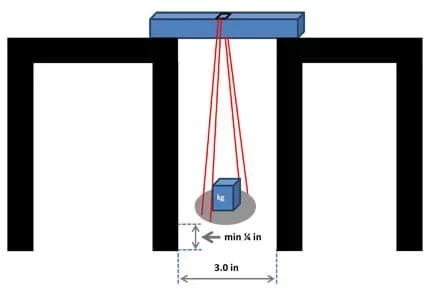 Beam test set-up for competition.Copyright 2012 Marc Bird, University of Houston
Part 2 — Activity Competition Procedure
(refer to Beam Testing Set-Up and Diagram (PDF))
- Prior to testing a group's beam, have the group record beam fabrication specifications and final beam specifications on the classroom board.
- Slip the pre-fabricated weigh pan/spring scale tension line apparatus over the mid span of the test beam.
- For the three-point bending test, place the beam on supports with the line placed in the middle span.
- Begin adding weights to the spring scale (optional) or other weight container.
- Observe carefully to make sure any beam deflection is within the competition guidelines. TIP: Place a yardstick behind the testing apparatus to more easily measure beam deflection.
- Continue to add weight until the beam breaks. Record the failure force (load) on the worksheet and on the classroom board.
- Repeat steps 2-6 for each group.
- Once all testing is done, have students calculate their beam stresses using the given equation. This is a good time to reinforce the concept that stress is material and geometry dependent (which essentially normalizes the data for comparison).
- Have students complete the rest of their worksheets, including all the questions and the data table.
- As a class, discuss and compare results, as described in the Assessment sectino. Ask students how they would improve their beam designs if they had time to make new ones. The group with the highest fracture stress wins the competition. (optional) Hand out a first place team prize for ingenuity, closest prediction for weight before breaking, and any additional prizes to other groups—at the teacher's discretion.
- brittle
- Ability of a material to break, snap, crack or fail easily when subjected to external loads.
- ceramic
- Hard, brittle, heat-resistant, good thermal and electrical insulators, corrosion-resistant covalent and/or ionic-bonded metal/non-metal and non-metal/non-metal materials.
- composite
- A material composed of two or more structurally different materials to make up a collective set of physical and mechanical properties that differ from each composition material.
- continuous
- Uninterrupted phase or phase that extends throughout a body without break or irregularity.
- discontinuous
- A body consisting of distinct or unconnected elements or phases.
- ductility
- Ability of a material to undergo permanent deformation through cross-section reductions and elongation without fracture.
- elastic deformation
- Reversible alteration of the form or dimensions of a solid body under stress.
- fracture strength
- Strength of material at fracture.
- homogeneous
- Uniform in structure or composition throughout a material volume.
- matrix
- A surrounding material where another material originates (precipitates), develops or is contained.
- mechanical behavior
- Behavior of materials when subjected to external mechanical loads.
- metal
- A material with primarily metallic bonding, which is a good thermal and electrical conductor. Possesses combinations of ductility and strength.
- particulate
- A granular substance or powder of minute separate particles.
- plastic deformation
- Irreversible alteration of the form or dimension of a solid body under stress.
- polymer
- Natural and synthetic high molecular weight compounds composed of millions of repeated chains or monomers of relatively light weight molecules.
- reinforcement
- A material that provides additional support, strength or a complementary property.
- strain
- Describes displacement of particles in a deforming body. Commonly represented by ratio of length changed and initial length (engineering strain). delta L / L = e
- stress
- Description of force exerted on an object over a defined cross-sectional area. Stress = Force/Area
- toughness
- Able to withstand great strain without tearing or cracking.
- ultimate tensile strength
- Measured stress at the onset of necking. Graphically represents the highest stress on stress-strain curve.
- yield strength
- Measured stress at the onset of plastic deformation.
- young's modulus
- Ratio of stress/strain. A measure of material stiffness.
Activity Embedded Assessment
Worksheet: The six-page Battle of the Beams Activity Worksheet (PDF) provides student materials lists and procedural instructions, serves as a materials design record sheet, and includes content-related questions to stimulate materials design thinking. Grade students' answers to the questions to gauge their understanding of composite materials and some chemistry. Expect students to complete Part 1 (questions and data table) prior to beam strength testing. Have them complete Part 2 (questions and data table) before handing in for grading.
Post-Activity Assessment
Class Discussion: As a class, compare results and determine the winning beam design (the one with the highest fracture stress). Explore what factors made a difference (reinforcement shapes, sizes and distribution? fabrication techniques?). How would you change your beam design to improve its strength? For what device or product might your beam be a suitable composite material?
Lesson Wrap-Up: As described in the Assessment section of the Fun Look at Material Science associated lesson, administer the post-lesson quiz and/or assign a four-page materials research paper.
- The materials used in this activity are completely safe and edible. However, it is not safe to eat or drink anything from laboratory equipment and is therefore forbidden for this activity.
- Require that students wear aprons and safety goggles.
- Require that students operating hot plates and handling hot beakers wear oven mitts or gloves rated for a minimum of 350 °F.
- Require that all observers wear safety glasses during beam testing. Experiments have shown that well-made beams shatter under high loading conditions.
- Cool any hot waste product to room temperature before placing it in a trash can.
If beam strength exceeds the loading weight set used, reduce the width and thickness dimensions by half and retest. Alternatively, cut a notch in every beam at the middle span approximately 1/4 to 1/3 the beam width and retest.
Candy Making Stages: The Cold Water Candy Test. The Science of Cooking, The Accidental Scientist, The Exploratorium. Accessed January 21, 2012. http://exploratorium.edu/cooking/candy/sugar-stages.html
Carter, Giles F. and Donald E. Paul. Materials Science & Engineering. ASM International, December 2006.
Hertzberg, Richard W. Deformation and Fracture Mechanics of Engineering Materials. 4th edition. New York, NY: John Wiley & Sons, Inc., 1996.
- Fun Look at Material Science
- Battle of the Beams
Contributors
Marc Bird
Supporting Program
National Science Foundation GK-12 and Research Experience for Teachers (RET) Programs, University of Houston
Acknowledgements
This digital library content was developed by the University of Houston's College of Engineering under National Science Foundation GK-12 grant number DGE 0840889. However, these contents do not necessarily represent the policies of the NSF and you should not assume endorsement by the federal government.
Copyright
2013 by Regents of the University of Colorado; original © 2012 University of Houston