
Mutation Telephone
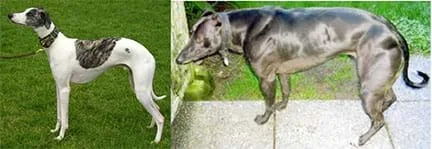 A mutation in the gene encoding for the myostatin protein causes extreme muscle growth in some animals, such as the Whippet shown on the right.Copyright (left) 2004 Elf, Wikimedia Commons (Creative Commons Attribution-Share Alike 3.0 Unported license), (right) 2007 PLoS genetics, Wikimedia Commons (Creative Commons Attribution 2.5 Generic license) https://commons.wikimedia.org/wiki/File:WhippetWhiteSaddled_wb.jpg https://en.wikipedia.org/wiki/File:MyostatinMutantWhippet.jpg
Students perform an activity similar to the childhood “telephone” game in which each communication step represents a biological process related to the passage of DNA from one cell to another. This game tangibly illustrates how DNA mutations can happen over several cell generations and the effects the mutations can have on the proteins that cells need to produce. Next, students use the results from the “telephone” game (normal, substitution, deletion or insertion) to test how the mutation affects the survivability of an organism in the wild. Through simple enactments, students act as “predators” and “eat” (remove) the organism from the environment, demonstrating natural selection based on mutation.
Genetic engineers alter the DNA of organisms to change properties or traits by modifying the proteins that are produced from the DNA. These changes take place in a controlled manner to reduce the likelihood of errors occurring, but even being careful is not always enough to prevent mistakes and unwanted results. Sometimes DNA spontaneously mutates when replicating, such as when researchers try to grow many bacteria from a single modified version. It is important to understand how mutations occur and the unintended effects they may have on the outcome of DNA modification. Engineers often use models to simplify complex processes; in this activity, students model how DNA can mutate using an easy-to-understand model that illustrates that errors can occur and where.
After this activity, students should be able to:
- List the different types of small-scale mutations.
- Describe when/where mutations occur.
- Demonstrate how mutations impact organisms.
- The sciences of biochemistry and molecular biology have made it possible to manipulate the genetic information found in living creatures.
Grades 9-12
Do you agree with this alignment?
- MS-LS3-1 Develop and use a model to describe why structural changes to genes (mutations) located on chromosomes may affect proteins and may result in harmful, beneficial, or neutral effects to the structure and function of the organism.
Grades 6-8
This resource focuses on the following Three Dimensional Learning aspects of NGSS:
Science & Engineering Practices- Develop and use a model to describe phenomena.Do you agree with this alignment?
Disciplinary Core Ideas- Genes are located in the chromosomes of cells, with each chromosome pair containing two variants of each of many distinct genes. Each distinct gene chiefly controls the production of specific proteins, which in turn affects the traits of the individual. Changes (mutations) to genes can result in changes to proteins, which can affect the structures and functions of the organism and thereby change traits.Do you agree with this alignment?
- In addition to variations that arise from sexual reproduction, genetic information can be altered because of mutations. Though rare, mutations may result in changes to the structure and function of proteins. Some changes are beneficial, others harmful, and some neutral to the organism.Do you agree with this alignment?
Crosscutting Concepts- Complex and microscopic structures and systems can be visualized, modeled, and used to describe how their function depends on the shapes, composition, and relationships among its parts, therefore complex natural structures/systems can be analyzed to determine how they function.Do you agree with this alignment?
Do you agree with this alignment? - Develop and use a model to describe phenomena.
- identify components of DNA, and describe how information for specifying the traits of an organism is carried in the DNA;
Grades 9-11
Do you agree with this alignment? - identify and illustrate changes in DNA and evaluate the significance of these changes;
Grades 9-11
Do you agree with this alignment?
Each group needs:
- 1 piece of fabric, 4 x 2 feet (122 x 61 m); optional idea: use fabric with a pattern to represent a forest or natural environment
- 4 sets of 10 pieces of paper each that are 1 x 2 inches (2.5 x 5 cm) in size, with each set being a different color (or pattern) that is present on both sides of the paper to represent an organism that has mutated or evolved to be different colors
- Mutation Telephone Worksheet (PDF), one per student
To share with the entire class:
- a supply of “instructions” for the Part 1 game, created by the teacher; refer to the Example Mutation Telephone Instructions (PDF) for ideas
- dry erase markers
- white board
- watch or clock, to time 30-second intervals
Students should have an understanding of the relationship between DNA and proteins and how a cell makes proteins from DNA. This activity focuses on small-scale mutations, so a basic knowledge of the differences between small- and large-scale mutations is important, which can be learned by conducting the associated lesson, All Sorts of Mutations: Changes in the Genetic Code.
Who can tell me how the X-Men got their powers? (Answer: They’re mutants!) We call them mutants, but what does that really mean? It means that they are still considered humans, but somewhere along the way DNA mutations gave them some powers.
Other than giving them superpowers, how do DNA changes really affect the X-Men? (Answer: They change the proteins that cells produce.) Of course, a single mutation in DNA would not really cause such a drastic change in abilities or appearance.
Today we will perform two activities to show how these mutations can occur and illustrate the possible effects of different mutations.
Before the Activity
- Prepare as many sets of telephone “instructions” as you need for a single class. Refer to the Example Mutation Telephone Instructions (PDF) for ideas; the instructions might be to draw a specific picture or perform a series of actions. Prepare to give the instructions using two methods—written and verbal—during different rounds. To do that, type up and print out numerous copies of some instruction sets; these will be the ones that you hand to one person in every student group. Also type up some additional instruction sets for which you only need one copy because you will verbally whisper them to one person in every student group. The instructions can be reused from class to class, but it is not advisable to reuse the instructions in a single class.
- Prepare enough sets of 1 x 2-inch pieces of paper for the number of groups you will have, which depends on your class size. Plan on five students per group for the natural selection activity (Part 2) that requires the papers. For the mutation activity (Part 1), use groups of 10 or more students each.
- Make copies of the Mutation Telephone Worksheet (PDF).
- Move aside the classroom desks to create an open space to conduct the activities.
With the Students—Part 1: Mutation
- Ask a pre-assessment question of the class, as described in the Assessment section.
- Then present to the class the Introduction/Motivation content.
- Next, organize the class into groups of 10 or more students each. The larger the group, the more likely a variety of mutations will develop in the instructions.
- Have the students in each group form into single file lines. Space the students far enough apart that they can only hear the instructions when passed directly to them.
- Explain that each student represents a cell/organism that is produced from the previous cell/organism (student).
- Give the first student in line a set of instructions, which represents a single gene from an organism’s DNA. This will be the only person in the group to read the instructions. Give the same instructions to the first students in each team line. The instructions might be to draw a specific picture or perform a series of actions. For the first round, start by handing written instructions to the first persons in each team line (make sure to take them back from the first persons). Then in the second round, give verbal instructions by whispering into the first students’ ears. Experiment with both methods during different rounds, giving different instructions during each round. Giving teams the same instructions enables many mutation variations to emerge for comparison.
- The first student whispers the instructions to the second student, the second student to the third, and so on until the last student in line has received instructions. This step models what happens to DNA (instructions) after several generations of replication (passing the instructions). (Note: For the first round, consider describing for the students what each step in the activity is modeling; then in subsequent performances of the activity, have the students explain what each step represents. Alternatively, as a class or individually, have students deduce what each step represents. Comparing the telephone game to the biological process is also reiterated on the student worksheet.)
- Then, the last student comes to the front of the room and performs the instructions that s/he was told. Explain that the newest cell (the last student) has been given DNA (instructions) from the previous cell and must now perform/use the DNA to build a protein (protein synthesis). Protein synthesis is represented by converting the instructions from text to some action.
- Next, have the first student in line perform what was given for the initial instructions. Depending on the complexity of the instructions and the student effort, this may be exactly the same or entirely different than the instructions the last student performed.
- Comparing the two, have students identify which types of mutations occurred in the instructions between the first and last students. Examples of possible instruction mutations are also provided in the example instructions, as well as in Figure 1.
- Substitution: One of the steps/instructions was replaced by a slightly different one.
- Deletion: One of the steps/instructions was dropped.
- Insertion: An entirely new step/instruction was added.
- (optional, or as time permits) Change the order of the students and repeat with a new set of instructions from which to gain practice identifying additional mutation types.
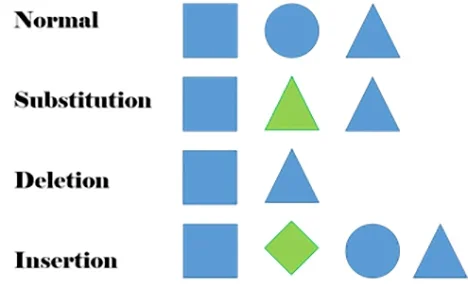 Figure 1. Example mutations. The first line represents a set of initial instructions. The other lines show some possible mutations that could occur during the telephone activity.Copyright 2015 Matthew Zelisko, GK-12 Program, University of Houston
With the Students—Part 2: Natural Selection
- Organize the class into groups of five students each. Distribute to each team a piece of fabric and four sets of small pieces of paper.
- Have each group place its fabric on a desk/table or on the floor, and sit around it.
- Dim or turn off the lights to simulate nighttime. Then, have students scatter the small pieces of paper around the fabric.
- Explain that the paper pieces represent lizards that have evolved into four different-colored lizards (or another biological example of your choice). Each of the four colors represents normal, substitution, deletion or insertion mutations (assign one to each of the colors).
- Direct the teams to each select two students to be “predators hunting at night” for 30 seconds. During the 30 sections, the predators try to collect as many pieces of paper as possible.
- Time 30 seconds. When the 30 seconds are up, turn on the lights and have teams count and record the numbers of each color the predators collected.
- (optional, or as time permits) Dim or turn off the lights again, scatter the papers, and repeat the 30-second predatory hunt a few more times, until all students have had a turn to be predators.
- As a class, discuss which colored lizard/mutation was best suited to avoid becoming prey and how mutations impact natural selection. Discuss how biological engineers might genetically modify the “normal” lizard to most successfully survive. Further discuss how mutations affect organisms.
- Assign students to complete the worksheet to help reinforce what each step in the activity represented and where the mutations occurred.
- deletion (genetics)
- The removal of a nucleotide base pair during DNA replication.
- dna
- A molecule that contains an organism’s complete genetic information. Abbreviation for deoxyribonucleic acid.
- dna replication
- The process by which DNA is copied and passed on to new cells.
- gene
- A subset of DNA that provides instructions for a cell to build a single protein.
- insertion (genetics)
- The addition of a nucleotide base pair during DNA replication.
- protein synthesis
- A process by which the instructions contained in DNA are used to produce proteins for a cell or organism.
- small-scale mutation
- A permanent change in the DNA nucleotide sequence during DNA replication.
- substitution
- The switching of one nucleotide base pair for another base pair during DNA replication.
Pre-Activity Assessment
Concept Check: Ask the class “What effect will a mutation in the DNA have on an organism?” Give students two or three minutes to individually think about it and then see what ideas they have.
Activity Embedded Assessment
Mutation Identification: During each round of the Part 1 activity, have students identify what mutations types occurred in the instructions. Student analyses of the mutation types in the changed instructions reveal their understanding of the telephone activity’s parallels to the biological process and the types of mutations that might occur.
Post-Activity Assessment
Predator Discussion: After Part 2 of the activity, as a class, have students share and compare their experiences with and conclusions from the predator game, as described in the Procedure section.
Worksheet: Have students complete the Mutation Telephone Worksheet (PDF) to review the concepts covered in the activity. Review student answers to gauge their depth of comprehension of the activity concepts.
- Part 1 of the activity can be slightly scaled up or down by changing the complexity of the original instructions.
- For higher grades, consider using a set of instructions that requires drawing, and then require each person in the line to draw what s/he was told. To do this, have each student pass along the instructions, and then draw what s/he was told on his/her own piece of paper. The benefit of this approach is that later, placing the drawings (all the replicated instructions) side-by-side reveals where specific mutations occurred. Note that this approach will not work if students are permitted to draw while receiving the instructions; they must first pass on the instructions before making their own drawings of what they were told.
- All Sorts of Mutations: Changes in the Genetic Code
- Mutation Telephone
Contributors
Matthew Zelisko; Kimberly Anderson; Kent Kurashima
Supporting Program
National Science Foundation GK-12 and Research Experience for Teachers (RET) Programs, University of Houston
Acknowledgements
This digital library content was developed by the University of Houston's College of Engineering under National Science Foundation GK-12 grant number DGE 0840889. However, these contents do not necessarily represent the policies of the NSF and you should not assume endorsement by the federal government.
Copyright
2016 by Regents of the University of Colorado; original © 2015 University of Houston