
Rocket Launch Time: Flying with Style
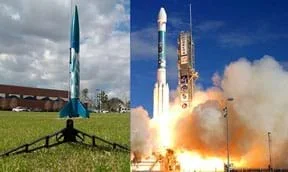 Students explore the physics behind rocket launchesCopyright (left) 2013 Brian Rohde, University of Houston, NSF
GK-12 Program; (right) Global Positioning System (GPS.gov) http://www.gps.gov/multimedia/images/
Students explore the physics behind rocket launchesCopyright (left) 2013 Brian Rohde, University of Houston, NSF
GK-12 Program; (right) Global Positioning System (GPS.gov) http://www.gps.gov/multimedia/images/
During the associated lesson, students have learned about Newton's three laws of motion and free-body diagrams and have identified the forces of thrust, drag and gravity. As students begin to understand the physics behind thrust, drag and gravity and how these relate these to Newton's three laws of motion, groups assemble and launch the rockets that they designed in the associated lesson. The height of the rockets, after constructed and launched, are measured and compared to the theoretical values calculated during the rocket lesson. Effective teamwork and attention to detail is key for successful launches.
Engineers study lift, thrust, gravity and drag so that they can put rockets into space, planes into the air and launch shuttles. Just like professional engineers, students compare their theoretical heights to their actual launch heights. Engineers design and test new systems every day, as well as troubleshoot any factors that result in their theoretical measurements differing from tested results. Their knowledge of mathematics is key, as well as their willingness and ability to work with others to brainstorm solutions to the challenges faced by the mystery of traveling in space.
After this activity, students should be able to:
- Use trigonometry to find the height of the rocket flight.
- Successfully work in teams to achieve a common goal.
- Use theoretical calculations to approximate real-world values and explain that with every calculation are some inherent assumption(s).
- CCSS.Math.Content.HSG-SRT.C Define trigonometric ratios and solve problems involving right triangles
Grades 9-12
Do you agree with this alignment? - CCSS.Math.Content.HSG-SRT.C.8 Use trigonometric ratios and the Pythagorean Theorem to solve right triangles in applied problems.
Grades 9-12
Do you agree with this alignment?
- Students will develop an understanding of the relationships among technologies and the connections between technology and other fields of study.
Grades K-12
Do you agree with this alignment?
- HS-PS2-1 Analyze data to support the claim that Newton's second law of motion describes the mathematical relationship among the net force on a macroscopic object, its mass, and its acceleration.
Grades 9-12
This resource focuses on the following Three Dimensional Learning aspects of NGSS:
Science & Engineering Practices- Analyze data using tools, technologies, and/or models (e.g., computational, mathematical) in order to make valid and reliable scientific claims or determine an optimal design solution.Do you agree with this alignment?
- Theories and laws provide explanations in science.Do you agree with this alignment?
- Laws are statements or descriptions of the relationships among observable phenomena.Do you agree with this alignment?
Disciplinary Core Ideas- Newton's second law accurately predicts changes in the motion of macroscopic objects.Do you agree with this alignment?
- Attraction and repulsion between electric charges at the atomic scale explain the structure, properties, and transformations of matter, as well as the contact forces between material objects.Do you agree with this alignment?
Crosscutting Concepts- Empirical evidence is required to differentiate between cause and correlation and make claims about specific causes and effects.Do you agree with this alignment?
Do you agree with this alignment? - Analyze data using tools, technologies, and/or models (e.g., computational, mathematical) in order to make valid and reliable scientific claims or determine an optimal design solution.
- G.9-12.9.A determine the lengths of sides and measures of angles in a right triangle by applying the trigonometric ratios sine, cosine, and tangent to solve problems; and
Grades 9-12
Do you agree with this alignment? - P.9-12.4.F use trigonometry in mathematical and real-world problems, including directional bearing;
Grades 9-12
Do you agree with this alignment?
- Science concepts. The student knows concepts of force and motion evident in everyday life. The student is expected to:
Grades 9-10
Do you agree with this alignment?
Each group needs:
- rocket (available at https://estesrockets.com/, reusable)
- engine (available at https://estesrockets.com/, non-reusable, comes with igniters and caps, plus extra igniters and caps)
- Rocket Launch Worksheet (PDF), one per student
To share with the entire class:
- rocket launch pad (available at https://estesrockets.com/, reusable)
- launch mechanism/controller (available at https://estesrockets.com/, reusable with batteries. Note: consider purchasing a spare launch controller and spare batteries.
- altimeter (available at https://estesrockets.com/, reusable)
- bucket
- safety glasses/goggles, one pair per student (available at Amazon.com)
- 1 box of latex gloves (available at Amazon.com)
- 2-3 large plastic bins to store rockets
- small plastic/cardboard boxes to store engines
- 1 roll duct tape
- 1 roll masking tape
- 6 calculators
- 1 bottle of acetone (available at Walmart)
- superglue
- Students should know trigonometry.
- Students should have a basic knowledge of what a rocket is and how it works. The Forces and Newton's Laws Presentation (attached lesson presentation file) and assessment questions in the associated lesson ensure students understand these concepts and know how to perform basic rocket calculations.
(Prior to conducting this activity, conduct the associated lesson, Rocketry Calculations: Houston, We Have a Problem!. Allow enough time for the rockets be assembled in advance, if necessary.)
You have already used your knowledge of physics during the lesson on rocketry to calculate the heights of your rockets. Once you have built your rockets, you will construct and initiate your launch procedures and finally launch your rockets outside.
The launch will reveal how accurate you were with your calculations, completed during the lesson. Will your rocket be a dud or fire true to form? How careful were with your calculations and will your construction and launch maximize your results?
This all sounds like fun, doesn't it? Time to cross check our calculations and see who has the highest launch! Let's get started.
Teacher Activity Information
Allow one 50-minute class period to build the rockets, including time to pack the nose cone with wadding if necessary, see instructions below. (Note: launch day goes more smoothly if the rockets have been completely assembled and pre-wadded.) If you buy preassembled rockets, some of these steps can be omitted.
Allow one 50-minute class period for finishing touches to the rockets and the launching of the rockets.
Background
In the associated lesson, Rocketry Calculations: Houston, We Have a Problem!, students worked on rocket design calculations and analysis. Thus, students should have already completed their rocket designs and have a good understanding of thrust, drag, lift and gravitational forces. Additionally, they should have a basic understanding of motion equations and familiarity with the equations on the Rocketry Calculation Worksheet to calculate their rocket's velocity, thrust and height during the boost and coast.
Lastly, groups should have already determined the engine size and rocket body to maximize the total height that their rocket will reach in the sky so that their rocket supplies could be ordered prior to the start of this activity.
See the associated lesson for further background information.
Before the Activity
- Gather materials.
- Make copies of the Rocket Launch Worksheet (PDF), one per student.
- 3-4 weeks in advance, order the requested rockets and engines from https://estesrockets.com/. Once received, make sure to read the building and launching instructions for each rocket.
- Identify (and reserve, if necessary) a suitable outdoor launch location (soccer/football field or larger if possible).
- Record student-calculated, theoretical/predicted heights from equation #11 on the Rocket Calculation Worksheet (PDF) onto the Rocket Launch Worksheet. (Note: It is more efficient during this step for the teacher to transfer the information from the Rocket Calculation Worksheet to the Rocket Launch Worksheet than to have students transfer the information.)
- Arrange for the following items to be available on launch day:
- bucket of water
- safety glasses
- launch pole on a stand, plus a back-up launch pole
- spare igniters
- spare engines (misfires are possible; having a spare is important)
- altimeter, plus spare altimeter
- calculators
- ignition box and key, plus a spare ignition box and key
- spare batteries
- duct tape, masking tape and super glue for last-minute repairs
- 100-meter tape measure
- fire extinguisher/blanket
With the Students
Rocket Building: Day 1
- Provide student groups with the building instructions included with their rockets (and as shown on the website https://estesrockets.com/). Make sure each group has a lab station in the lab.
- Provide each group with a tube of superglue to put its rocket together.
- Have each student use latex gloves and safety glasses. (As stated on superglue bottles, acetone can help if fingers get super glued together.)
- Have students read all instructions before assembly, since each rocket has slightly different assembly instructions.
- Remind students to wear latex gloves and goggles during the gluing process and to avoid sticking their fingers together or touching other students or objects.
- When attaching the nose cone with the paper, make sure to glue it an inch or two into the rocket tube to allow for insertion of the nose cone. (Demonstrate this for students since this is one of the trickier steps of the process.)
- Encourage students who get stuck on a step to ask for assistance, rather than just guessing or looking at a neighbor, since each rocket has unique assembly instructions.
Rocket Pre-Launching: Day 2
- If necessary, direct students to finish constructing their rockets.
- Once finished with the construction, each group must see the teacher about installing the wadding to protect the parachute from engine burn. Instruct students to very carefully follow the Wadding Instructions listed below and also provided on the Rocket Launch Worksheet (PDF), page 2).
- If your rocket does not have a parachute, skip this step. Using the wadding that is included with the each rocket, pack two or three of the sheets into the nose cone loosely and push down gently into the tube.
- If your rocket does have a parachute, follow this step. Untangle, fold and carefully insert the parachute as instructed. Each rocket comes with unique assembly instructions, but most are similar to the steps described in the activity worksheet.
- Carefully, replace the nose cone.
- Illustrate for students how they should load their engines. Also, demonstrate how to perform the launch procedure to help things go smoothly; the process is described on the activity worksheet.
- Place rockets, without engines, in a plastic tub and bring to the launch. Separate by class period/section.
- Put engines in boxes, labeled by engine type. Students must know in advance which engine goes in their rockets; have a list handy so students confirm their engine types.
- Review the launch procedures with students.
- Show students how to use the altimeter; its use is covered in the activity worksheet and described below:
- Aim the device at the predicted height.
- Press and hold the trigger of the rocket tracking gun while aiming at the rocket. This releases the angle finder.
- Continue to hold the trigger; keep the crosshairs on the rocket as it travels.
- As the rocket travels through the air, continue to hold the trigger until it reaches its maximum height.
- Once the rocket has reached its peak (just before it appears to slow down or curve to return to the ground), release the trigger.
- Take angle reading from the rocket tracking gun.
Loading the Engine: Day 2
- Direct students to place the engine into the bottom of the rocket with the hole outward.
- Have them place the engine cap to hold the rocket in place.
- Tell them to place the igniter through the hole and into the rocket engine. Remind them to be careful, as fragile leads may separate and not work correctly. Take care not to cross the two leads, as they will short.
- Direct students to place the (pink) plastic seat to hold the igniter firmly in the engine, again, being careful not to let the leads cross.
- Remind students to make sure the leads are separated and do not cross and to not pull apart too hard, as the leads may separate (the igniters are fragile).
Launching the Rocket: Day 3
- Direct students to attach the alligator clips coming from the launch module to the two leads of the rocket and back up the full length of the wire.
- Provide group with their launch keys.
- Ask students to put their team member who will take the altitude measurement at the 100 m mark, away from the rocket, ready to go.
- Insert the launch key into the firing/launch mechanism (as described in the launch instructions that come with each launcher).
- When each measuring team member is ready, count down 3, 2, 1, and fire. Instruct two students to fire by holding the key fully depressed and pressing the launch button at the same time.
- Douse spent engines with water.
Data Analysis: Day 3
- Ask students to find the actual height calculated on the Rocket Launch Worksheet (PDF) based on the altimeter height (see the Rocket Launch Worksheet Answer Key (PDF) for an example calculation).
- Compare this calculation to the theoretical/predicted height (recorded at the top of the Rocket Launch Worksheet based on the previous rocket lesson worksheet). (Glean the theoretical/predicted height information from the associated lesson when students calculated their theoretical/predicted height based on engine size and rocket body and recorded the information on the Rocket Calculation Worksheet (PDF).)
- action-reaction pairs
- Thrust backward of the rocket causes a propulsion forward of the rocket.
- applied force
- A force that gives the rocket forward acceleration (usually a rocket booster). Thrust is an example.
- free-body diagram
- A diagram that shows all the forces acting upon an object.
- newton's first law
- If the forces are balanced the body will stay at rest or continue with the same velocity neither accelerating nor decelerating. Example: A rocket on the launch pad will not move without an outside force.
- newton's second law
- If the forces are unbalanced the body will accelerate in an inverse proportion to the mass and direct proportion to the force. F=ma. Example: A large rocket will require more force or a larger engine for the same acceleration.
- newton's third law
- For every action there is but an equal and opposite reaction. See action-reaction pairs below.
- resistive forces
- A force that slows the rocket down. Usually gravity if on the rise or parachute resistance during free fall. Wind drag is another example.
- rocket
- A device that has an engine to lift off into the air. The Apollo 11 was the first rocket on the Moon.
Pre-Activity Assessment
Lesson Worksheets: Conduct a design/analysis of the height of the rockets in order to place purchasing orders for the rockets and engines. Use the Rocket Calculations Worksheet (PDF), Rocket Calculations Worksheet Sample Answer Key (PDF) and Rocketry Calculation Excel (XLSX) spreadsheet calculations from the associated lesson to assess students' work. Direct groups that oversized their rockets to work out the design flaws so that the appropriate rockets can be purchased.
Activity Embedded Assessment
Pre-Launch Questions: During the construction phase of the activity, ask students the following questions to confirm that the rockets are ready for launch. If a group answers no to any of these questions, instruct students to make modifications to ensure a successful rocket launch.
- Is the rocket correctly assembled?
- Is the nose cone secure?
- Are all the fins securely mounted and spaced evenly and true?
- When the cone is lifted on the larger rockets, are the nose cones attached to the rocket and are the parachutes gently rolled and tucked into the housing?
Above are common problems students encounter when trying to follow the Estes instructions. During the construction phase, circulate among the groups to make sure these mistakes are not made and guide students back on track if they are discovered.
Rocket Launch Worksheet: Students or the teacher pre-fill out the theoretical/predicted launch heights based on the Rocket Calculation Worksheet (PDF) in the associated rocket lesson conducted before this activity.
- Students record the actual launch height of their launches. This must be calculated via trigonometry using the angle of the altimeter at the peak of the rocket launch as described in the Launch Activity worksheet. The equation is: tan (Ө) = h/(100 m)
- Have students answer the following post-launch question: Why do you think the actual rocket height did not meet, met or exceeded the theoretical/predicted/calculated height? (Answers will vary as many factors come into play. Discussion of these factors at the end of the activity spurs additional thinking about the concepts taught in the rocket lesson and about the assumptions that were made. Also refer to the Investigating Questions section.)
Post-Activity Assessment
Post-Launch Worksheet: Have students complete the activity worksheet. Note: Theoretical/predicted height calculations should have already been confirmed to ensure that a reasonable height is maintained (~100-200 meters).
Questions/Discussion: Assess student accomplishments at activity end based on the following questions:
- Were group rockets able to launch?
- Did students accurately analyze the results of comparing their theoretical calculated (predicted) heights to the actual launch heights?
- Make sure launching groups are as far away as the launch leads allow during the launch (about 3 meters); have all other participants stand 100 meters away from the launch.
- If a misfire occurs, wait at least 60 seconds after removal of the firing pin before approaching and installing a new igniter (or possibly a new engine in some circumstances). Usually it is an igniter lead that has broken.
- Have plenty of water on hand to soak spent engines. Remind students to use caution because the engines are very warm/hot to the touch when just fired.
- A fire hazard exists due to the burning of engines, so have a fire extinguisher or blanket handu.
If possible, have one teacher monitor launching and another supervising altimeter and loading of engines from a safe distance of 100 m from the launch site. If only one teacher is available, load all the engines by the altimeter site and then have the teacher move to the launch site and call each group out one at a time.
Order a few extra engines and approximately 20 extra igniters. If possible, order one extra rocket of each type in case of malfunctions.
In the case of a misfire, pull the firing pin and put in a spare igniter. If that does not work, remove the firing pin and put in a spare engine. Reset the firing pin to re-launch.
Estes-Cox Corp, http://www.estesrockets.com/, Accessed September 18, 2013. (Source of rockets, including Materials List prices and assembly procedure.)
- Rocketry Calculations: Houston, We Have a Problem!
- Rocket Launch Time: Flying with Style
Contributors
Don McGowan; Brian Rohde
Supporting Program
National Science Foundation GK-12 and Research Experience for Teachers (RET) Programs, University of Houston
Acknowledgements
This digital library content was developed by the University of Houston's College of Engineering under National Science Foundation GK-12 grant number DGE 0840889. However, these contents do not necessarily represent the policies of the NSF and you should not assume endorsement by the federal government.
Copyright
2013 by Regents of the University of Colorado; original © 2012 University of Houston