
Eat Iron?!
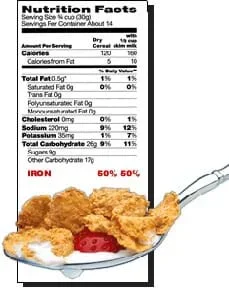 Box panel from iron-fortified cereal box.Copyright 2005 U.S. Department of Agriculture http://www.ars.usda.gov/is/pr/2005/050512.htm
To gain an understanding of mixtures and the concept of separation of mixtures, students use strong magnets to find the element of iron in iron-fortified breakfast cereal flakes. Through this activity, they see how the iron component of this heterogeneous mixture (cereal) retains its properties and can thus be separated by physical means.
Mixtures are characterized by the fact that they can be separated into their components by physical means, such as filtration, evaporation, sublimation and magnetic separation. It is common and important in chemical and petroleum engineering to use a combination of such processes to separate mixtures into their distinct components. An example chemical separation application is the processing of crude oil, which is a mixture of various hydrocarbons. While valuable in this natural form, demand is far greater for various purified hydrocarbons, such as natural gases, gasoline, diesel, jet fuel, lubricating oils, asphalt, etc. Water purification is another example of the application of separation techniques. Separations methods take advantage of differences in chemical properties such as size, shape, mass or chemical affinity between the constituents of a mixture. The magnetic separation technique uses magnets to separate iron particles from a mixture.
After this activity, students should be able to:
- Distinguish and describe the three types of matter: elements, compounds, mixtures.
- Define pure and impure materials.
- Give some examples of elements, mixtures and compounds.
- Explain the different properties of each group of materials.
- Explain how engineers use the magnet separation technique to separate ferrous and nonferrous materials.
- STEL-8Q Synthesize data and analyze trends to make decisions about technological products, systems, or processes.
Grades 9-12
Do you agree with this alignment?
- classify matter as pure substances or mixtures through investigation of their properties.
Grades 10-12
Do you agree with this alignment?
Each group needs:
- big dish
- water
- handful of cereal flakes (iron-fortified)
- strong magnet
- clear plastic cup
- plastic spoon
To share with the class:
- ~2 cups of iron-fortified cereal
- 2 cups water
- blender
- Define element, mixture and compound.
- Explain the differences between pure substances and mixtures.
- Explain the characteristics of the mixtures.
- Give some examples of elements, mixtures and compounds.
- Define the homogeneous and heterogeneous mixtures and give some examples.
- Explain in general how mixtures can be separated.
- Name some separation techniques.
- Explain how chemical engineers apply these separation methods to purify various hydrocarbons such as natural gases, gasoline, diesel, jet fuel, lubricating oils, asphalt, etc from crude oil.
(Present the following information after students teams have had a chance to experiment with magnets and cereal flakes in bowls of water, as described in the Procedure section.)
Elements are fundamental substances that cannot be further reduced to simpler substances by ordinary processes and are composed of only one type of atom. All matter is made up of elements. The elements are classified as pure substances. The elements hydrogen, carbon, nitrogen and oxygen are the elements that make up most living organisms. Some other elements found in living organisms are: magnesium, calcium, phosphorus, sodium, potassium. Of the 114 known elements, 92 occur in nature. The periodic table of the chemical elements is a tabular display of the known chemical elements. The elements are arranged by electron structure so that many chemical properties vary regularly across the table.
Compounds are another class of pure substances. A compound is a material composed of two or more different atoms that are chemically bonded to one another. That means that it cannot be separated into its constituents by mechanical or physical means. For example, if we bring a magnet near a sample of iron sulphide, the iron present in the iron sulphide cannot be separated. Properties of a compound differ entirely from those of its constituent elements. Water is made of hydrogen and oxygen. However, the properties of hydrogen and oxygen (both gases) are different from water (liquid). Hydrogen is combustible, oxygen is a supporter of combustion whereas water (composed of both hydrogen and oxygen) puts out flames. Energy changes are involved in the formation of compounds. For example, iron and sulphur react only when heat is supplied. The constituent elements in a compound are in a fixed proportion by weight. In water, hydrogen and oxygen are present in a fixed ratio of 1:8 by weight. A compound is a homogeneous substance. That is, it is same throughout in properties and composition.
Mixtures are classified as impure substances. A mixture is a material containing two or more elements or compounds that are in close contact and are mixed in any proportion. For example, air, sea water, crude oil, etc. The constituents of a mixture can be separated by physical means, such as filtration, evaporation, sublimation and magnetic separation. In the preparation of a mixture, energy is neither evolved nor absorbed. A mixture has no definite melting and boiling point. The constituents of a mixture retain their original set of properties. What are some examples of mixtures?
- solid in liquid: sugar and coffee
- liquid in liquid: water and alcohol
- gas in liquid: soda
- gas in solid: air entrapped in soil
- gas in gas: air containing hydrogen, oxygen, nitrogen, carbon dioxide, etc.
- solid in solid: metal alloys
Mixtures are either homogeneous or heterogeneous. A homogeneous mixture has the same uniform appearance and composition throughout its mass. For example, sugar or salt dissolved in water, alcohol in water, etc. A heterogeneous mixture consists of visibly different substances or phases. The three phases or states of matter are gas, liquid, and solid. A heterogeneous mixture does not have a uniform composition throughout its mass (its components are distributed unevenly), like the raisins and flakes in a raisin bran cereal.
Most materials found in nature are in the form of mixtures. In engineering, a separation process is used to transform a mixture of substances into two or more distinct products. This is done by taking advantage of the fact that the different components of a mixture probably have different properties such as: size, density, solubility, boiling point, etc.
Depending on the raw mixture, various processes can be employed to separate the mixtures. Quite often, two or more processes are used in combination to obtain the desired separation. In addition to chemical processes, mechanical processes are applied. In the example of crude oil, one upstream distillation operation feeds its two or more product streams into multiple downstream distillation operations to further separate the crude, and so on until final products are purified.
What are some separation techniques for mixtures?
- Filtration separates solids from fluids (liquids or gases) by interposing a medium through which only the fluid can pass.
- Distillation works for mixtures of liquids that have different boiling points.
- Chromatography separates dissolved substances by different interaction with (that is, travel through) a material.
- Centrifugation and cyclonic separation, achieves separation based on density differences.
- Drying removes liquids from solids by vaporization.
- Magnetic separation techniques use magnets to pull iron particles from mixtures.
Before the Activity
- Gather materials.
- Prepare the cereal by placing ~2 cups of water and 2 cups of cereal in a blender. Let it sit for a few minutes until the cereal is soft, then blend to make a smooth and shake-like slurry.
- Divide the class into groups of four students each.
With the Students
- Show the class a box of iron-fortified cereal flakes and pose the question: If you look at the nutritional label on the box of this cereal, you'll see that it contains some amounts of iron in its elemental form. Does that mean that it would be attracted to a magnet? What do you think? (Expect almost all students believe that it will not be attracted to a magnet.)
- After some discussion, give a few cereal flakes and a magnet to each group and ask them to try to move the flakes with the magnet. They will see that nothing happens; the flakes will not move as they may have predicted. After discussing why nothing happened (possible reasons: the flake is too big, not enough iron in the flakes, too much friction to overcome, magnet not strong enough), ask what might be done to overcome some of these issues. (Hopefully, a student will suggest the idea of floating the flake on some water.)
- Direct groups to place a big dish on their tables and completely fill them with water, above the rim. Very slowly put a big cereal flake on the water surface, near the middle. If the cereal flake is too close to the rim, it will go move towards the rim because of the water's surface tension. If the cereal flake soaks in the water, slowly and carefully put another one on the water again. Ask the groups to try using the magnets now. Direct them to put the magnet very close to the cereal flake and move the magnet very slowly in one direction. (Oh yaaaa!!!!) Expect students to see that the flake moves! To verify that its movement is due to the magnet, slowly change the direction the magnet is moving. If the cereal follows the magnet, then it is because of the iron present in the cereal.
- After doing this part of the activity, present to students the content information on elements, mixtures, compounds, homogenous and heterogeneous mixtures, and the separation of mixtures, as provided in the Introduction/Motivation section. If the topic has been explained to students before, just quiz them as a brief review.
- After students have learned about mixtures, ask them some question related to the iron in the cereal:
- Is cereal a compound or a mixture? (mixture)
- Do its ingredients keep their individual properties? (yes)
- Is this helpful for separating components of the mixture? (yes)
- Make the following points:
- The individual components in mixtures retain their own physical properties.
- This conservation of properties can be taken advantage of to separate out components from a mixture.
- A homogeneous mixture is one in which the components are evenly distributed. A heterogeneous mixture has uneven distribution of its components. Breakfast cereals are good examples of heterogeneous mixtures (think of the raisins and flakes in a raisin bran cereal).
- Iron in its elemental form is strongly attracted to magnets. Compounds of iron are not as strongly attracted to magnets.
- Continue on with the activity. Pour samples of the already-prepared cereal slurry into clear plastic cups, one for each group. Direct groups to have one student hold a magnet against the outside of the cup about midway up, while another student uses the plastic spoon to gently stir the slurry for 20-30 seconds. What happens? Expect to see a black line appear on the cup wall, which is the iron particles being stopped close to the magnet.
- Conclude with a class discussion that makes the point that using magnets is a useful way to separate iron from mixtures. It is the very same way that recycling centers use magnets to separate cans from plastic and cardboard, and materials engineers use magnets to separate ferrous from nonferrous materials.
- element
- A substance consisting one type of atom.
- mixture
- A substance consisting of two or more materials.
- compound
- A pure chemical substance consisting of two or more different chemical elements.
- homogeneous mixture
- A mixture that has a uniform appearance and composition throughout its mass.
- heterogeneous mixture
- A mixture composed of visibly different substances or phases.
Pre/Post Activity Quiz: Before starting the activity, gauge students' level of pre-existing knowledge by asking them to classify as either elements (pure substances), compounds or mixtures a range of different items that are present in the classroom or provided on a display table. Repeat a similar quiz at activity end, also asking them to differentiate between homogeneous and heterogeneous mixtures, to assess any change in content knowledge.
For best results, choose (and test in advance!) cereals that claim to meet 100% RDA for iron. Not all cereals work well for this activity.
Contributors
Parnia Mohammadi; Roberto Dimaliwat
Supporting Program
NSF GK-12 and Research Experience for Teachers (RET) Programs, University of Houston
Acknowledgements
This digital library content was developed by the University of Houston's College of Engineering under National Science Foundation GK-12 grant number DGE 0840889. However, these contents do not necessarily represent the policies of the NSF and you should not assume endorsement by the federal government.
Copyright
2013 by Regents of the University of Colorado; original © 2010 University of Houston