
Wizardry and Chemistry
 Students create sparklers and explore the chemistry involvedCopyright 2004 Microsoft Corporation, One Microsoft Way, Redmond, WA 98052-6399 USA. All rights reserved.
Students learn how common pop culture references (Harry Potter books) can relate to chemistry. While making and demonstrating their own low-intensity sparklers (muggle-versions of magic wands), students learn and come to appreciate the chemistry involved (reaction rates, Gibb's free energy, process chemistry and metallurgy). The fun part is that all wands are personalized and depend on how well students conduct the lab. Students end the activity with a class duel—a face-off between wands of two different chemical compositions. This lab serves as a fun, engaging review for stoichiometry, thermodynamics, redox and kinetics, as well as advanced placement course review.
Pyrotechnics has been a part of human society for thousands of years—from signal flares to the most amazing starburst chemistry. The scientific concepts embedded in this activity— reaction rates, Gibb's free energy, process chemistry and metallurgy —are used by chemical, metallurgical, mechanical, and explosives engineers in the development of many materials, some of which become the ingredients in what we see as the "magic" of pyrotechnics. (See the Introduction/Motivation section for details.)
After this activity, students should be able to:
- Identify reaction products from a reaction description.
- Calculate and determine whether a reaction is spontaneous using standard thermodynamic data.
- Infer reaction spontaneity by applying definitions of enthalpy, entropy, and Gibb's free energy.
- Understand what is meant by spontaneous reaction and how this relates to reactivity when multiple elements are involved.
- Determine the difference between kinetics and thermodynamics.
- Manipulate chemical reactions and conduct stoichiometric calculations.
- Identify the importance of oxidizers and reducers in high-intensity reactions.
- Asking questions and making observations helps a person to figure out how things work.
Grades K-2
Do you agree with this alignment? - STEL-2G Illustrate how, when parts of a system are missing, it may not work as planned.
Grades 3-5
Do you agree with this alignment? - STEL-5F Analyze how an invention or innovation was influenced by its historical context.
Grades 6-8
Do you agree with this alignment? - STEL-7P Illustrate the benefits and opportunities associated with different approaches to design.
Grades 6-8
Do you agree with this alignment? - STEL-8A Analyze how things work.
Grades -1-2
Do you agree with this alignment? - STEL-8D Follow directions to complete a technological task.
Grades 3-5
Do you agree with this alignment?
- HS-PS1-5 Apply scientific principles and evidence to provide an explanation about the effects of changing the temperature or concentration of the reacting particles on the rate at which a reaction occurs.
Grades 9-12
This resource focuses on the following Three Dimensional Learning aspects of NGSS:
Science & Engineering Practices- Apply scientific principles and evidence to provide an explanation of phenomena and solve design problems, taking into account possible unanticipated effects.Do you agree with this alignment?
Disciplinary Core Ideas- Chemical processes, their rates, and whether or not energy is stored or released can be understood in terms of the collisions of molecules and the rearrangements of atoms into new molecules, with consequent changes in the sum of all bond energies in the set of molecules that are matched by changes in kinetic energy.Do you agree with this alignment?
Crosscutting Concepts- Different patterns may be observed at each of the scales at which a system is studied and can provide evidence for causality in explanations of phenomena.Do you agree with this alignment?
Do you agree with this alignment? - Apply scientific principles and evidence to provide an explanation of phenomena and solve design problems, taking into account possible unanticipated effects.
- use the law of conservation of mass to write and balance chemical equations; and
Grades 10-12
Do you agree with this alignment? - perform stoichiometric calculations, including determination of mass relationships between reactants and products, calculation of limiting reagents, and percent yield.
Grades 10-12
Do you agree with this alignment? - perform stoichiometric calculations, including determination of mass and volume relationships between reactants and products for reactions involving gases; and
Grades 10-12
Do you agree with this alignment? - use thermochemical equations to calculate energy changes that occur in chemical reactions and classify reactions as exothermic or endothermic;
Grades 10-12
Do you agree with this alignment?
For teacher introductory presentation:
- movie clip of Harry choosing his wand from Harry Potter and the Sorcerer's Stone (show students a portion of a video of the movie, or use the 3:55 minute video clip of that part of the movie on YouTube at https://www.youtube.com/watch?v=5whe9XtdQgw)
- 1 (or more) sparkler(s), made with materials and procedures described in this document
- lab surface/table with stationary lighter or Bunsen burner
- whiteboard, markers and erasers
Each group needs:
- 9 g dextrin (starch)
- 20 ml distilled water (available at grocery stores)
- 20 cm length 2 mm diameter Fe wire (iron wire available at hardware stores)
- 150 ml beaker
- stir rod
- hot plate
- test tube rack
- 18 x 150 mm test tube
- oven capable of 120° C
- aprons, goggles and fume hood
- scale with weighing dishes, to measure ingredients
- wash bottle, for cleaning glassware
- (optional) hair dryer
- W&C Student Lab Handout (PDF), one per student
Sparkler Chemistry 1: "Gryffindor" (ingredients for one wand)
- 5 g iron powder (-200 mesh)
- 1.0 g magnesium powder (-325 mesh)
- 7.0 g aluminum powder (-40 + 325 mesh)
- 6 g barium nitrate
- 25 g potassium nitrate
NOTE: The following ingredients are available from Flinn Scientific, Inc. (www.flinnsci.com), Alfa Aesar (www.alfa.com), or Sigma Aldrich (www.sigmaaldrich.com):
- powdered metals: iron, aluminum, magnesium
- nitrates: potassium and barium nitrate
- miscellaneous: dextrin, iron wire, distilled water
- W&C Introduction Discussion Questions & Answers (pdf)
- W&C Introduction Discussion Questions & Answers (doc)
- W&C Student Lab Handout (pdf)
- W&C Student Lab Handout (doc)
- W&C Student Lab Handout Answers (pdf
- W&C Student Lab Handout Answers (doc)
- W&C Post-Duel Discussion Questions & Answers (pdf)
- W&C Post-Duel Discussion Questions & Answers (doc)
This activity is designed for advanced placement classes. Students must have been introduced to concepts in thermodynamics, stoichiometry, reaction types, oxidation reduction and kinetics. Additionally, students must have taken a laboratory safety exam and be familiar with all rules and regulations.
(Be ready to show the movie clip and conduct the sparkler demonstration.)
The key instrument for every successful wizard is his/her wand. This wand is chosen by the up-and-coming wizard and is unique to that wizard.
"Harry took the wand. He felt a sudden warmth in his fingers. He raised the wand above his head, brought it swishing down through the dusty air and a stream of red and gold sparks shot from the end like a firework, throwing dancing spots of light onto the walls."
However, in the muggle world, we never use magic wands, but perhaps use something similar to a wand—SPARKLERS! Why the sparkler? This fantastic magic (light) caster is unique to the creator, and ignites with brilliant colors, just as Harry's wand did for him. Additionally, muggles (students) usually find bright flares and colors of light to be exciting and entertaining. The only twist is that our muggle chemists understand the chemistry at work.
Can you think of other examples of real-life magic wands? Three real-life engineering examples come to mind when casting muggle spells: welding rods, magnetism by inductance, and stir rods. (These examples offer a starting point for real-life presentations; teachers are encouraged to develop additional examples.) These might not seem exciting, but they offer a practical perspective on how science allows us to create new things, move objects and whisk chemicals.
- Welding rods allow the joining of similar and dissimilar metals to build and repair common structures and tools. To the untrained eye a welding rod is just a rod of metal alloy. However when charged with an electrical current and placed fractions of an inch away from a conductive material, it seems like magic happens: an arc (plasma) is formed, radiating intense light, and heat fuses the metals together.
- Magnetism by inductances is truly magical scientific theory. A ferromagnetic rod is just a plain rod until an electrical wire is wrapped around it and an electrical current is passed through it. It may be used to levitate objects. Conversely, a highly magnetic core with hundreds of electrical wire wraps may generate electrical current, which is the principle behind inductors and transformers. A transformer is essential in electrical engineering for transforming power from high-voltage transmitting lines to low-voltage for household appliances (such as toasters).
- Stir rods may be ordinary and not have the fun characteristics of sparklers, but they serve a very important function. They could be perceived as similar to some of the shielding spells casted by magicians because stir rods enable chemists to not touch dangerous chemicals while allowing them to manipulate and speed chemical reaction kinetics of such chemicals.
Pyrotechnics and Engineering—The scientific concepts of reaction rates, Gibb's free energy, process chemistry and metallurgy are all embedded in this activity. Where do these fit in engineering disciplines and what types of engineers might use these scientific concepts? The answer is simple—chemical, metallurgical, mechanical, and explosives engineers.
Think about the ingredients used for fireworks. How are these materials processed to the point that they become pyrotechnics? Where do these materials come from? These questions are answered by the many types of engineers who have developed processes to extract, process and fabricate these materials to the end product.
Chemical engineers use their understanding of physical (chemistry, physics) and life sciences (biology, microbiology, biochemistry) to develop systems to process raw chemicals into usable or more valuable materials. Think about the binding resin used in fireworks. Some resins come from corn, but the actual ingredient does not look like corn. A chemical process for extracting starch compounds from corn is used. Another example: the safety gear we use in this lab activity was all made possible by chemical engineers. Goggles and aprons come from a combination of organic polymer chains that are chemically stable and processed in two different manners to yield different-behaving materials. The result is that goggles have an inherent stiffness while aprons are much more compliant.
Metallurgical engineers use physical science concepts to develop methods for extracting metals from raw ore, and processes and treatments for creating metal alloys of varying compositions and mechanical properties. How might one extract aluminum, magnesium or iron powder? How do these pyrotechnic ingredients become powder? Metallurgical engineers have developed chemical processes for extracting specific elements from raw ore and comminution circuits for grinding/downsizing materials into fine powders. Extraction systems such as leaching (selective acid attack or dissolving), flotation (density differences and flocculation) and roasting are some commonly used extraction methods. Autogenous, semi-autogenous grinding, ball or rod milling are popular grinding techniques.
Mechanical engineers use physics and metallurgy (material science) in combination to analyze and develop mechanical systems. Most mechanical systems rely on electrical integration and control systems, and vibration and stress analysis. For pyrotechnic processing and use, varying degrees of mechanical design and fabrication are necessary. Conveyor systems, rotary components (shafts, gears, belts) and control systems (electrical process control devices) are all needed to run successful processing plants to make the ingredients used in this lab. Additionally, mechanical engineers may have input on pyrotechnic combustion path and projectile casing design.
Explosives engineers use principles from chemistry, physics and material science to design, develop and regulate pyrotechnics. Pyrotechnic development is a combination of the above engineering disciplines with a specific focus on explosives chemistry (chemical stability, or moreover, instability) and explosives/projectile design. These engineers combine the ingredients from other engineering processes in innovative mixtures to yield new explosion patterns, colors and sounds.
Background
These procedures are suitable for class sizes of 15-20 students. Depending on equipment and availability of other tools, the procedures may need to be altered.
This activity is designed to reinforce chemistry concepts in the following subtopics: stoichiometry, chemical reactions, thermodynamics and kinetics. These theories and engineering principles are made fun by relating them to a common pop-culture icon, Harry Potter, and his magic wand (sparklers). Additionally, this activity is geared towards teaching students practical laboratory practices and application of science concepts while relating them to engineering. Students often forget why they learn topics and this activity provides a relevant and practical twist that revives memories and sparks interest.
Practical applications of scientific theories(for example, engineering) are often hard for students. Typically, one does not know where to start or how to begin. However, using basic scientific principles and applying a logical sequence of steps for problem solving, anything is possible. For instance, sparkler fabrication requires a precise mixture of chemical compounds, as do the precise words chosen by a wizard when chanting spells. How do these sparklers and spells come about? Careful observation and a base knowledge of chemistry or wizardry is the key requirement.
In this activity, students mix chemical compounds and metallic powders to a desired formulation. While this step seems trivial, one might begin to think on how those compounds react with one another. Another thought might be about how the reactions might proceed and the rate at which they proceed. Knowing the reactant compounds is the first step in understanding the chemical reaction sequence. Secondly, predicting reaction products requires a specific knowledge of electronic structure and bonding; whether the reactions are single or double replacement type reactions. These aspects to writing chemical equations provide students with insight to chemical processes before experiments are conducted (that is, forming logical hypotheses). For instance, for a mixture of a nitrate, metal powder and resin, the nitrate might hint that a gaseous product is produced when the compound decomposes.
Once students can write out complete reactions or the main reactions, thermodynamics helps to guide them to reaction feasibility. Understanding Gibb's free energy and its components (enthalpy, entropy) is essential to check hypothesized chemical reactions. Consider this step as a screening process to weed out all reactions that are non-spontaneous. Additionally, thermodynamic quantities can be used to predict heats of reactions and obtain maximum temperatures expected from reactions and provide insights into reaction kinetics (comparatively). These aspects may be important when designing a reactor.
As the chemical reaction and thermodynamic quantities check out, one has to fabricate experiments or test their reactions. Using the BALANCED chemical reaction and understanding stoichiometry principles, students can assign concentrations or mole quantities to each reactant and calculate the presence of limiting reactants (if any) and reaction product final concentrations. Understanding these quantities enables students to compare theory with actuality by conducting post-mortem experiments on "what is left over." If gross differences exist, then the findings provide a new starting point for investigation. Additionally, reaction kinetics can be monitored by measuring reactant concentration decreases throughout the process, along with reaction temperature measurements. It must be obvious that these quantities are ultimately compared to the original chemical reaction, thermodynamic quantities and stoichiometric calculations.
This brief explanation of possible investigation steps contains an appreciable amount of chemistry knowledge and logical thinking. These are the same as some of the steps taken by scientists and engineers, every day, as they approach these types of problems. Fortunately, the magic wand problem has been solved and is well understood. However, it is imperative that all muggle chemists go through this exercise not only to reinforce chemistry concepts but to introduce scientific implementation.
Before the Activity
- Purchase enough of the sparkler chemical ingredients.
- Gather materials and make copies of the W&C Student Lab Handout (PDF).
- Make one or more sparklers for the Day 1 teacher muggle magic wand demonstration, using the materials and procedures detailed in this document.
- For the teacher demonstration, set up a stationary lighter or Bunsen burner on a standard lab surface/table, and have ready one or more sparklers.
- For the student lab, set up three or four stations with hot plates, stirring rods, beakers, distilled water and pre-measured dextrin. If possible, provide one hair dryer per station.
- Inorganic ingredients must remain under fume hood. One scooper per ingredient.
DAY 1: Introduction, Fabrication and Problem Set
- Open the activity with a brief introduction about wizardry, chemistry, pyrotechnics, and engineering.
- To focus the class on the activity objective, show a short video clip of Harry Potter choosing his wand.
- Lead a class discussion, as described in the Assessment section.
 Copyright 2004 Microsoft Corporation, One Microsoft Way, Redmond, WA 98052-6399 USA. All rights reserved.
- Conduct a muggle magic wand demonstration. NOTE: This presentation should take no longer than 20 minutes. Demonstration suggestion:
- On a standard lab surface/table with students in their seats, have ready one or more sparklers and either a stationary lighter or Bunsen burner.
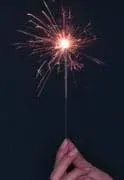
- Over an open flame (from the stationed lighter or Bunsen burner) chant a magic spell, waive the wand as Harry Potter would, and ignite the sparkler. (SHOWMANSHIP IS EVERYTHING!!!)
- With the sparkler lit, tell the students "You are going to make your own magic wand!" and transition into the activity objectives and safety precautions.
Overall Laboratory Instructions Provided by Teacher:
- Direct students to get their appropriate protective equipment (goggles, aprons, gloves etc.) for the laboratory, and to put on their lab aprons and safety goggles.
- Direct the class to organize into groups of three student each. Pass out the lab handout.
- Assign teams each a sparkler number that corresponds to a particular "recipe."
- Assign a group name or number for sparkler labeling.
- Following instructions on the lab handout, have each group begin mixing and heating the starch solution, and proceed in a safe manner (observing the laboratory safety rules).
- One group at a time, under the fume hood, have students measure the inorganic ingredients and pour them into the starch mixture.
- Then have teams move back to their stations to continue following the lab handout instructions.
- Once all groups are finished making their sparklers, bake them before Day 2.
Student Procedures (also provided on the Student Lab Handout):
- Place 9 g of dextrin in a 150 ml beaker and add distilled water.
- While stirring, heat the starch mixture gently; heat until it makes a paste.
- Using separate weighing dishes under the fume hood, measure to the nearest gram the listed ingredients.
- Remove the beaker from the heat, add inorganic ingredients to the starch solution and stir. Perform this step under the fume hood until the mixture is uniform.
- Pour/scrape the entire mixture into a test tube.
- Quickly, dip the iron wire into the test tube, making sure to have an even coat along the length of the submerged wire.
- Pull the coated wire out of the test tube and begin drying the paste using a hair dryer positioned approximately 10 cm from the coated wire.
- During drying, rotate the wire to keep the paste on the wire.
- Once the mixture is no longer runny, stand the coated wire in the test tube rack.
- To dry thoroughly, place the rack in a 120° C oven for one to three hours.
- Outside, use a lighter to ignite the top of the coated wire. Let the chemistry begin!
Student Lab Handout Problem Set:
- While students are waiting to measure ingredients to make their sparklers, have them work on the problem set in the lab handout.
- Require students to complete all handout questions and problems before they are allowed to participate in the wizardry duel on Day 2. NOTE: The 90-miniute period should include plenty of time to complete the handout, but if not, have students finish the handout as homework.
DAY 2: Demonstration and Post-Activity Discussion
- Ask students to put on their lab aprons and safety goggles.
- Pass out sparklers to each group and instruct students to walk outside the school building.
- When outside, divide the class into two groups, based on sparkler type 1 or 2.
- Have students line-up in two rows facing each other and prepare for a duel. NOTE: Students are allowed to take on any wizardry poses they like.
- Instructor and one volunteer begin lighting the sparklers. Students then light the sparklers next to them. As needed, re-light the sparklers.
- Sit back and watch the magic at hand!!!
- chemical engineering
- A discipline of engineering that applies physical science (chemistry and physics) and life sciences (biology, microbiology, biochemistry) to raw material or chemical processing into more useful or valuable forms.
- duel
- A prearranged combat or contest between two persons or parties, fought with deadly weapons according to an accepted procedure.
- endothermic
- A reaction is said to be endothermic when absorption of heat is required for completion (driving force).
- enthalpy (h)
- Thermodynamic function that measures the energy flow as heat in a constant pressure system.
- entropy (s)
- Thermodynamic function that measures randomness or disorder.
- equilibrium
- A state in which the net (average) flow of matter and energy is equal or approximately equal to zero.
- equilibrium constant (k˅eq)
- A quantitative measure of reaction equilibrium based on product and reactant concentrations, partial pressures or chemical activity.
- exothermic
- Reaction is said to be exothermic when a release of heat is created upon completion.
- explosives engineering
- A field of science and engineering that is related to examining the behavior and usage of explosive materials.
- gibb's free energy (g)
- Thermodynamic energy function with independent variables of enthalpy (H), entropy (S) and temperature (T [K]). Change in energy under constant volume and entropy conditions with varying pressure and temperature.
- kinetics
- An area of chemistry that concerns reaction rates.
- mechanical engineering
- A discipline of engineering that applies physics and materials science principles for analysis, design, manufacturing and maintenance of mechanical systems.
- metallurgy
- The process of separating a metal from its ore and preparing it for use. The study of separation, processing, chemical and mechanical behavior of metals.
- muggle
- A person without magical powers. Also: A common person, especially one who is ignorant or has no skills. (Example: There are muggles in every computer class.) (Source: Dictionary.com's 21st Century Lexicon)
- reaction quotient (q)
- A quantitative measure of current reaction state in reference to reaction equilibrium point. Q>K reaction proceeds to left; Q<K reaction proceeds to right.
- reaction rate
- A change in concentration of a reactant of product per unit time.
- redox
- Another term for oxidation reduction. A reversible chemical reaction between two substances usually involving the transfer of electrons, in which one reaction is an oxidation (loses electron) and the reverse reaction is a reduction (receives electron).
- stoichiometry
- The calculation of quantities of material consumed and produced in chemical reactions.
- sensible heat
- Another term for enthalpy or heat produced from a given reaction that is available for both reactants and products to absorb and raise the temperature.
- thermodynamics
- The study of energy and its conversions.
Pre-Activity Assessment
Opening Class Discussion: Open with one of the following questions. Refer to the W&C Introduction Discussion Questions & Answers (PDF). To help stimulate their minds, encourage students to participate as the teacher adds in the answers.
- Can you create science magic with chemistry?
- How would you make a magic wand in this science laboratory?
Activity Embedded Assessment
Activity Problem Set Handout: Have students complete the W&C Student Lab Handout (PDF)prior to Day 2 of the activity. The eight problems are designed to test students' knowledge of the associated chemistry topics. Additionally, the problem set serves as a link to bring practical application and theory together by illustrating how theory is applied. For fun, require students to research common spells and charms and decide (as a team) which they will use during the duel.
Post-Activity Assessment
Concluding Class Discussion: After the duel demonstration of the sparklers, lead a discussion with students to reiterate topics discussed in the handout's problem set. Refer to the attached W&C Post-Duel Discussion Questions & Answers (PDF). Also incorporate additional observations that may be linked to specific theory.
- CAUTION!! The ingredients is this lab are reactive when exposed to certain conditions so handle them only as instructed and with care. Following the instructions ensures that the materials are safe for handling.
- Students are to wear safety goggles and aprons on both testing days.
- Use spare containers to store waste. Make sure all waste is disposed of according to appropriate state and local guidelines.
Experiment with both sparkler chemistries. Depending on intensity or color, you may want to change the compositions.
Have teams research how they would improve the burn rate and color of their sparklers (wands). Require students to submit two-page (maximum) reports that includes reliable references.
Show students additional Harry Potter movie clips that show magic wands in use, such as the following:
- Harry Potter 5 Duel (Voldemort vs. Dumbledore) (2:44 min) at https://www.youtube.com/watch?v=SWpHRwkBLUo
- Harry Potter - Dueling Club (4:57 min) at https://www.youtube.com/watch?v=vEPhYhKdJ7k
Chase, Malcolm W. Jr., NIST-JANAF Thermochemical Tables, 4th edition. Woodbury, NY: American Institute of Physics, 1998.
Copes, Jane Snell, "The Chemical Wizardry of J.K. Rowling," Journal of Chemical Education, Vol. 83, No. 10, October 2006, pp. 1479-1483. Accessed December 4, 2011. (Source of answers for introduction discussion questions) http://www.scienceoutsidethebox.com/More%20Fun%20With%20Science_files/JCE1006p1479-1483.pdf
Keeney, Allen, Christina Walters, Richard D. Cornelius, "Making Sparklers: An Introductory Laboratory Experiment," Journal of Chemical Education, Vol. 72, No. 7, July 1995, pp. 652-653. DOI: 10.1021/ed072p652
Lide, David R., CRC Handbook of Chemistry and Physics, 90th edition. Boca Raton, FL: CRC Press, 2009-10.
Rowling, J.K., "Harry Potter and the Sorcerer's Stone." New York, NY: Scholastic, Inc., 1997, pg. 85.
Shakhashiri, Bassam Z. "Chemical of the Week: Fireworks." Chemistry, University of Wisconsin-Madison. Accessed December 4, 2011.http://www.scifun.org
Additional Educational Standards Met—This lesson also meets the 2010-11 advanced placement chemistry requirements of North Shore Senior High School (Houston TX):
Unit 1: Chemistry Fundamentals
- Manipulate chemical quantities
- Solve problems using dimensional analysis
- Demonstrate safe laboratory practices
Unit 2: Stoichiometry
- Write and balance chemical equations
- Calculate the masses of reactants and products using chemical equations
- Demonstrate the use of limiting reagents in stoichiometric calculations
Units 6 and 7: Thermochemistry, Thermodynamics and Equilibria
Unit 8: Chemical Kinetics
- Provide a molecular explanation for the factors that affect the rate of a reaction: nature of reactants, surface area, concentration, physical state and catalysis
Source: Zumdahl, S. S. and Zumdahl, S. A. Chemistry (5th edition). Boston, MA: Houghton Mifflin, 2000.
Contributors
Marc Bird; Eugene Chiappetta
Supporting Program
National Science Foundation GK-12 and Research Experience for Teachers (RET) Programs, University of Houston
Acknowledgements
This digital library content was developed by the University of Houston's College of Engineering under National Science Foundation GK-12 grant number DGE 0840889. However, these contents do not necessarily represent the policies of the NSF and you should not assume endorsement by the federal government.
Copyright
2013 by Regents of the University of Colorado; original © 2011 University of Houston