
Sustainable Separations Through Chemical Engineering
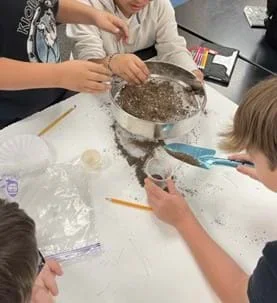 Students use common household items to separate potting soil into its components.Copyright Dr. Betsy Lawrence
Students participate in hands-on activities that introduce them to chemical engineering and sustainability. They explore various separation methods, such as distillation, crystallization, and adsorption, and apply these techniques in real-world scenarios. The activity concludes with an engineering design challenge, where students must design a system to separate the components of potting soil and develop strategies to recycle the separated materials, applying their understanding of sustainability and separation processes.
Chemical engineers design and optimize processes to separate, purify, and produce substances such as chemicals, fuels, and other materials. They develop methods to separate chemicals from mixtures, ensuring that each component is isolated and refined for use in various products. Engineers also focus on improving efficiency, safety, and sustainability in industrial production. They work to reduce environmental impacts, as seen with refrigerants, by developing eco-friendly alternatives to harmful chemicals such as chlorofluorocarbons (CFCs) and hydrofluorocarbons (HFCs). Through their work, chemical engineers create practical solutions to complex global challenges, including sustainability, climate change, and resource management.
After this activity, students should be able to:
- Explain the history of climate change.
- Describe various ways that chemical engineers separate mixtures.
- Engineer a way to separate plant food from potting soil to then use the water to grow plants in a hydroponic system.
- MS-ETS1-1 Define the criteria and constraints of a design problem with sufficient precision to ensure a successful solution, taking into account relevant scientific principles and potential impacts on people and the natural environment that may limit possible solutions.
Grades 6-8
This resource focuses on the following Three Dimensional Learning aspects of NGSS:
Science & Engineering Practices- Define a design problem that can be solved through the development of an object, tool, process or system and includes multiple criteria and constraints, including scientific knowledge that may limit possible solutions.Do you agree with this alignment?
Disciplinary Core Ideas- The more precisely a design task's criteria and constraints can be defined, the more likely it is that the designed solution will be successful. Specification of constraints includes consideration of scientific principles and other relevant knowledge that is likely to limit possible solutions.Do you agree with this alignment?
Crosscutting Concepts- The uses of technologies and any limitations on their use are driven by individual or societal needs, desires, and values; by the findings of scientific research; and by differences in such factors as climate, natural resources, and economic conditions.Do you agree with this alignment?
- All human activity draws on natural resources and has both short and long-term consequences, positive as well as negative, for the health of people and the natural environment.Do you agree with this alignment?
Do you agree with this alignment? - Define a design problem that can be solved through the development of an object, tool, process or system and includes multiple criteria and constraints, including scientific knowledge that may limit possible solutions.
- MS-ETS1-2 Evaluate competing design solutions using a systematic process to determine how well they meet the criteria and constraints of the problem.
Grades 6-8
This resource focuses on the following Three Dimensional Learning aspects of NGSS:
Science & Engineering Practices- Evaluate competing design solutions based on jointly developed and agreed-upon design criteria.Do you agree with this alignment?
Disciplinary Core Ideas- There are systematic processes for evaluating solutions with respect to how well they meet the criteria and constraints of a problem.Do you agree with this alignment?
Do you agree with this alignment? - Evaluate competing design solutions based on jointly developed and agreed-upon design criteria.
- MS-ETS1-3 Analyze data from tests to determine similarities and differences among several design solutions to identify the best characteristics of each that can be combined into a new solution to better meet the criteria for success.
Grades 6-8
This resource focuses on the following Three Dimensional Learning aspects of NGSS:
Science & Engineering Practices- Analyze and interpret data to determine similarities and differences in findings.Do you agree with this alignment?
Disciplinary Core Ideas- There are systematic processes for evaluating solutions with respect to how well they meet the criteria and constraints of a problem.Do you agree with this alignment?
- Sometimes parts of different solutions can be combined to create a solution that is better than any of its predecessors.Do you agree with this alignment?
- Although one design may not perform the best across all tests, identifying the characteristics of the design that performed the best in each test can provide useful information for the redesign process—that is, some of the characteristics may be incorporated into the new design.Do you agree with this alignment?
Do you agree with this alignment? - Analyze and interpret data to determine similarities and differences in findings.
- MS-ETS1-4 Develop a model to generate data for iterative testing and modification of a proposed object, tool, or process such that an optimal design can be achieved.
Grades 6-8
This resource focuses on the following Three Dimensional Learning aspects of NGSS:
Science & Engineering Practices- Develop a model to generate data to test ideas about designed systems, including those representing inputs and outputs.Do you agree with this alignment?
Disciplinary Core Ideas- Models of all kinds are important for testing solutions.Do you agree with this alignment?
- The iterative process of testing the most promising solutions and modifying what is proposed on the basis of the test results leads to greater refinement and ultimately to an optimal solution.Do you agree with this alignment?
Do you agree with this alignment? - Develop a model to generate data to test ideas about designed systems, including those representing inputs and outputs.
- MS-PS1-1 Develop models to describe the atomic composition of simple molecules and extended structures.
Grades 6-8
This resource focuses on the following Three Dimensional Learning aspects of NGSS:
Science & Engineering Practices- Develop a model to predict and/or describe phenomena.Do you agree with this alignment?
Disciplinary Core Ideas- Substances are made from different types of atoms, which combine with one another in various ways. Atoms form molecules that range in size from two to thousands of atoms.Do you agree with this alignment?
- Solids may be formed from molecules, or they may be extended structures with repeating subunitsDo you agree with this alignment?
Crosscutting Concepts- Time, space, and energy phenomena can be observed at various scales using models to study systems that are too large or too small.Do you agree with this alignment?
Do you agree with this alignment? - Develop a model to predict and/or describe phenomena.
- MS-PS1-2 Analyze and interpret data on the properties of substances before and after the substances interact to determine if a chemical reaction has occurred.
Grades 6-8
This resource focuses on the following Three Dimensional Learning aspects of NGSS:
Science & Engineering Practices- Analyze and interpret data to determine similarities and differences in findings.Do you agree with this alignment?
- Science knowledge is based upon logical and conceptual connections between evidence and explanations.Do you agree with this alignment?
Disciplinary Core Ideas- Each pure substance has characteristic physical and chemical properties (for any bulk quantity under given conditions) that can be used to identify it.Do you agree with this alignment?
- Substances react chemically in characteristic ways. In a chemical process, the atoms that make up the original substances are regrouped into different molecules, and these new substances have different properties from those of the reactants.Do you agree with this alignment?
Crosscutting Concepts- Macroscopic patterns are related to the nature of microscopic and atomic-level structure.Do you agree with this alignment?
Do you agree with this alignment? - Analyze and interpret data to determine similarities and differences in findings.
- MS-PS1-3 Gather and make sense of information to describe that synthetic materials come from natural resources and impact society.
Grades 6-8
This resource focuses on the following Three Dimensional Learning aspects of NGSS:
Science & Engineering Practices- Gather, read, and synthesize information from multiple appropriate sources and assess the credibility, accuracy, and possible bias of each publication and methods used, and describe how they are supported or not supported by evidence.Do you agree with this alignment?
Disciplinary Core Ideas- Each pure substance has characteristic physical and chemical properties (for any bulk quantity under given conditions) that can be used to identify it.Do you agree with this alignment?
- Substances react chemically in characteristic ways. In a chemical process, the atoms that make up the original substances are regrouped into different molecules, and these new substances have different properties from those of the reactants.Do you agree with this alignment?
Crosscutting Concepts- Structures can be designed to serve particular functions by taking into account properties of different materials, and how materials can be shaped and used.Do you agree with this alignment?
- Engineering advances have led to important discoveries in virtually every field of science, and scientific discoveries have led to the development of entire industries and engineered systems.Do you agree with this alignment?
- The uses of technologies and any limitations on their use are driven by individual or societal needs, desires, and values; by the findings of scientific research; and by differences in such factors as climate, natural resources, and economic conditions. Thus technology use varies from region to region and over time.Do you agree with this alignment?
Do you agree with this alignment? - Gather, read, and synthesize information from multiple appropriate sources and assess the credibility, accuracy, and possible bias of each publication and methods used, and describe how they are supported or not supported by evidence.
Part 1:
Each student needs:
- Timeline of Climate Change Worksheet (PDF)
- scissors
- (optional) glue
- (optional) piece of paper (to glue timeline events to)
Part 2:
Each student needs:
Each group needs:
Distillation Activity
- 1 500 mL beaker
- 1 graduated cylinder
- 250 mL water
- 15 g salt
- 1 glass stirring rod
- 4 pH strips
- sheet of foil that fits atop the beaker
- hot plate
- 1 Styrofoam cup
- 1 digital scale
- 1 weigh boat
- 1 spatula
Crystallization Activity
- 2 clear plastic cups
- 50 mL water
- 10 g Epsom salt
- 10 g sodium carbonate
- 1 graduated cylinder
- 2 glass stirring rods
- 1 digital scale
- 2 weigh boats
Adsorption Activity
- 1 250 mL beaker
- 100 mL water
- 100 mL vegetable oil
- 1 graduated cylinder
- 1 clean, absorbent sponge
Membrane Activity
- 1 plastic cup
- 50 mL water
- filter paper cut into strips (must be thicker than coffee filters; see example)
- 1 graduated cylinder
- red food coloring
- blue food coloring
Absorption and Stripping Activity
- 1 laptop or tablet
- 1 empty cup
- 1 cup of water
- 1 clean, absorbent sponge
- hands for squeezing
Extraction Activity
- 1 laptop or tablet
Part 3:
Each student needs:
Each group needs:
- sieving trays of various mesh sizes
- funnels
- coffee filters
- beakers
- water
- sponges
- hot plates
- distillation kit (if available)
- cups
- scales
- pH strips
- neoprene clone collars (see example)
- Timeline of Climate Change Worksheet (docx)
- Timeline of Climate Change Worksheet (pdf)
- Types of Separations Worksheet (docx)
- Types of Separations Worksheet (pdf)
- Types of Separations Worksheet Answer Key (docx)
- Types of Separations Worksheet Answer Key (pdf)
- Separating Potting Soil for Vertical Gardens Worksheet (docx)
- Separating Potting Soil for Vertical Gardens Worksheet (pdf)
Students need to be:
- Able to create a line graph using x and y coordinates with data they have collected.
- Familiar with the engineering design process.
Climate change is a significant issue that affects everyone and our planet. Simply put, climate change refers to long-term changes in the Earth's weather patterns, including shifts in temperature and seasons. Although some changes occur naturally, many of the current shifts are driven by human activities, such as burning fossil fuels (such as oil, coal, and gas), deforestation, and the use of certain chemicals. These actions release greenhouse gases such as carbon dioxide into the atmosphere, where they trap heat and raise the Earth's temperature.
Think of the Earth as a blanket that keeps everything at a comfortable temperature. If we add too many greenhouse gases, it’s like making the blanket too thick, causing the Earth to overheat. This warming can lead to severe consequences, such as melting ice caps, rising sea levels, stronger storms, wildfires, and droughts.
To combat climate change, chemical engineers are developing innovative solutions. They design processes to reduce harmful emissions, create cleaner energy sources such as solar and wind power, and find ways to capture and recycle carbon dioxide from the atmosphere. By advancing new technologies, chemical engineers play a vital role in slowing down climate change and protecting our environment for future generations.
Now, let’s talk about CFCs. Who has heard of CFCs? What does CFC stand for? (Answer: Chlorofluorocarbons (CFCs) are man-made chemicals that were commonly used in refrigerators, air conditioners, aerosol sprays, and foam-blowing agents. They were popular because they were non-toxic, non-flammable, and stable. However, their stability, which made them useful, also caused significant environmental harm.)
Chemical engineers are currently researching ways to separate existing refrigerants into less harmful gases because many refrigerants contribute to global warming. Refrigerants are essential for keeping our homes cool and preserving food, but the ones we use today can harm the environment. Therefore, there is an urgent need for safer alternatives that can effectively cool our spaces without negatively impacting the planet.
In this activity, we will first explore the history of climate change and the impact of CFCs. Then, we will delve into the methods chemical engineers use to separate mixtures. Finally, we’ll take on the role of chemical engineers and tackle the challenge of separating potting soil!
Background
Climate Change: Human activities have played a significant role in driving climate change over the past few centuries. The timeline begins in the 1750s with the Industrial Revolution, when factories started using coal and other fossil fuels, releasing large amounts of carbon dioxide (CO₂) into the atmosphere. In 1896, Swedish scientist Svante Arrhenius discovered the greenhouse effect, calculating that CO₂ from burning fossil fuels could trap heat and warm the Earth. By the 1950s, human activities such as burning fossil fuels and deforestation sharply increased during what is known as the "Great Acceleration," leading to a rapid rise in greenhouse gas emissions.
Public awareness of environmental issues began to grow in 1970, when the first Earth Day was celebrated, and the United States created the Environmental Protection Agency (EPA) to address pollution and other environmental problems. In 1987, the Montreal Protocol was signed to phase out harmful chemicals such as CFCs, which were damaging the ozone layer and contributing to global warming. The first global treaty to reduce greenhouse gas emissions, the Kyoto Protocol, was adopted in 1997, encouraging countries to take action against climate change. Finally, in 2015, the Paris Agreement was signed, with world leaders committing to limit global temperature rise to below 2°C and promote renewable energy solutions.
Chlorofluorocarbons (CFCs) are man-made chemical compounds that were commonly used in refrigerators, air conditioners, aerosol sprays, and foam-blowing agents. CFCs were popular because they were non-toxic, non-flammable, and highly stable. However, their stability, which made them useful in industry, also made them environmentally harmful.
CFCs are harmful because they deplete the ozone layer, a protective layer in the Earth's stratosphere that absorbs most of the sun's harmful ultraviolet (UV) radiation. When CFCs are released into the atmosphere, they eventually rise to the stratosphere. There, they are broken down by UV radiation, releasing chlorine atoms. These chlorine atoms react with ozone (O₃) molecules, causing them to break apart into oxygen (O₂) and a single oxygen atom. A single chlorine atom can destroy thousands of ozone molecules, thinning the ozone layer and creating "holes" in it, particularly over the polar regions.
This thinning of the ozone layer allows more harmful UV radiation to reach the Earth's surface, increasing the risk of skin cancer, cataracts, and other health issues in humans, as well as damaging ecosystems, marine life, and crops. CFCs also contribute to global warming, as they are potent greenhouse gases that trap heat in the atmosphere. Although the Montreal Protocol in 1987 successfully phased out the use of CFCs, their long lifespan means they will continue to impact the environment for many years.
Before the Activity
Part 1
- Make copies of the Timeline of Climate Change Worksheet (PDF). (1 per student)
- Gather materials.
Part 2
- Make copies of the Types of Separations Worksheet. (PDF) (1 per student)
- Gather materials.
- For the Membrane exploration station, create a mystery mixture using water and red and blue food coloring.
- Measure 50 mL of water.
- Add 1 red and 2 blue drops of food coloring into the cup, along with the water.
- Place a strip of filter paper into the cup for 5 minutes.
- Take out the strip after the 5 minutes with the completed separation.
Part 3
- Make copies of the Separating Potting Soil for Vertical Gardens Worksheet (PDF). (1 per student)
- Gather materials.
During the Activity
Part 1: Pre-Activity and Timeline of Climate Change
Pre-Activity
- Give students 10 minutes to search the internet for pictures of things that keeps humans and/or things cool.
- Have students either write down their items or place their selected pictures for the entire class to view. (Note: This could be on a shared slide or by using FigJam.
- Have each student share their item(s) with the class.
- As a class, look at and discuss the commonalities of their pictures. Guide students to pictures or items that contain refrigerant(s).
- Define refrigerants for the students:
Refrigerants are chemical compounds used in cooling systems such as refrigerators, air conditioners, and heat pumps to absorb and release heat, enabling these systems to cool or heat spaces. They work by circulating through a cycle of evaporation and condensation, transferring heat from one place (inside a refrigerator or room) to another (outside the appliance or building).
Historically, many types of refrigerants have been used, including chlorofluorocarbons (CFCs), hydrofluorocarbons (HFCs), and hydrochlorofluorocarbons (HCFCs). These refrigerants were effective for cooling but harmful to the environment. CFCs and HCFCs, for example, contributed to ozone layer depletion, while HFCs, though not harmful to the ozone layer, have a high global warming potential (GWP), meaning they trap a significant amount of heat in the atmosphere and contribute to climate change.
Modern refrigerants such as hydrofluoroolefins (HFOs), and natural refrigerants such as ammonia, carbon dioxide, and hydrocarbons, are designed to minimize environmental impact. They have lower global warming potential and are often used in more sustainable cooling technologies. However, transitioning to these newer refrigerants is a challenge, and chemical engineers are actively working on finding even more efficient and eco-friendly refrigerant solutions to reduce their contribution to climate change.
Climate Change Timeline Activity
- Hand out one Timeline of Climate Change Worksheet (PDF)to each student.
- Show students the first figure in their worksheet.
- Give students a few minutes to look at the graph and write down what they notice on the “Notice” side of their “Notice and Wonder” chart on their worksheet.
- Provide time for students to talk to their shoulder partner about the things they noticed about the graph and things they wondered. [Note: Listen for ideas related to the temperature increasing drastically around 1980. This can lead to students wondering what happened during this time, and possibly relating this observed temperature increase the use of CFCs (chlorofluorocarbons).]
- Bring the class back together and point out human drivers as things we as humans have done to increase climate change, and natural drivers as things that nature has done. For example:
- 1750s - Industrial Revolution: Factories begin using coal and other fossil fuels, releasing large amounts of carbon dioxide (CO₂) into the atmosphere.
- 1896 - Discovery of the Greenhouse Effect: Scientist Svante Arrhenius calculates that CO₂ from burning fossil fuels can trap heat and warm the Earth.
- 1950s - Great Acceleration: Human activities, such as burning fossil fuels and deforestation, rapidly increase after World War II, leading to a sharp rise in greenhouse gas emissions.
- 1970 - First Earth Day: Public awareness of environmental issues, including climate change, starts growing. The U.S. creates the Environmental Protection Agency (EPA).
- 1987 - Montreal Protocol: An international agreement is signed to phase out the use of chemicals such as CFCs, which were damaging the ozone layer and contributing to global warming.
- 1997 - Kyoto Protocol: The first international treaty is created to reduce global greenhouse gas emissions, encouraging countries to take action against climate change.
- 2015 - Paris Agreement: World leaders agree to limit global temperature rise to below 2°C by reducing emissions and promoting renewable energy sources such as wind and solar power.
- Tell students they will now be creating a timeline of events that are driving factors of climate change.
- Provide students with the following websites to read and take note of key events of climate change. (Note: These are also noted in their Timeline of Climate Change Worksheet (PDF).)
- https://www.history.com/topics/natural-disasters-and-environment/history-of-climate-change
- https://climate.nasa.gov/evidence
- https://www.epa.gov/climatechange-science/causes-climate-change
- https://www.britannica.com/story/timeline-of-climate-change
- https://climate-wise.com/news-and-articles/climate-change-a-timeline
- Give students time to read the above links explaining the history of climate change.
- Have students write down events of note in their Timeline of Climate Change Worksheet (PDF).
- After they finish their research and write down their climate change events, have students cut apart their 10 climate change events.
- (optional) Modification: If students need guidance for specific events, or you as a teacher would like to provide students with specific events to sort, use the following website for a list of events: https://history.aip.org/climate/timeline.htm
- Have each group arrange their events chronologically across their desks.
- Guide students to see the correlation of CFCs and increasing climate change.
- Remind students that CFCs are man-made chemical compounds that were commonly used in refrigerators, air conditioners, aerosol sprays, and foam-blowing agents. CFCs were popular because they were non-toxic, non-flammable, and highly stable. However, their stability, which made them useful in industry, also made them environmentally harmful. CFCs are harmful because they deplete the ozone layer, a protective layer in the Earth's stratosphere that absorbs most of the sun's harmful UV radiation.
- Have students engage in a gallery walk to share their timelines.
- (optional) Post the timelines for display.
Part 2: Chemical Engineering and Types of Separation
Chemical engineering and chemical engineers
- Define chemical engineering and chemical engineers to the students:
“Broadly, chemical engineers conceive and design processes involved in chemical manufacturing. The main role of chemical engineers is to design and troubleshoot processes for the production of chemicals, fuels, foods, pharmaceuticals, and biologicals, to name just a few. They are most often employed by large-scale manufacturing plants to maximize productivity and product quality while minimizing costs.” (American Chemical Society Website)
- Have students read this article about what a chemical engineer does:
- Show this video (6:23 minutes) to give students an idea of what chemical engineers do: https://www.youtube.com/watch?v=k-7B_YfHWXQ
Separation Process Understanding Activity
- Split the class into six groups.
- Give each student a Types of Separations Worksheet (PDF).
- Assign each group one of the separation methods: distillation, crystallization, adsorption, membrane, absorption and stripping, and extraction. This will be the first station/method they will work on.
- Have each group rotate through each of the six stations/methods listed in the Types of Separations Worksheet (PDF):
- Distillation
Expected results: pH of water and collected water droplets will be the same, indicating only water is distilled from the saltwater mixture.
- Crystallization
Expected results: White solid particles will form and deposit as a precipitate.
- Adsorption
Expected Results: A microporous solid (like a sponge) will adsorb one or more components of the mixture. For example, the sponge will soak up oil but leave water behind, showing that the absorbent has a stronger affinity for one part of the mixture.
- Membrane
Expected Results: Students will see how the membrane selectively allows certain particles to pass through while blocking others, separating the components based on size or other properties.
- Absorption and Stripping
Expected Results: One component of the mixture will be absorbed into a solid or liquid, while the other remains separate, demonstrating how absorption works to isolate certain substances.
- Extraction
Expected Results: A solvent will be used to extract one component from the mixture, leaving the other behind, showing how different solubility levels are used for separation.
Part 3: Engineering Design Challenge: Can we separate potting soil to be used for something else?
- (optional) Review the separation techniques covered in Part 2.
- (optional) Introduce Project EARTH by showing this video (2:57 minutes): Project EARTH Video. This project focuses on sustainable processes for separating HFC refrigerant mixtures.
- Introduce the design challenge:
“Today, we are going to become engineers like the Project EARTH chemical engineers. Project EARTH engineers aim to separate a gas refrigerant mixture into two parts: one that can be reused into the next type of refrigerant, and one that will be recycled into something new. Although we are not going to be using a refrigerant, we are going to separate something you might be familiar with: potting soil.“
- Show students the bag of potting soil.
- Review the engineering design process.
- State the following to set up motivation for the design challenge:
“I was watching the news this morning, and I came across a really interesting story. Because so many people are working from home now, there are quite a few empty office buildings. Instead of tearing down those office buildings, many people have decided to turn them into places where they can grow plants vertically inside.”
- Have students read the following article: https://www.smithsonianmag.com/innovation/empty-office-buildings-are-being-turned-into-vertical-farms-180982502.
- Lead a class discussion about the article, what people are doing about this problem, and any interesting ideas that the class found when reading the article.
- Ask students to identify the components of potting soil. (Answers include peat moss, bark, perlite [white pellets].)
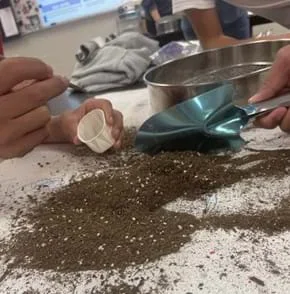 Students sift through potting soil.Copyright Dr. Betsy Lawrence
- State the following:
“Most plants commonly use potting soil for growth because it provides structure, water retention, and nutrients. However, plants don’t necessarily need soil to grow. The dilemma with potting soil is that it can be messy. Plants can grow in water through a method called hydroponics, as long as the water contains the proper nutrients for plant development. Unfortunately, I have lots of potting soil, but I would love to see if we are able to start a vertical garden such as what was explained in the article.
If we want to potentially use this potting soil to make a vertical garden, what might we need to do?” (Lead students to the answer of separating the perlite from the dirt.)
“You are going to take on the role of a chemical engineer today. The past few days we have looked at different ways that chemical engineers separate mixtures.”
- Divide students into small groups.
- Give each student a Separating Potting Soil for Vertical Gardens Worksheet (PDF).
- Have each team problem solve together and make a plan to separate the potting soil. Remind students that their plan will need to include what data you will collect, using plant growth to show how successful your separation was. (Teacher note: Look for data related to measuring the height of the plant. Students might also think about measuring the pH of the separation: perlite dissolved in water).
- Once each team has a plan, have each group present their ideas to you.
- Once you approve a group’s plan, each team can work through their plan to separate the potting soil.
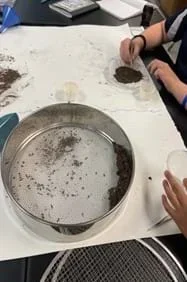 Students analyze their separated soil.Copyright Dr. Betsy Lawrence
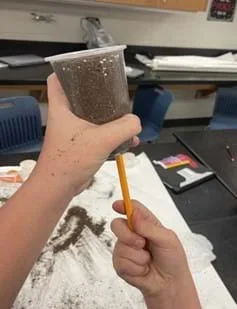 A student uses a pencil to create holes in a plastic cup to filter potting soil.Copyright Dr. Betsy Lawrence
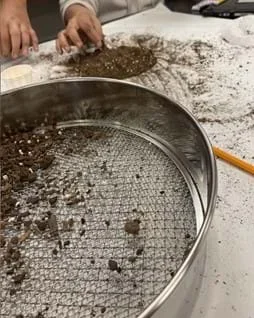 Students use a large filter to sift potting soil.Copyright Dr. Betsy Lawrence
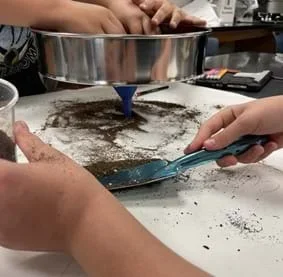 Students gather their separated potting soil with a trowel.Copyright Dr. Betsy Lawrence
Students use common household items to separate potting soil into its components.Copyright Dr. Betsy Lawrence
- Have each group put their “plant food” in a cup with water.
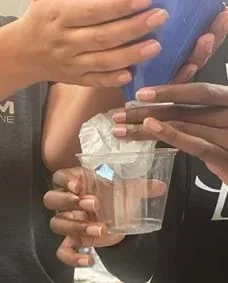 Students practice separating soil components with filter paper and a funnel.Copyright Dr. Betsy Lawrence
- Provide each group with a net pod containing a seed to test their plant growth.
- Over the next two weeks, have students collect and document their observations and measurements. They should:
- Record data.
- Graph their results.
- Prepare a presentation summarizing their separation process, data collection, findings, and the effectiveness of their method.
- Have students create a final presentation after the growth period of their separated potting soil. Their presentation should include how they separated the potting soil, how they collected data, what their data showed, and how effective they determined their separation to be.
- separation
- The process of separating or extracting different components of a mixture using some physical method.
- chemistry
- The branch of science that deals with the identification of the substances of which matter is composed; the investigation of their properties and the ways in which they interact, combine, and change; and the use of these processes to form new substances.
- chemical engineering
- The development and design of chemical manufacturing processes. Chemical engineers apply the principles of chemistry, physics, and engineering to design equipment and processes for manufacturing products such as gasoline, detergents, and paper.
- hydroponics
- The process of growing plants in sand, gravel, or liquid, with added nutrients but without soil.
- kinetic separation
- The separation of a mixture by sorting it based on molecular size.
- thermodynamic separation
- Major system separation by means of heat supplied from a higher temperature level at the reboiler and rejected in the condenser at a lower temperature level.
- polymer
- A substance that has a molecular structure consisting mostly or entirely of a large number of similar units bonded together; e.g., many synthetic organic materials used as plastics and resins.
- refrigerant
- A substance used for refrigeration.
- ph
- A figure expressing the acidity or alkalinity of a solution on a logarithmic scale on which 7 is neutral, lower values are more acid, and higher values are more alkaline.
- acidity
- The level of acid in substances such as water or soil.
- property
- An attribute, quality, or characteristic of something.
Pre-Activity Assessment
Online research: Students have 10 minutes to search the internet for a picture of something that keeps them cool or that keeps things cool. The purpose of this pre-activity assessment is to give you an idea of what students know about the ways that refrigerant is used. Pictures might include those of air conditioners or refrigerators. Once students have selected a picture, ask them one by one to place them such that the entire class is able to view them. This could be on a shared slide or by using FigJam. Students are to look for commonalities among their pictures.
Activity Embedded (Formative) Assessment
Worksheet: Students fill out the Types of Separations Worksheet (PDF) to better understand the different types of separation.
Post-Activity (Summative) Assessment
Presentation: Students will be assessed on their final presentation after the growth period of their separated potting soil. Rubric to use with presentation: https://www.readwritethink.org/sites/default/files/30700_rubric.pdf
For lower grades, modify activities to be conducted with a teacher-led demo in which students can observe the experiment. Allow students the opportunity to share with peers their thoughts as to why this specific reaction occurred.
Contributors
Dr. Betsy Lawrence; Ellie Hill; Andrew Yancey-Jardon; Abby Harders; Dr. Mark Shifflett; Dr. Douglas Huffman; Dr. Meagan Patterson; Dr. Prajna Dhar; Valerie Pringle Griffin
Supporting Program
Inquiry-Driven Engineering Activities using Bioengineering (IDEA-BioE), University of Kansas
Acknowledgements
This material is based upon work supported by the National Science Foundation under grant no. ECC-2055716 - a Research Experience for Teachers program titled Inquiry-Driven Engineering Activities using Bioengineering (IDEA-BioE) at the University of Kansas. Any opinions, findings and conclusions or recommendations expressed in this material are those of the author(s) and do not necessarily reflect the views of the National Science Foundation.
Copyright
2025 by Regents of the University of Colorado; original © 2024 University of Kansas