
Stop the Stick: Using Surfactants to Prevent Protein Aggregation in Pharmaceuticals
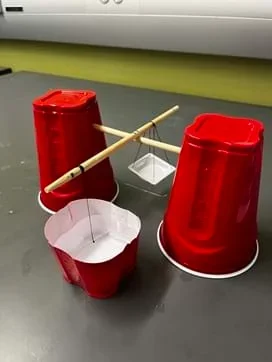 The assembled balance for the Method 1 activityCopyright This is an image taken by the creators of this lesson.
Students act as chemical engineers tasked with improving the stability of protein-based medicines by developing a cost-effective surfactant to reduce protein aggregation during shipment. They learn about surface tension, surfactants, and the contributions of the scientist Agnes Pockels before using a simple Langmuir-Pockels trough model to test unknown additives. Using their collected data, students propose and evaluate a surfactant solution to minimize protein aggregation caused by agitation.
Chemical engineers apply principles of chemistry, physics, biology, and math to design, analyze, and improve processes involving chemicals, materials, or biological substances. In exploring the surface tension of potential additives, they investigate how substances such as surfactants interact with liquids to reduce surface tension and prevent problems such as protein aggregation in medicines. By testing and analyzing different additives, chemical engineers can select or design solutions that stabilize products, improve performance, and remain cost effective during production, storage, and shipment.
After this activity, students should be able to:
- Identify the need for surfactants in protein-based pharmaceutical solutions.
- Identify the key effect of surfactants on surface tension.
- Apply data and knowledge collected from surface tension and surfactant experiments to the problem of protein aggregation.
- Use collected experimental data to plan an ideal surfactant additive that will minimize protein aggregation due to agitation.
- HS-ETS1-2 Design a solution to a complex real-world problem by breaking it down into smaller, more manageable problems that can be solved through engineering.
Grades 9-12
This resource focuses on the following Three Dimensional Learning aspects of NGSS:
Science & Engineering Practices- Design a solution to a complex real-world problem, based on scientific knowledge, student-generated sources of evidence, prioritized criteria, and tradeoff considerations.Do you agree with this alignment?
Disciplinary Core Ideas- Criteria may need to be broken down into simpler ones that can be approached systematically, and decisions about the priority of certain criteria over others (trade-offs) may be needed.Do you agree with this alignment?
Do you agree with this alignment? - Design a solution to a complex real-world problem, based on scientific knowledge, student-generated sources of evidence, prioritized criteria, and tradeoff considerations.
- HS-PS1-3 Plan and conduct an investigation to gather evidence to compare the structure of substances at the bulk scale to infer the strength of electrical forces between particles.
Grades 9-12
This resource focuses on the following Three Dimensional Learning aspects of NGSS:
Science & Engineering Practices- Plan and conduct an investigation individually and collaboratively to produce data to serve as the basis for evidence, and in the design: decide on types, how much, and accuracy of data needed to produce reliable measurements and consider limitations on the precision of the data (e.g., number of trials, cost, risk, time), and refine the design accordingly.Do you agree with this alignment?
Disciplinary Core Ideas- The structure and interactions of matter at the bulk scale are determined by electrical forces within and between atoms.Do you agree with this alignment?
Crosscutting Concepts- Different patterns may be observed at each of the scales at which a system is studied and can provide evidence for causality in explanations of phenomena.Do you agree with this alignment?
Do you agree with this alignment? - Plan and conduct an investigation individually and collaboratively to produce data to serve as the basis for evidence, and in the design: decide on types, how much, and accuracy of data needed to produce reliable measurements and consider limitations on the precision of the data (e.g., number of trials, cost, risk, time), and refine the design accordingly.
In-class teacher demonstration
For the teacher:
- 1 standard size paper plate
- 25 mL water
- less than 2 g of ground black pepper
- 5-10 drops of liquid dish soap (Dawn or similar)
For the class to share
- laptop or computer with projector (to display Exploring Surfactants Presentation (PPTX) to class)
Part 1: Investigating surface tension and surfactants
Note: To test the surface pressures of different chemicals, each group will need to assemble a testing apparatus. This activity provides two options: Method 1 is a low-cost DIY version that will collect more general qualitative data, while Method 2 uses a scientific triple-beam balance (which may be available in some classrooms) to collect more precise quantitative data.
Method 1: Building a low-cost DIY surface tension balance
Each group needs:
- 3 18 oz. plastic cups
- 1 small weigh boat
- 1 spool of thread
- 1 sewing needle
- 2 small wooden dowels or chopsticks
- 1 pair of scissors
- 1 utility knife
- 1 permanent marker
- 1 ruler with units in centimeters
- modeling clay
- tape
- water, preferably distilled
- 2 g SLSA powder
- weigh boat
- spoon or stirring rod
- 100 mL graduated cylinder
- 1 ml bulb pipette
- permanent marker
- paper towels
- (optional) 1 electronic balance
For the entire class to share:
- 1 electronic balance
Method 2: Assembling a scientific beam balance apparatus
Each group needs:
- 1 50 mL beaker
- 1 spool of thread
- 1 medium plastic button (preferably flat-faced, 4 holes, approximately 17-20 mm in diameter)
- 1 ruler with units in centimeters
- (optional) 1 triple-beam pan balance (e.g., Ohaus Cent-O-Gram™ Balance or similar)
For the class to share
- 1 triple-beam pan balance (e.g., Ohaus Cent-O-Gram™ Balance or similar)
Part 2: Investigating protein aggregation solutions
Each group needs:
- 50 mL of four mystery solutions (labeled A, B, C, D) for testing. Each solution should be prepared at a 4% concentration using one of the following compounds: a surfactant (such as SLSA powder), a stabilizer (such as sugar), or potentially disruptive agents (such as borax or salt).
- 1 hand mixer with 2 eggbeater attachments
- 100 mL egg whites
- 5 small containers with transparent lids
- 1 bowl large enough to mix solutions in
- 5-10 pipettes
- 50 mL water, preferably distilled
- Chemical Lab Sheet (docx)
- Chemical Lab Sheet (pdf)
- Measuring Surface Tension Method 1 (docx)
- Measuring Surface Tension Method 1 (pdf)
- Measuring Surface Tension Method 2 (docx)
- Protein Aggregation (docx)
- Protein Aggregation (pdf)
- Exploring Surfactants Presentation (pptx)
- Exploring Surfactants Presentation (pdf)
Students should have:
- Basic understanding of molecules.
- Basic understanding of how balances work.
- Ability to do computational work (adding, multiplying).
- Familiarity with best practices for collecting data.
One of the most important developments in current pharmaceutical research is the development of protein-based drugs. The protein drugs market is projected to reach $655.7 billion by 2029. But with this new frontier in medicine comes new challenges. Because proteins are large, complex molecules, shipment can present issues, as proteins are prone to aggregation when agitated. Chemical engineers are working on cost-effective ways to prevent aggregation using surfactants to change the properties of the materials being used to ship these protein-based drugs.
If you have a container of water, two “interfaces” will be present. Who knows what I mean by “interface”? (Let students offer answers.) An interface is where two different phases of matter meet. Water molecules at this liquid-gas interface react differently than water molecules in the “bulk solution.” Water molecules in the bulk solution will be attracted to each other in all directions equally; therefore, there is no net force in any one direction. However, water molecules at the liquid-gas interface are more attracted to the water molecules near them than to molecules in the air. These imbalanced forces can cause serious problems for any proteins suspended in the liquid, as these imbalanced forces can cause the proteins to get stuck together, a phenomenon known as protein aggregation.
To address this challenge, chemical engineers can use surfactants, which are chemical compounds with a preference for the interface. They are amphiphilic, meaning they have a hydrophilic head and a hydrophobic tail. When surfactants are present, they tend to dominate the interface, pushing other chemicals into the bulk of the solution. When surfactants are present in water, they interrupt the forces of the water molecules at the interface and lower the surface tension.
In this activity, you will play the role of a chemical engineer tasked with finding a cost-effective surfactant additive to prevent the aggregation of a ground-breaking new protein-based drug. You will need to investigate the chemical properties of an array of potential chemical additives, propose a potential additive, and then test its effect on protein aggregation in your suspended protein sample. Let’s get started!
Background
Surface tension is the property of a liquid’s surface that makes it behave like a stretched elastic sheet. It happens because molecules at the surface are not surrounded on all sides by similar molecules, so they experience a net inward pull from the liquid beneath. This inward pull causes the surface to contract and resist being stretched or broken.
A surfactant is a surface-active agent, a molecule that reduces surface tension between two substances, such as a liquid and air or oil and water. Surfactants have two distinct parts: a hydrophilic (water-loving) head that is attracted to water, and a hydrophobic (water-fearing) tail that repels water and prefers oils or fats. When added to water, surfactants arrange themselves at the surface or at the interface between different substances. By disrupting the cohesive forces between water molecules, they lower surface tension, allowing the liquid to spread more easily, mix with oils, and/or form stable bubbles. Surfactants are widely used in soaps and detergents to remove grease, in foods and cosmetics to stabilize mixtures, and in pharmaceuticals to prevent protein-based medicines from clumping during storage or shipment.
In pharmaceuticals, surfactants are used to stabilize protein-based medicines and other formulations. Proteins and other delicate molecules can clump together or aggregate during manufacturing, storage, or shipment, especially when exposed to physical stress such as shaking or temperature changes. Surfactants reduce surface tension and coat the protein molecules, preventing them from sticking together. This helps maintain the drug’s effectiveness, safety, and shelf life.
Surfactants are also used to improve the solubility of drugs, help mix ingredients in creams or suspensions, and aid in drug delivery by stabilizing emulsions or nanoparticles. Essentially, they ensure that the medicine remains uniform and effective from production to patient use.
Protein aggregation is the process in which individual protein molecules stick together and clump to form larger structures. This usually happens when proteins are exposed to stress, such as shaking, heat, freezing, or changes in pH, which can cause their natural three-dimensional structure to unfold or misfold.
In pharmaceuticals, protein aggregation is a problem because it can reduce the effectiveness of protein-based medicines such as insulin or monoclonal antibodies, and sometimes trigger immune reactions in patients. Surfactants and other stabilizing agents are often added to formulations to prevent aggregation and keep proteins in their proper, functional form during storage and shipment.
Agnes Pockels was a self-taught German scientist in the late 19th and early 20th centuries who made important contributions to the study of surface chemistry. She developed a simple method to measure surface tension at home using everyday materials, long before she had access to a formal laboratory. Her work helped scientists understand how molecules behave at the interface between liquids and air, laying the foundation for modern interface science.
Interface science is the study of the boundary between two phases, such as liquid-air, liquid-liquid, or liquid-solid interfaces. It explores how molecules interact at these boundaries, which is critical for understanding phenomena such as surface tension, emulsions, foams, and the behavior of surfactants. Pockels’ experiments showed that careful observations and simple tools could lead to important discoveries about molecular behavior at interfaces.
The ideal ratio of surfactant to protein is the best balance that keeps protein molecules from clumping when a solution is shaken or stirred. Surfactants coat the proteins and reduce surface tension, preventing aggregation, while the protein remains functional. Finding this ratio ensures that the medicine stays stable and effective during shipping without using more surfactant than necessary.
Before the Activity
- Choose the methods you will use for each part of the activity. Note: Each part of the activity has a DIY method that can be completed with commonly available materials, and a scientific method that uses equipment commonly found in secondary science labs. These methods can be mixed and matched depending on the equipment available.
- Gather the necessary materials for the method you have chosen. (Note: You may choose to prepare certain materials for the students before the lesson based on time and their readiness. For example, you may want to prepare the weigh baskets for the Method 1 activity in advance.)
- Optional: If you are collecting digital student artifacts, make sure you have an inbox set up.
Part 1: Surface Tension and Surfactants
- For Method 1:
- Make copies of the Measuring Surface Tension Method 1 (PDF) worksheet (1 per student).
- Gather materials for each group.
- For Method 2:
- Make copies of the Measuring Surface Tension Method 2 (PDF)worksheet (1 per student).
- Gather materials and place chemicals into “blind bags” that are labeled with a generic chemical #, a chemical formula, and a skeletal structure. Note: Sample labels are available on the Chemical Lab Sheet (PDF).
- Make sure each group has access to a testing apparatus.
- Optional: Depending on the level of your students, you may wish to prepare 4% stock solutions of each chemical to ensure uniformity of materials between groups. Note: If you make stock solutions, each group will need 50 mL of each solution.
Part 2: Protein aggregation
- Make copies of the Protein Aggregation (PDF) worksheet (1 per student).
- Prepare four mystery solutions (labeled A, B, C, D) for testing. Each solution should be prepared at a 4% concentration using one of the following compounds: a surfactant (such as SLSA powder), a stabilizer (such as sugar), or potentially disruptive agents (such as borax or salt).
- Gather materials for each group.
During the Activity
Day 1: Teacher Demonstration and Introduction to Surface Tension and Surfactants
- Gather materials for the teacher demonstration.
- Perform the demonstration:
- Show students the bowl of water.
- Sprinkle pepper over the bowl of water so that the pepper gently sits on the surface of the water.
- Add a drop of soap to the water and have students notice what happens (i.e., the pepper will shoot to the sides of the bowl.)
- Put students into small groups (3-4 students).
- Ask each group to brainstorm what could be happening to the pepper.
- Show Slide 2 of the Exploring Surfactants Presentation (PPTX), which has questions for students to discuss.
- Give students 5 minutes to discuss.
- Bring the groups back together to share their ideas.
- What do you observe about the water and the pepper? Potential responses:
- "The pepper is just floating on top of the water."
- "The pepper spreads out and sits on the surface."
- "It doesn’t sink; it just kind of stays on top."
- What happened to the pepper after the soap was added? Why do you think this occurred? Potential responses:
- "The pepper shot away really fast from where the soap touched."
- "It spread out to the sides of the bowl."
- "I think the soap broke the surface tension of the water and pushed the pepper away."
- "Maybe the soap changed the way the water molecules stick together."
- Would the pepper react the same way if another substance were added to the water? What type of substance do you think would cause a similar reaction?
- "Not with just anything. If it was like sugar or salt, probably not."
- "I think only things like soap or detergent would make the pepper move like that."
- "Another chemical that breaks surface tension, like dish soap, would cause a similar reaction."
- "Maybe oil would act differently, but not the same as soap."
- Read Slide 3: What causes surface tension?
- Read Slide 4: What affects surface tension?
- Show Slide 5: What happened to the pepper?
- Give students 5 minutes to write a short explanation as to what happened with the pepper, including the terms surface tension, forces and surfactants.
- Read Slides 6 and 7: Measuring surface tension.
- Use Slide 8 to introduce Part 1 of the activity: Measuring Surface Tension and hype students up for the next session.
Day 2: Investigating Surface Tension and Surfactants
Surface Tension and Surfactants Method 1:
- Put students into small groups (3-4 students).
- Give each member of the group a Measuring Surface Tension Method 1 (PDF) sheet.
- Referencing the worksheet, walk students through the steps in Part 1: Building the Balance:
- Make the weigh basket.
- Make the base.
- Make the trough.
- Make the balance beam.
- Give groups time to create their balance. As they build, walk around the classroom to answer questions and supervise.
- Once groups have finished their balances, bring the class back together.
- Again, referencing the Measuring Surface Tension Method 1 (PDF) sheet, walk students through the steps in Part 2: Conducting Surface Tension Trials:
- Set up.
- Conduct trials with water.
- Conduct trials with surfactant.
- Show students the Data Sheet section of the Measuring Surface Tension Method 1 (PDF)sheet for recording their data.
- Give groups time to conduct the experiments and record their data.
- After students have finished their trials and collected their data, discuss their results as a class.
- Have students answer the Reflection Questions at the end of the Measuring Surface Tension Method 1 (PDF) sheet. (Optionally, this can be done as homework.)
The assembled balance for the Method 1 activityCopyright This is an image taken by the creators of this lesson.
Surface Tension and Surfactants Method 2:
- Divide students into groups of 3-4 students.
- Pass out or post the Measuring Surface Tension Method 2 (PDF) sheet.
- Referencing the worksheet, walk students through the steps in Part 1: Assembling the Testing Apparatus.
- Give groups time to create their balance. As they build, walk around the classroom to answer questions and supervise.
- Once groups have finished their balances, bring the class back together.
- Again referencing the Measuring Surface Tension Method 2 (PDF)sheet, walk students through the steps in Part 2: Conducting Surface Tension Trials.
- Give groups time to conduct the experiments and record their data.
- After students have finished their trials and collected their data, give groups time to make all of the calculations at the end of the Data Sheet section.
- If time permits, bring the class back together and discuss their results as a class.
- Have students answer the Reflection Questions at the end of the Measuring Surface Tension Method 2 (PDF) sheet. (Optionally, this can be done as homework.)
Days 3 and 4
- Display Slide 9 of the Exploring Surfactants Presentation (PPTX).
- Class discussion: Lead the class through the following questions and points:
- What happens when you whisk egg whites for a long time? (Answer: When you whisk egg whites for a long time, you are physically breaking the protein structures and then incorporating air to create a foam. The longer you whisk, the denser and stiffer the foam becomes, moving through distinct stages: from frothy to soft peaks, then stiff peaks, and finally, if you whisk too long, to a broken, unusable stage.)
- Medicines often contain proteins! Medicines often contain proteins because proteins are the primary functional molecules of life, making them ideal for targeting specific biological processes with high precision. These protein-based drugs are called biologics (or biopharmaceuticals).
- What are some examples of agitation that medicines might face from production to the patient?
- Mixing and pumping: Shaking happens right in the factory when big machines stir the liquid medicine or pump it through tubes. This fast movement can break the tiny protein structures inside.
- Filtering: The liquid is pushed hard through a filter to clean it. This high-pressure squeezing is a major shake-up.
- Filling the vials: When the liquid drops into the little glass bottles, it can create bubbles and foam. That bubbly surface is very rough on the medicine's proteins.
- Truck and plane vibration: During transport, the medicine gets constant, gentle jiggling and
- Dropping and bumping: This is when a box of medicine is dropped by a worker or smashed into another box during loading. It is a sudden, hard hit.
- Rough handling: Any time a person is careless when moving the boxes, like stacking them too quickly or rolling them across the floor.
- Mixing powdered drugs: If the medicine comes as a powder that needs water added (like some antibiotics), shaking it hard instead of gently swirling it can damage the drug.
- Patient mishaps: When a patient drops their pen or syringe at home or carries it in a backpack that gets constantly jostled.
- Protein aggregation in medicines is a big problem and can cause the drug to be less effective. A protein aggregate in medicines is an accumulation of protein molecules that have clumped together. This typically happens when the protein's natural, folded structure is disrupted (denatured), causing the exposed surfaces to stick to other similar proteins. This is a critical concern for biologic medicines (such as antibodies, hormones, and vaccines), as aggregation can compromise the drug's safety and effectiveness.
- This is a problem bioengineers want to prevent. What do you think could be done about this problem? (Answer to lead students toward: “adding surfactants”: The most common approach is to add a small amount of a surfactant (like Polysorbate 80). Just as a surfactant reduces surface tension in your cleaning experiment, it works here by occupying the air-liquid and liquid-container interfaces. This prevents the delicate drug proteins from sticking to those surfaces, which is what triggers unfolding and aggregation when the solution is shaken.)
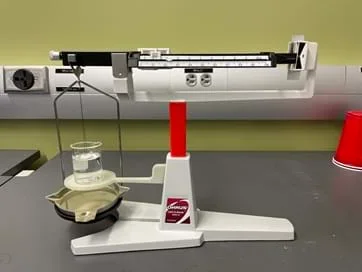 The assembled balance for the Method 2 activity.Copyright This is an image taken by the creators of this lesson.
- Display Slide 10 of the Exploring Surfactants Presentation (PPTX).
- Introduce the challenge: Bioengineers are often expected to run tests on samples without being told exactly what they are! We are going to run an experiment to see what mystery solution, when added to egg whites, could prevent protein aggregation at the interface of the protein solution.
- Give each student a Protein Aggregation (PDF) worksheet.
- Divide students into groups of 3-4 students.
- Distribute materials to each group.
- As a class, go over the instructions for the Control Method and Mystery Solutions Method in the Protein Aggregation (PDF)worksheet.
- Give groups time to conduct the experiments and record their data. As they work, walk around the classroom to answer questions and supervise.
- After students have finished their trials and collected their data, discuss their results as a class.
- Have students answer the Reflection Questions at the end of the Protein Aggregation (PDF) worksheet. (Optionally, this can be done as homework.)
- surface tension
- Tension of the surface film of a liquid caused by the attraction of the particles in the surface layer by the bulk of the liquid, which tends to minimize surface area.
- surface pressure
- A measure of the effect of a surfactant on the surface tension of a material. It is calculated as the surface tension of the pure subphase minus the surface tension of the subphase with amphiphiles floating on the surface.
- surfactant
- Chemical compounds that decrease the surface tension or interfacial tension between two liquids, a liquid and a gas, or a liquid and a solid.
- interface
- The point where two systems meet and interact. At the liquid–gas interface, cohesive forces are generally greater than adhesive forces, leading to an inward pull on the molecules toward the bulk. This force pulls and keeps the molecules of the interface together and tends to contract the surface, resulting in minimization of the exposed surface area.
- aggregation
- The formation of a number of things into a cluster. This module will examine the clustering of proteins into masses.
Pre-Activity Assessment
Brainstorming: After viewing the pepper demonstration, put students into small groups (3-4 students). Ask students to brainstorm about what could be happening to the pepper. After allowing groups to discuss, bring the groups back together to share their ideas.
Activity Embedded (Formative) Assessment
Data Collection: Students complete the Data Section of their Measuring Surface Tension Method 1 (PDF) or Measuring Surface Tension Method 2 (PDF)sheet.
Reflection questions: Students answer the Reflection Questions of their Measuring Surface Tension Method 1 (PDF) or Measuring Surface Tension Method 2 (PDF) sheet.
Post-Activity (Summative) Assessment
Protein Aggregation Worksheet: Students complete the Protein Aggregation activity and fill out the summative questions.
Carvalho TC, Horng M. McConville JT. Application of a pull on a disk method to measure surface tension of liquids. AAPS PharmSciTech. 2012 Mar 13(1):305-12. Doi: 10.1208/s12249-011-9737-4. Epub 2012 Jan 19. PMID: 222588802; PMCID: PMC3299463
Kruse, A, & Schwarzl, S.M. (n.d.). Who Was Agnes Pockels. Technische Universitat Braunshweig. https://www.tu-braunschweig.de/en/agnes-pockels-labor/who-was-agnes-pockels
Notter, R.H. (2000). Lung Surfactants: Basic Science and Clinical Applications (Lung Biology in Health and Disease). CRC.
Contributors
Chris Elniff; KP Preut; Dr. Prajna Dhar; Valerie P. Griffin
Supporting Program
IDEA-BioE RET Program through the University of Kansas
Acknowledgements
This material is based upon work supported by the National Science Foundation under grant no. ECC-2055716 - a Research Experience for Teachers program titled Inquiry-Driven Engineering Activities using Bioengineering (IDEA-BioE) at the University of Kansas. Any opinions, findings and conclusions or recommendations expressed in this material are those of the author(s) and do not necessarily reflect the views of the National Science Foundation.
Copyright
2025 by Regents of the University of Colorado; original © 2024 University of Kansas