
Helping Hands: Engineering Solutions for Multiple Sclerosis
Students work collaboratively to create a low-cost, easy-to-use device that helps individuals with multiple sclerosis (MS) securely hold a pencil, addressing difficulties with fine motor skills. After learning about MS and discussing how biomedical engineers develop assistive devices, students establish criteria and constraints for their designs. They brainstorm, sketch, and select materials, then build and test their prototypes within a set time. Following testing, they evaluate and improve their designs, ultimately presenting their final devices to the class.
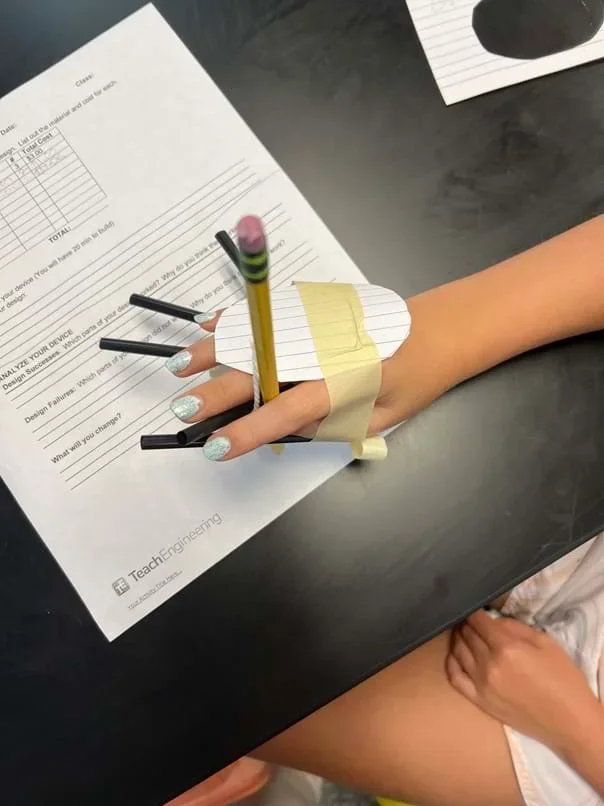 A student testing their device.Copyright Erin Messerly
Biomedical engineers design assistive devices to improve the quality of life for people with medical conditions such as multiple sclerosis (MS). Biomedical engineers use the engineering design process—defining problems, establishing criteria and constraints, brainstorming, prototyping, testing, and refining—to create solutions that address the specific physical challenges patients face.
After this activity, students should be able to:
- Design and prototype an assistive device to help MS patients hold a pencil and write.
- Apply the engineering design process, including brainstorming, testing, and iterating their designs.
- MS-ETS1-2 Evaluate competing design solutions using a systematic process to determine how well they meet the criteria and constraints of the problem.
Grades 6-8
This resource focuses on the following Three Dimensional Learning aspects of NGSS:
Science & Engineering Practices- Evaluate competing design solutions based on jointly developed and agreed-upon design criteria.Do you agree with this alignment?
Disciplinary Core Ideas- There are systematic processes for evaluating solutions with respect to how well they meet the criteria and constraints of a problem.Do you agree with this alignment?
Do you agree with this alignment? - Evaluate competing design solutions based on jointly developed and agreed-upon design criteria.
- MS-ETS1-4 Develop a model to generate data for iterative testing and modification of a proposed object, tool, or process such that an optimal design can be achieved.
Grades 6-8
This resource focuses on the following Three Dimensional Learning aspects of NGSS:
Science & Engineering Practices- Develop a model to generate data to test ideas about designed systems, including those representing inputs and outputs.Do you agree with this alignment?
Disciplinary Core Ideas- Models of all kinds are important for testing solutions.Do you agree with this alignment?
- The iterative process of testing the most promising solutions and modifying what is proposed on the basis of the test results leads to greater refinement and ultimately to an optimal solution.Do you agree with this alignment?
Do you agree with this alignment? - Develop a model to generate data to test ideas about designed systems, including those representing inputs and outputs.
- MS-LS1-8 Gather and synthesize information that sensory receptors respond to stimuli by sending messages to the brain for immediate behavior or storage as memories.
Grades 6-8
This resource focuses on the following Three Dimensional Learning aspects of NGSS:
Science & Engineering Practices- Gather, read, and synthesize information from multiple appropriate sources and assess the credibility, accuracy, and possible bias of each publication and methods used, and describe how they are supported or not supported by evidence.Do you agree with this alignment?
Disciplinary Core Ideas- Each sense receptor responds to different inputs (electromagnetic, mechanical, chemical), transmitting them as signals that travel along nerve cells to the brain. The signals are then processed in the brain, resulting in immediate behaviors or memories.Do you agree with this alignment?
Crosscutting Concepts- Cause and effect relationships may be used to predict phenomena in natural systems.Do you agree with this alignment?
Do you agree with this alignment? - Gather, read, and synthesize information from multiple appropriate sources and assess the credibility, accuracy, and possible bias of each publication and methods used, and describe how they are supported or not supported by evidence.
Suggested materials that the groups can “purchase”:
- craft sticks
- straws
- string (30 cm)
- rubber bands
- pipe cleaners
- note cards
- paper clips
- masking tape (30 cm)
- cotton balls
- playdoh
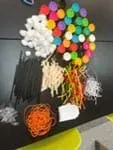 This was enough supplies for approximately 200 students.Copyright Erin Messerly
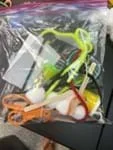 Bagged supplies for each table that had 2-3 groups of students at it.Copyright Erin Messerly
For the entire class to share:
- iPad or laptop with internet access and projector to show videos
- scissors
(Play this video: Facebook Video [shaky hand that struggles to even touch fingers together].).
Take a close look at this person's hand. What do you notice happening? What do you wonder about? (Pause for student responses.)
Now, think about a time when you tried to do something that required a lot of precision with your hands, like threading a needle, holding a paintbrush, or even writing your name after your hand felt tired or shaky. Maybe you were playing sports for hours, or your muscles were just really worn out. How did it feel? Were you able to control your movements the way you normally do? (Pause to let students share their thoughts.)
Imagine if that feeling didn’t go away, no matter how much rest you got. For people with a condition called multiple sclerosis, or MS, their nerve cells don’t send signals the way they should, leading to challenges like shaky hands, weakness, and trouble controlling movements. What do you think could be happening inside the body that might cause these symptoms? (Pause for student ideas.)
Let’s investigate this further. What is myelin? (Allow students to respond.) Myelin is a fatty substance that wraps around the axons of neurons [nerve cells] in the nervous system. Its main function is to insulate these axons, much like the plastic coating on electrical wires, allowing nerve signals to travel quickly and efficiently along the nerve cells. How do you think that might affect someone’s ability to move, write, or even hold something like a pencil? (Discuss student responses.)
This brings us to our big question:
Why do some people experience difficulties performing simple tasks like holding a pencil, and how can we use engineering to help them?
We'll explore this together today.
Today, we’re going to use what we know about the nervous system, neurons, and myelin to think like biomedical engineers. Your challenge is to design a device that can help someone with MS hold a pencil and write—something that’s so easy for most of us that we probably don’t even think about it. You’ll need to observe, ask questions, and problem-solve just like engineers do. Let’s get started!
Background
Multiple sclerosis (MS) is a chronic disease whereby the immune system attacks the protective myelin sheath that covers nerve fibers. This leads to communication problems between the brain and the rest of the body. Over time, the disease can cause permanent damage or deterioration of the nerves. Symptoms include fatigue, difficulty walking, numbness, and problems with coordination. Understanding how nerve cells work, particularly the role of myelin in facilitating fast signal transmission, is crucial for this activity. The goal is for students to apply their knowledge of the nervous system to create an engineering solution that assists people with MS in performing a fine motor skill task such as writing.
Before the Activity
- Gather all building materials.
- Make copies of the Losing my Fine Motor Skills Article (PDF).
- Make copies of the Helping Hands Worksheet (PDF).
- Set up an iPad or laptop with internet access and projector to show videos.
During the Activity
Ask & Research (20 minutes)
- Go through Introduction and Motivation section.
- Play the following video to learn more about MS: YouTube Video (1:55 minutes)
- Have a class discussion about what happens when myelin is damaged. Ask what might happen to tasks like writing or buttoning a shirt if myelin is damaged.(Answer: When myelin is damaged, the signals slow down or get mixed up, making it hard for people to do things like write or button a shirt. MS can make everyday tasks very difficult.)
- Hand out copies of the Losing my Fine Motor Skills Article (PDF).
- Have students read the article in pairs.
- After everyone finishes reading the article, lead a class discussion and ask the following questions:
- “How has Matt’s life been affected by MS?”
- “Have you ever used or seen someone use a device to help them with a task? Maybe a grandparent using a cane, or someone using special tools in the kitchen?"
- “What do biomedical engineers do for MS patients?” (Potential answers: Biomedical engineers develop rehabilitation devices such as wearable exoskeletons, robotic braces, and smart canes, which help patients walk more easily and improve muscle strength and balance. These devices help people with MS regain independence and reduce reliance on caregivers.)
Criteria and Constraints (10 minutes)
- Divide students into groups of 2-3.
- Pass out the Helping Hands Worksheet (PDF).
- As a class, define the criteria for the device:
- It must hold a pencil securely.
- It must be easy to use (i.e., can be put on and taken off easily).
- As a class, discuss the constraints of the challenge:
- Cost – device cannot cost more than $5 worth of materials.
- Time – device must be built in 20 minutes.
- Size – device must be sized to work for middle school students to adults.
Imagine & Plan (10 minutes)
- Have students work in their groups to brainstorm and sketch their design ideas in their Helping Hands Worksheet (PDF).
- After they settle on one solution, have each group determine the materials they want to use under the set budget in their Helping Hands Worksheet (PDF).
Create & Test (20 minutes)
- Give students 20 minutes to build and test their designs.
- Have groups test their design by trying to write with the device.
- Once they have their final design, have them describe their device in their Helping Hands Worksheet (PDF).
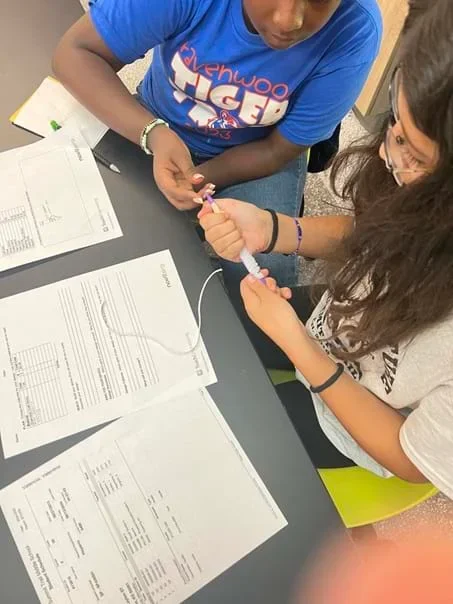 Students designing and building their device.Copyright Erin Messerly
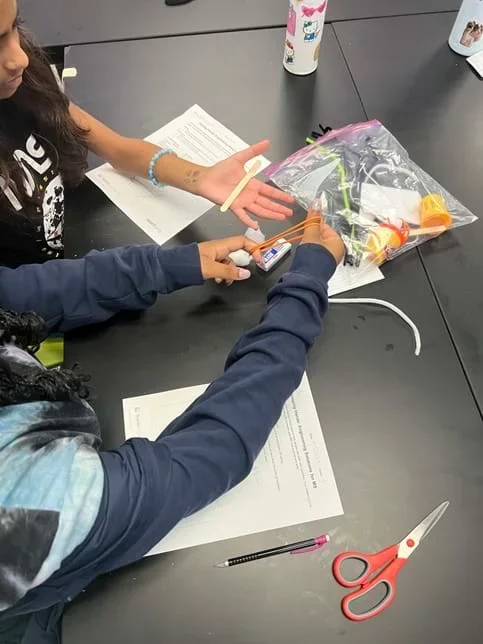 Students designing and building their device.Copyright Erin Messerly
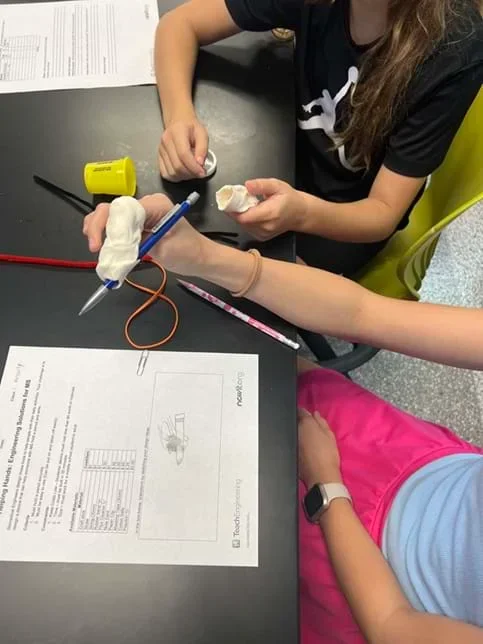 Students designing and building their device.Copyright Erin Messerly
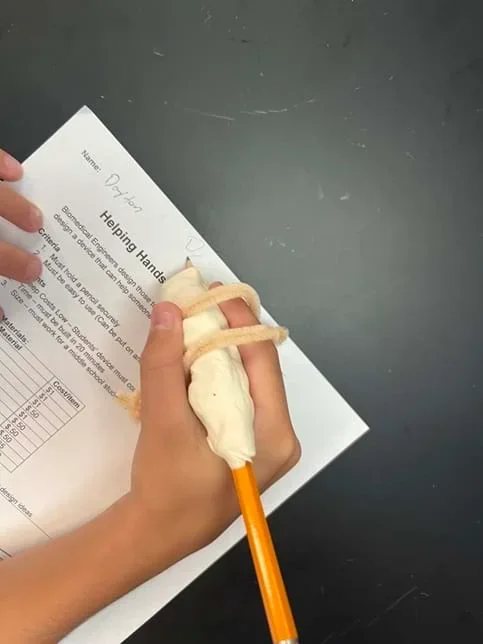 A student testing their device.Copyright Erin Messerly
A student testing their device.Copyright Erin Messerly
Evaluate, Redesign and Test (20 minutes)
- Give students 20 minutes to evaluate, design, and retest.
- Have students determine what worked well on their design and what needs improvement.
- Have students write their responses on their Helping Hands Worksheet (PDF).
- Allow students to make necessary modifications to their design and then retest their modified design.
Presentation and Reflection (10 minutes)
- Have each group present their final prototypes to the entire class or in small groups, depending on time. Assess each presentation and device based on the Helping Hands Rubric (PDF).
- Wrap up with a class discussion on the iterative nature of engineering and the importance of understanding phenomena like MS to create meaningful solutions. Revisit the driving question:
"Why do some people experience difficulties performing simple tasks like holding a pencil, and how can we use engineering to help them?"
Ask students:
- "How did your understanding of this question change during the activity?"
- "How can engineers use science to design solutions for other real-world challenges?"
- neuron
- A specialized, impulse-conducting cell that is the functional unit of the nervous system, consisting of the cell body and its processes, the axon, and dendrites.
- myelin
- A soft, white, fatty material in the membrane of Schwann cells and certain neuroglial cells.
- myelin sheath
- A wrapping of myelin around certain nerve axons, serving as an electrical insulator that speeds nerve impulses to muscles and other effectors.
- assistive device
- A product that helps someone perform a function that could not be done without that piece of technology.
- biomedical engineering
- The application of engineering principles and techniques to problems in medicine and biology.
- engineering design process
- A series of steps used by engineering teams to guide them as they develop new solutions, products, or systems; the process is cyclical and iterative.
- multiple sclerosis (ms)
- A disease that affects the brain and spinal cord, which are important parts of the nervous system. In MS, the protective covering around the nerves, called myelin, gets damaged; this makes it harder for the nerves to send messages to the rest of the body.
- demyelination
- The loss of myelin from the nerve sheaths.
Pre-Activity Assessment
During the introduction, be sure to review myelin by asking students how myelin helps nerve signals travel. (Possible answers: Myelin acts like insulation around nerve fibers, helping electrical signals travel quickly and efficiently. It helps protect the nerve fibers from damage. Myelin allows for fast and precise communication between different parts of the body. It speeds up transmission.)
Activity Embedded (Formative) Assessment
Worksheet (In pairs/groups): Have students complete the Helping Hands Worksheet (PDF) as they work through the activity. Use a checklist to assess student engagement and understanding during the brainstorming, design, and building phases. For example:
- Are students discussing the role of myelin and nerve signals in their designs?
- Are they applying the criteria and constraints effectively?
- Are they collaborating and sharing ideas within their group?
Post-Activity (Summative) Assessment
After building and testing their devices, have students present their designs to the class. In their presentations, ask them to address:
- "What challenge did you solve, and how does your device address it?"
- "How did your understanding of myelin and nerve signals influence your design?"
- "What would you improve if you had more time or resources?"
Use the Helping Hands Rubric (PDF) to assess the students on their device and collaboration for this activity.
- Advanced Design Challenge: Have students design a more complex assistive device for other tasks affected by fine motor skill loss, such as buttoning a shirt or using utensils.
- Guest Speaker: Invite a healthcare professional or biomedical engineer to talk about their work with MS patients and assistive technology.
- Math Integration: Incorporate a math activity where students calculate the cost of materials and budget for creating multiple devices, practicing real-world math skills.
For younger grades: Instead of designing a device, ask students to modify a pre-made grip (e.g., foam, rubber tubing) to make it easier for someone to hold a pencil.
Contributors
Erin Messerly; Reegan Scott
Supporting Program
Inquiry-Driven Engineering Activities using Bioengineering (IDEA-BioE), University of Kansas
Acknowledgements
This material is based upon work supported by the National Science Foundation under grant no. ECC-2055716 - a Research Experience for Teachers program titled Inquiry-Driven Engineering Activities using Bioengineering (IDEA-BioE) at the University of Kansas. Any opinions, findings and conclusions or recommendations expressed in this material are those of the author(s) and do not necessarily reflect the views of the National Science Foundation.
Copyright
2024 by Regents of the University of Colorado; original © 2024 University of Kansas