
How Additives Affect Surface Tension
 Close-up of the pure and soapy water droplets on the tape strip.Copyright Nicholas Anderson
Students explore the concept of surface tension and how additives such as surfactants can alter it. Students investigate how substances like surfactants change the surface tension of water and relate this to lung function. Students will then connect their observations to real-world concerns, examining how vaping additives may interfere with lung surfactants and potentially impact breathing over time.
Biomedical engineers are actively working on developing artificial lung surfactants to help patients with conditions such as idiopathic pulmonary fibrosis (IPF). To do this, they study the function of natural lung surfactants in alveolar fluid, modeling the fluid and testing its behavior under different conditions. A key area of research is understanding how chemical additives, such as those found in vaping cartridges, impact the surface tension of alveolar fluid and, consequently, lung function. In this activity, students will engage in a similar process, observing, modeling, and analyzing how substances can alter fluid behavior in the lungs, mirroring the investigative work performed by biomedical engineers.
After this activity, students should be able to:
- Describe the forces involved with the surface tension of a fluid.
- Determine how a surfactant decreases the surface tension of water.
- Discuss the possible impact of long-term vaping on lung alveoli fluid.
- CCSS.Math.Practice.MP2 Reason abstractly and quantitatively.
Grades K-12
Do you agree with this alignment?
- STEL-4T Evaluate how technologies alter human health and capabilities.
Grades 9-12
Do you agree with this alignment? - STEL-8Q Synthesize data and analyze trends to make decisions about technological products, systems, or processes.
Grades 9-12
Do you agree with this alignment?
- HS-PS1-3 Plan and conduct an investigation to gather evidence to compare the structure of substances at the bulk scale to infer the strength of electrical forces between particles.
Grades 9-12
This resource focuses on the following Three Dimensional Learning aspects of NGSS:
Science & Engineering Practices- Plan and conduct an investigation individually and collaboratively to produce data to serve as the basis for evidence, and in the design: decide on types, how much, and accuracy of data needed to produce reliable measurements and consider limitations on the precision of the data (e.g., number of trials, cost, risk, time), and refine the design accordingly.Do you agree with this alignment?
Disciplinary Core Ideas- The structure and interactions of matter at the bulk scale are determined by electrical forces within and between atoms.Do you agree with this alignment?
Crosscutting Concepts- Different patterns may be observed at each of the scales at which a system is studied and can provide evidence for causality in explanations of phenomena.Do you agree with this alignment?
Do you agree with this alignment? - Plan and conduct an investigation individually and collaboratively to produce data to serve as the basis for evidence, and in the design: decide on types, how much, and accuracy of data needed to produce reliable measurements and consider limitations on the precision of the data (e.g., number of trials, cost, risk, time), and refine the design accordingly.
Each group needs:
- 1 laptop computer or Chromebook
- 1 high-resolution camera (available on most modern cell phones)
- 1 protractor (available online)
- 1 roll of Teflon (PTFE) tape
- 1 pair of scissors
- 1 magnifying glass
- Relating a Phenomenon to Our Everyday Lives - Part 1 Worksheet (PDF) (1 per student)
- Relating a Phenomenon to Our Everyday Lives - Part 2 Worksheet (PDF) (1 per student)
- Investigating the Effect of Additives on Surface Tension – Part 1 Worksheet (PDF) (1 per student)
- Investigating the Effects of Additives on Surface Tension - Part 2 Worksheet (PDF)(1 per student)
- Understanding a Phenomenon - Part 1 Worksheet (PDF) (1 per student)
- Understanding a Phenomenon - Part 2 Worksheet (PDF)(1 per student)
- Exploring a Phenomenon - Part 1 Worksheet (PDF)(1 per student)
- Exploring a Phenomenon - Part 2 Worksheet (PDF)(1 per student)
- Applying Our Learning to a Problem Worksheet (PDF) (1 per student)
For the class to share:
- 1 laptop computer or Chromebook with projector and internet access (for showing YouTube videos)
- access to pure water (tap water will work)
- liquid hand soap
- plastic, disposable pipettes (droppers)
- Exploring a Phenomenon - Part 1 Worksheet (docx)
- Exploring a Phenomenon - Part 1 Worksheet (pdf)
- Exploring a Phenomenon - Part 2 Worksheet (docx)
- Exploring a Phenomenon - Part 2 Worksheet (pdf)
- Understanding a Phenomenon - Part 1 Worksheet (docx)
- Understanding a Phenomenon - Part 1 Worksheet (pdf)
- Understanding a Phenomenon - Part 1 Worksheet Answer Key (docx)
- Understanding a Phenomenon - Part 1 Worksheet Answer Key (pdf)
- Understanding a Phenomenon - Part 2 Worksheet (docx)
- Understanding a Phenomenon - Part 2 Worksheet (pdf)
- Understanding a Phenomenon - Part 2 Worksheet Answer Key (docx)
- Understanding a Phenomenon - Part 2 Worksheet Answer Key (pdf)
- Relating a Phenomenon to Our Everyday Lives - Part 1 Worksheet (docx)
- Relating a Phenomenon to Our Everyday Lives - Part 1 Worksheet (pdf)
- Relating a Phenomenon to Our Everyday Lives - Part 1 Worksheet Answer Key (docx)
- Relating a Phenomenon to Our Everyday Lives - Part 1 Worksheet Answer Key (pdf)
- Relating a Phenomenon to Our Everyday Lives - Part 2 Worksheet (docx)
- Relating a Phenomenon to Our Everyday Lives - Part 2 Worksheet (pdf)
- Relating a Phenomenon to Our Everyday Lives - Part 2 Worksheet Answer Key (docx)
- Relating a Phenomenon to Our Everyday Lives - Part 2 Worksheet Answer Key (pdf)
- Investigating the Effect of Additives on Surface Tension – Part 1 Worksheet (docx)
- Investigating the Effect of Additives on Surface Tension – Part 1 Worksheet (pdf)
- Investigating the Effect of Additives on Surface Tension – Part 1 Worksheet Answer Key (docx)
- Investigating the Effect of Additives on Surface Tension – Part 1 Worksheet Answer Key (pdf)
- Investigating the Effects of Additives on Surface Tension - Part 2 Worksheet (docx)
- Investigating the Effects of Additives on Surface Tension - Part 2 Worksheet (pdf)
- Applying Our Learning to a Problem Worksheet (docx)
- Applying Our Learning to a Problem Worksheet (pdf)
- Applying Our Learning to a Problem Worksheet Answer Key (docx)
- Applying Our Learning to a Problem Worksheet Answer Key (pdf)
- Revised Drop of Soapy Water Model Answer Key (pdf)
- Revised Drop of Pure Water Model Answer Key (pdf)
Prerequisite knowledge before delivering this module:
- All matter is made of tiny particles (atoms, ions, molecules).
- A force is an influence that can cause a change in an object's motion or shape.
- All particles in a sample of matter exert some level of attractive or repulsive forces on each other.
- Particles in liquids are generally able to slide past each other.
Before we dive into today’s activity, I want you to do something simple: slow down, and pay attention to something we usually ignore.
We’re going to look at drops. Just drops of liquid—water and soapy water. Sounds ordinary, right? But here’s the thing: When you really look at something simple, it stops being ordinary.
When you place a drop of water on a surface and truly observe it, you’ll start to notice things. Maybe something unexpected. Maybe something that makes you pause and ask, “Wait, why is it doing that?”
That’s exactly where science begins—not with answers, but with curiosity. It starts with noticing.
And here’s the twist: What you’ll be doing today isn’t just schoolwork. This kind of careful observation? This way of paying attention? It’s the same approach used by scientists and engineers tackling some of the most critical problems in health and medicine. People who design systems to help babies breathe. People who study how fluids behave inside the body. People who create new ways to clean wounds, coat medical tools, or deliver medicine deep into the lungs.
So yeah, it starts small. With you. With a drop.
Your task today is simple: observe. Compare. Notice everything. Ask questions—even the weird ones. Especially the weird ones!
You’re not just doing a school activity. You’re stepping into the shoes of someone who makes sense of the world by looking closer.
We’ll talk more later. But for now—go explore. Let’s see what you can discover.
Background
Surface Tension and Surfactants
Surface tension is the cohesive force that occurs at the surface of a liquid due to water molecules sticking together through hydrogen bonding. This cohesion creates a kind of "skin" on the liquid’s surface, causing drops of water to bead up into domes rather than flatten out. The surface behaves almost like an elastic membrane. When soap is added, it disrupts these cohesive forces between water molecules, which lowers the surface tension and causes the liquid to spread out more readily.
Cohesion and adhesion are key forces that influence how liquids behave on surfaces. Cohesion is the attraction between like molecules, such as water molecules clinging to each other. Adhesion, on the other hand, is the attraction between different substances (e.g., water sticking to glass or plastic.) These two forces work together to determine the shape of a drop on a surface and explain the differences observed between pure water and soapy water.
The contact angle is the angle formed at the edge where a liquid drop meets a solid surface. A high contact angle means the drop beads up more, which indicates stronger surface tension and more cohesive forces. A low contact angle means the drop spreads out more, signaling weaker surface tension—such as what happens when soap is added.
Surfactants, short for surface-active agents, are substances that reduce surface tension. Soap is a common example. Surfactants work by inserting themselves between water molecules, with their hydrophilic (water-attracting) heads and hydrophobic (water-repelling) tails disrupting the normal cohesive interactions. This interference lowers the surface tension and allows the liquid to spread more easily across a surface.
Engineering and Health Applications
In the human body, surface tension plays a crucial role in lung function. Tiny air sacs in the lungs called alveoli rely on a balance of forces to stay open and facilitate breathing. Surface tension from the fluid lining the alveoli could cause them to collapse, but the body produces pulmonary surfactant to lower this tension and keep the alveoli stable. Premature infants often lack enough of this surfactant, which can lead to respiratory distress syndrome. Biomedical scientists and engineers have responded by developing artificial surfactants to help these infants breathe more easily.
In material science and engineering, the concept of wettability (i.e., how well liquid spreads on or adheres to a surface) is critical. Wettability is directly influenced by surface tension and adhesion, both of which can be observed through the shape and behavior of a liquid drop. Engineers use this knowledge to design surfaces that are hydrophobic (i.e., repel water) or hydrophilic (i.e., attract water), depending on the need, such as in medical devices, coatings, and drug delivery systems.
Before the Activity
- Gather materials listed in the equipment and materials section.
- Print off worksheets (1 per student) listed in the Worksheets and Attachments.
During the Activity
Day 1: Exploring a Phenomenon (50 minutes)
Part 1 (30 minutes)
- Divide the class into groups of 3-5 students.
- Introduce the phenomenon: The shape of a drop of pure water is different from a drop of soapy water when placed on a surface.
- Distribute one Exploring a Phenomenon - Part 1 Worksheet (PDF) to each student.
- Instruct students to follow the worksheet instructions to observe a drop of pure water and a drop of soapy water.
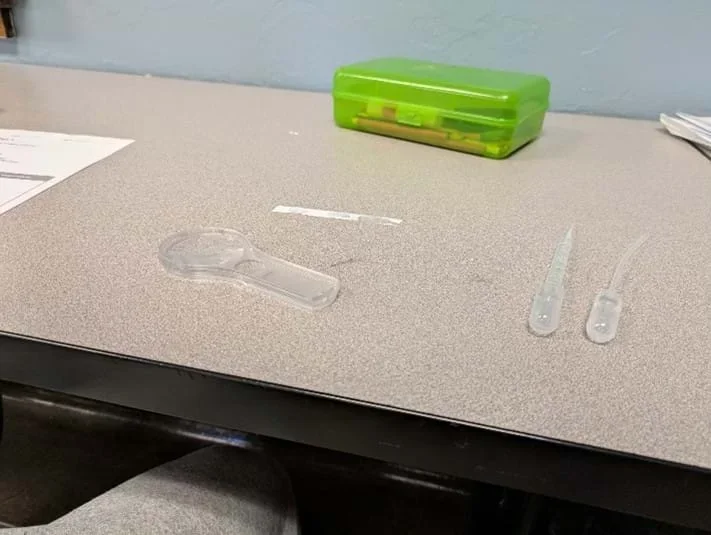 Students observe the differences between the pure water droplets and the soapy water droplets.Copyright Nicholas Anderson
Close-up of the pure and soapy water droplets on the tape strip.Copyright Nicholas Anderson
- Ask each group to discuss and compare their observations.
- Have students individually record their observations on their worksheet.
- Once observations are recorded, have students turn their worksheet over and record at least three questions based on what they noticed.
Part 2 (20 minutes)
- Distribute one Exploring a Phenomenon - Part 2 Worksheet (PDF) to each student.
- Have students take a guess: Based on your observations and prior science learning, complete the models to show what forces are present and how they are causing the two drops to take the shapes that they are. Remember to include particles of water and soap in your models.
- Have students turn the worksheet over and write an explanation of the models they just made describing what caused the difference in shape for each drop.
- When students finish, have them share their models and explanations with their group members.
- Ensure students record any common ideas on their worksheet.
Day 2: Understanding a Phenomenon (50 minutes)
Part 1 (25 minutes)
- Lead the class in a consensus-building activity for the phenomenon. Highlight the following:
- Gravity is a present force with both drops.
- The force of gravity is trying to flatten each drop.
- Water particles have some sort of force that allows them to attract each other strongly enough to not be completely flattened by gravity.
- Soap particles somehow interfere with the attractive forces between water particles, because a drop of soapy water is flatter than a drop of pure water.
- Distribute one Understanding a Phenomenon - Part 1 Worksheet (PDF) to each student.
- Draw attention to the questions the class will need to address to make sense of the phenomenon:
- What force(s) hold water particles together?
- How do soap particles affect the forces between water particles?
- Show the YouTube video Properties of Water - Amoeba Sisters (6:50 minutes), which introduces the concept of surface tension, addressing the question “What force(s) hold water particles together?” Have students take notes on the terms listed in their worksheet.
- Lead a class discussion on students’ notes:
- Hydrogen bonding – a type of bond that holds water particles together (like a magnet).
- Cohesion – when water particles stick to each other.
- Surface tension – a property allowing water to resist an external force (Note: Water has a high level of surface tension when compared to other liquids).
- Have students turn their worksheets over and revise their “drop of water” model.
- Once they have their revised model, have students describe the revisions they made on their worksheet.
Part 2 (25 minutes)
- Distribute one Understanding a Phenomenon – Part 2 Worksheet (PDF) to each student.
- Refer to the second question that needs to be answered: “How do soap particles affect the forces between water particles?”
- Show the YouTube video Surfactants Mechanism of Action - Nonstop Neuron (3:42 minutes), which introduces the concept of surfactants and how they impact the surface tension of water. Have students take notes on the terms listed in their worksheet.
- Lead a class discussion on students’ notes:
- Soapy water: a mixture of soap particles and water particles.
- Soap particles: Soap is a type of surfactant. Each particle has a charged head that interacts with water and a neutral tail that doesn’t interact with water.
- Have students turn their worksheets over and revise their “drop of soapy water” model.
- Once they have their revised model, have students describe the revisions they made on their worksheet.
Day 3: Relating a Phenomenon to Our Everyday Lives (50 minutes)
Part 1 (15 minutes)
- Distribute one Relating a Phenomenon to Our Everyday Lives - Part 1 Worksheet (PDF) to each student.
- Show the YouTube video Surfactant and Surface Tension in Respiration | Breathing Mechanics | Respiratory Physiology - Byte Size Med (4:21 minutes), which introduces how surfactants play an important role in the functioning of our lungs. Have students take notes on the terms listed in their worksheet.
- Have student groups pair and share their answers.
- Have students turn their worksheets over and take a pre-activity survey concerning their perceived level of risk for vaping.
Part 2 (35 minutes)
- Distribute one Relating a Phenomenon to Our Everyday Lives - Part 2 Worksheet (PDF) to each student.
- Show the YouTube video Vaping Is Too Good To Be True - Kurzgesagt – In a Nutshell (13:53 minutes), which is a study showing that vaping is on the rise while cigarette smoking is decreasing among high school students.
- Pose the question to the class, “How much additive does it take to noticeably affect the surface tension of a fluid?”
- Give students time to brainstorm possible ways to investigate this question with their groups.
- Lead a class discussion on how to design the investigation based upon student ideas. Note: During the discussion, introduce the concept of measuring a drop’s contact angle and how it’s related to the surface tension of a liquid. (Refer to Relating a Phenomenon to Our Everyday Lives - Part 2 Worksheet Answer Key (PDF).)
Day 4: Investigating the Effects of Additives on Surface Tension (50 minutes)
Part 1
- Distribute one Investigating the Effects of Additives on Surface Tension - Part 1 Worksheet (PDF) to each student.
- Have each group measure the contact angle of three different mixtures following the previously determined investigation procedure.
- Instruct groups to have you check their data for accuracy.
- Have each group analyze their concentration versus contact angle data to determine whether there is a relationship between the two variables.
- Once each group finishes, lead a class discussion to determine whether a relationship exists between the two variables and what the results might suggest about the potential effects of long-term vaping on lung health.
Part 2
- Distribute one Investigating the Effects of Additives on Surface Tension - Part 2 Worksheet (PDF) to each student.
- Give each group time to design and then conduct a procedure to determine the volumetric ratio between soap and water to obtain a contact angle of 80 degrees.
Day 5 (50 minutes)
Investigating the Effects of Additives on Surface Tension (continued)
- Finish the Investigating the Effects of Additives on Surface Tension - Part 2 (PDF) activity, if necessary.
Real-World Application
- Distribute one Applying Our Learning to a Problem Worksheet (PDF)to each student.
- Have each group apply their learning from this activity to address what might be happening in the lungs of a long-term vape user.
- hydrogen bonding
- A specific type of bond that holds water particles together.
- cohesion
- An attractive force between particles that are the same (e.g., water particles are attracted to each other).
- surface tension
- The level of attraction between particles at the surface of a substance. Substances with a high surface tension, like water, resist forces that try to flatten or break through their surface.
- surfactant
- Each particle has a charged head that interacts with water and a neutral tail that doesn’t interact with water. Surfactants lower the surface tension of water and water-based substances.
- contact angle
- The angle formed where a liquid droplet meets a solid surface. It measures how well a liquid wets (spreads out on) a surface. It is used to study the surface tension of a substance.
Pre-Activity Assessment
Not applicable.
Activity Embedded (Formative) Assessment
Understanding the Phenomenon-Part 1: Students complete the Understanding a Phenomenon - Part 1 Worksheet (PDF), which introduces the concept of surface tension and addresses the question, “What force(s) hold water particles together?” (Refer to Revised Drop of Pure Water Model Answer Key (PDF).)
Understanding the Phenomenon-Part 2: Students complete the Understanding a Phenomenon - Part 2 Worksheet (PDF), which requires them to use their observations and prior science learning to draw models that show what forces are present and how they are causing the two drops to take the shapes that they are. (Refer to Revised Drop of Soapy Water Model Answer Key (PDF).)
Post-Activity (Summative) Assessment
Real-World Application: Students complete the Applying Our Learning to a Problem Worksheet (PDF), using what they learned about surface tension and surfactants to analyze and address a real-world scenario. (Refer to Applying Our Learning to a Problem Worksheet Answer Key (PDF).)
For younger students / lower grades (middle school):
- Focus on observation and discussion rather than quantitative measurements.
- Skip measuring contact angles and concentration ratios and instead use qualitative observations of drop shape and spread.
- Allow more time for group discussion and drawing models.
For older or more advanced students (grades 11–12, AP level, or STEM electives):
- Include quantitative measurements such as contact angles, drop diameters, or concentration calculations.
- Have students graph their data and fit a line or curve to analyze relationships between additive concentration and surface tension.
- Extend the redesign component to allow students to propose modifications to reduce additive impact or simulate surfactant function.
- Introduce literature research and have students compare experimental results to published studies on lung surfactants, vaping, or fluid mechanics.
- Challenge students to design a follow-up experiment testing multiple variables (e.g., temperature, different surfactants, or types of liquid).
Time management and pacing adjustments:
- For shorter class periods, reduce discussion time and focus on observation and modeling.
- For longer or block periods, add data analysis, graphing, or extended redesign steps to deepen the engineering connection.
- Use peer review or group comparisons to increase engagement and reflection.
Contributors
Nicholas Anderson (science teacher); Cara Snyder (science teacher); Soraiya Coffman (science teacher); Dr. Prajnaparamita Dhar (professor, Director of Graduate Studies); Meagan M. Patterson (professor)
Supporting Program
Inquiry-Driven Engineering Activities using Bioengineering (IDEA-BioE), University of Kansas
Acknowledgements
This material is based upon work supported by the National Science Foundation under grant no. ECC-2055716 - a Research Experience for Teachers program titled Inquiry-Driven Engineering Activities using Bioengineering (IDEA-BioE) at the University of Kansas. Any opinions, findings and conclusions or recommendations expressed in this material are those of the author(s) and do not necessarily reflect the views of the National Science Foundation.
Copyright
2026 by Regents of the University of Colorado; original © 2025 University of Kansas