
Get Slimy: Exploring Matter One Stretch at a Time
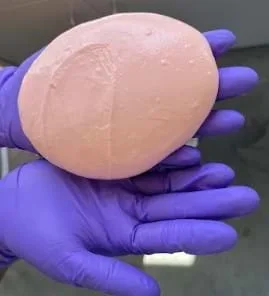 Students design slimeCopyright Ester Abellon/Maricel Gavis
Students become materials engineers tasked with designing and optimizing a functional polymer-based material (i.e., slime) through systematic testing and iteration. They begin by making a control slime and collecting quantitative and qualitative data on key material properties, including stretch length, bounce height, and texture. Through repeated trials and averaging results, students analyze variability and identify relationships between composition and performance. Students then apply this analysis in an engineering design challenge, where they select performance criteria and redesign their slime to meet specific functional requirements. They iterate based on experimental data, evaluate trade-offs between competing properties, and refine formulations accordingly to optimize material performance for a defined application.
Materials engineers focus on understanding and controlling how materials behave by linking structure at the molecular level to performance at the macroscopic level. In polymers, they study how long chains of molecules interact, how those chains are connected through processes such as cross-linking, and how these connections influence properties like strength, flexibility, and durability. Materials engineers are also developing more sustainable alternatives to traditional plastics, including packaging materials made from natural polymers such as casein (a protein found in milk), which can break down more easily in the environment. Just like in the slime investigation, they test how new materials form and evaluate properties such as strength, flexibility, and durability. By studying slime, students practice the same kinds of observations and data-driven decisions engineers use to design safer, more sustainable materials for real-world problems.
After this activity, students should be able to:
- Model the structure of matter by explaining how glue polymers and borax interact at the molecular level to form a new substance.
- Gather and analyze data on the physical properties of slime, such as bounciness, stretchiness, and texture, and relate them to the proportions of materials used.
- Identify and explain evidence of a chemical reaction by observing how the mixture changes from a liquid to a stretchy, solid-like material with new properties.
- 6.SP.5 Summarize numerical data sets in relation to their context, such as by:
Grade 6
Do you agree with this alignment? - 7.RP.2 Recognize and represent proportional relationships between quantities:
Grade 7
Do you agree with this alignment?
- MS-ETS1-2 Evaluate competing design solutions using a systematic process to determine how well they meet the criteria and constraints of the problem.
Grades 6-8
This resource focuses on the following Three Dimensional Learning aspects of NGSS:
Science & Engineering Practices- Evaluate competing design solutions based on jointly developed and agreed-upon design criteria.Do you agree with this alignment?
Disciplinary Core Ideas- There are systematic processes for evaluating solutions with respect to how well they meet the criteria and constraints of a problem.Do you agree with this alignment?
Do you agree with this alignment? - Evaluate competing design solutions based on jointly developed and agreed-upon design criteria.
- MS-PS1-1 Develop models to describe the atomic composition of simple molecules and extended structures.
Grades 6-8
This resource focuses on the following Three Dimensional Learning aspects of NGSS:
Science & Engineering Practices- Develop a model to predict and/or describe phenomena.Do you agree with this alignment?
Disciplinary Core Ideas- Substances are made from different types of atoms, which combine with one another in various ways. Atoms form molecules that range in size from two to thousands of atoms.Do you agree with this alignment?
- Solids may be formed from molecules, or they may be extended structures with repeating subunitsDo you agree with this alignment?
Crosscutting Concepts- Time, space, and energy phenomena can be observed at various scales using models to study systems that are too large or too small.Do you agree with this alignment?
Do you agree with this alignment? - Develop a model to predict and/or describe phenomena.
- MS-PS1-3 Gather and make sense of information to describe that synthetic materials come from natural resources and impact society.
Grades 6-8
This resource focuses on the following Three Dimensional Learning aspects of NGSS:
Science & Engineering Practices- Gather, read, and synthesize information from multiple appropriate sources and assess the credibility, accuracy, and possible bias of each publication and methods used, and describe how they are supported or not supported by evidence.Do you agree with this alignment?
Disciplinary Core Ideas- Each pure substance has characteristic physical and chemical properties (for any bulk quantity under given conditions) that can be used to identify it.Do you agree with this alignment?
- Substances react chemically in characteristic ways. In a chemical process, the atoms that make up the original substances are regrouped into different molecules, and these new substances have different properties from those of the reactants.Do you agree with this alignment?
Crosscutting Concepts- Structures can be designed to serve particular functions by taking into account properties of different materials, and how materials can be shaped and used.Do you agree with this alignment?
- Engineering advances have led to important discoveries in virtually every field of science, and scientific discoveries have led to the development of entire industries and engineered systems.Do you agree with this alignment?
- The uses of technologies and any limitations on their use are driven by individual or societal needs, desires, and values; by the findings of scientific research; and by differences in such factors as climate, natural resources, and economic conditions. Thus technology use varies from region to region and over time.Do you agree with this alignment?
Do you agree with this alignment? - Gather, read, and synthesize information from multiple appropriate sources and assess the credibility, accuracy, and possible bias of each publication and methods used, and describe how they are supported or not supported by evidence.
- MS-PS1-4 Develop a model that predicts and describes changes in particle motion, temperature, and state of a pure substance when thermal energy is added or removed.
Grades 6-8
This resource focuses on the following Three Dimensional Learning aspects of NGSS:
Science & Engineering Practices- Develop a model to predict and/or describe phenomena.Do you agree with this alignment?
Disciplinary Core Ideas- Gases and liquids are made of molecules or inert atoms that are moving about relative to each other.Do you agree with this alignment?
- In a liquid, the molecules are constantly in contact with others; in a gas, they are widely spaced except when they happen to collide. In a solid, atoms are closely spaced and may vibrate in position but do not change relative locations.Do you agree with this alignment?
- The changes of state that occur with variations in temperature or pressure can be described and predicted using these models of matter.Do you agree with this alignment?
- The term "heat" as used in everyday language refers both to thermal energy (the motion of atoms or molecules within a substance) and the transfer of that thermal energy from one object to another. In science, heat is used only for this second meaning; it refers to the energy transferred due to the temperature difference between two objects.Do you agree with this alignment?
- The temperature of a system is proportional to the average internal kinetic energy and potential energy per atom or molecule (whichever is the appropriate building block for the system's material). The details of that relationship depend on the type of atom or molecule and the interactions among the atoms in the material. Temperature is not a direct measure of a system's total thermal energy. The total thermal energy (sometimes called the total internal energy) of a system depends jointly on the temperature, the total number of atoms in the system, and the state of the material.Do you agree with this alignment?
Crosscutting Concepts- Cause and effect relationships may be used to predict phenomena in natural or designed systems.Do you agree with this alignment?
Do you agree with this alignment? - Develop a model to predict and/or describe phenomena.
Each group needs:
- 1 digital scale (accurate to 0.1 g)
- 1 250 mL graduated cylinder or measuring cup
- 1 mixing bowl/cup (approximately 500 mL capacity)
- 1 stirring stick (wooden craft sticks work well)
- 50 mL white school glue (to mix with glue)
- 50 mL warm water
- 2 g borax powder (sodium borate)
- 60 mL warm water (to dissolve borax, where the concentration of the borax solution is 3.33% m/v)
- (optional) food coloring or glitter for customizing slime
- 1 metric ruler or tape measure (up to 30 cm)
- paper towels
- resealable container for storage
For the entire class to share:
- 1 laptop or tablet and projector with access to the internet (to show YouTube videos)
- poster paper and markers – for designing or illustrating their slime formulas and results
- paper towels or wipes for cleanup
- plastic containers or resealable bags to store slime
- (optional) a digital thermometer, if measuring temperature changes is part of the extension
- Worksheet for LSEN (Learners with Special Educational Needs) (docx)
- Worksheet for LSEN (Learners with Special Educational Needs) (pdf)
- Worksheet for LSEN Answer Key (docx)
- Worksheet for LSEN Answer Key (pdf)
- Slime Data Sheet (docx)
- Slime Data Sheet (pdf)
- Slime Data Sheet with Accommodation (docx)
- Slime Data Sheet with Accommodation (pdf)
- Reflections Questions (docx)
- Reflection Questions (pdf)
- Reflections Questions Answer Key (docx)
- Reflection Questions Answer Key (pdf)
- Reflections Questions with Accommodation (docx)
- Reflection Questions with Accommodation (pdf)
- Reflections Questions with Accommodation Answer Key (docx)
- Reflection Questions with Accommodation Answer Key (pdf)
- Controlled Day Slime (docx)
- Controlled Day Slime (pdf)
- Activity Cards (docx)
- Activity Cards (pdf)
- Engineering Design Packet (docx)
- Engineering Design Packet (pdf)
Students should already have the following skills and knowledge:
- A basic understanding that all matter is made of particles too small to be seen (foundational concept in physical science).
- Familiarity with the states of matter (solid, liquid, gas) and how materials can change state.
- The ability to recognize and describe physical vs. chemical changes (e.g., changes in texture, color, or form).
- Basic measurement skills using milliliters (mL) and grams (g) with tools like graduated cylinders or digital scales.
- Understanding ratios and proportions to mix ingredients and experiment with different slime formulas (e.g., 2:1 glue-to-borax solution).
- Ability to calculate average (mean) from multiple trials (e.g., average bounce height or stretch length).
Good morning, engineers! Today, I am giving you a real-world challenge and it involves one of your favorite substances: slime! But we are not just going to play with slime. Today you are going to think and work like materials engineers.
A materials engineer is someone who designs and tests new materials used in everyday products. Materials engineers help create things like phone cases, athletic shoes, food wrappers, toys, and even medical devices. They test materials to see if they are strong enough, flexible enough, or safe enough for real-world use. (Write the word "materials engineer" on the board.)
Believe it or not, many companies use the same kinds of tests you will be doing today—checking how stretchy, sticky, or bouncy a material is—to decide whether it will work in a product.
Before we begin, let’s talk about an environmental problem scientists are studying: microplastics. Microplastics are tiny pieces of plastic smaller than 5 millimeters. Most plastics are made from materials called polymers, which are long chains of repeating molecules. These polymer-based materials come from larger plastic items like bags, bottles, and synthetic clothing fragmenting over time. These tiny plastic fragments are now found in oceans, rivers, soil, and even our food. One major problem is that many synthetic polymers do not biodegrade easily. Instead, they can persist in the environment for hundreds of years and gradually break into smaller and smaller fragments. Scientists and engineers are studying polymers and other materials to design safer alternatives for the future.
Today, we will explore how materials behave by studying something that forms when two substances mix together—slime. This connects directly to what we just discussed about microplastics and polymers. Slime is a model of a polymer material, and many real-world plastics are also polymers. Engineers design these materials by controlling their properties, such as stretchiness, strength, and durability, depending on what the material needs to do. In real-world applications, those same design choices can affect how long plastics last and how they break down into smaller fragments, including microplastics. By studying how slime behaves, we are learning how engineers think about designing, testing, and improving materials.
Your mission for this activity is to design the best possible slime for a specific product application. It might be a toy, a stress-relief material, or even a material used for packaging. To do this, you will experiment with different amounts of glue and borax or contact lens solution. As you change the amounts, you will observe how the properties of the slime change.
(Write on board: Design a slime with the best combination of stretch, bounce, and texture.)
Before we begin, let’s think about a few questions. Have you ever made slime at home? What did you like or dislike about it? (Allow students to share. Possible answers: too sticky, not stretchy enough, dried out quickly.)
Let’s think more about slime. What is slime made of? (Sample answer: glue and something that makes it thicken, like borax.) What makes one slime better than another? (Sample answer: how stretchy, bouncy, or non-sticky it is.) What do you already know about how liquids turn into solids? (Sample answer: heating, cooling, or mixing can change things.)
Why do you think some slimes bounce, while others just melt in your hand? (Guide students toward thinking about ingredients and proportions.)
What everyday products do you think use stretchy or gooey materials like slime? (Possible answers: putty, glue, squishy toys, rubber bands, gummy candy.)
If you were designing a toy or food wrapper, what qualities would you want in the material? Would you want it to be stretchy, strong, soft, flexible, or durable? (List student ideas on the board.)
All kinds of careers use materials science. Some of you might want to become chefs, designers, artists, mechanics, engineers, or scientists. All of those jobs involve understanding how materials behave. Even YouTubers and filmmakers think about materials—how something looks, sounds, or feels on camera. So, today’s activity is about more than slime. It is about learning how materials behave, how scientists test them, and how engineers design materials that help solve real-world problems.
Background
Polymers and Everyday Materials
Most modern materials that students interact with daily are made from polymers. Polymers are large molecules composed of long chains of repeating smaller units. These chains can be arranged and connected in different ways, which gives polymers a wide range of properties. Some polymers are rigid and strong (like hard plastics used in helmets), while others are flexible and stretchy (like rubber bands or soft packaging films). Because of this versatility, polymers are widely used in engineering design for products such as clothing fibers, medical devices, adhesives, packaging materials, and consumer goods.
Materials engineers study how changes at the molecular or structural level affect a material’s macroscopic properties. By adjusting factors such as molecular structure, cross-linking, or additives, engineers can design materials that meet specific performance requirements like strength, elasticity, durability, or biodegradability.
Slime Chemistry and Polymer Cross-Linking
Slime provides a hands-on example of how polymer chemistry can change material properties. School glue contains polyvinyl acetate (PVA), a polymer made of long chains of repeating molecules. In its original form, these polymer chains can slide past one another, allowing the glue to behave like a viscous liquid.
When a cross-linking agent is added, the structure of the polymer changes. Borax (sodium borate), when dissolved in water, acts as a cross-linker—it connects the polymer chains together, forming a network. This cross-linking transforms the material from a liquid-like substance into a stretchy, semi-solid material with very different physical properties.
A similar effect occurs when other additives are used, such as cornstarch, baking soda, or multi-purpose contact lens solutions (which often contain borate compounds or similar buffering agents). In each case, the added substance interacts with the polymer chains in glue, altering how they move and connect.
This change is evidence of a chemical reaction because a new material with different physical properties is formed. The resulting slime behaves as a viscoelastic material—it has both liquid-like and solid-like characteristics, depending on how force is applied.
Microplastics and Environmental Impact
Microplastics are plastic particles smaller than 5 millimeters that are now found throughout natural environments, including oceans, freshwater systems, soil, and even the food chain. Most microplastics originate from larger plastic items that gradually break down through physical, chemical, and environmental processes such as sunlight exposure, friction, and weathering. Because most plastics are synthetic polymers, they do not biodegrade easily. Instead, they persist in the environment for long periods and fragment into progressively smaller pieces over time.
Microplastics are an important real-world example of how material design decisions have long-term consequences. Plastics are often engineered for durability, but that same durability contributes to environmental persistence. Engineers and scientists are actively researching new polymer systems, recycling methods, and biodegradable alternatives to reduce microplastic pollution while still meeting performance needs in consumer and industrial products.
Slime as a Model for Materials Engineering
Slime provides a simple, hands-on model of how polymer materials behave and how materials engineers think about design. By adjusting the ratio of ingredients, students directly change the degree of cross-linking in the polymer network, which alters properties such as stretchiness, stickiness, and bounce. This mirrors how materials engineers modify polymers in real-world applications by controlling composition and structure to achieve desired performance characteristics.
Through this activity, students experience a simplified version of the engineering design process: They define desired material properties, test different formulations, collect observational data, and iterate on their design. Although slime is not an industrial material, it serves as an effective analog for understanding how engineers design, test, and refine materials to meet functional requirements in real-world products.
Before the Activity
- Gather all necessary materials for each student group (see Materials List below).
- Prepare a borax solution ahead of time (2 g of borax in 60 mL of warm water per group).
- Make copies of the Slime Data Sheet (PDF)and Reflection Questions (PDF)(1 per student).
- Set up group lab stations with labeled tools.
- Recommended: Test the glue and borax mixture ahead of time to ensure ideal results.
- Optional: Prepare a short video or visual explanation of polymers and cross-linking
- Set expectations for cleanup and safe slime handling.
During the Activity
Day 1 (90 minutes)
Introduction and Motivation (10 minutes)
- Greet students and introduce the activity as a hands-on materials engineering challenge.
- Share examples of real-world materials that stretch, bounce, or stick (e.g., toys, packaging, adhesives, and even food).
- Ask discussion questions to connect to student experiences:
- Have you ever made slime?
- What makes good slime? What makes bad slime?
- What real-life products rely on similar materials?
- Explain that in this activity, they will act like engineers by creating the best slime for a specific product or purpose.
- Introduce molecular-level concept: Explain that glue is made of long chains of molecules called polymers, and borax works like a “connector” that links these chains together. This changes the material from a liquid into a stretchy, solid-like substance with new properties.
- Show the short video Polyvinyl Alcohol (PVA) Slime! (2:41 minutes) to introduce the science of slime and polymers.
Mixing and Testing Control Slime (35 minutes)
- Distribute one Controlled Day Slime Worksheet (PDF) to each student.
- Explain that students will first create a control slime using a standard recipe. Note: This will allow them to compare results later when they change ingredient ratios.
- Divide class into groups of 2–3 students.
- Distribute materials to each group.
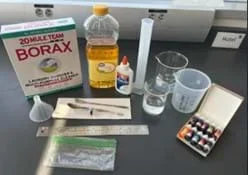 Basic materials needed for the activity.
- Follow the instructions on the Controlled Day Slime Worksheet (PDF):
- Instruct each group to mix 50 mL of glue with 50 mL of water in a bowl (a 1:1 ratio) and stir until completely blended. (This is the glue solution.)
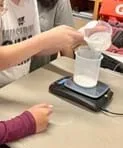 Students measuring glue on the weight scale.Copyright Ester Abellon/Maricel Gavis
- In a separate container, have students dissolve 2 g of borax into 60 mL of warm water to create a 3.33% borax solution. Note: This is a 1:30 ratio of borax to water by mass to volume. (This is the borax solution.)
- Ensure students slowly add 15 mL of the borax solution to the glue mixture while stirring constantly.
- Instruct students to continue to add the borax solution in 5–10 mL increments, stirring after each addition, until the slime thickens and begins to pull away from the bowl.
- During mixing, prompt students to observe how the material changes from a liquid to a gel-like substance and then to a stretchy solid. Emphasize that this change is evidence of a chemical reaction involving polymer chains linking together through cross-linking at the molecular level.
Controlled Slime (3.33% borax solution)Copyright Ester Abellon/Maricel Gavis
- Once thickened, have students remove the slime from the bowl and knead it by hand for 2–3 minutes.
- Once each group has their control slime sample, instruct them to test the following properties:
- Bounce Test: Students drop the slime from 30 cm and measure bounce height. Repeat 5 times and calculate the average.
- Stretch Test: Students stretch the slime and measure the maximum length before breaking. Repeat 5 times and calculate the average.
- Remind students to record all their results in their Controlled Day Slime Worksheet (PDF).
Data Analysis and Reflection (20 minutes)
- Ask students to compare their results to other groups.
- Facilitate group discussion using prompts:
- “Which mixture produced the best bounce?”
- “How did the ratio of glue to borax affect the stretchiness?”
- “What would you change in your next testing?”
- Guide students in constructing an explanation using evidence from their data, connecting how the interaction between glue polymers and borax led to changes in material properties such as stretchiness, firmness, and bounce.
- Give students time to complete the reflection questions in the Controlled Day Slime Worksheet (PDF).
- As a class, review the key takeaways: What did we learn about how the ratio of borax to glue affects slime properties? (Possible answers: More borax = stiffer slime; less borax = stickier slime.)
Introduce the Engineering Design Challenge (10 minutes)
- Introduce the challenge: Students will choose one of six Slime Design Activity Cards (PDF) and then use the engineering design process to design a slime that satisfies the card’s requirements. (Essentially, students will modify slime ingredient ratios and then test for targeted slime properties such as stretch, bounce, smoothness, or color.)
- Emphasize that real engineers do not just try to make materials better. They design materials for specific jobs, and every improvement involves trade-offs between properties like strength, flexibility, texture, and appearance.
- Optional: Review the engineering design process.
- Display or distribute the six Slime Activity Cards (PDF). Note: Each group only chooses ONE card.
- Distribute one Engineering Design Packet (PDF) to each student.
Ask, Research and Imagine (15 minutes)
- Instruct each group to complete the Ask section of the Engineering Design Packet (PDF).
- Emphasize that engineers clearly define a problem before designing a solution.
- A strong problem statement includes both measurable criteria and a clear user or real-world purpose (e.g., who the slime is for or how it will be used).
- Instruct each group to complete the Research section of the Engineering Design Packet (PDF). Note: Students use their Day 1 control slime investigation and results as evidence to inform their design decisions.
- Once the Ask and Research sections are complete, instruct students to individually brainstorm at least FOUR ideas/ways of how they would create their designer slime using the provided materials in the Imagine section of their packet. Optionally this can be assigned as homework.
Day 2: Designer Slime Activity (90 minutes)
Plan, Create, Test and Improve (45 minutes)
- Optional: Review the key takeaways from their original slime research (i.e., What did we learn about how the ratio of borax to glue affects slime properties?) Make sure students understand that more borax = stiffer slime and less borax = stickier slime.
- Ask students to revisit their brainstormed ideas and, as a group, choose one design idea and develop a plan in their Engineering Design Packet (PDF), making sure to include the following:
- New glue-to-water ratio
- New borax solution amount
- Predicted outcome (What do they expect to change? Why?)
- Guide students through the slime-making process, following the same procedure as Day 1 to ensure consistency and fair testing:
- Mix glue and water.
- Add borax solution in small amounts.
- Knead until desired texture is achieved.
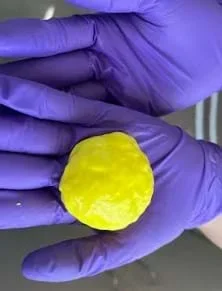 Controlled Slime (Accommodation) (10 g contact lens solution)Copyright Ester Abellon/Maricel Gavis
- Prompt each group to test their designer slime and evaluate it based on their card objective:
- Stretch test: Measure how far it stretches before breaking.
- Bounce test: Drop from 30 cm and measure height.
- Texture: Rate using descriptors (smooth, sticky, rubbery).
- (optional) Color: Evaluate visual design and record any observations about how additives (if used) affect material behavior
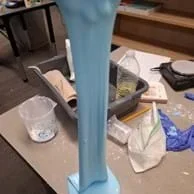 Students measure how far their slime can stretch.Copyright Ester Abellon/Maricel Gavis
- Remind students to record the following:
- Ingredient amounts
- Test results
- Observations
- Guide students to answer the questions in the Test section of their Engineering Design Packet (PDF). Include what changes they would make in the next iteration and why (based on evidence).
- Optional: Give groups time to modify and improve their designer slime recipe. Encourage at least one iteration, if time allows, to reinforce the engineering design cycle.
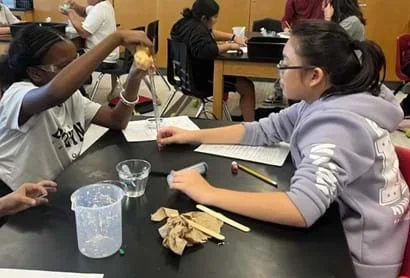 Students measure how high their controlled slime can bounce.Copyright Ester Abellon/Maricel Gavis
Reflection (15 minutes)
- Lead a class reflection using questions like:
- Which slime met your goal the best?
- What did you change from yesterday, and did it help?
- If you were selling your slime as a product, how would you market it?
- Ask students to connect their design choices back to molecular structure, explaining how changing borax or glue ratios affects polymer cross-linking density and therefore material behavior such as elasticity and firmness.
- Distribute one Reflection Questions Worksheet (PDF)to each student.
- Give students time to complete the reflection questions.
Communicate Results (30 minutes)
- Have each group present their slime, sharing the following:
- Their design goal
- What worked/did not work
- One thing they would improve next time
- bounciness
- A measure of a material’s ability to rebound—i.e., convert stored energy during impact back into kinetic energy, rather than dissipating it.
- reaction
- A process whereby one or more substances, called reactants, are converted into different substances, called products, through the breaking and formation of chemical bonds.
- cross-link
- A bond or connection that links one polymer chain to another, creating a network of polymers rather than individual strands.
- elasticity
- The ability of a material to deform under stress and then fully return to its original shape and size once the stress is removed.
- viscosity
- A measure of a fluid's "thickness" or its resistance to flowing freely.
Pre-Activity Assessment
Discussion Prompt (Whole Class or Think-Pair-Share): To activate prior knowledge about materials, properties, and chemical change, ask students the following questions:
- What is slime made of? (Sample answer: glue and something that makes it thicken, like borax.)
- What makes one slime better than another? (Sample answer: how stretchy, bouncy, or non-sticky it is.)
- What do you already know about how liquids turn into solids? (Sample answer: heating, cooling, or mixing can change things.)
Activity Embedded (Formative) Assessment
Controlled Day Slime Worksheet: Students record amounts of glue, borax solution, and results for bounce, stretch and viscous in the Controlled Day Slime Worksheet (PDF). While students work, check for the following:
- Correct units (mL, g, cm)
- Clear, accurate observations
- Adjustments made and reasons why (design iteration)
Circulating Questions: Circulate during the activity and prompt groups with the following questions:
- Why do you think your slime is breaking or too sticky? (Possible answer: too much glue and not enough borax / the polymers did not link well.)
- What did you change in your second trial? Why? (Possible answer: Added more borax to make it less sticky.)
- How does this connect to real-life materials or products? (Possible answer: food wrappers, toys, gel products.)
Mini Check-In (Mid-Activity): Midway through the activity, ask each group to rate their slime’s performance so far (1–5 scale), justify their rating using one observation, and describe what they would try differently.
Post-Activity (Summative) Assessment
Reflection Questions: Students answer the questions in the Reflection Questions Worksheet (PDF) and you then review their answers to evaluate their understanding of key science and engineering concepts, ability to analyze data, and reflection on the design process.
Exit Ticket (Quick Assessment): Sample Prompt: Explain or model what happens at the molecular level when borax is added to glue and how this changes the material’s properties. (Answer: The glue polymers are connected together by the borax, forming a new stretchy substance.)
(Optional) Poster Presentation or Written Report: Each group summarizes:
- Their goal.
- What formula they used.
- What tests they conducted.
- What they learned or would change
Borax
- Do not eat or taste; it is a chemical and can be harmful if swallowed.
- Avoid contact with eyes and prolonged contact with skin, as it may cause irritation.
- Wash hands immediately after handling.
Glue (School/White Glue)
- Safe to touch, but do not eat or place near the mouth.
- Avoid contact with eyes.
- Wash hands after use.
Contact Lens Solution (contains boric acid)
- Do not spray or squirt at others.
- Use only the amount directed by the teacher.
- In the event of eye or skin irritation, notify the teacher immediately.
General Safety Rules
- Always follow teacher instructions carefully.
- Wear gloves and/or safety goggles if instructed.
- Keep your workspace clean and organized.
- Wash hands thoroughly after the activity.
- Report immediately to an adult if any material gets in eyes or mouth, or if you feel unwell.
For students who need more challenges or faster pacing:
- Add a viscosity observation: Students evaluate viscosity using a descriptive scale (Low / Medium / High).
- Require multi-variable testing, where students intentionally change more than one ratio (e.g., glue + borax AND temperature or mixing time) and analyze interactions between variables.
- Introduce quantitative engineering targets, such as “design a slime with ≥40 cm stretch and ≥10 cm bounce height.”
- Require graphing data (e.g., borax concentration vs. stretch length or bounce height).
- Have students calculate percentage change between control and redesigned slime properties.
- Require a formal engineering report or product pitch, including claims supported by data.
For students who need additional structure or reduced cognitive load:
- Provide a pre-measured recipe with limited decision points (students adjust only one variable, such as borax amount).
- Use guided data tables with sentence starters (e.g., “My slime stretched ___ cm.”).
- Reduce trials to 1–2 tests instead of 5 or provide class average data.
- Allow oral responses or drawing-based reflections instead of written explanations.
- Pair students in structured roles (e.g., mixer, measurer, recorder) to reduce processing load.
For students with exceptional needs, have students focus on the following:
- Explaining how glue and contact lens solutions join and form a new substance.
- Measuring and comparing how slime stretches, bounces, and flows.
- Explaining how the mixture changes from liquid to elastic, bouncy, and viscous solid.
- Completing the following worksheets:
- Worksheet for LSEN (Learners with Special Educational Needs)
- Slime Data Sheet with Accommodation
- Reflections Questions with Accommodation
Contributors
Esther Abellon; Maricel Gavis; Dr. Alan Allgeier; Dr. Prajna Dhar; Dr. Meagan Patterson; Dr. Massa Mafi; Dr. Douglas Huffman; Ms. Esraa Abdallah Abdelsalam; Ms. Tarannom Salehi
Supporting Program
Research Experience for Teachers (RET), University of Kansas
Acknowledgements
This material is based upon work supported by the National Science Foundation under grant no. ECC-2055716 - a Research Experience for Teachers program titled Inquiry-Driven Engineering Activities using Bioengineering (IDEA-BioE) at the University of Kansas. Any opinions, findings and conclusions or recommendations expressed in this material are those of the author(s) and do not necessarily reflect the views of the National Science Foundation.
We would like to extend our deepest gratitude to the individuals and teams whose dedication, vision, and hard work have been instrumental in elevating this program to its current level of excellence. Thank you to all the people whose strategic guidance, mission-setting, and rigorous oversight provided the cohesive vision driving our program’s success. To our mentor, our heartfelt gratitude for creative thinking, experimental rigor, and perseverance that turned challenging ideas into concrete results. Furthermore, we would also like to express our sincere appreciation to all those who generously contributed their ideas, insights, and thoughtful feedback throughout this research journey, significantly shaping its direction and success.
Copyright
2026 by Regents of the University of Colorado; original © 2025 University of Kansas