
Clustering and Exploring the Periodic Table of Elements
 Students sort LEGO pieces.Copyright A photo showing students’ arms and hands as they are grouping different types of LEGO pieces.
Students explore the periodic table of elements and connect it to the concept of clustering in machine learning. Students create their own clustering system for the elements based on various criteria, such as atomic mass, reactivity, and state at room temperature. They justify their element groupings and engage in discussions to compare and contrast different clustering systems. By analyzing the patterns and trends within the periodic table, students develop a deeper understanding of the properties and organization of elements, while also gaining insight into data analysis, classification, material properties, and collaboration, all of which have connections to engineering.
The ability to organize data into meaningful groups can be an important first step in understanding a problem. This is a strategy that engineers can use when they apply design thinking to solve problems. In this activity, students explore clustering using LEGO pieces and elements from the periodic table of elements.
After this activity, students should be able to:
- Understand the concept of clustering in machine learning.
- Apply clustering techniques to group elements based on their properties.
- Create rules to explain the rationale behind their chosen element clusters.
- Recognize the organizational patterns and trends in the periodic table of elements.
- Analyze the reasons for grouping elements together in specific regions of the periodic table.
- HS-PS1-1 Use the periodic table as a model to predict the relative properties of elements based on the patterns of electrons in the outermost energy level of atoms.
Grades 9-12
Do you agree with this alignment? - HS-PS1-2 Construct and revise an explanation for the outcome of a simple chemical reaction based on the outermost electron states of atoms, trends in the periodic table, and knowledge of the patterns of chemical properties.
Grades 9-12
Do you agree with this alignment? - HS-PS1-3 Plan and conduct an investigation to gather evidence to compare the structure of substances at the bulk scale to infer the strength of electrical forces between particles.
Grades 9-12
Do you agree with this alignment?
- HS-PS1-1 Use the periodic table as a model to predict the relative properties of elements based on the patterns of electrons in the outermost energy level of atoms.
Grades 9-12
This resource focuses on the following Three Dimensional Learning aspects of NGSS:
Science & Engineering Practices- Use a model to predict the relationships between systems or between components of a system.Do you agree with this alignment?
Disciplinary Core Ideas- Each atom has a charged substructure consisting of a nucleus, which is made of protons and neutrons, surrounded by electrons.Do you agree with this alignment?
- The periodic table orders elements horizontally by the number of protons in the atom's nucleus and places those with similar chemical properties in columns. The repeating patterns of this table reflect patterns of outer electron states.Do you agree with this alignment?
Crosscutting Concepts- Different patterns may be observed at each of the scales at which a system is studied and can provide evidence for causality in explanations of phenomena.Do you agree with this alignment?
Do you agree with this alignment? - Use a model to predict the relationships between systems or between components of a system.
- HS-PS1-2 Construct and revise an explanation for the outcome of a simple chemical reaction based on the outermost electron states of atoms, trends in the periodic table, and knowledge of the patterns of chemical properties.
Grades 9-12
This resource focuses on the following Three Dimensional Learning aspects of NGSS:
Science & Engineering Practices- Construct and revise an explanation based on valid and reliable evidence obtained from a variety of sources (including students' own investigations, models, theories, simulations, peer review) and the assumption that theories and laws that describe the natural world operate today as they did in the past and will continue to do so in the future.Do you agree with this alignment?
Disciplinary Core Ideas- The periodic table orders elements horizontally by the number of protons in the atom's nucleus and places those with similar chemical properties in columns. The repeating patterns of this table reflect patterns of outer electron states.Do you agree with this alignment?
- The fact that atoms are conserved, together with knowledge of the chemical properties of the elements involved, can be used to describe and predict chemical reactions.Do you agree with this alignment?
Crosscutting Concepts- Different patterns may be observed at each of the scales at which a system is studied and can provide evidence for causality in explanations of phenomena.Do you agree with this alignment?
Do you agree with this alignment? - Construct and revise an explanation based on valid and reliable evidence obtained from a variety of sources (including students' own investigations, models, theories, simulations, peer review) and the assumption that theories and laws that describe the natural world operate today as they did in the past and will continue to do so in the future.
- HS-PS1-3 Plan and conduct an investigation to gather evidence to compare the structure of substances at the bulk scale to infer the strength of electrical forces between particles.
Grades 9-12
This resource focuses on the following Three Dimensional Learning aspects of NGSS:
Science & Engineering Practices- Plan and conduct an investigation individually and collaboratively to produce data to serve as the basis for evidence, and in the design: decide on types, how much, and accuracy of data needed to produce reliable measurements and consider limitations on the precision of the data (e.g., number of trials, cost, risk, time), and refine the design accordingly.Do you agree with this alignment?
Disciplinary Core Ideas- The structure and interactions of matter at the bulk scale are determined by electrical forces within and between atoms.Do you agree with this alignment?
Crosscutting Concepts- Different patterns may be observed at each of the scales at which a system is studied and can provide evidence for causality in explanations of phenomena.Do you agree with this alignment?
Do you agree with this alignment? - Plan and conduct an investigation individually and collaboratively to produce data to serve as the basis for evidence, and in the design: decide on types, how much, and accuracy of data needed to produce reliable measurements and consider limitations on the precision of the data (e.g., number of trials, cost, risk, time), and refine the design accordingly.
Each group needs:
- LEGO pieces (about 80-100 per group, all sizes/shapes)
- periodic table (one per group; can be printouts, in a textbook, or projected on the wall)
- large poster board (or space on the classroom wall)
- Clustering Criteria Handout (PDF)
For the entire class to share:
- index cards/sticky notes
- markers/pens
Familiarity with the concept of elements and grouping of similar/dissimilar items.
Think about your brain—it’s like a detective, always on the lookout for patterns. Whether it’s recognizing a melody or spotting shapes in the clouds, humans have a knack for noticing things that repeat and grouping things together. This isn’t a random coincidence; it’s an important part of understanding how the world works.
Being able to describe patterns is important in scientific, computational, and engineering thinking. A major component to that involves sorting, classifying, and clustering—key components of machine learning and Big Data. What patterns can we find when we sort objects in different ways? Today, we will explore this using LEGO pieces and the periodic table.
First, we’ll explore clustering using LEGO pieces. When creating groups of pieces, there are no right or wrong answers, a hallmark of machine learning clustering. Then, we’ll move on to exploring sorting and clustering with the elements of the periodic table.
Background
Overview
As educators, we know that being able to find and describe patterns allows students to become more proficient in scientific, computational, and engineering thinking. A major component to that involves sorting, classifying, and clustering—key components of machine learning and Big Data. As teachers, we can pose the following question to our students to help drive this home: What patterns can we find when we sort objects in different ways? The question can be approached through an almost infinite variety of activities; this lesson focuses on two—LEGO pieces and the periodic table.
How can we improve our students’ ability to recognize and, more important, define patterns? Being able to explain the criteria behind a particular set of clusters is a large part of communicating in science, which should be one of our main goals as teachers: to get students ready to communicate not only what they know, but also how they know it, to others. This lesson serves as a training ground to improve those communication skills in explaining the reasons behind sorting decisions. It’s more than just putting things in groups; it’s about understanding the rules that govern those sorting decisions.
This lesson provides two opportunities to hone those skills in students. In the first, the lesson takes advantage of the ubiquity of LEGO bricks to provide a familiar playground to create those groups—without right or wrong answers, a hallmark of machine learning clustering. In the second, students switch gears to a more “classroom-content” focused activity that allows them to explore the elements of the periodic table, again without right or wrong answers.
Clustering and Machine Learning
Clustering is the process of grouping similar items or data points together based on shared characteristics or criteria, allowing for organization and analysis. Cluster analysis is a common task in machine learning. The program analyzes given data and sorts objects. There are many ways to cluster items. Clustering can be used as a first step in understanding a data set. It can also be used to identify patterns and relationships in data, thus allowing one to predict where a new piece of data might fit based on how its characteristics match those in existing groups.
The periodic table of elements is an example of clustering data. An element’s place in a row or column is determined by characteristics such as its size and chemical properties. Elements are also arranged into blocks, which show the location of their valence electrons. Dmitri Mendeleev looked at the characteristics of the known elements and grouped them to create a draft of the periodic table in 1869. Mendeleev used the clusters of elements to predict unknown elements, which were later discovered and found to have characteristics very similar to his predictions.
Most of the skills of computational thinking are explicitly discussed with the students throughout the walk-around/monitoring section of the activity, and again at the end during the whole-group discussion. The goal of the lesson is to start them working with the periodic table not as a declaration from on high, but as a method to organize patterns in the properties of elements.
Before the Activity
- Gather materials.
- Create piles of 80-100 LEGO pieces for student groups. Optional: Place LEGO pieces in small bags for ease of distribution to groups.
- Review vocabulary for the activity.
- Clustering – The process of grouping similar items or data points together based on shared characteristics or criteria, allowing for organization and analysis.
- Periodicity – The property of recurring patterns or trends in the periodic table, where elements exhibit similar behaviors or properties at regular intervals.
- Classification – The act of categorizing items or data into groups or classes based on shared characteristics or attributes.
- Subjectivity – The quality of being influenced by personal opinions, interpretations, or perspectives, rather than being solely objective or based on concrete facts.
During the Activity
- Introduction (5 minutes)
- Engage students by discussing the concept of clustering in machine learning and its purpose in grouping similar data points.
- Relate the concept of clustering to the organization of the periodic table of elements, highlighting that elements are grouped based on similarities in properties.
- Explain that clustering elements is subjective, with different criteria resulting in different groupings.
- Clustering Activity Part 1 (15 minutes)
- Divide students into groups of 3 or 4.
- Give each student group a variety of LEGO pieces (the more varied the better, approximately 80-100 pieces). Reserve at least 3-4 pieces for each group.
- Tell students to group the LEGO pieces. Be explicitly vague about what this entails and mention that there are few rules—a group needs to have more than one piece, there must be more than one group, and the students must be able to provide justification for why the pieces are grouped as they are. Students sort LEGO pieces.Copyright Steve Martell & Jessica Elliott, 2023
- When students have completed their groupings, give each student group the reserved pieces and ask them to place them into the existing groups, providing an explanation of each group’s criteria (this may be a full-group discussion).
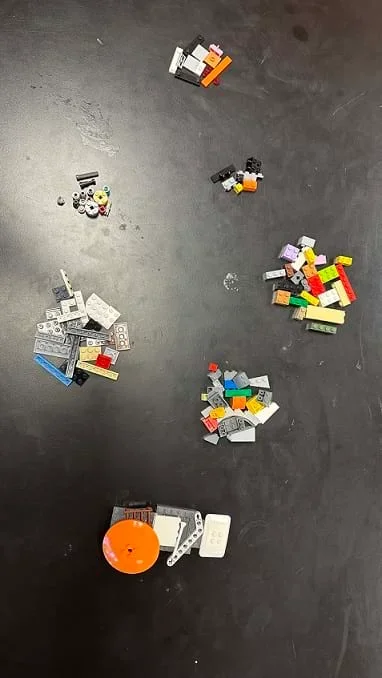 Sorted piles of LEGO pieces.Copyright Steve Martell & Jessica Elliott, 2023
- Clustering Activity Part 2 (15 minutes)
- Collect LEGO pieces from the groups.
- Provide each group with index cards or sticky notes and markers.
- Distribute the Clustering Criteria Handout (PDF) containing a list of element properties (e.g., atomic mass, reactivity, state at room temperature, etc.).
- Explain that each group will choose one or more criterion from the handout to create their own clustering system for the elements.
- Instruct students to write element names on individual index cards or sticky notes based on their chosen criteria.
- Allow groups to collaborate and place the index cards or sticky notes on a large poster board or classroom wall, forming clusters based on their criteria.
- Encourage students to explain the reasoning behind their element placement within clusters, emphasizing the importance of justifying their choices.
- Exploring the Periodic Table (10 minutes)
- Distribute printed periodic tables, or project one for the class to see.
- Instruct students to spend a few minutes examining the periodic table to become familiar with its layout and information.
- Facilitate a brief class discussion to ensure that students understand atomic number, symbol, and the organization of elements into periods and groups.
- Group Discussion (15 minutes)
- Conduct a class discussion, with each group presenting their clusters and explaining their rationale.
- Compare and contrast the clusters created by groups, and the machine learning model, and the actual organization of the periodic table.
- Wrap-Up and Reflection (10 minutes)
- Summarize the key points of the activity, highlighting that the periodic table organizes elements based on multiple properties and trends.
- Discuss the challenges and benefits of clustering elements using different criteria.
- Prompt students to reflect on what they learned about the periodic table, clustering, and the reasoning behind element grouping.
- Conclude by reinforcing the idea that the periodic table is a dynamic tool for understanding and predicting the properties of elements.
- clustering
- The process of grouping similar items or data points together based on shared characteristics or criteria, allowing for organization and analysis.
- periodicity
- The property of recurring patterns or trends in the periodic table, where elements exhibit similar behaviors or properties at regular intervals.
- classification
- The act of categorizing items or data into groups or classes based on shared characteristics or attributes.
- subjectivity
- The quality of being influenced by personal opinions, interpretations, or perspectives, rather than being solely objective or based on concrete facts. In the context of clustering elements, subjectivity refers to the fact that different individuals or groups may create different element groupings based on their own chosen criteria.
Pre-Activity Assessment
Vocab Review: Using hand signals (1-5 fingers, etc.), ask students about their familiarity with the terms in the vocabulary section, and clustering as a whole.
Activity Embedded (Formative) Assessment
Check-Ins: As students work, visit the groups and check in. Ask students to explain the reasoning behind the element placement within their clusters, emphasizing the importance of justifying their choices.
Post-Activity (Summative) Assessment
Written Reflection: Have students individually write up their reflections on what they learned about the periodic table, clustering, and the reasoning behind elemental grouping.
- Provide students with additional sets of clustering criteria and challenge them to create alternative clusterings for the elements.
- Have students research and present on specific element groups within the periodic table, explaining the scientific rationale behind their grouping.
- Have students explore real-life applications of clustering in chemistry and other scientific fields, discussing how it helps in data analysis and pattern recognition.
- Machine Learning Extension – Have students investigate how machine learning clusters anything, including images (e.g., optical character recognition [OCR] using digital pen displays and student writing samples).
“Cluster Analysis.” Wikipedia, Wikimedia Foundation, 22 June 2024, en.wikipedia.org/wiki/Cluster_analysis#. Accessed 10 July 2024.
“Periodic Table.” Wikipedia, Wikimedia Foundation, 21 June 2024, en.wikipedia.org/wiki/Periodic_table. Accessed 10 July 2024.
Contributors
Steve Martell (Henry County High School); Jessica Elliott (Henry County High School); Dr. Thomas Tretter (University of Louisville School of Education); Dr. Olfa Nasraoui (University of Louisville Speed School of Engineering)
Supporting Program
RET Site: Research Experiences for Teachers in Big Data and Data Science, University of Louisville
Acknowledgements
This curriculum was developed through University of Louisville School NSF RET in Big Data and Data Science program under grant number CNS-1801513 under National Science Foundation. However, these contents do not necessarily represent the policies of the NSF, and you should not assume endorsement by the federal government.
Copyright
2024 by Regents of the University of Colorado; original © 2023 University of Louisville