
Designing Musical Instruments Using Material Properties
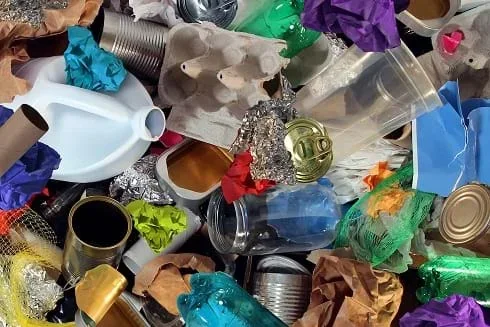 Ideas of what you can use for instrumentsCopyright 2021 Catherine Jones, University of Texas NASCENT RET
Students use recyclable materials to make musical instruments. Students learn the different states of matter and that matter has properties. They observe and classify recycled materials by size, color, material and any other property the students feel is important. As they observe the materials, students decide which materials would work best for instruments. Students use the engineering design process to create and build an instrument. Working with a small group, they collaborate, ask, imagine, plan, create, and test their instrument. As time allows, they also improve their instrument by thinking about what materials can be added or taken away to make their instrument sound and work better.
Scientists look at the physical properties of materials (matter) to classify them and determine their best use or purpose. Engineers use these materials to invent, design, and maintain a variety of materials and structures. Engineers use the engineering design process to create and make improvements in order to arrive at their end product. Determining the most suitable material for a project can mean the difference between success and failure.
After this activity, students should be able to:
- Describe the physical characteristics of matter.
- Sort matter into like groups based on their properties.
- Work through the engineering design process.
- Determine which materials work best for different instruments based on their properties.
- 2-PS1-1 Plan and conduct an investigation to describe and classify different kinds of materials by their observable properties.
Grade 2
This resource focuses on the following Three Dimensional Learning aspects of NGSS:
Science & Engineering Practices- Plan and conduct an investigation collaboratively to produce data to serve as the basis for evidence to answer a question.Do you agree with this alignment?
Disciplinary Core Ideas- Different kinds of matter exist and many of them can be either solid or liquid, depending on temperature. Matter can be described and classified by its observable properties.Do you agree with this alignment?
Crosscutting Concepts- Patterns in the natural and human designed world can be observed.Do you agree with this alignment?
Do you agree with this alignment? - Plan and conduct an investigation collaboratively to produce data to serve as the basis for evidence to answer a question.
- 2-PS1-2 Analyze data obtained from testing different materials to determine which materials have the properties that are best suited for an intended purpose.
Grade 2
This resource focuses on the following Three Dimensional Learning aspects of NGSS:
Science & Engineering Practices- Analyze data from tests of an object or tool to determine if it works as intended.Do you agree with this alignment?
Disciplinary Core Ideas- Different properties are suited to different purposes.Do you agree with this alignment?
Crosscutting Concepts- Simple tests can be designed to gather evidence to support or refute student ideas about causes.Do you agree with this alignment?
- Every human-made product is designed by applying some knowledge of the natural world and is built using materials derived from the natural world.Do you agree with this alignment?
Do you agree with this alignment? - Analyze data from tests of an object or tool to determine if it works as intended.
- 2-PS1-3 Make observations to construct an evidence-based account of how an object made of a small set of pieces can be disassembled and made into a new object.
Grade 2
This resource focuses on the following Three Dimensional Learning aspects of NGSS:
Science & Engineering Practices- Make observations (firsthand or from media) to construct an evidence-based account for natural phenomena.Do you agree with this alignment?
Disciplinary Core Ideas- Different properties are suited to different purposes.Do you agree with this alignment?
- A great variety of objects can be built up from a small set of pieces.Do you agree with this alignment?
Crosscutting Concepts- Objects may break into smaller pieces and be put together into larger pieces, or change shapes.Do you agree with this alignment?
Do you agree with this alignment? - Make observations (firsthand or from media) to construct an evidence-based account for natural phenomena.
- classify matter by physical properties, including shape, relative mass, relative temperature, texture, flexibility, and whether material is a solid or liquid;
Grade 2
Do you agree with this alignment? - demonstrate that things can be done to materials to change their physical properties such as cutting, folding, sanding, and melting; and
Grade 2
Do you agree with this alignment? - combine materials that when put together can do things that they cannot do by themselves such as building a tower or a bridge and justify the selection of those materials based on their physical properties.
Grade 2
Do you agree with this alignment?
Each group needs:
- recycled materials, such as cardboard boxes and tubes, string, plastic bottles and containers, bottle caps
- tape
- scissors
- rubber bands
- small items (10-15 per group) that students can sort such as pipe cleaners, papers, marbles, craft sticks, erasers
- paper bag (to hold the small items)
- Describing Properties Student Worksheet (PDF), EDP Student Worksheet (PDF), Idea Chart Worksheet (PDF)
For the teacher
- copy of Ada’s Violin (available on Amazon) or the Ada's Violin Read Aloud on YouTube
For the entire class to share:
- poster paper
- cardboard
- magic markers
- crayons
- craft sticks
- string
Did you know recycled materials can be altered or changed in some way to create sound? There are many countries where students do not have the money to purchase instruments for school or individual use. A solution that the students in Paraguay discovered was to take recycled materials and change them in different ways to make instruments. Once they decide which instrument they would like to make, they have to make some decisions. Which material would work best for that instrument? What parts will I take away or add to make my instrument work? These are decisions that engineers make when they are working on a project. Engineers test and study different materials to decide which material will work best for an item and be the most reliable.
In this activity, we are going to observe materials and classify them. We will determine what these materials have in common and decide how we could put them into groups that have similar properties.
We are then going to look at some different items and determine which ones we think work best for certain instruments and why. Is it the material that makes the difference? Is it the changes we make to the material? Is it because we added items to another item to make a change that would produce sound?
After we have sorted our materials and discovered their properties, we are going to be planning and constructing an instrument for our team. We will be following the Engineering Design Process to complete our instrument. You will brainstorm, plan, give feedback and revise your plan before completing the instrument.
Background
Matter is anything that has mass and takes up spaces. The clouds, the ocean, and the trees, it's all matter! There are three different states of matter: solid, liquid and gas. These states of matter have properties. Observable properties include color, flexibility, hardness, texture, and absorbency. Properties of small objects do not change when the pieces are combined with other objects.
If students need a refresher on matter, ask them these questions and discuss as a class:
- How does the shape of things help it do what it was made to do?
- How does the color of things help it do what it was made to do?
- Texture is used to describe how something feels. What words can be used to describe the texture of a material?
- How does the texture of a material help it do what it was made to do?
- What are other properties of matter? Why are they important?
Engineers use a model called the engineering design process to guide them through any project. We will be using this process to make our instruments.
Before the Activity
- Gather recycled materials. Start collecting recycled materials at least a month before the project; reach out to your community! Ideas of what you can use for instrumentsCopyright 2021 Catherine Jones, University of Texas NASCENT RET
- Gather various small items (e.g., pipe cleaners, paper, marbles, craft sticks, erasers), enough for each group to have 10-15 items. Place each group’s items into paper bags.
- Make copies of the Describing Properties Student Worksheet (PDF), EDP Student Worksheet (PDF), Idea Chart Worksheet (PDF).
- Get a copy of Ada’s Violin (available on Amazon) or the Ada's Violin Read Aloud on YouTube.
With the Students
Day 1
- Read Ada’s Violin (or Ada's Violin Read Aloud on YouTube) and show YouTube videos of Recycled Orchestra - https://www.youtube.com/watch?v=yYbORpgSmjg.
- Review prior knowledge of matter, properties of matter and ways to sort/classify matter.
- Divide students into groups of three.
Day 2
- Create a chart with descriptive words.
- Give students a paper bag with different, small items in it. They will observe the physical features of the items and record their findings on their Describing Properties Student Worksheet (PDF).
- Students will then sort their items in any way and will explain why they grouped those items together—what feature did they have in common?
- Have students re-sort their items by different physical characteristics by material type, size, and purpose.
- Then ask the question, “If you were told that you would be making an instrument out of these materials, would you change the way you sorted them?”
- Let students re-sort their items based on new information.
- Have students observe and record findings.
Day 3
- Introduce the engineering design process and talk through all the steps. Distribute the EDP Student Worksheet (PDF).
- Have a table with all the recycled materials on it that the students will have access to and additional supplies.
- Let students in each group start planning, designing, and collaborating.
- Remind students that they are restricted by time and materials, so they need to take that into account.
- Check that students are filling out the “Ask,” “Imagine,” and “Plan” sections of the EDP Student Worksheet (PDF).
Day 4
- Tell students that now it is time to create their designs!
- They will use this time to gather their materials and construct their instruments. Remind students to refer to the plans they made on the EDP Student Worksheet (PDF) to guide them.
- Students need to use caution when cutting materials as some items may be sharp; walk around and help students as needed.
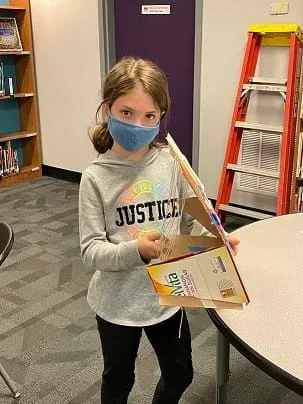 A student showing a harp made of cardboard and string.Copyright 2021 Catherine Jones, University of Texas NASCENT RET
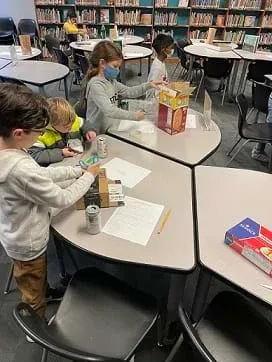 Students at work on their musical designs.Copyright An image of students working their plan using the recycled materials. Some students are cutting and some students are taping.
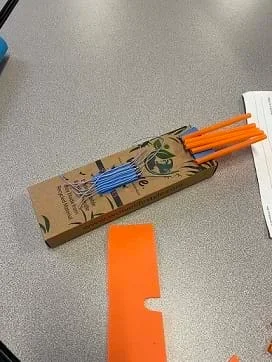 An example of a student-designed violin.Copyright 2021 Catherine Jones, University of Texas NASCENT RET
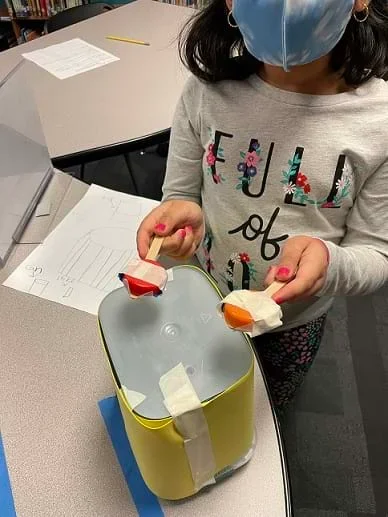 An example of student-designed drum.Copyright 2021 Catherine Jones, University of Texas NASCENT RET
Day 5
- Tell students that it is time to perform!
- Students will present their instrument, demonstrate how it works and share their process.
- If time allows, students can revise their plan, consider the advice, and improve their instrument. They will fill out the “Test” and “Improve” sections of the EDP Student Worksheet (PDF).
- classify
- To place items into different categories based on their features/properties.
- matter
- Anything that takes up space is call matter.
- property
- A characteristic of an object that can be observed, such as its size, shape, color or material.
- solid
- A type of matter that keeps its shape and has a definite volume.
Pre-Activity Assessment
Idea Chart: Draw the idea chart on the board. Have students use the Idea Chart Worksheet (PDF) and share out.
Have students brainstorm words that they could use to describe a solid. Create an anchor chart for these words.
Datasheet: Have students use the Describing Properties Student Worksheet (PDF)to record the properties of the items at their table.
Think and Sort: Have students identify some other characteristics of the items. Let them sort the items in any way they want. Listen to conversations.
Activity Embedded (Formative) Assessment
Handout: Have students work together to fill out the EDP Student Worksheet (PDF)of the design process
Post-Activity (Summative) Assessment
Demonstrate their instrument. Complete the last two steps of the design process.
Making Sense Assessment: Have students reflect on the science concepts they explored and/or the science and engineering skills they used by completing the Making Sense Assessment. (DOCX)
- Use caution with using scissors.
- Be aware of sharp edges on metals, plastics and cardboard.
- Take pictures of the instruments and recordings of students playing them and send them to the head of the Recycled Orchestra.
- Create a YouTube channel.
- Brainstorm other uses for recycled materials to reduce pollution.
- For younger students- the activity could include just the properties of matter and sorting of materials by properties.
- For older students- concepts of sound energy, conservation and financial literacy could be taught.
- YouTube link about Recycled Orchestra, https://www.youtube.com/watch?v=yYbORpgSmjg
- Ada's Violin Read Aloud on YouTube, https://www.youtube.com/watch?v=E3A85bWecwg
Contributors
Catherine Jones; Melissa Saldana; Risa Hartman; Emily Brady; Diana Garcia; Dr. Eric Taleff
Supporting Program
2021 NASCENT Research Experience for Teachers (RET), Department of Mechanical Engineering, University of Texas at Austin
Acknowledgements
This material is based upon work supported by the National Science Foundation under grant no. EEC-1160494—a Research Experience for Teachers program titled “Nanomanufacturing Systems for Mobile Computing and Mobile Energy Technologies, or NASCENT.” Any opinions, findings and conclusions or recommendations expressed in this material are those of the author(s) and do not necessarily reflect the views of the National Science Foundation.
Copyright
2023 by Regents of the University of Colorado; original © 2022 University of Texas at Austin