
Using Membranes to Remove Toxic Algae
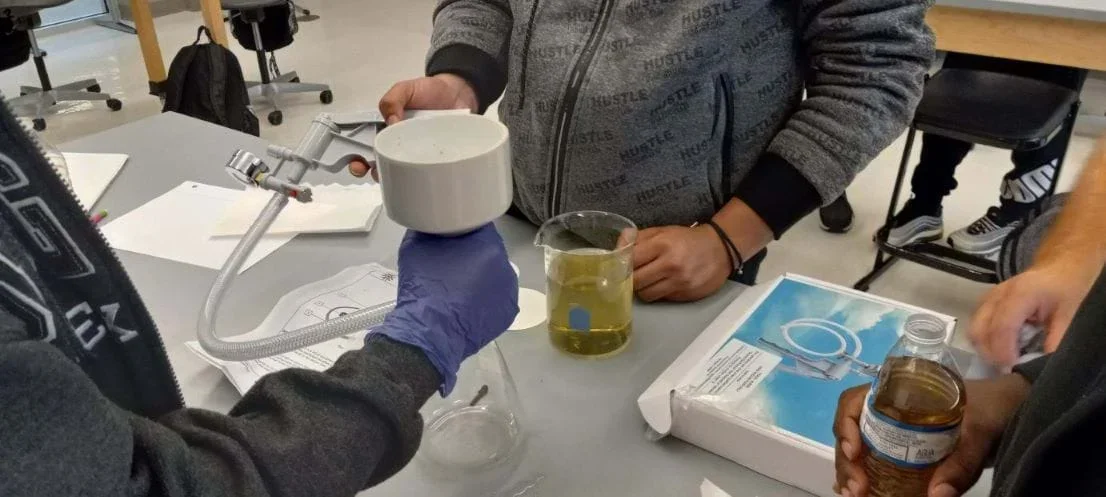 Students using a filtering flask to filter algae from a sample grown in the classroom.Copyright Ellen Lukasik, 2021
This activity considers the use of asymmetric membranes as micro filtration devices to remove algae from lake water. Students compare the efficiency of different membranes and/or repeated filtration processes to remove algae content.
The Framework for Quality K-12 Engineering Education includes the process of design, the application of science, math, and engineering knowledge, and the understanding of the impact of solutions in a global, economic, environmental, and societal context. In this activity, students make design decisions regarding the water filtration processes to remove toxic algae from local waters with asymmetric membranes. Students explore different membranes and design configurations of a filtration system, as well as economic and environmental costs of removing existing blue-green algae from bodies of water.
After this activity, students should be able to:
- Describe uses of asymmetric membranes for filtration.
- Discuss the effects of imbalances in ecosystems.
- Critically describe design elements of a water filtration process including asymmetric membranes in various formations.
- CCSS.Math.Content.HSF-IF.B.6 Calculate and interpret the average rate of change of a function (presented symbolically or as a table) over a specified interval. Estimate the rate of change from a graph.
Grades 9-12
Do you agree with this alignment? - CCSS.Math.Content.HSS-IC.A.1 Understand statistics as a process for making inferences about population parameters based on a random sample from that population.
Grades 9-12
Do you agree with this alignment? - CCSS.Math.Content.HSS-ID.B.6a Fit a function to the data; use functions fitted to data to solve problems in the context of the data.
Grades 9-12
Do you agree with this alignment? - CCSS.Math.Practice.MP4 Model with mathematics.
Grades K-12
Do you agree with this alignment?
- HS-ESS3-4 Evaluate or refine a technological solution that reduces impacts of human activities on natural systems.
Grades 9-12
This resource focuses on the following Three Dimensional Learning aspects of NGSS:
Science & Engineering Practices- Design or refine a solution to a complex real-world problem, based on scientific knowledge, student-generated sources of evidence, prioritized criteria, and tradeoff considerations.Do you agree with this alignment?
Disciplinary Core Ideas- Scientists and engineers can make major contributions by developing technologies that produce less pollution and waste and that preclude ecosystem degradation.Do you agree with this alignment?
- When evaluating solutions it is important to take into account a range of constraints including cost, safety, reliability and aesthetics and to consider social, cultural and environmental impacts.Do you agree with this alignment?
Crosscutting Concepts- Engineers continuously modify these technological systems by applying scientific knowledge and engineering design practices to increase benefits while decreasing costs and risks.Do you agree with this alignment?
- Feedback (negative or positive) can stabilize or destabilize a system.Do you agree with this alignment?
Do you agree with this alignment? - Design or refine a solution to a complex real-world problem, based on scientific knowledge, student-generated sources of evidence, prioritized criteria, and tradeoff considerations.
- HS-ETS1-3 Evaluate a solution to a complex real-world problem based on prioritized criteria and trade-offs that account for a range of constraints, including cost, safety, reliability, and aesthetics, as well as possible social, cultural, and environmental impacts.
Grades 9-12
This resource focuses on the following Three Dimensional Learning aspects of NGSS:
Science & Engineering Practices- Evaluate a solution to a complex real-world problem, based on scientific knowledge, student-generated sources of evidence, prioritized criteria, and tradeoff considerations.Do you agree with this alignment?
Disciplinary Core Ideas- When evaluating solutions it is important to take into account a range of constraints including cost, safety, reliability and aesthetics and to consider social, cultural and environmental impacts.Do you agree with this alignment?
Crosscutting Concepts- New technologies can have deep impacts on society and the environment, including some that were not anticipated. Analysis of costs and benefits is a critical aspect of decisions about technology.Do you agree with this alignment?
Do you agree with this alignment? - Evaluate a solution to a complex real-world problem, based on scientific knowledge, student-generated sources of evidence, prioritized criteria, and tradeoff considerations.
- HS-LS2-7 Design, evaluate, and refine a solution for reducing the impacts of human activities on the environment and biodiversity.
Grades 9-12
This resource focuses on the following Three Dimensional Learning aspects of NGSS:
Science & Engineering Practices- Design, evaluate, and refine a solution to a complex real-world problem, based on scientific knowledge, student-generated sources of evidence, prioritized criteria, and tradeoff considerations.Do you agree with this alignment?
Disciplinary Core Ideas- When evaluating solutions it is important to take into account a range of constraints including cost, safety, reliability and aesthetics and to consider social, cultural and environmental impacts.Do you agree with this alignment?
- Moreover, anthropogenic changes (induced by human activity) in the environment—including habitat destruction, pollution, introduction of invasive species, overexploitation, and climate change—can disrupt an ecosystem and threaten the survival of some species.Do you agree with this alignment?
- Humans depend on the living world for the resources and other benefits provided by biodiversity. But human activity is also having adverse impacts on biodiversity through overpopulation, overexploitation, habitat destruction, pollution, introduction of invasive species, and climate change. Thus sustaining biodiversity so that ecosystem functioning and productivity are maintained is essential to supporting and enhancing life on Earth. Sustaining biodiversity also aids humanity by preserving landscapes of recreational or inspirational value.Do you agree with this alignment?
- Biodiversity is increased by the formation of new species (speciation) and decreased by the loss of species (extinction).Do you agree with this alignment?
Crosscutting Concepts- Much of science deals with constructing explanations of how things change and how they remain stable.Do you agree with this alignment?
Do you agree with this alignment? - Design, evaluate, and refine a solution to a complex real-world problem, based on scientific knowledge, student-generated sources of evidence, prioritized criteria, and tradeoff considerations.
- HS-LS4-6 Create or revise a simulation to test a solution to mitigate adverse impacts of human activity on biodiversity.
Grades 9-12
This resource focuses on the following Three Dimensional Learning aspects of NGSS:
Science & Engineering Practices- Create or revise a simulation of a phenomenon, designed device, process, or system.Do you agree with this alignment?
Disciplinary Core Ideas- When evaluating solutions it is important to take into account a range of constraints including cost, safety, reliability and aesthetics and to consider social, cultural and environmental impacts.Do you agree with this alignment?
- Both physical models and computers can be used in various ways to aid in the engineering design process. Computers are useful for a variety of purposes, such as running simulations to test different ways of solving a problem or to see which one is most efficient or economical; and in making a persuasive presentation to a client about how a given design will meet his or her needs.Do you agree with this alignment?
- Changes in the physical environment, whether naturally occurring or human induced, have thus contributed to the expansion of some species, the emergence of new distinct species as populations diverge under different conditions, and the decline-and sometimes the extinction-of some species.Do you agree with this alignment?
- Humans depend on the living world for the resources and other benefits provided by biodiversity. But human activity is also having adverse impacts on biodiversity through overpopulation, overexploitation, habitat destruction, pollution, introduction of invasive species, and climate change. Thus sustaining biodiversity so that ecosystem functioning and productivity are maintained is essential to supporting and enhancing life on Earth. Sustaining biodiversity also aids humanity by preserving landscapes of recreational or inspirational value.Do you agree with this alignment?
Crosscutting Concepts- Empirical evidence is required to differentiate between cause and correlation and make claims about specific causes and effects.Do you agree with this alignment?
Do you agree with this alignment? - Create or revise a simulation of a phenomenon, designed device, process, or system.
Each student needs:
- Algae Sorting Recording Worksheet (PDF)
- Week 1 Questions (PDF)
- (optional) Optional Assessment (PDF)
- lab safety goggles
- Week 2 Questions (PDF)
- Week 3 Questions (PDF)
- Week 4 Questions (PDF)
Each group needs:
- Algae Sorting Activity (PDF) cards
- empty water bottle
- water quality testing materials, such as water test strips (e.g., 16-in-1 Drinking Water Quality Test Strips) and/or reef aquarium testing kits (e.g., Red Sea Reef Care Algae Control Test Kit)
- a filtration unit with vacuum flask and hand pump, such as one as in Figure 1
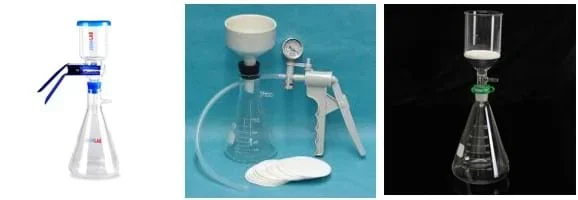 Figure 1: Filtration units with vacuum flasks and hand pumps can speed up the filtration process.Copyright Left: https://www.amazon.com/Laboratory-Filtration-Distillation-Apparatus-Filtering/dp/B0942NYT9L Center: https://www.walmart.com/ip/Olympia-Sports-16072-Filtering-Set-with-90-mm-Porcelain-Buchner-Funnel/47753231 Right: https://www.amazon.com/Vacuum-Suction-Filtration-Conical-Buchner/dp/B09479W6B8?th=1
OR
- 2 L or 3 L soda bottle
- 1,000 mL beaker
- large rubber band(s)
AND
- forceps
- funnel
- petri dish, 1 per used filter
- various microfilters for testing (available at https://www.sterlitech.com/custom-sample-packs.html)
OR
- filter paper or coffee filters
For the entire class to share:
- collected water from a fish tank or pond for testing (may be collected as an additional class activity)
- Collect 0.5 L per student group, or no more than 5 L per class. Store water in an amber HDPE bottle.
- nutrient solution
- deionized water
- aluminum foil
- waterproof tape
- paper towels
- microscope
- (optional, but recommended) spectrophotometer
- Algae Presentation (pptx)
- Algae Presentation (pdf)
- Algae Sorting Activity (docx)
- Algae Sorting Activity (pdf)
- Algae Sorting Activity Answer Key (docx)
- Algae Sorting Activity Answer Key (pdf)
- Algae Sorting Activity Recording Sheet (docx)
- Algae Sorting Activity Recording Sheet (pdf)
- Student Worksheet (docx)
- Student Worksheet (pdf)
- Week 1 Questions (docx)
- Week 1 Questions (pdf)
- Week 1 Questions Answer Key (docx)
- Week 1 Questions Answer Key (pdf)
- Week 2 Questions (docx)
- Week 2 Questions (pdf)
- Week 2 Questions Answer Key (docx)
- Week 2 Questions Answer Key (pdf)
- Week 3 Questions (docx)
- Week 3 Questions (pdf)
- Week 3 Questions Answer Key (docx)
- Week 3 Questions Answer Key (pdf)
- Week 4 Questions (docx)
- Week 4 Questions (pdf)
- Week 4 Questions Answer Key (docx)
- Week 4 Questions Answer Key (pdf)
- Optional Assessment (docx)
- Optional Assessment (pdf)
- Optional Assessment Answer Key (docx)
- Optional Assessment Answer Key (pdf)
Students need a general understanding of substances, filtration, measurement, and graphing. A basic understanding of algae, biological systems, and algebraic functions is preferable but not required.
One use of asymmetric membranes is microfiltration. Since 2019, numerous dogs have died after swimming in lakes with toxic algae blooms in Austin, Texas.
Today we will test membranes’ abilities to separate algae from the water. (As appropriate, have students consider the permeance of membranes to separate gases in the lab as a connection to this activity.)
Given the recurring presence of cyanobacteria that can attack the liver and neurological systems of dogs, can an asymmetric membrane effectively remove toxic algae from lake waters without adverse environmental effects?
You will make design decisions regarding the water filtration processes to remove toxic algae from local waters with asymmetric membranes. You will also explore different membranes and design configurations of a filtration system, as well as economic and environmental costs of removing existing blue-green algae from bodies of water.
Background
Harmful algae blooms were first discovered in Lady Bird Lake in Austin, Texas, in 2019 and have led to the deaths of at least five dogs. This planktonic algae is dormant when water temperatures are between 60 and 65 degrees, but as water temperatures rise, algae blooms grow and reproduce. In Austin’s popular lakes, toxic algae blooms have occurred each year since 2019.
According to the U.S. Environmental Protection Agency, algal blooms are a major environmental problem in all 50 states and have severe impacts on human health, aquatic ecosystems, and the economy. Harmful blooms in Florida, California, New Jersey, Texas, and Ohio have been documented in peer-reviewed research.
Asymmetric membranes comprise two main layers with diverse properties, characterized by a relatively dense and extremely thin top layer supported on an open, much thicker, porous substructure bottom layer.
Polymeric membranes are employed in myriad applications involving transport processes. These applications include desalination of seawater by reverse osmosis, dialysis by an artificial kidney, large-scale gas separations in chemical process plants, purification of biopharmaceuticals, skin patches for controlled release of drugs, plastic wrap and ketchup bottles, and aircraft fuel tanks, as well as removing lithium from produced water and removing fluoride from groundwater.
This activity considers using membranes as microfilters to remove toxic algae from existing bodies of water.
Microfiltration is generally operated in cross-flow or dead-end filtration. In cross-flow filtration, fluid is passed tangentially along the membrane. In dead-end filtration, fluid is passed through the membrane, and particles larger than the pore size of the membrane are stopped at the surface. If circumstances allow, teachers may test one or both of these configurations. For ease of setup with more commonplace materials, dead-end filtration is described.
Before the Activity
- Collect water to be filtered from a fish tank or pond. This can be done as a class activity if time and circumstances permit. It is recommended to use 0.5 L per student group, or no more than 5 L per class in an amber HDPE bottle.
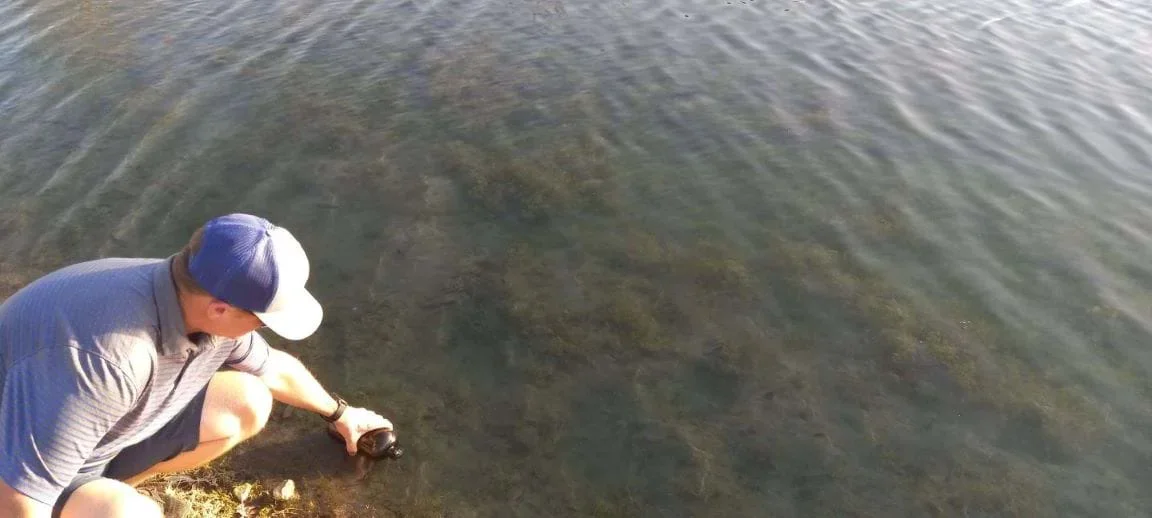 Collecting a water sample from a local, stagnant body of water.Copyright Ellen Lukasik, 2021
 - Gather materials and make copies of handouts/worksheets.
- Cut out each type of algae from the Algae Sorting Activity (PDF)to form cards; each group needs one set of cards.
With the Students
Week 1
- Review background information and the problem situation with students. Discuss possible filtration configurations and asymmetric membranes, and measurement techniques to be employed. Prompt a discussion by asking the following: What is algae? What are the concerns and potential uses of algae? See Algae Presentation (PPTX) Slides 1-3 and show students the videos: What if Algae Took Over the Oceans? (6:03 minutes) and What Makes Blue-Green Algae Dangerous? (3:53 minutes).
- Distribute the Algae Sorting Activity (PDF) cards and Algae Sorting Activity Recording Sheets (PDF) and lead students through the sorting activity (see Algae Presentation (PPTX)Slides 4-8).
- Have a class discussion about algae (see Algae Presentation (PPTX) Slides 9-16).
- Distribute the Week 1 Questions (PDF); allow students to work individually or in groups.
- Optional: Give students the Optional Assessment (PDF).
Week 2
- Break students into groups of 3-4 or complete the activity as a class. Review lab safety guidelines and practices with students.
- Have students use or choose a sample of the locally collected algae starter, nutrients, and water to grow algae in an empty water bottle. Have students examine collected water under a microscope prior to creating their system; show the How to Prepare a Wet Mount Slide video (2:30 minutes).
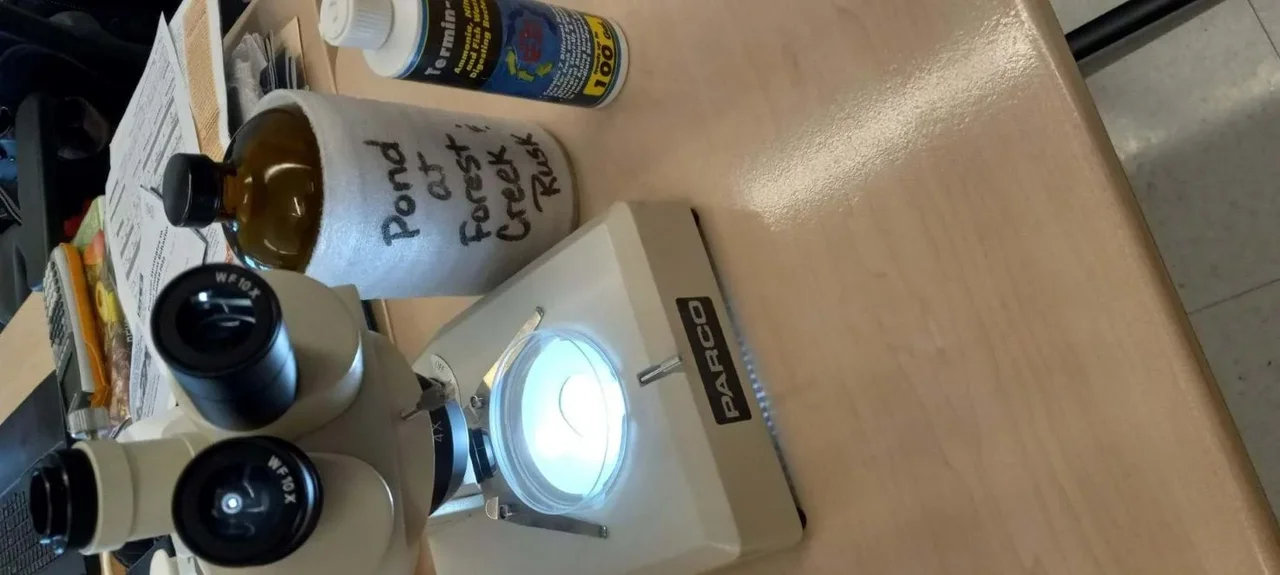 Examining a water sample under a microscope before adding nutrients to grow algae in the classroom.Copyright Ellen Lukasik, 2021
 - Show students the How to Grow Algae video (1:09 minutes) for instructions on how to grow algae. Allow groups to mix the materials in the water bottle to grow algae.
- Store the water bottles in a warm or sunny place. Have students record sources of samples and conditions in a lab journal.
- Provide students with the Week 2 Questions (PDF); allow students to work with their groups to complete the handout.
Week 3
- Tell students they will now test their algae systems and examine the water conditions. Hand out the Week 3 Questions (PDF).
- Allow the students access to water quality testing materials and show videos to assist them: How To Test Your Water Quality With Water Test Strips (5:55 minutes) and Red Sea Reefer pt15: Algae Control (10:30 minutes). Tell students to record test results in their lab journals.
- Have students discuss the following question: What characteristics does the system have? Allow students access to books/internet to learn about factors that influence or impede the growth of algae. Tell students to record notes in their lab journals.
- If possible, look at an algae sample in a spectrophotometer with students. Talk about how a spectrophotometer works, and what we can learn from it. Show the Spectrophotometry video (8:23 minutes).
Week 4
- Tell students that now they will use asymmetric membranes to design a water filter with the goal of removing algae from the water. Remind students that toxic algae can be harmful to people and animals; encourage them to research the algae status in their local area (or use data for Austin, Texas).
- Prepare students to filter the water by showing them the video Water Filter Experiments! - SODA, MILK, KOOL-AID + MORE (5:44 minutes) to pique their curiosity about filters. If using filtration units, show students the video Chemistry Lab - 6 - Filtering Flask (5:28 minutes) for instructions on how to set them up. Distribute the Week 4 Questions (PDF) for students to answer.
- Have students configure their filters with the materials that are available, and in configurations that they believe will be most efficient for the removal of algae. Instruct students to record their brainstorming ideas and reasons for choosing one design to prototype. Tell students that they will complete the filtration process with at least two different membrane filters (as available, and as time permits). Students using a filtering flask to filter algae from a sample grown in the classroom.Copyright Ellen Lukasik, 2021
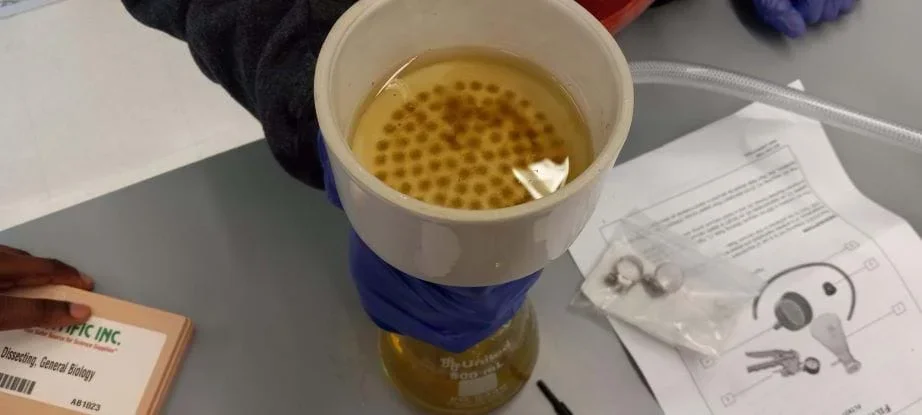 Filtering algae with membranes.Copyright Ellen Lukasik, 2021
 - Encourage students to examine their filters under a microscope. Have them discuss the following questions and record notes in their lab journals: How do the results compare with that of their peers? Did the type of filter or method of filtering make a significant difference in the results?
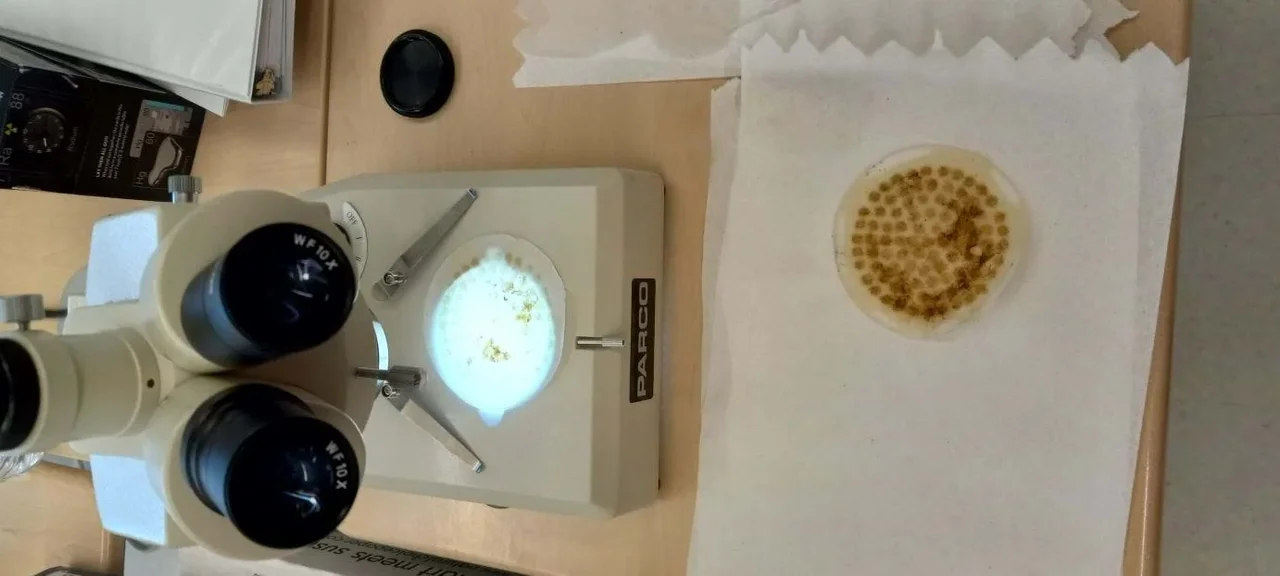 After filtering the algae, students examined the growths under a microscope.Copyright Ellen Lukasik, 2021
- algae
- A simple, nonflowering, typically aquatic plant of a large group that includes the seaweeds and many single-celled forms.
- asymmetric membrane
- Anisotropic structures comprising two main layers with diverse properties, such as morphology and permeability, characterized by a relatively dense and extremely thin top layer supported on an open, much thicker, porous substructure bottom layer.
- membrane
- A thin, pliable sheet of material forming a barrier or lining.
- micro filter
- A type of physical filtration process whereby a contaminated fluid is passed through a special pore-sized membrane to separate microorganisms and suspended particles from process liquid.
- polymer
- A substance or material consisting of very large molecules, or macromolecules, composed of many repeating subunits.
Pre-Activity Assessment
Guided Discussion: Lead a discussion to gauge students’ previous knowledge on algae, asymmetric membranes, and microfiltration.
Activity Embedded (Formative) Assessment
Handouts and Questions: Use the Week Questions (see the “Worksheets and Attachments” section) as formative assessments, serving as checkpoints as students make choices regarding their filtration processes. The handouts/weekly sheets will allow students to record their knowledge and understanding as well as indicate their progress.
Post-Activity (Summative) Assessment
Persuasive Essay: The persuasive essay that students will write at the conclusion of the work will summarize their findings and recommendations for filtration of algae. Give students the following prompt:
Write a persuasive essay to the mayor or news media describing the problem with algae blooms, summarizing the details of the findings and supporting the use of asymmetric membrane filtration as a cost-effective, environmentally friendly means of providing safe recreational and outdoor environments for dogs.
- Use eye protection (goggles or safety glasses) during this activity.
- Prevent spills or clean them up as they occur; keep paper towels nearby.
- Although any risk from the bacteria in the water is assumed to be negligible, have students wash their hands after handling the samples.
- Avoid skin contact; at no time is this water safe for consumption.
- No algae in water: Examine the removal of other elements or contaminants in the water.
- No access to asymmetric membrane microfilters: Use coffee filters or other readily available materials. Compare the use of one filter to the use of two filters if more than one type is not found.
- No lakes or bodies of water nearby: Get a water sample from an aquarium or fish store, a water treatment facility, or a standing source in the neighborhood (drain, fountain, untreated pool, etc.).
Have students explore other uses of asymmetric membranes. Examples include desalination of seawater by reverse osmosis, dialysis by an artificial kidney, large-scale gas separations in chemical process plants, purification of biopharmaceuticals, skin patches for controlled release of drugs, plastic wrap and ketchup bottles, and aircraft fuel tanks, as well as removing lithium from produced water and removing fluoride from groundwater.
Students can work in small groups to design a filtering system for large volumes of water. What is the best way to apply what you have learned to impact the environment in a positive and cost-efficient way?
Ask students to write a persuasive essay to the mayor or news media describing the problem with algae blooms, summarizing the details of the findings and supporting the use of asymmetric membrane filtration as a cost-effective, environmentally friendly means of providing safe recreational and outdoor environments for dogs.
Imagine and test new uses of asymmetric membranes.
Research the conditions that promote algae growth and/or the effects of using chemicals to treat water. What are the impacts on the ecological system? Grow algae in the classroom and study potential impacts in a controlled environment.
For advanced students:
- Create a filtration device and test membrane samples for the removal of algae from samples gathered from local bodies of water.
- Design a filtering system for large volumes of water.
Week One-
What if Algae Took Over the Oceans? (6:03 minutes)
What Makes Blue-Green Algae Dangerous? —Speaking of Chemistry (3:53 minutes)
Week Two-
Short growing algae video (1:09 minutes):
Short prepare a slide video (2:30 minutes):
Week Three-
How To Test Your Water Quality With Water Test Strips (5:55 minutes)
Red Sea Reefer pt15: Algae Control (10:30 minutes)
Spectrophotometry (8:23 minutes)
Week Four-
Water Filter Experiments! - SODA, MILK, KOOL-AID + MORE (5:44 minutes)
Chemistry Lab - 6 - Filtering Flask (5:28 minutes)
Austin American Statesman. Austin crafts new strategies against harmful blue-green algae in lakes as summer heats up. June 15, 2021. https://www.statesman.com/story/news/2021/06/02/austin-crafts-new-strategies-against-harmful-blue-green-algae-lakes/7507563002
Berkman, Julie A. Hambrook, and M. G. Canova. Chapter A7. Section 7.4. Algal biomass indicators. No. 09-A7. 4. US Geological Survey, 2007. https://pubs.usgs.gov/twri/twri9a7/twri9a7_7.4.pdf
City of Austin. Harmful Algae. July 2, 2021. https://www.austintexas.gov/page/algae
Jahan Kauser, Stephanie Farrell, Robert Hesketh, C. Stewart Slater, and Kevin Dahm. "A Project Based Approach To Teaching Membrane Technology." Association for Engineering Education - Engineering Library Division Papers (2001): 6.82.1. Web: https://peer.asee.org/9690
“Membrane Filtration.” Adapted from PA website, dated November 2005, and National Drinking Water Clearing House Web site, dated March 1999. https://www.mrwa.com/WaterWorksMnl/Chapter%2019%20Membrane%20Filtration.pdf
Sanders, David F, Smith, Zachary P, Guo, Ruilan, Robeson, Lloyd M, McGrath, James E, Paul, Donald R, and Freeman, Benny D. "Energy-efficient Polymeric Gas Separation Membranes for a Sustainable Future: A review." Polymer (Guilford) 54.18 (2013): 4729-761. Web: https://www.sciencedirect.com/science/article/pii/S0032386113005399
wikiHow. How to Grow Algae: 10 Steps with Pictures. March 31, 2021. https://www.wikihow.com/Grow-Algae
Contributors
Ellen James
Supporting Program
Support for this research was provided by the National Science Foundation through the Engineering Research Center for Innovative and Strategic Transformation of Alkane Resources (CISTAR)
Acknowledgements
This work is based upon work supported in part by the National Science Foundation under Cooperative Agreement No. EEC-1647722. Any opinions, findings and conclusions or recommendations expressed in this material are those of the authors and do not necessarily reflect the views of the National Science Foundation.
Copyright
2024 by Regents of the University of Colorado; original © 2021 University of Texas