
Exploring Light With Holographic Chocolate
Students explore how light interacts with matter. Using the principles of spectroscopy, they learn how light can cause molecules to react by entering into an excited state. This activity addresses diffraction grating, which is in a spectrometer (a specialized instrument used to track and measure the path of different wavelengths of light). This instrument is used in many applications that study light-matter interactions. Students apply a diffraction grating to chocolate, allowing them to observe the ray of light being separated into different colors and wavelengths and how light can interact differently with common materials by altering their properties. Students further explore light by designing light-powered products and presenting their designs to the class.
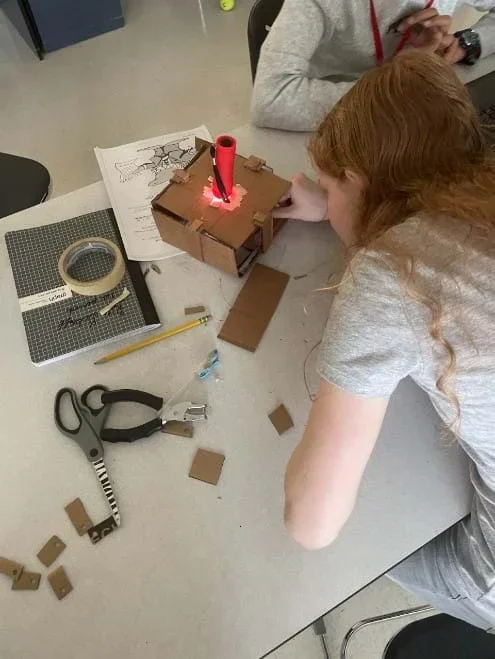 A student’s product, a laser maze, uses mirrors to refract light to make it get to a certain point at the end of the maze.Copyright Hollis McKinney
Engineers use the information from spectroscopy to design and explore different systems that use light-matter interactions. For example, companies that make solar panels need to know the power conversion efficiency, which describes the efficiency of electricity produced from light absorbed. One contribution to this efficiency is the range of colors absorbed.
After this activity, students should be able to:
- Explain that light travels in a straight line until it strikes an object and is reflected or travels through one medium to another and is refracted.
- Describe light as a spectrum that includes visible and invisible light.
- Summarize the uses of energy, including mechanical, light, thermal, electrical, and sound energy.
- Apply the use of electromagnetic waves in applications by creating a final product that harnesses light energy.
- Explain the differences and similarities between diffraction and refraction.
- STEL-7Q Apply the technology and engineering design process.
Grades 6-8
Do you agree with this alignment?
- MS-ETS1-1 Define the criteria and constraints of a design problem with sufficient precision to ensure a successful solution, taking into account relevant scientific principles and potential impacts on people and the natural environment that may limit possible solutions.
Grades 6-8
This resource focuses on the following Three Dimensional Learning aspects of NGSS:
Science & Engineering Practices- Define a design problem that can be solved through the development of an object, tool, process or system and includes multiple criteria and constraints, including scientific knowledge that may limit possible solutions.Do you agree with this alignment?
Disciplinary Core Ideas- The more precisely a design task's criteria and constraints can be defined, the more likely it is that the designed solution will be successful. Specification of constraints includes consideration of scientific principles and other relevant knowledge that is likely to limit possible solutions.Do you agree with this alignment?
Crosscutting Concepts- The uses of technologies and any limitations on their use are driven by individual or societal needs, desires, and values; by the findings of scientific research; and by differences in such factors as climate, natural resources, and economic conditions.Do you agree with this alignment?
- All human activity draws on natural resources and has both short and long-term consequences, positive as well as negative, for the health of people and the natural environment.Do you agree with this alignment?
Do you agree with this alignment? - Define a design problem that can be solved through the development of an object, tool, process or system and includes multiple criteria and constraints, including scientific knowledge that may limit possible solutions.
- MS-ETS1-2 Evaluate competing design solutions using a systematic process to determine how well they meet the criteria and constraints of the problem.
Grades 6-8
This resource focuses on the following Three Dimensional Learning aspects of NGSS:
Science & Engineering Practices- Evaluate competing design solutions based on jointly developed and agreed-upon design criteria.Do you agree with this alignment?
Disciplinary Core Ideas- There are systematic processes for evaluating solutions with respect to how well they meet the criteria and constraints of a problem.Do you agree with this alignment?
Do you agree with this alignment? - Evaluate competing design solutions based on jointly developed and agreed-upon design criteria.
- MS-ETS1-4 Develop a model to generate data for iterative testing and modification of a proposed object, tool, or process such that an optimal design can be achieved.
Grades 6-8
This resource focuses on the following Three Dimensional Learning aspects of NGSS:
Science & Engineering Practices- Develop a model to generate data to test ideas about designed systems, including those representing inputs and outputs.Do you agree with this alignment?
Disciplinary Core Ideas- Models of all kinds are important for testing solutions.Do you agree with this alignment?
- The iterative process of testing the most promising solutions and modifying what is proposed on the basis of the test results leads to greater refinement and ultimately to an optimal solution.Do you agree with this alignment?
Do you agree with this alignment? - Develop a model to generate data to test ideas about designed systems, including those representing inputs and outputs.
- MS-PS4-2 Develop and use a model to describe that waves are reflected, absorbed, or transmitted through various materials.
Grades 6-8
This resource focuses on the following Three Dimensional Learning aspects of NGSS:
Science & Engineering Practices- Develop and use a model to describe phenomena.Do you agree with this alignment?
Disciplinary Core Ideas- A sound wave needs a medium through which it is transmitted.Do you agree with this alignment?
- When light shines on an object, it is reflected, absorbed, or transmitted through the object, depending on the object's material and the frequency (color) of the light.Do you agree with this alignment?
- The path that light travels can be traced as straight lines, except at surfaces between different transparent materials (e.g., air and water, air and glass) where the light path bends.Do you agree with this alignment?
- A wave model of light is useful for explaining brightness, color, and the frequency-dependent bending of light at a surface between media.Do you agree with this alignment?
- However, because light can travel through space, it cannot be a matter wave, like sound or water waves.Do you agree with this alignment?
Crosscutting Concepts- Structures can be designed to serve particular functions by taking into account properties of different materials, and how materials can be shaped and used.Do you agree with this alignment?
Do you agree with this alignment? - Develop and use a model to describe phenomena.
Chocolate Tempering Method
Each group needs:
- 600 g chocolate
- a diffraction grating – 12” x 6” (Note: This grating can be reused.)
- a hot plate
- a pot (double boiler)
- a digital thermometer
- parchment paper
- an aluminum baking sheet
- a paper plate
- a marker
- a hand towel, potholder, or trivet
- a rubber spatula
- a flashlight
- Holographic Chocolate Worksheet (PDF)
Each student needs:
- science notebook
- pencil or pen
- lab gloves
- lab goggles
- KWL Chart (PDF)
For the whole class to share:
- laptop and projector to show videos
- access to a refrigerator
- various recyclable materials for the student products
- various adhesives for student products (i.e., clear tape, masking tape, glue, hot glue w/ hot glue gun, etc.)
- scissors
Students need a basic understanding of energy and how light behaves (i.e., light refracts/diffracts, reflects, or is absorbed). They need knowledge of how to work in cooperative groups, and knowledge of basic lab safety.
Today we are going to talk about alternatives to fossil fuels, in particular solar power. First, we will look at how the human consumption of fossil fuels has led to climate change by watching a video. I’d like you to draw a T-chart in your notebook and label the first column “What I Notice,” and the second column “What I Wonder.” While you watch this video, you will add information to your T-chart. Afterward, you will share these thoughts with your small groups and then we will follow up with a whole-class discussion.
(Show this video to the students: https://youtu.be/JCFJlCMGmgY (3:11 minutes).)
(Give students five minutes to discuss their thoughts with their small groups or shoulder partners. After five minutes, pull the students’ attention back to the whole class.)
What is causing climate change and global warming? (Let students offer answers.) How can we reduce our dependence on fossil fuels? (Let students offer answers. Guide students toward solar power.)
Solar power comes from the sun. The energy from the sun (i.e., sunlight) is an alternative to fossil fuels because sunlight is abundant and renewable. How can sunlight be used as a replacement for forms of energy that require fossil fuels? (Let students offer answers. Answer: Light energy is used in many applications to create electricity.) Solar panels are a great example of light energy being used as a replacement for fossil fuels.
How do solar panels work? The simplest explanation is this: When the sun shines onto a solar panel, the sunlight is absorbed by cells in the panel. This collected energy transforms into electrical energy (or electrical charges).
A solar panel is made of multiple solar cells called photovoltaic (PV) cells. When sunlight shines on the PV cells, that light may be reflected or absorbed, or pass right through the cell. The PV cell is composed of semiconductor material, meaning that it can conduct electricity better than an insulator but not as well as a good conductor like a metal. When the semiconductor is exposed to light, it absorbs the light’s energy and transfers it to negatively charged particles in the material called electrons. This extra energy allows the electrons to flow through the material as an electrical current. This current is extracted through conductive metal contacts—the grid-like lines on a solar cell—and can then be used to power houses and other things on the electric grid.
The amount of electricity produced from PV cells depends on the characteristics of the light (such as intensity and wavelengths) and the attributes of the PV cell. An important property of PV semiconductors is the bandgap, which indicates what wavelengths of light the material can absorb and convert to electrical energy. If the semiconductor’s bandgap matches the wavelengths of light shining on the PV cell, then that cell can efficiently make use of all the available energy.
To explore how light interacts with matter, we are first going to make holographic chocolate and then you will work in pairs to create your own light device!
Background
Solar cells contain semiconductors that conduct electricity when there is sunlight. In sunlight, the semiconductor absorbs light and transfers energy to negatively charged particles (i.e., electrons). Electrons flow through the semiconductor as an electrical current; it travels to an inverter, which converts the direct current (DC) to alternating current (AC) that flows into the electric grid. The energy in the grid can be used to power people’s homes. As long as the semiconductor is hit by the sun, it continues to generate electricity.
Everything we see is based on light interacting with objects in different ways. It can bounce off of, diffract around or bend around objects, or refract, which means change direction. These different interactions are perceived and processed differently by our eyes and brains. Light can also behave as a wave or a particle, depending on how you are observing it. An example of such waves would be radio waves, and an example of such particles would be photons. Photons carry an amount of energy. This is the energy the kids used on their products. Unlike soundwaves, light waves require no medium to travel through and can travel very quickly. Nothing moves faster than the speed of light.
How/why does light have a spectrum? The spectrum is a way to measure different waves of light in nanometers. Light is a form of energy, and the spectrum is used to determine how much energy light has. Long wavelengths correspond with low energies, and short wavelengths correspond with high energies.
What are visible light and invisible light? How are they related to the light spectrum? Visible light is the light we can see. This is ROYGBIV, or the colors of the rainbow. Invisible light is gamma rays, x-rays, ultra-violet (UV), infrared, and radio waves. They all fall on the spectrum, with visible light falling between UV and infrared. Radio waves have lower energy, whereas gamma rays have higher energy. The spectrum shows each light’s radiation, energy level, and wavelength.
Summarize the uses of energy, including mechanical, light, thermal, electrical, and sound energy.
- Mechanical: To move objects and complete tasks that the human body cannot. An example would be a car on a hill.
- Light: Uses the energy stored in light particles. An example would be solar energy.
- Thermal: Uses energy from heat; a renewable alternative to burning fossil fuels. Examples would be fire or hydrothermal power.
- Electrical: Moves charged particles to generate electricity. An example is a phone charger connected to the wall.
- Sound: This is when objects vibrate; used for communication. Examples would be sonar, or a drum being played.
There are differences and similarities between diffraction and refraction. Refraction is the change in direction of waves that occurs when waves travel from one medium to another. An example would be a straw in a cup of water. Refraction deals with wavelength and speed changes. Diffraction is the bending of waves around obstacles and openings. An example would be light passing through a slit.
Before the Activity
- Practice tempering chocolate by following the directions in the Holographic Chocolate Worksheet (PDF).
- Gather all necessary supplies for making holographic chocolate.
- Before Day 1, place supplies in a central location in the room. Optional: Pre-arrange supplies into piles for each group.
- Gather recycled materials for students to use in their light-powered designs. Optional: Ask students to bring in recyclables such as cardboard boxes, or empty plastic containers (cleaned).
- Before Day 5, place supplies in a central location in the room so students can see them while brainstorming their designs.
- (Optional) Make copies of the KWL Chart (PDF).
With the Students
Day 1: Introduction & Chocolate Tempering
- Conduct the Pre-Activity Assessment to introduce the concept of light and how light behaves: Everything we see is based on light interacting with objects in different ways. Light can bounce off of objects, diffract around or bend around objects, or refract (i.e., change direction) around objects. These different interactions are perceived and processed differently by our eyes and brains. Light behaves as a wave or as a particle, depending on how you are observing it. An example of such waves would be radio waves, and an example of such particles would be photons. Photons carry an amount of energy. Unlike sound waves, which have to travel through the air, light waves require no medium to travel through and can travel very quickly. Nothing is faster than the speed of light.
- Give students the following two questions to discuss with their table and/or shoulder partners:
- How does light behave when it comes into contact with different types of matter? (Answer: It could bounce off of, diffract around or bend around objects, or refract.)
- Would there be color if there was no light? (Answer: No. Without light, color would not be possible.)
- Have each group share their information in a whole-class discussion.
- Record student answers on the KWL Chart (PDF). This can be provided by the teacher, or students can create the chart in their lab notebooks.
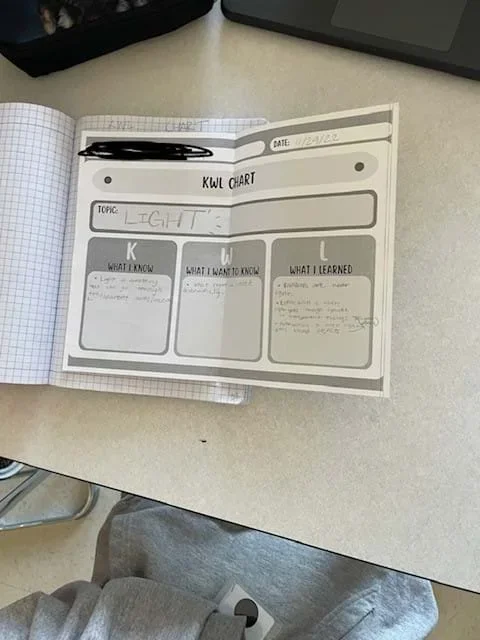 Example KWL chart filled out by a student on the topic of light.Copyright Hollis McKinney
 - Have students split into groups of four if they have not already done so. Review lab safety (e.g., use of goggles, gloves, hot plate, etc.).
- Distribute copies of the Holographic Chocolate Worksheet (PDF). Tell students to read through the procedure for tempering chocolate before allowing them to gather their supplies.
- Have each group gather supplies for making holographic chocolate. Tell students to notate every step they take while tempering the chocolate, so they can reflect on the process.
- Walk around to monitor students as they temper their chocolate and pour it onto the diffraction grating. Ensure that students are continuously stirring the chocolate and that the correct temperatures are reached as they proceed. Ask students to reflect on any successes and failures they encounter; tell students that this is a very real-world application in research.
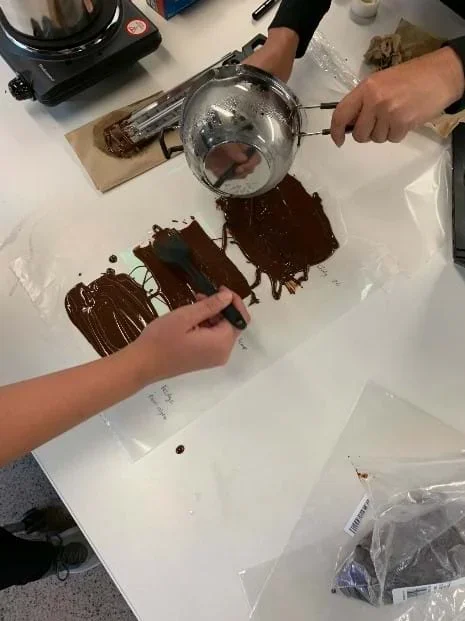 Notice the sheen of the chocolate.Copyright Hollis McKinney
 - After students finish creating their holographic chocolate, have them clean up their supplies.
Day 2: Analyzing Holographic Chocolate
- Have students collect their holographic chocolates and provide them with a flashlight or other light source to view their chocolates under light.
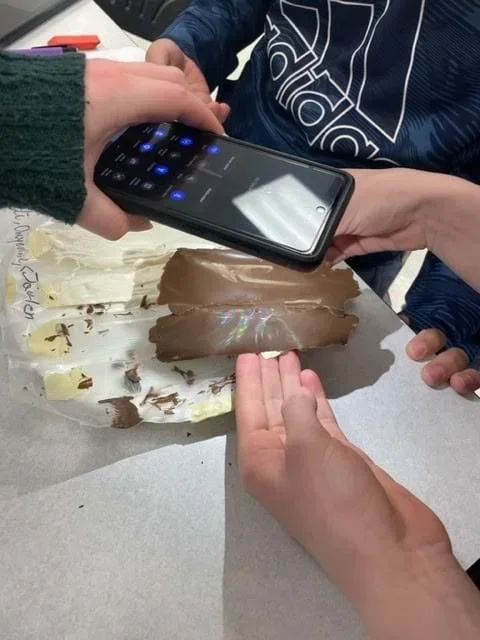 The chocolate should have a shiny rainbow once the light hits it.Copyright Hollis McKinney
 - Give students time to complete the questions on the Holographic Chocolate Worksheet (PDF). Allow them to research information about light interactions and diffraction gratings if needed.
- Discuss answers as a class.
Day 3: Ask and Research
- Review the Engineering Design Process (EDP) with the students.
- Split students into groups of two.
- Ask: Tell students that they are engineers who are tasked with creating, designing, and testing a light-powered product. Inform students of the criteria and constraints for this design challenge:
- They can only use recycled materials.
- They will have one flashlight.
- Their design must use light energy (either natural or via the flashlight).
Research: Give students ~30 minutes to research how light-powered products work. Encourage them to search for various types of products and record their findings.
Day 4: Imagine
- Imagine: Have students use their research to brainstorm designs for their light-powered product. Encourage them to be creative and to record any ideas they have.
- Tell students that this is the time to think of wild ideas and defer judgement. Tell them they should discuss ideas one at a time, and that they can build on the ideas of others.
- If students seem to be struggling, tell them to return to the Research step of the EDP. Inform students that engineers often conduct research throughout the EDP. If needed, scaffold their research by directing them to the Five Easy Solar Power Experiments website.
Day 5: Plan & Create
- Plan: Tell students to review their ideas and select a promising design for their light-powered product.
- Remind them of the criteria and constraints:
- They can only use recycled materials.
- They will have one flashlight.
- Their design must use light energy (either natural or via the flashlight).
- Have students create detailed plans for their designs that include a list of the materials they will use.
- Once students decide on a plan, allow them to collect the materials.
- Create: Have students build prototypes of their designs. Walk around to monitor students and ask questions about why they selected the designs they did, and how the product will be powered using light.
Day 6: Create & Test
- Let students finish creating their prototypes (if needed).
- Test: Tell students to test their designs using the flashlight. Have them evaluate the prototype by analyzing what works, what doesn’t, and what could be improved. Remind them to record their analyses.
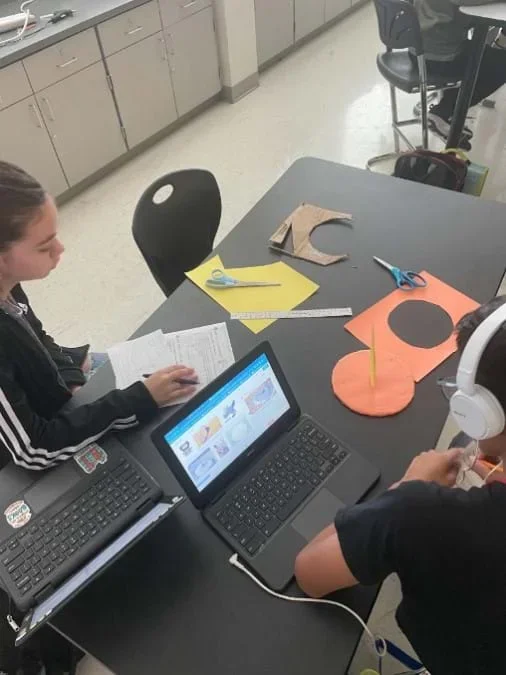 Students test their light-powered sundial.Copyright Hollis McKinney
Days 7-10: Improve
- Improve: Have students use the results from their testing to discuss how to improve their designs. Tell students that, like engineers, they are iterating on their designs to make the best light-powered product they can.
- Tell students to record their improved designs, including how they differ from the original and whether there are any new materials they will use.
- Have students create their redesigned prototypes, re-test them, and re-evaluate the designs. Allow students plenty of time to iterate their designs. A student’s product, a laser maze, uses mirrors to refract light to make it get to a certain point at the end of the maze.Copyright Hollis McKinney
Day 11: Prepare to Communicate
- Tell students to pretend that they are trying to pitch their product to get a solar company to purchase it or provide funding for further research to make it applicable to the real world (e.g., using non-recycled materials). Tell them that these elevator-pitch-style presentations will be 2-5 minutes long.
- Tell students that their pitches must include 1) An explanation of how their design uses light to work, and (2 how it relates to the light-matter interactions discussed after they made holographic chocolate. Remind them that engineers communicate their designs with others to share their products and receive feedback.
- Give students time to prepare for their presentations. Allow them to review their notes from the holographic chocolate part of the activity, and to conduct further research on the properties of light and light-matter interactions as needed.
Day 12: Communicate
- Give students about 5 minutes to review their notes and prepare for their presentations.
- Have students present their pitches to the class. To facilitate feedback from the class, ask the audience to share two “glows” (i.e., compliments) and one “grow” (e.g., constructive criticism) for each presentation.
- diffraction
- The process by which a beam of light or other system of waves is spread out as a result of passing through a narrow aperture or across an edge, typically accompanied by interference between the waveforms produced.
- light
- Electromagnetic radiation; a form of energy containing particle-like photons with wavelike properties.
- spectroscopy
- The branch of science concerned with the investigation and measurement of photophysical properties due to light-matter interactions.
- wavelength
- The distance between successive crests of a wave; the length of a period within an oscillation.
- reflect
- Light bouncing off a surface, where the angle of reflection is equal to the angle of incidence.
- refract
- When light bends or changes direction once it comes into contact with a different medium; this is due to the change in the speed of light.
- absorb
- When light is taken in by a medium.
Pre-Activity Assessment
KWL Chart: At the beginning of Day 1, introduce the concept of light and how it behaves. As students discuss in their groups, they complete a KWL Chart (PDF). Students also brainstorm ways to demonstrate the properties of light.
Drawing Light: Have students illustrate each of the ways that light can travel. Ensure that they draw examples of reflection, diffraction, and refraction.
Activity Embedded (Formative) Assessment
Light & Chocolate: Students complete the Holographic Chocolate Worksheet (PDF)to explore how light interacts with matter.
Design Process: Observe students as they create their light-powered product to ensure that they work through the whole engineering design process.
Post-Activity (Summative) Assessment
Reflection: Once students have created their light energy products, they will reflect on their designs. What about their design (and redesign(s)) worked or didn’t work? How could they improve it? Have students write a reflection about their experience with the design process.
Making Sense Assessment: Have students reflect on the science concepts they explored and/or the science and engineering skills they used by completing the Making Sense Assessment (PDF).
Holographic Chocolate:
- If students are operating the hot plates and pots, they need to be aware of how hot it can be.
- Students should wear gloves when handling chocolate.
- Students should wear goggles when tempering the chocolate.
- Students should not eat the chocolate, or lick the spatula.
Student Product:
- Students should be careful when using hot glue guns and scissors.
It is recommended that the teacher test the holographic chocolate activity before rolling out the activity with their class to iron out any issues with tempering the chocolate and producing the holographic design.
Chocolate bars work better than chocolate chips for making tempered chocolate.
The chocolate should not stay in the refrigerator for longer than one night, as the chocolate does not retain the holographic qualities when left in the refrigerator for too long.
If students do not have access to hot plates, or if the chocolate is not tempering during testing, use candy melts and a microwave instead:
- Give each group 100 g of candy melts. Place the candy in a microwave-safe bowl.
- Melt the candy for 30-second intervals at 50% power in the microwave.
- Stir with a rubber spatula after each interval.
- Complete until the chocolate is melted and shiny.
- Pour melted candy over the diffraction grating (about 2-3 mm thick).
- Refrigerate for at least 20 minutes, or overnight.
- Have students clean their supplies.
Have students explore spectroscopy in more detail. Encourage them to research spectroscopy and build their own DIY Spectrometer:
- DIY Spectrometer – A guide for students to create their own spectrometer.
- Breaking down how we collect spectroscopic information – Reading on how a spectrometer works.
- What is a Spectrometer? – Reading on how a spectrometer works.
- What is a Spectrometer? – A more detailed link that also examines how a spectrometer might be used in different types of spectrometry.
For 3rd-5th grade: Use candy melts instead of tempering the chocolate; see the Troubleshooting section for directions.
For 6th-8th grade: Focus more on the electromagnetic spectrum. Have students explore where light fits into this spectrum, and how scientists and engineers use waves to design products.
For 9th-12th grade: Take a deeper dive into exploring waves on the electromagnetic spectrum, comparing frequencies, and graphing wavelength comparison. There is also an optional Extension Activity using a DIY spectrometer.
Intro to spectroscopy - 4:54-min long video discussing some of the aspects of the above reading and defining spectroscopy and its applications.
BrainPop: Light for a 5-minute overview of Light
Study Jams, Light Absorption, Reflection, and Refraction
“The Science and Engineering Behind the Optics” What is Light?
Optics for Kids Web Site, the first page, “What is Light?”
Discovery Learning Physical Sci: Light full Video 20 Min.
Discovery Learning Exploring Light and Color: Full Video 30 Min.
Research for light uses: http://www.darvill.clara.net/emag/emagvis.htm
Science Facts for Light: https://www.sciencekids.co.nz/sciencefacts/light.html
Scavenger Hunt different resources: http://www.3x3links.com/lightenergy
Teachers' Domain: Refraction of Light Demonstration (Requires Flash)
"Holographic Rainbow Chocolate". Instructables, 2022, https://www.instructables.com/Holographic-Rainbow-Chocolate/
“Introduction to Spectroscopy”. 2022, https://www.khanacademy.org/science/ap-chemistry-beta/x2eef969c74e0d802:intermolecular-forces-and-properties/x2eef969c74e0d802:spectroscopy-and-the-electromagnetic-spectrum/v/introduction-to-spectroscopy
“Using Quantum Mechanics to Make Holographic Rainbows on Chocolate”. YouTube.com, 2022, https://www.youtube.com/watch?v=yhmCRliJ93w
2022, https://www.valrhona.com/en/l-ecole-valrhona/discover-l-ecole-valrhona/chocolate-terminology/tempering-chocolate
"Five Easy Solar Power Experiments For Kids | STEAM | Solar4stem". Solar4stem Science Kits, 2022, http://www.solar4stem.com/blog/five-easy-solar-power-experiments-for-kids-steam-stem
"How Do Black Lights Work, Why Do Highlighters Look So Bright, And How Can You Impress Your Significant Other With Science?". Sustainable Nano, 2022, https://sustainable-nano.com/2013/02/25/how-do-black-lights-work-why-do-highlighters-look-so-bright-and-how-can-you-impress-your-girlfriend-with-science/
"Modular 3D Printed Absorption And Emission Spectrometer Guide". Damrauer Group, 2022, https://www.colorado.edu/lab/damrauergroup/modular-spectrometer#spectrometer_introduction_and_parts-13
"Molecules And Light". Phet, 2022, https://phet.colorado.edu/en/simulations/molecules-and-light
"Spectroscopy: Interaction Of Light And Matter (Article) | Khan Academy". Khan Academy, 2022, https://www.khanacademy.org/science/chemistry/electronic-structure-of-atoms/bohr-model-hydrogen/a/spectroscopy-interaction-of-light-and-matter
"The Scale Of The Universe 2". Htwins.Net, 2022, https://htwins.net/scale2/
"Welcome to Earth, Season 1 Episode 2: Descent into Darkness”. Disneyplus.com, 2022, https://www.disneyplus.com/video/cd2b84ff-254c-46b5-b3d9-44ccfe0658f2
"What Is A Spectrometer? UV, VIS And IR Spectrometer Explained". Wavelength Opto-Electronic, 2022, https://wavelength-oe.com/blog/what-is-a-spectrometer/
"4.5: Photoluminescence, Phosphorescence, And Fluorescence Spectroscopy". Chemistry Libretexts, 2022, https://chem.libretexts.org/Bookshelves/Analytical_Chemistry/Physical_Methods_in_Chemistry_and_Nano_Science_(Barron)/04%3A_Chemical_Speciation/4.05%3A_Photoluminescence_Phosphorescence_and_Fluorescence_Spectroscopy
“PV Cells 101: A Primer on the Solar Photovoltaic Cell”. Solar Energy Technologies Office, 2019, https://www.energy.gov/eere/solar/articles/pv-cells-101-primer-solar-photovoltaic-cell
Contributors
Hollis McKinney; Jennifer Sladek; Danielle M. Cardena; Laura Estergreen; Sean T. Roberts
Supporting Program
NASCENT (Nanomanufacturing Systems for Mobile Computing and Mobile Energy Technologies) Engineering Research Center, Research Experiences for Teachers Program, University of Texas at Austin
Acknowledgements
This material is based upon work supported by the National Science Foundation under grant no. EEC-1160494—a Research Experience for Teachers program titled “Nanomanufacturing Systems for Mobile Computing and Mobile Energy Technologies, or NASCENT.” Any opinions, findings and conclusions or recommendations expressed in this material are those of the author(s) and do not necessarily reflect the views of the National Science Foundation.
Copyright
2024 by Regents of the University of Colorado; original © 2022 University of Texas at Austin