
I’m at the End of My (Aluminum) Rope!
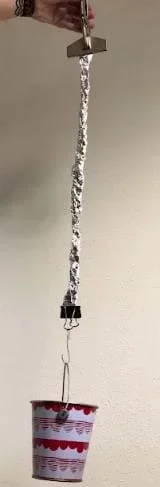 Strength test example.Copyright 2023 Danielle Woods, Yvette Dodd
Students construct a rope from pieces of aluminum foil. They must determine how to join two pieces together as they explore and learn about structural materials. Students experiment with different methods of connecting the foil to form an aluminum rope and determine which method supports the most weight. Student designs must conform to given constraints, such as required dimensions, quantity of foil, and supplies for joining. After creating their prototype aluminum rope, students test the strength of their aluminum rope under tension by suspending weight from the bottom of the rope and recording the weight that causes failure. As part of the engineering design process, students then have an opportunity to go back and explore alternative designs and make improvements. Students subject their new designs to the original testing methodology and evaluate the effects of their design changes.
Structural engineers are responsible for designing, analyzing, and ensuring the stability and safety of structures such as buildings, bridges, dams, towers, and other infrastructure. Their primary focus is on ensuring that these structures can withstand various loads, including gravity, wind, seismic forces, and environmental pressures. Structural engineers utilize principles of physics, mathematics, and materials science to determine the most suitable materials and construction methods for each project.
Materials engineers focus on understanding the properties, behavior, and performance of materials, ranging from metals and ceramics to polymers and composites. Their work involves developing and designing new materials, improving existing ones, and selecting the appropriate materials for specific applications. Materials engineers study the structure of materials at various scales, from atomic and molecular levels to macroscopic properties. They investigate factors such as mechanical strength, thermal conductivity, electrical conductivity, corrosion resistance, and durability.
After this activity, students should be able to:
- Describe the physical properties of matter, with a focus on metals.
- Plan a simple investigation to test the strength of structural components.
- Evaluate how the structural components fail, and use this to engineer new designs.
- Explain the role of metallurgists and their importance to society.
- 3-5-ETS1-1 Define a simple design problem reflecting a need or a want that includes specified criteria for success and constraints on materials, time, or cost.
Grades 3-5
This resource focuses on the following Three Dimensional Learning aspects of NGSS:
Science & Engineering Practices- Define a simple design problem that can be solved through the development of an object, tool, process, or system and includes several criteria for success and constraints on materials, time, or cost.Do you agree with this alignment?
Disciplinary Core Ideas- Possible solutions to a problem are limited by available materials and resources (constraints). The success of a designed solution is determined by considering the desired features of a solution (criteria). Different proposals for solutions can be compared on the basis of how well each one meets the specified criteria for success or how well each takes the constraints into account.Do you agree with this alignment?
Crosscutting Concepts- People's needs and wants change over time, as do their demands for new and improved technologies.Do you agree with this alignment?
Do you agree with this alignment? - Define a simple design problem that can be solved through the development of an object, tool, process, or system and includes several criteria for success and constraints on materials, time, or cost.
- 3-5-ETS1-2 Generate and compare multiple possible solutions to a problem based on how well each is likely to meet the criteria and constraints of the problem.
Grades 3-5
This resource focuses on the following Three Dimensional Learning aspects of NGSS:
Science & Engineering Practices- Generate and compare multiple solutions to a problem based on how well they meet the criteria and constraints of the design problem.Do you agree with this alignment?
Disciplinary Core Ideas- Research on a problem should be carried out before beginning to design a solution. Testing a solution involves investigating how well it performs under a range of likely conditions.Do you agree with this alignment?
- At whatever stage, communicating with peers about proposed solutions is an important part of the design process, and shared ideas can lead to improved designs.Do you agree with this alignment?
Crosscutting Concepts- Engineers improve existing technologies or develop new ones to increase their benefits, to decrease known risks, and to meet societal demands.Do you agree with this alignment?
Do you agree with this alignment? - Generate and compare multiple solutions to a problem based on how well they meet the criteria and constraints of the design problem.
- 3-5-ETS1-3 Plan and carry out fair tests in which variables are controlled and failure points are considered to identify aspects of a model or prototype that can be improved.
Grades 3-5
This resource focuses on the following Three Dimensional Learning aspects of NGSS:
Science & Engineering Practices- Plan and conduct an investigation collaboratively to produce data to serve as the basis for evidence, using fair tests in which variables are controlled and the number of trials considered.Do you agree with this alignment?
Disciplinary Core Ideas- Tests are often designed to identify failure points or difficulties, which suggest the elements of the design that need to be improved.Do you agree with this alignment?
- Different solutions need to be tested in order to determine which of them best solves the problem, given the criteria and the constraints.Do you agree with this alignment?
Do you agree with this alignment? - Plan and conduct an investigation collaboratively to produce data to serve as the basis for evidence, using fair tests in which variables are controlled and the number of trials considered.
- analyze data and interpret patterns to construct reasonable explanations from data that can be observed and measured;
Grade 4
Do you agree with this alignment? - measure, compare, and contrast physical properties of matter, including size, mass, volume, states (solid, liquid, gas), temperature, magnetism, and the ability to sink or float;
Grade 4
Do you agree with this alignment?
Each student needs:
- an engineering notebook
Each student pair needs:
- 2 pieces of pre-cut aluminum foil sheets (Size: 14 in x 10 1/4 in)
- a large binder clip
- an S hook or metal shower hook
For the entire class to share:
- tape (recommend no more than 30 cm per group)
- staplers with staples
- glue sticks
- scissors
- meter sticks
- paperclips
- one-hole punch
- rubber bands
For the teacher:
- a whiteboard or smartboard
- multiple samples of metals such as aluminum, copper wire, brass weights, and other metals that can be found around the classroom (to be used during the Pre-Assessment activity)
- a pair of sheet metal vise grips or strong clamps
- a plastic or metal bucket with handle; a large and lightweight one would be best
- marbles or brass gram weights
- a fish scale
- a digital scale
- a mat or thick rug (optional, to muffle the sound of falling objects)
Students should have:
- A basic understanding of joining items together.
- An understanding of the purpose of ropes.
- An ability to make measurements with a meter stick or ruler.
- An understanding of decimal representation of real numbers.
Metals play a vital role in the function of our everyday lives. Think about your morning routine as you get ready for school. Think about how often you interact with metal just in that short period of time. How do you wake up in the morning? Some people wake up to an alarm on their phone, or their parents might wake them up by turning on the light switch; both options utilize metal. As you get dressed, you might get your clothes from your dresser or closet, both of which are fastened with metal components. Once you are dressed, do any of your clothes have metal buttons or zippers on them? When you eat your breakfast, how is it prepared, and then how will you eat it? Maybe it’s prepared in a pan, and you eat your breakfast with a fork or spoon. Last, how do you get to school? Some students get to school by bus, scooter, bike, skateboard, or their family car. Even students that walk to school encounter metal signs that allow them to get to school safely. Metals are everywhere!
Metals and metal workers have been a vital part of society for thousands of years. Today, materials scientists and engineers who work with metals are called metallurgists. Metallurgists conduct very thorough experiments to determine and understand the physical properties of metals. Metallurgists are important in everything we do. Without metallurgists, we would not be able to explore space or go under the sea! We would not be able to travel safely in cars! We wouldn’t even have cell phones! Ultimately, metallurgists play a huge part in how we can function as a society.
Today, we are going to be engineers and create a rope using strips of aluminum foil. We will evaluate the strength of our ropes by gradually applying weight to them. We are going to look at the different ways to join foil together to create durable ropes at least 40 centimeters long! We will also explore how the ropes fracture once they break. Do you have what it takes to create the strongest rope? Let’s put it to the test!
Background
Structural materials are materials whose main purpose is to transmit or support significant forces. Metals are among the most common structural materials. Metals are substances such as gold, tin, or copper that have a shiny appearance, are good conductors of electricity and heat, and are usually capable of being shaped. Metals and their alloys (substances that combine more than one metal or mix a metal with other non-metallic elements) usually have mechanical properties that are well-suited for structural applications. These mechanical properties can include high strength, stiffness, and ductility. The mechanical properties of metals are determined by the crystal structure and microstructure of the metal. The metal aluminum is known for its low cost, its low density, and its modest strength, but the joining of aluminum components often presents challenges in industry. One reason is because aluminum melts at a lower temperature than steel, and the temperature needed to weld aluminum is very close to the temperature to melt aluminum.
Newton’s law of gravitational force: Newton said that the force of gravity between objects depends on their mass, or the amount of material they contain. The greater the mass of an object, the greater is its force of gravity. For example, the sun, which has a very large mass, has a greater force of gravity than the Earth, which has a much smaller mass. Even a speck of dust has a force of gravity, but its gravity is very, very small. The force of gravity also depends on the distance between two objects. The smaller the distance, the greater the force of gravity between them.
This activity aims to teach students about different ways aluminum components can be joined to produce strong and efficient bonds.
Before the Activity
Prepare materials:
- Print out the Making Sense Assessment (PDF) (one for each pair of students).
- Collect metal samples for each group to analyze during the Pre-Activity Assessment. This can include actual metals such as aluminum, copper wire, brass weights, and other metals you can find around your classroom.
- Ready the student materials: Have four sheets of foil ready for each pair of students (two sheets for Part 1 and two sheets for Part 3), one S hook, and one large binder clip.
- Have available a fish scale, a very strong clamp or a sheet metal vise grip, a large and light bucket, many marbles or other weights, and a digital scale.
- Have the following supplies available for student pairs (or groups) to use: stapler with staples, glue sticks, rubber bands, tape, paperclips, hole punch, meter sticks, and scissors.
- Prepare an area for the students to test their rope. This can be an area at the front of the classroom.
- Create a table on the whiteboard or smartboard that resembles the table below (you will need one row per student group).
- Understand and be able to briefly describe Newton’s law of gravitational force.
- Know how to read a fish scale, and be prepared to demonstrate this to the entire class.
- Practice using a very strong clamp or a sheet metal vise grip.
During the Activity (Note: This project will span two days; Parts 1and 2 occur on Day 1, and Parts 3 and 4 occur on Day 2.)
Part 1 (Day 1):
- Conduct the pre-activity assessment:
- Divide the class into small groups (3-4 students).
- Pass out different types of metal pieces to each group. These can include actual metals such as aluminum, copper wire, brass weights, and other metals you can find around your classroom.
- Give students time to use their senses to observe their metal samples.
- Have students individually record their observations of their group’s metals in their engineering notebooks.
- Have students draw diagrams of their metal samples and include which metal pieces they believe are the heaviest and most durable.
- Have students predict which object they believe will land on the ground first when dropped at the same time (refer to Newton’s law of gravitation). (Their predictions and observations should be recorded in their engineering notebooks.)
- Present the Introduction/Motivation section to the class.
- (Optional) Review how to read a meter stick with the students if needed.
- Tell students that their design constraint is that their rope MUST be at least 40 centimeters long.
- Establish pairs or groups of no more than three students.
- Use your method of supply distribution and ensure that each pair (or group) of students has their sheets of aluminum foil, large binder clip, and S hook.
- Ensure that students have access to a stapler with staples, paperclips, hole punch, tape, scissors, and glue sticks.
- Without giving too much information on the different structures of ropes (e.g., braided or twisting), instruct the students to work together to create a strong rope.
- Inform the students that they will have 15 minutes to create their rope.
- Remind the students that their rope MUST BE 40 centimeters long.
- Demonstrate to the students how the large binder clip will be clipped to one end of their rope and hang from the S hook.
- Have students first brainstorm and sketch their rope design in their engineering notebook.
- Set a timer for 15 minutes and release students to start creating.
- As students are creating their ropes, walk around the classroom and BRIEFLY ask your students about their designs (remember, they only have 15 minutes).
- After the alarm has gone off, have students drop everything.
- Have students return their supplies to their designated locations. (Note: They will need to have access to these materials for Part 3.)
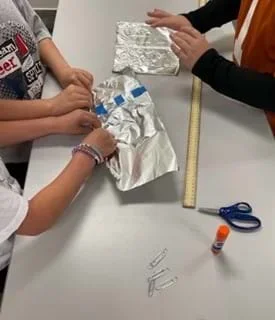 Students designing their aluminum rope.Copyright Danielle Woods, Yvette Dodd
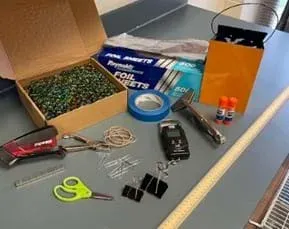 Supplies for teacher and students to use to create their ropes.Copyright 2023 Danielle Woods, Yvette Dodd
Part 2 (Day 1):
- Have students gather on the floor or return to their desks.
- Call on each pair (or group) of students to conduct the strength test with their rope in the front of the class. You may have the students help you conduct the test on their rope, or you may have the students lead in the testing of their own rope.
- Strength test:
- Measure the students’ rope. If the rope falls short of 40 centimeters, do not complete the strength test for that pair (or group). Kindly let them know that they did not meet the length requirement.
- Carefully attach a very strong clamp or a sheet metal vise grip to the opposite end of the students’ binder clip and S hook.
- Hang the lightweight bucket from the S hook on the opposite end of the strong clamp or sheet metal vise grip.
- The rope, clamp, and bucket should hang freely above the ground.
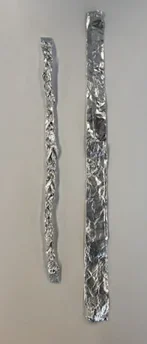 Two examples of possible foil ropes.Copyright 2023 Danielle Woods, Yvette Dodd
 - Add marbles or weights to the bucket, or have one of the students do so. Continue adding weight until the rope breaks.
- Once the rope breaks, gather the bucket and marbles that fell on the floor and put the marbles back in the bucket.
- Measure the weight of the bucket and marbles using a digital scale or a fish scale.
- Record the weight in the table on the whiteboard or smartboard (that you created before the activity):
Student Group: | Length of rope (cm): | Weight supported (gram-force): |
|
|
|
- Review with the class that the point at which the rope breaks is called the fracture point.
- Have a brief class discussion about what caused the rope to break. Where did the fracture or tear originate?
- Have students record their results in their engineering notebook using the chart above.
- Follow this same strength test for the remaining pairs (or groups) of students.Strength test example.Copyright 2023 Danielle Woods, Yvette Dodd
Part 3 (Day 2):
- Inform the students that they will be able to redesign their ropes!
- Add three columns to the chart, so that it resembles the following:
Student Group: | Length of rope #1 (cm): | Weight supported #1 (gram-force): | Length of rope #2 (cm): | Weight supported #2 (gram-force): | Improvement? Yes or No |
|
|
|
|
|
|
- Repeat the following steps from Part 1:
- Inform the students that their rope MUST be at least 40 centimeters long.
- Use your method of supply distribution and ensure that each pair (or group) of students has their sheets of aluminum foil, large binder clip, and S hook.
- Ensure that students have access to a stapler with staples, paperclips, hole punch, tape, scissors, and glue sticks.
- Inform the students that they will have 15 minutes to redesign and build their rope.
- Have students brainstorm how they want to redesign their rope. They should sketch their rope redesign in their engineering notebook.
- Encourage students to redesign their rope using the provided materials.
- Set a timer for 15 minutes and let students start creating.
- As students are creating their ropes, walk around the classroom and BRIEFLY ask your students about their designs (remember, they only have 15 minutes).
- After the alarm has gone off, have students drop everything.
- Tell students to return their supplies to their designated locations.
Part 4 (Day 2):
- Repeat the strength test for each pair’s (or group’s) redesigned rope and fill in the rest of the chart:
Student Group: | Length of rope #1 (cm): | Weight supported #1 (gram-force): | Length of rope #2 (cm): | Weight supported #2 (gram-force): | Improvement? Yes or No |
|
|
|
|
|
|
- As you wrap up each pair’s (or group’s) strength test, be sure to ask them if there was an improvement to the strength of their aluminum rope based on the data recorded. Answer Yes or No to the Improvement question in the table.
- After you have recorded all of the pairs’ (or groups’) data on the white board or smartboard, have students answer the following questions in their engineering notebooks:
- Did your rope break in the first iteration?
- Why do you think it broke?
- What did you do to improve your rope? Explain your thinking.
- Did your rope break in the second iteration?
- Why do you think it broke?
- What did you do to improve your rope? Explain your thinking.
- Finally, either in class or as homework, have students reflect on the science concepts they explored and/or the science and engineering skills they used by completing the Making Sense Assessment (PDF).
- alloy
- A metallic substance composed of two or more elements.
- design
- To form or conceive in the mind; to make drawings, sketches or plans for a work; to make a new product; to plan how to improve a process.
- engineer
- A person who applies their understanding of science and mathematics to creating things for the benefit of humanity and our world.
- fracture
- The failure of a solid body by separation into at least two pieces.
- joint
- The connection between two structural parts.
- tension
- The state of a solid body subjected to forces that tend to pull it apart.
Pre-Activity Assessment
Brainstorming: In small groups, pass out different types of metal pieces. This can include actual metals such as aluminum, copper wire, brass weights, and other metals you can find around your classroom. Students will record their observations in their engineering notebooks. They will draw diagrams and include which pieces they believe are the heaviest and most durable. They will predict which object they believe will land on the ground first when dropped at the same time (refer to Newton’s law of gravitation). Their predictions and observations will be noted in their engineering notebooks.
Activity Embedded (Formative) Assessment
Hands-On Design Activity: Students use the engineering design process to create an aluminum rope that can hold the most weight possible.
Teacher Walk-Around: While students plan, design, and build their aluminum ropes, walk around the classroom and BRIEFLY ask the students about their designs.
Engineering Notebooks: Students report their observations, sketch their designs, and record their testing results in their engineering notebook.
Post-Activity (Summative) Assessment
Reflection Questions: Students write down their reflections in their engineering notebooks.
Ask students to think about how successful their metal rope was and then answer the following reflection questions:
- Did it break?
- Why do you think it broke?
- What can you do to improve your rope?
Conclusions: Have students write and explain how they created their metal rope and then explain what changes they would make to improve their design.
Group Participants | Diagram of Metal Rope | Results | What improvements can I make to my rope? |
|
|
|
|
Making Sense Assessment: Have students reflect on the science concepts they explored and/or the science and engineering skills they used by completing the Making Sense Assessment (PDF).
- Make sure you have enough supplies for the class to do this activity twice. Due to the nature of foil, students will be unable to recycle their first creation.
- Students will have the option to cut their foil to create their ropes. Ensure that students are being safe with their scissors. There may be a small chance that a student could cut themselves with the foil.
- If you have a competitive class, this activity might cause some conflict in the classroom. Advise students that they are in competition with themselves and that the purpose of the activity is to increase the weight that their rope can hold.
- For lower grades, you can have students use one piece of foil.
- For upper grades, you can have students use more than two pieces of foil and implement a longer rope standard.
AlexandraLPC. “5 Most Popular Types of Metals & Their Uses.” Texas Iron and Metal, 1 Apr. 2021, www.texasironandmetal.com/most-popular-metal-types/.
Callister, William D., and David G. Rethwisch. Materials Science and Engineering: An Introduction. Willey, 2020.
“Find Definitions Written for Kids.” Merriam-Webster, www.merriam-webster.com/kids. Accessed 3 July 2023.
Periodic Table – Royal Society of Chemistry, www.rsc.org/periodic-table. Accessed 3 July 2023.
“Team.” Steel Fabrication Melbourne, 16 Feb. 2023, www.austgen.com.au/how-is-metal-made.
“What Does a Metallurgist Do, Exactly?” Study, study.uq.edu.au/stories/what-does-metallurgist-do-exactly. Accessed 3 July 2023.
“What Is a Metallurgist?” EnvironmentalScience.Org, www.environmentalscience.org/career/metallurgist. Accessed 3 July 2023.
Contributors
Danielle Woods; Yvette Dodd; Dr. Eric Taleff; Dr. Jeremiah McCallister; Tommy Bennett; Monica Martinez
Supporting Program
Research Experience for Teachers (RET), The Material Science and Engineering Department, University of Texas at Austin
Acknowledgements
This curriculum was developed under National Science Foundation RET grant no. DMR-1720595— Center for Dynamics and Control of Materials at the University of Texas at Austin. Any opinions, findings, and conclusions or recommendations expressed in this material are those of the authors and do not necessarily reflect the views of the National Science Foundation.
Copyright
2024 by Regents of the University of Colorado; original © 2023 University of Texas at Austin