
Exploring Density Solutions Using the Engineering Design Process
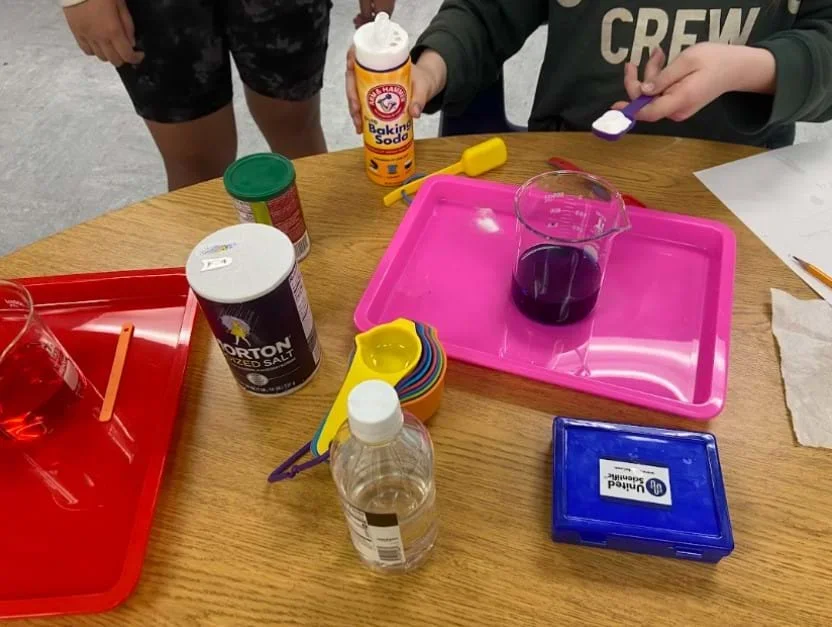 Students creating one of their solutions.Copyright Elizabeth Schuster
In this activity, students explore engineering concepts through hands-on experiments with density, mass, and weight. They are introduced to the engineering design process and work in groups to test blocks that sink or float in water, and they conduct research on the differences between mass, weight, and density. Students then brainstorm and plan the creation of three distinct mixtures, each with different densities, while adhering to specific constraints. After creating and testing their mixtures, they observe the results and make improvements based on their findings. The activity concludes with students reflecting on their process and completing an assessment to demonstrate their understanding.
Chemical engineers frequently design processes that involve mixing substances to create solutions or products with specific properties, such as the right density for separation or reaction. The activity mirrors the work of chemical engineers, who must understand how different materials interact, how to manipulate those interactions to achieve desired outcomes, and how to operate within constraints such as material properties and quantity.
After this activity, students should be able to:
- Design and create mixtures using the engineering design process.
- Test the relative density of mixtures.
- Evaluate whether a mixture is a solution.
- 3-5-ETS1-1 Define a simple design problem reflecting a need or a want that includes specified criteria for success and constraints on materials, time, or cost.
Grades 3-5
This resource focuses on the following Three Dimensional Learning aspects of NGSS:
Science & Engineering Practices- Define a simple design problem that can be solved through the development of an object, tool, process, or system and includes several criteria for success and constraints on materials, time, or cost.Do you agree with this alignment?
Disciplinary Core Ideas- Possible solutions to a problem are limited by available materials and resources (constraints). The success of a designed solution is determined by considering the desired features of a solution (criteria). Different proposals for solutions can be compared on the basis of how well each one meets the specified criteria for success or how well each takes the constraints into account.Do you agree with this alignment?
Crosscutting Concepts- People's needs and wants change over time, as do their demands for new and improved technologies.Do you agree with this alignment?
Do you agree with this alignment? - Define a simple design problem that can be solved through the development of an object, tool, process, or system and includes several criteria for success and constraints on materials, time, or cost.
- 3-5-ETS1-3 Plan and carry out fair tests in which variables are controlled and failure points are considered to identify aspects of a model or prototype that can be improved.
Grades 3-5
This resource focuses on the following Three Dimensional Learning aspects of NGSS:
Science & Engineering Practices- Plan and conduct an investigation collaboratively to produce data to serve as the basis for evidence, using fair tests in which variables are controlled and the number of trials considered.Do you agree with this alignment?
Disciplinary Core Ideas- Tests are often designed to identify failure points or difficulties, which suggest the elements of the design that need to be improved.Do you agree with this alignment?
- Different solutions need to be tested in order to determine which of them best solves the problem, given the criteria and the constraints.Do you agree with this alignment?
Do you agree with this alignment? - Plan and conduct an investigation collaboratively to produce data to serve as the basis for evidence, using fair tests in which variables are controlled and the number of trials considered.
- 5-PS1-2 Measure and graph quantities to provide evidence that regardless of the type of change that occurs when heating, cooling, or mixing substances, the total weight of matter is conserved.
Grade 5
This resource focuses on the following Three Dimensional Learning aspects of NGSS:
Science & Engineering Practices- Measure and graph quantities such as weight to address scientific and engineering questions and problems.Do you agree with this alignment?
Disciplinary Core Ideas- The amount (weight) of matter is conserved when it changes form, even in transitions in which it seems to vanish.Do you agree with this alignment?
- No matter what reaction or change in properties occurs, the total weight of the substances does not change. (Boundary: Mass and weight are not distinguished at this grade level.)Do you agree with this alignment?
Crosscutting Concepts- Science assumes consistent patterns in natural systems.Do you agree with this alignment?
- Standard units are used to measure and describe physical quantities such as weight, time, temperature, and volume.Do you agree with this alignment?
Do you agree with this alignment? - Measure and graph quantities such as weight to address scientific and engineering questions and problems.
- collect, record, and analyze information using tools, including calculators, microscopes, cameras, computers, hand lenses, metric rulers, Celsius thermometers, prisms, mirrors, pan balances, triple beam balances, spring scales, graduated cylinders, beakers, hot plates, meter sticks, magnets, collecting nets, and notebooks; timing devices, including clocks and stopwatches; and materials to support observations of habitats or organisms such as terrariums and aquariums; and
Grade 5
Do you agree with this alignment? - classify matter based on physical properties, including mass, magnetism, physical state (solid, liquid, and gas), relative density (sinking and floating), solubility in water, and the ability to conduct or insulate thermal energy or electric energy;
Grade 5
Do you agree with this alignment? - demonstrate that some mixtures maintain physical properties of their ingredients such as iron filings and sand; and
Grade 5
Do you agree with this alignment? - identify changes that can occur in the physical properties of the ingredients of solutions such as dissolving salt in water or adding lemon juice to water.
Grade 5
Do you agree with this alignment?
Each student needs:
Each group needs:
- 1 box of food coloring with at least three different colors
- 1 set of measuring spoons
- 1 set of measuring cups
- stirring rods (or spoons)
- 3 glass beakers (500 mL)
- wooden, metal, and plastic blocks of various densities
- rulers
For the entire class to share:
- water
- milk
- salt
- sand
- cocoa powder
- baking soda
- cornstarch
- flour
- sugar
- vinegar
- lemon juice
- vegetable oil
- digital mass scale
Students should:
- Know the three basic states of matter.
- Be able to differentiate between what constitutes a mixture and a solution.
- Be familiar with density and relative density.
Have you ever wondered why some things float in water, while others sink? Engineers often ask questions like this when they design things such as boats, submarines, or even new kinds of materials.
In this activity, you'll become chemical engineers and explore what makes objects sink or float by experimenting with different materials. You'll also learn about important ideas such as density, mass, and weight, which help us understand why some things are heavier or lighter, even if they're the same size. By the end, you'll be able to create your own mixtures with different densities using the engineering design process, just like chemical engineers do when they design new products or processes! Let’s dive into the world of engineering and discover how science helps us solve real-world problems!
Background
The main difference between a mixture and a solution lies in how the substances are combined, and their properties:
- Mixture: A mixture is a combination of two or more substances that are physically combined but not chemically bonded. The individual components retain their own properties and can usually be separated by physical means, such as filtering or sorting. Mixtures can be homogeneous (uniform throughout) or heterogeneous (not uniform; the different substances can be seen).
- Solution: A solution is a specific type of mixture where one substance (the solute) is completely dissolved in another substance (the solvent), creating a homogeneous mixture. In a solution, the solute particles are distributed at the molecular level, so it looks uniform and cannot be separated by physical means such as filtering. An example of a solution is salt water, where salt is dissolved in water.
In summary, although all solutions are mixtures, not all mixtures are solutions. Solutions are uniform and consist of dissolved substances, whereas mixtures can be either uniform or non-uniform and consist of substances that can often be separated.
Before the Activity
- Collect the materials for the activity and have them ready for student use.
- Make copies of the Exploring Density Solutions Worksheet (PDF). (one per student)
- Prepare to project the Density Solutions Engineering PowerPoint (PPTX) in presentation mode, starting on Slide 3, “What is Engineering?”
With the Students
Day 1
Introduction: (15 min)
- Project the Density Solutions Engineering PowerPoint (PPTX) for the class to see.
- Read the title of Slide 3: “What is Engineering?”
- Have one student volunteer to read the response to the prompt.
- Lead the class to brainstorm specific things that engineers might design and create that are not on that list. (Potential answers: bridges, cars, airplanes, roller coasters, computers, phones, robots, medical devices, solar panels, wind turbines, packaging for food, water filters, video games, etc.) Encourage students to be open-minded and think outside of the box.
- Jot the student responses on chart paper or a dry erase board under the heading “What do engineers design?”
- Show Slide 4 and read its title, “What is an Engineer?” Have a volunteer read the description of what an engineer is.
- Show Slide 5 and read its title, “How Does Engineering Happen?” As a class, read and discuss the engineering design process diagram on Slide 5.
- Show the class the video “Crash Course: The Engineering Process” (5:16 minutes).
Ask: (20 min)
- Give each student an Exploring Density Solutions Worksheet (PDF).
- Tell students that they will be designing specialized mixtures with different densities for this activity.
- Ask the class: “What makes objects sink or float?”
- Let students share their thoughts.
- Remind the class that engineers find out how things work, and that today they are going to become engineers and explore what makes objects sink or float in water.
- Split the class into groups of 2-3 students.
- Give each group a 500 mL beaker.
- Have each group fill their beaker with water up to the 300 mL mark.
- Pass out the density blocks.
- Give groups 10 minutes to use the density blocks to explore what makes those different blocks sink or float.
- Let students use their rulers and the mass scale to find the blocks’ mass and weight.
- Have students record their observations and reflections in complete sentences in the “Ask” section of the Exploring Density Solutions Worksheet (PDF).
Research: (15 min)
- Pose this question to students: “What is the difference between mass, weight, and density?”
- Have students use their school’s online research resources and/or their science textbooks to find out what mass, weight, and density are, and how they are different.
- Have students record their findings in their “Research” section of their Exploring Density Solutions Worksheet (PDF).
- Bring the class back together to discuss the students’ findings as a class.
- Discuss the following concepts:
- Density (Answer: Density is the amount of mass [or matter] packed into a specific space or volume. It helps explain why some objects are heavier than others, even if they're the same size. If an object has a high density, it has a lot of mass in a small space, while a low-density object has less mass in the same amount of space. Density is often used to determine whether something will float or sink in water.)
- Relative density (Answer: Relative density is a way to compare the density of one substance to the density of another, usually water. It helps us understand whether something will float or sink. If an object has a relative density less than 1, it will float in water because it’s less dense than water. If its relative density is more than 1, it will sink because it’s denser than water. Relative density helps us compare how heavy or light something is compared to water or another material.)
- Weight (Answer: Weight is the force that gravity exerts on an object, which depends on both the object's mass and the strength of the gravitational pull acting on it. It tells us how heavy something is. Weight is typically measured in units such as pounds or kilograms. For example, if you weigh yourself on Earth, your weight is the result of Earth's gravity pulling down on your mass. If you were on the moon, you would weigh less because the moon's gravity is weaker than Earth's, even though your mass would stay the same.)
- Mass (Answer: Mass is the amount of matter or "stuff" that makes up an object. It tells us how much material is in something, no matter where it is. Unlike weight, which can change depending on gravity (such as on the moon), mass stays the same everywhere. Mass is measured in units such as grams or kilograms, and it's what makes things heavy or light. The more mass something has, the heavier it feels.)
- Make sure all students have a clear understanding of these terms, and make sure they can differentiate between density, mass, and weight.
Day 2
Imagine: (20 minutes)
- Have students pull out their Exploring Density Solutions Worksheet (PDF).
- Tell students that, based on their previous research, they are now going to imagine/brainstorm how they can create different solutions, each with a different density.
- Ask the students: “How would you design and test these solutions?” Encourage students to think outside of the box, and to not be afraid of coming up with ideas that might not work.
- Have students individually come up with 5-6 brainstormed ideas.
- Have students write their individual ideas in the “Imagine” section of their Exploring Density Solutions Worksheet (PDF).
Plan: (30 minutes)
- Tell students that in their groups they are going to design for three different mixtures. Tell them the following criteria:
- Each mixture must be a solution.
- Each mixture must contain three ingredients.
- Each mixture must be 300 mL.
- Each mixture must have a different density.
- Highlight the idea of constraints. Make sure students know that the constraints of their activity are the materials they have available to work with. Tell them that engineers must operate within the constraints of the materials, budget, and time.
- Have students share their brainstormed ideas with their group.
- Have each group choose three ideas (or a mixture of ideas) to design.
- Tell students to add a different color of food coloring to each mixture, to help keep track of which mixture is which.
- Have students record their groups’ planned mixtures in their Exploring Density Solutions Worksheet (PDF), making sure to write a materials list and a procedure for each of the three mixtures they will design.
- Have students brainstorm as a team how they plan to test the relative densities of their mixtures. (If any group gets stumped on this, remind them about their initial “Ask” exploration of density.) (Note: This is another student-driven process, in which your main function is to manage behavior and respond to student inquiries.)
- Have students write down how they will test the relative densities of their mixtures in the “Test” section of their Exploring Density Solutions Worksheet (PDF).
Day 3
Create: (15 minutes)
- Give students 15 minutes to use their planned materials and procedures to create their mixtures. (This should be a student-driven process, with you providing guidance as needed.)
- Make sure students know that each mixture will go into a separate beaker.
- Remind students to use the correct color for each mixture.
- When their mixtures have all been created, have students make observations and record them in their worksheets.
- Have students note whether each mixture became a solution.
Students creating one of their solutions.Copyright Elizabeth Schuster
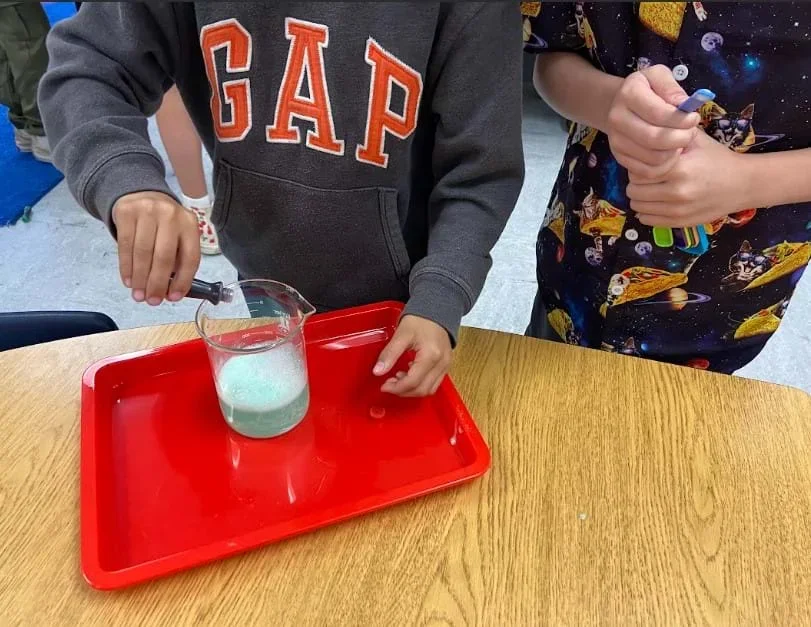 Students adding food coloring to one of their solutions.Copyright Elizabeth SchusterTest: (15 minutes)
- Give students 15 minutes to test their mixtures and write down their observations.
- Make sure students write down their observations of each of their tests in the “Test” section of their Exploring Density Solutions Worksheet (PDF).
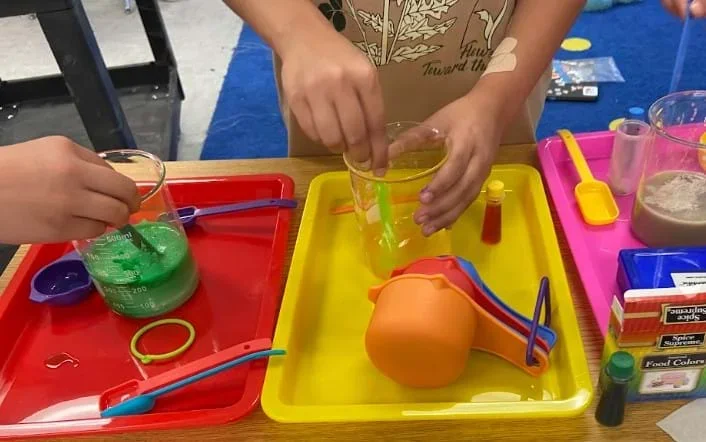 Students stirring ingredients in their solutions.Copyright Elizabeth Schuster
Improve: (10 minutes)
- Tell students that now they are going to do what real engineers do, and use the results of their hands-on experiments to make an improvement on what they made.
- Ask the students: “Did each mixture have a different density? How could you tell? If not, what can you change next time?” Have them discuss and record their responses in their Exploring Density Solutions Worksheet (PDF).
- Ask the students: “Was each mixture a solution? How could you tell? If not, what can you change next time?” Have them discuss and record their responses in their Exploring Density Solutions Worksheet (PDF).
- Have students record their reflections about this activity in their Exploring Density Solutions Worksheet (PDF).
Activity Exit Ticket (10 minutes)
- Have students complete the Making Sense Assessment (PDF).
- mixture
- A combination of two or more substances.
- solution
- A special type of mixture in which one substance (solute) is dissolved evenly into another substance (solvent).
- solute
- The substance in a solution that is dissolved by another substance.
- solvent
- The substance in a solution that dissolves another substance.
- density
- A physical property that measures how closely packed together a substance's particles are.
- relative density
- How the density of one material compares to the density of another material.
- beaker
- A glass container with a flat bottom used to hold and measure liquids.
- volume
- The amount of space something takes up.
Pre-Activity Assessment
The pre-assessment comprises student responses in the “Ask” section of their Exploring Density Solutions Worksheet (PDF). This pre-assessment gauges their existing understanding of density, mixtures, and solutions.
Activity Embedded (Formative) Assessment
The formative assessment comprises student responses in the “Research,” “Imagine,” and “Create” sections of their Exploring Density Solutions Worksheet (PDF). This will allow you to gauge each student’s level of participation and understanding.
Post-Activity (Summative) Assessment
The performance-based summative assessment comprises student responses in the “Test” and “Improve” sections of their Exploring Density Solutions Worksheet (PDF). These reflective responses will demonstrate their understanding of the physical properties of their mixtures, and require them to utilize the engineering design process.
Activity Exit Ticket: Have students complete the Making Sense Assessment (PDF).
Because this is a student inquiry lesson in which students design mixtures and tests to evaluate relative density, not every group will use the exact same materials or procedures.
Remind students that in real life, engineers are constrained by the materials they have available. Likewise, as student engineers, they are constrained by the materials that their particular group has available.
Special needs students who require modifications to be able to participate in this activity can complete their Exploring Density Solutions Worksheet (PDF)using drawings and photographs rather than words.
Student groups create the new and improved mixtures that they wrote about in the “Improve” section of their Exploring Density Solutions Worksheet (PDF). They test those improved mixtures to see if they actually fulfill the anticipated real-life applications.
Contributors
Elizabeth Schuster; Advika Kamatar; Zachary Wilborn; Risa Hartman
Supporting Program
Research Experience for Teachers (RET), The Material Science and Engineering Department at the University of Texas, Austin
Acknowledgements
This curriculum was developed under National Science Foundation through the Center for Dynamics and Control of Materials: an NSF MRSEC under Cooperative Agreement number DMR-1720595. Any opinions, findings, and conclusions or recommendations expressed in this material are those of the authors and do not necessarily reflect the views of the National Science Foundation.
Copyright
2024 by Regents of the University of Colorado; original © 2023 University of Texas at Austin