
Lens to Equality: DIY Microscope Challenge
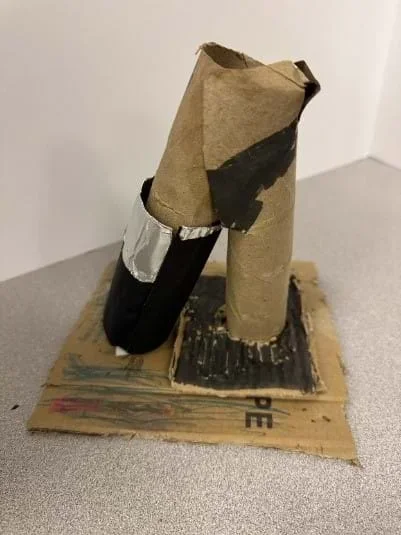 A student-created DIY Microscope using mostly repurposed materials.Copyright Larry McKenzie
Students design and construct a functional, budget-friendly microscope using lenses and a variety of accessible materials. Through this process, they investigate how light behaves as it travels through different media, gaining a deeper understanding of optical principles. As their exploration progresses, students enhance their comprehension of key concepts such as reflection, refraction, absorption, and the wave nature of light.
Engineers apply principles of light and optics to design and develop devices that address real-world challenges. Optical engineers, in particular, integrate physics, chemistry, and mathematics to create advanced technologies that manipulate light, including lenses, microscopes, telescopes, lasers, sensors, and fiber-optic communication systems. Their work is critical to advancing technologies such as solar energy, where light is converted into electricity, and enhancing microscopic imaging capabilities. In designing these systems, optical engineers must account for factors such as light wavelengths, reflection, refraction, absorption, lens materials, laser intensity, safety, cost, and overall efficiency. The contributions of optical engineers are essential and often underappreciated in our increasingly technology-driven world.
After this activity, students should be able to:
- Describe the behavior of light as it travels from one medium to another.
- Determine the paths of light when it is refracted through a medium.
- Draw and label a model of light traveling through a microscope.
- Use the engineering design process to solve the problem of building a budget-friendly microscope for students.
After the extension:
- Students should be able to model how light and sound travel through space through waves.
- Students should be able to compare and contrast transverse and longitudinal waves.
- CCSS.Math.Content.4.NBT.B.4 Fluently add and subtract multi-digit whole numbers using the standard algorithm.
Grade 4
Do you agree with this alignment? - CCSS.Math.Content.5.NBT.B.7 Add, subtract, multiply, and divide decimals to hundredths, using concrete models or drawings and strategies based on place value, properties of operations, and/or the relationship between addition and subtraction; relate the strategy to a written method and explain the reasoning used.
Grade 5
Do you agree with this alignment? - CCSS.Math.Content.6.NS.B.3 Fluently add, subtract, multiply, and divide multi-digit decimals using the standard algorithm for each operation.
Grade 6
Do you agree with this alignment?
- 3-5-ETS1-1 Define a simple design problem reflecting a need or a want that includes specified criteria for success and constraints on materials, time, or cost.
Grades 3-5
This resource focuses on the following Three Dimensional Learning aspects of NGSS:
Science & Engineering Practices- Define a simple design problem that can be solved through the development of an object, tool, process, or system and includes several criteria for success and constraints on materials, time, or cost.Do you agree with this alignment?
Disciplinary Core Ideas- Possible solutions to a problem are limited by available materials and resources (constraints). The success of a designed solution is determined by considering the desired features of a solution (criteria). Different proposals for solutions can be compared on the basis of how well each one meets the specified criteria for success or how well each takes the constraints into account.Do you agree with this alignment?
Crosscutting Concepts- People's needs and wants change over time, as do their demands for new and improved technologies.Do you agree with this alignment?
Do you agree with this alignment? - Define a simple design problem that can be solved through the development of an object, tool, process, or system and includes several criteria for success and constraints on materials, time, or cost.
- 3-5-ETS1-3 Plan and carry out fair tests in which variables are controlled and failure points are considered to identify aspects of a model or prototype that can be improved.
Grades 3-5
This resource focuses on the following Three Dimensional Learning aspects of NGSS:
Science & Engineering Practices- Plan and conduct an investigation collaboratively to produce data to serve as the basis for evidence, using fair tests in which variables are controlled and the number of trials considered.Do you agree with this alignment?
Disciplinary Core Ideas- Tests are often designed to identify failure points or difficulties, which suggest the elements of the design that need to be improved.Do you agree with this alignment?
- Different solutions need to be tested in order to determine which of them best solves the problem, given the criteria and the constraints.Do you agree with this alignment?
Do you agree with this alignment? - Plan and conduct an investigation collaboratively to produce data to serve as the basis for evidence, using fair tests in which variables are controlled and the number of trials considered.
- 4-PS4-2 Develop a model to describe that light reflecting from objects and entering the eye allows objects to be seen.
Grade 4
This resource focuses on the following Three Dimensional Learning aspects of NGSS:
Science & Engineering Practices- Develop models to describe phenomena.Do you agree with this alignment?
Disciplinary Core Ideas- An object can be seen when light reflected from its surface enters the eyes.Do you agree with this alignment?
Crosscutting Concepts- Cause and effect relationships are routinely identified.Do you agree with this alignment?
Do you agree with this alignment? - Develop models to describe phenomena.
- MS-PS4-2 Develop and use a model to describe that waves are reflected, absorbed, or transmitted through various materials.
Grades 6-8
This resource focuses on the following Three Dimensional Learning aspects of NGSS:
Science & Engineering Practices- Develop and use a model to describe phenomena.Do you agree with this alignment?
Disciplinary Core Ideas- A sound wave needs a medium through which it is transmitted.Do you agree with this alignment?
- When light shines on an object, it is reflected, absorbed, or transmitted through the object, depending on the object's material and the frequency (color) of the light.Do you agree with this alignment?
- The path that light travels can be traced as straight lines, except at surfaces between different transparent materials (e.g., air and water, air and glass) where the light path bends.Do you agree with this alignment?
- A wave model of light is useful for explaining brightness, color, and the frequency-dependent bending of light at a surface between media.Do you agree with this alignment?
- However, because light can travel through space, it cannot be a matter wave, like sound or water waves.Do you agree with this alignment?
Crosscutting Concepts- Structures can be designed to serve particular functions by taking into account properties of different materials, and how materials can be shaped and used.Do you agree with this alignment?
Do you agree with this alignment? - Develop and use a model to describe phenomena.
For the entire class to share:
- double convex lens 25 mm diameter transparent lens
- double convex lens 42 mm diameter transparent lens
- Nitrile disposable gloves
- cardboard (paper towel/toilet paper roll tubes)
- construction paper (black)
- markers/colored pencils
- aluminum foil
- other recyclable materials that can be brought from home by students (e.g., plastic fruit containers, cardboard boxes, etc.)
- plant leaves for samples
Each group will need:
- 1 roll of tape
- 1 ruler
- 1 pair of scissors
- glue
- 1 laser pointer LED flashlight
- 1 flashlight
- 1 prism
- 2-4 lenses
- 1 How do waves behave? Article
- 1 Microscope Diagram (PDF)
- 1 Decision Matrix (PDF)
- (optional) Household & Government Education Spending Graph (PDF) (1 per group or project digital version)
Each student needs:
- 1 Activity Packet (PDF)
- 2 copies of the Pre/Post Assessment (PDF)
- writing utensil
- Household & Government Education Spending Graph (pdf)
- How do waves behave? Article (pdf)
- Microscope Diagram (docx)
- Microscope Diagram (pdf)
- Materials Price List (docx)
- Materials Price List (pdf)
- Activity Packet (docx)
- Activity Packet (pdf)
- Activity Packet Answer Key (docx)
- Activity Packet Answer Key (pdf)
- Decision Matrix (docx)
- Decision Matrix (pdf)
- Pre/Post Assessment (docx)
- Pre/Post Assessment (pdf)
- Pre/Post Assessment Answer Key (docx)
- Pre/Post Assessment Answer Key (pdf)
- PHET Extension (docx)
- PHET Extension (pdf)
Students should:
- Understand that electricity can travel in a closed circuit and can produce energy and light.
- Be familiar with light ‘bending’ and ‘bouncing’.
- Have some knowledge of financial literacy, including the concept of budgeting.
- Have the ability to add and subtract decimal numbers to the hundredth place.
Today, we're going to start by looking at a graph about how much money different countries spend on education. Look at the Household & Government Education Spending Graph (PDF). The graph shows where the money comes from—either from the government or from families at home. As you look at the graph, take some time to write down what you notice and what you wonder. Look closely at the title and the labels on the graph. For example, you might notice that the red and purple parts of the bars are different sizes. That’s important, because it tells us that in some countries, the government pays more for school, and in others, families have to pay more themselves.
Now, look at the countries where most of the money for school comes from families at home. What do you notice about those countries? What do you already know about them? You might think, "Maybe these countries don’t get much money from their government." That’s a good observation. Many of these countries are also poorer, which means families may struggle to pay for school.
If these countries are poorer, what other problems do you think people there might face? Think about things like housing, clean water, or access to technology. What might life be like for students in those places? Maybe they don’t have schools nearby, or they can’t get there easily. They might not have school supplies or even electricity. Their school experience could be very different from ours.
Next, we’re going to watch a TED Talk by Manu Prakash, an engineer and inventor who cares a lot about education in these countries. While you watch, keep writing down what you notice and wonder—especially how the video connects to the graph we just studied, and how we might help solve some of these problems.
In the video, you’ll hear about people getting sick but not knowing why—because the thing making them sick is too small to see. Given that many of these countries don’t have much money, what could we invent to help? Think of an idea in your head, then share it with your team. After everyone shares, you can raise your hand if you’d like to tell the class.
Some of you might say, “We could create a tool to help people see small things.” That’s a great idea! What kinds of tools help us do that? You might think of magnifying glasses, microscopes, or telescopes. But since these countries don’t have a lot of money, we’ll need to think about how to make a cheap or budget-friendly version of a microscope.
Talk with your team: How could we create a microscope using low-cost materials or reused items? What did your group come up with? Maybe you said we could use simple plastic lenses or pieces of old cameras. That’s a great start!
Now, let’s think about what a microscope needs in order to work. Most microscopes use lenses to magnify small objects. They often have a light, and they show us a clear image. So, what do we need to learn or research before we start building one ourselves? Maybe we need to understand how lenses work, how magnification happens, and how to focus light to make small things appear larger.
You’re doing a great job thinking like engineers! We’ve figured out the problem and what we need to research. Now let’s work together to write a guiding question—one big question that will help lead our design and learning. For example: How can we design a low-cost, working microscope to help students in low-resource areas see the tiny things that might be making them sick?
Background
How does a DIY microscope work? It works simply by bending the light rays as they enter the lens, passing from one medium (air) to another (lens). This bending is also referred to as refraction, where the angle of the path of the light has been changed. If the medium were a prism, then the light rays would be bent in such a way that they would be separated into their spectrums. However, for this activity, we are focusing on using lenses, not prisms.
The type of lens will also determine how the light is bent. For example, if you have a concave lens, the light rays tend to be spread, which is why these lenses are also called divergent lenses. On the other hand, if you have a convex lens, it will focus the light rays to what is called a focal point; these are referred to as convergent lenses. As for the lens material itself, there can be a variety of materials. In the past, lenses were typically made from glass, but now most lenses are made out of clear plastic. You can also make lenses out of unconventional items such as clear gelatin and even water.
When combining lenses to create a simple compound microscope, it’s useful to know the focal point of the lenses that you are working with. If they are lenses that have been purchased, the focal point should be listed as part of the information for the lens. If they are lenses that you already have in your classroom and the information is not available, then you can either calculate it using a formula or experiment and measure the distances where there is decent magnification and image resolution. This is essentially the process that we expect students to engage in as
they play with the lenses and think of possible designs for their microscope. Once the distance is determined, then the other aspect of building the microscope is the housing material and how to secure the lenses in the housing. Depending on the materials you provide for the students, this can be done in any number of ways. The most basic way is using tape to affix the lenses to the body of their microscope.
Before the Activity
- Gather building materials for each group.
- Collect plant leaves (tree, bush, etc.) so each group has a leaf as a sample.
- Make copies of:
- Activity Packet (PDF)(1 per student)
- Pre/Post Assessment (PDF) (2 per student)
- (optional) Household & Government Education Spending Graph (PDF) (1 per group or project digital version)
- How do waves behave? Article (PDF) (1 per group)
- Microscope Diagram (PDF) (1 per group)
- Decision Matrix (PDF)(1 per group)
During the Activity
Day 1
Pre-Assessment:
- Distribute the Pre/Post Assessment (PDF) to each student.
- Give students time to complete the assessment.
Engineering Design Process
- Introduce (or review) the steps of the engineering design process.
- Divide the class into groups of three or four students.
- Give one Activity Packet (PDF) to each student.
Ask:
- Direct groups to identify questions that could help solve the equality problem, starting with “How can we...?”
- Direct groups to share and come to a class consensus on the guiding question.
- Direct students to write guiding questions in their packets.
Research:
- Hand out research materials to each group: the Microscope Diagram (PDF), different lenses, prism, and the Newsela Microscope Article (PDF).
- Direct students to the research portion of the packet and have them read over the questions they are trying to answer while they research.
- Have students split up the research and begin working to answer the research questions in the packet.
- Have students to compare their findings with other teams.
- Facilitate a discussion over findings while researching.
Day 2
Imagine:
- Direct students' attention to the supplies available to build.
- Ask them to turn to the criteria and constraints section in their activity packet.
- Have students discuss as a group any other criteria or constraints that should be added, and how they will impact their microscope build.
- Direct students to the Imagine portion of their packet. For the next 5 minutes, have students draw and label a model of a budget-friendly microscope that shows the light traveling through it.
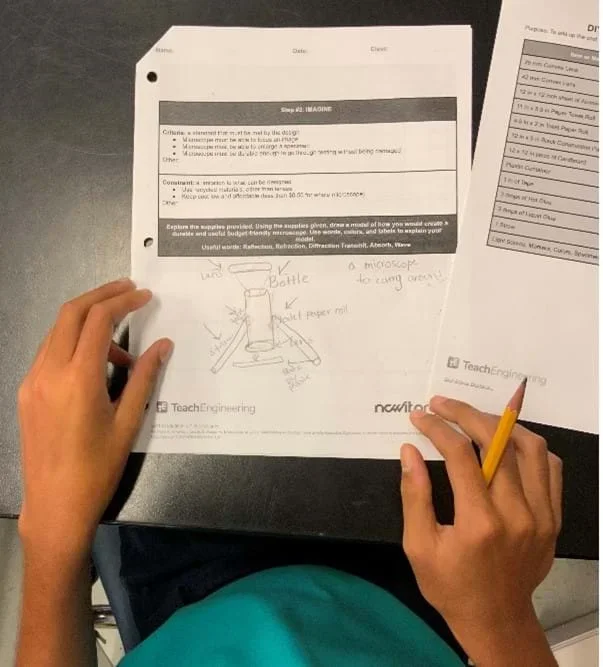 A student sketching and designing a DIY microscopeCopyright Larry McKenzie
Plan:
- Hand out a Decision Matrix (PDF) to each group.
- Go over expectations and have students come to a consensus on the microscope model they would like to build as a group.
- Give students time to work in their groups to design a consensus microscope model that shows the light traveling through it.
Create (Part 1):
- Remind students about the criteria and constraints.
- Have students split up the work.
- Send one student to get supplies.
- Have students begin making their model.
Day 3
Create (Part 2):
- Remind students about the criteria and constraints.
- Give them 20 minutes to finish building their model.
Test:
- Have students line up to go outside and collect leaf samples. Then, come back inside to begin testing their microscopes.
- Direct students to the Test section in their packet.
- Discuss the three areas students will need to test: durability, image resolution, and cost.
- Have each group calculate the overall cost of their microscope and add it to their packet.
- Have groups trade microscopes and instruct the other group to test the durability and image resolution.
- While testing, ask each group to come up with feedback for the microscope they are testing: 2 stars (things they thought worked well) and 1 wish (one thing they may want to improve).
- Have students share findings with paired groups and update their packet scores.
- Have students share some of their findings and feedback.
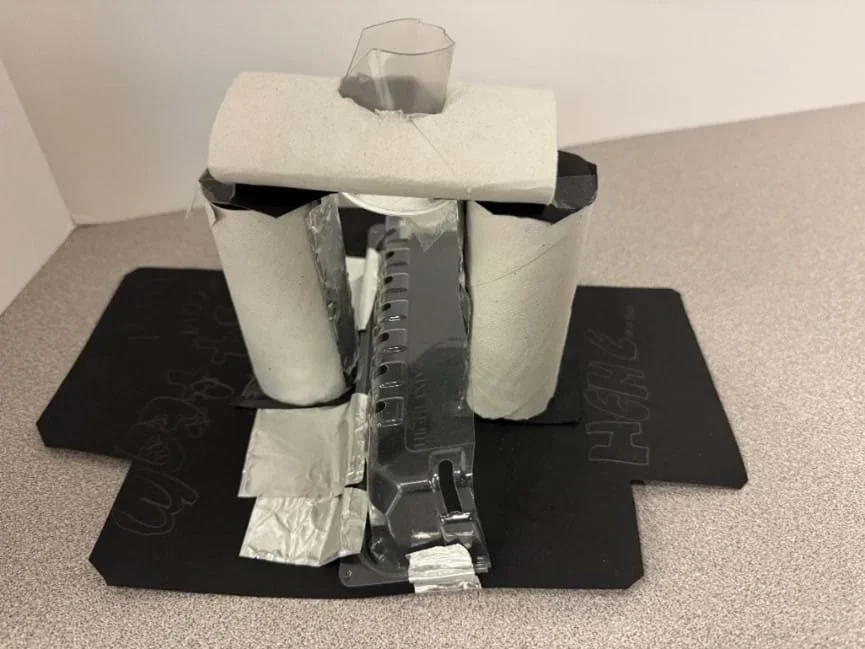 A student-created DIY Microscope using mostly repurposed materials.Copyright Larry McKenzie
A student-created DIY Microscope using mostly repurposed materials.Copyright Larry McKenzie
Day 4
Improve:
- Direct students to the Improve section in their packet. Have student groups decide on one or two design features they would like to improve.
- Have students make changes to their models.
- Direct students to the Reflection portion of their packet and complete it based on their experience.
Assess:
- Have students form a circle to discuss the advantages and disadvantages.
- Distribute a new copy of the Pre/Post Assessment (PDF) to each student.
- Have students complete the Pre/Post Assessment (PDF) to get a better understanding of student growth.
- absorption
- The act or process of absorbing, either liquid or light.
- reflection
- The property of a propagated wave being thrown back from a surface (such as a mirror).
- refraction
- The turning or bending of a wave, such as a light or sound wave, when it passes from one medium into another of different optical density.
- lens
- An object, usually made of glass, that focuses or defocuses the light that passes through it.
- optic
- A lens or other part of an optical instrument that interacts with light.
- concave
- Curved like the inner surface of a sphere or bowl.
- convex
- Curved or bowed outward like the outside of a bowl, circle, or sphere.
- microscope
- An optical instrument used for observing small objects.
- microscopy
- The use of microscopes.
- wave
- To cause to move back and forth repeatedly.
- light wave
- Forms of moving energy made of microscopic particles called photons.
Pre-Activity Assessment
Pre-Assessment: Students will complete the Pre/Post Assessment (PDF)individually to have baseline data on their knowledge before engaging in the activity. The assessment will have students complete a diagram of light traveling through a lens followed by a three or more-sentence description of how the light is behaving. Then the students write three or more explanations of how light travels through a microscope using the terms reflection, refraction, and absorption.
Activity Embedded (Formative) Assessment
Activity packet: Students will fill out the Activity Packet (PDF)as they progress through their project. At the end of the activity, students will turn in their packets for review.
Post-Activity (Summative) Assessment
Final Summative Model: Students will complete the Pre/Post Assessment (PDF) individually to have data on the growth of their knowledge after engaging in the lesson. The assessment will have students complete a diagram of light traveling through a lens followed by a three-or-more-sentence description of how the light is behaving. Then the students write a three-or-more-sentence explanation of how light travels through a microscope using the terms reflection, refraction, and absorption.
Because the students will be working with lasers, they need to be aware of the possible injuries to the eyes if they misuse the equipment; safety procedures must be reviewed.
The lasers will be used by passing the beam through different materials, and the students need to be aware of the path that the light will take and use caution to take the appropriate measures so the beam only goes where it’s supposed to go.
Using the plastic lenses suggested in the materials list shouldn’t pose a safety issue, but it would be a very good idea for students to handle the lenses with gloves on to avoid fingerprints on the lenses, which will affect image quality.
A common snag that students will encounter is the fact that they cannot see the laser beam until it strikes something, so they may be thinking that what they’re doing isn’t working, when in actuality the light is traveling. So part safety issue and part project issue is that it needs to be demonstrated that even though the laser beam is traveling in a straight line, they won’t see it until it strikes something. This is where things like light blocks will be useful for the students, so that they can verify that the light is traveling where it is supposed to be.
More than likely, for most groups, their first attempt to make a microscope based on the way light travels through convex lenses probably will not work or will not work as well as they hope. This is the perfect opportunity to bring in the failure aspect of engineering. Encourage them to troubleshoot their microscope and identify what problems they are having with their design. If groups are stuck trying to identify their issues, then give them some guiding questions regarding image quality, lens distances, etc.
Related to image quality, a reason why students would struggle with the microscope would be because the lenses are dirty from fingerprints or other contamination. If they are struggling with their image quality, have them check their optics to make sure they are free from contamination. If they are contaminated, then they will need to clean their lenses with lens paper.
6th-grade Extension:
- Day 5: PHET Extension (PDF)
- Ask students, how does light travel through space? (Answer: waves.) Discuss this with your team. What do you all think? Maybe, by using the air particles; by waves like radio waves do. Right, so how does light travel through a microscope and change to make an image? Take some time to write or draw some possible answers to the question. What do you think? I think the lens changes the path of the light like we saw when we played with the lenses. Do the lenses do anything else? How does the path of light get to one lens and then the next? Let’s take some time to explore this idea using a Slinky!
- Let students work in teams to complete the Slinky Lab.
- Debrief the questions with the class.
For lower grades:
- You can provide students with multiple video options on how to create DIY microscopes like the ones listed below:
- DIY Microscope: https://www.youtube.com/watch?v=Cyj6IB1DPdI
- How to make a simple microscope at home: https://www.youtube.com/watch?v=4V69YozxYMw
- How to make a microscope from cardboard: https://www.youtube.com/watch?v=J07k9IOuR0o
Focal Length of a Lens. (n.d.). http://hyperphysics.phy-astr.gsu.edu/hbase/geoopt/foclen.html
Global Education Monitoring Report 2019: Migration, Displacement, and Education – Building Bridges, not Walls. (2019). In UNESCO eBooks. https://doi.org/10.54676/zhfr5975
TED. (2014, March 7). Manu Prakash: A 50-cent microscope that folds like origami [Video]. YouTube. h8 https://www.youtube.com/watch?v=cF5QPPmWU
Marrison, J., Räty, L., Marriott, P., & O’Toole, P. (2013). Ptychography – a label-free, high-contrast imaging technique for live cells using quantitative phase information. Scientific Reports, 3(1). https://doi.org/10.1038/srep02369
Microscopes and Microscope Cameras | School Outfitters. (n.d.).
https://www.schooloutfitters.com/catalog/default/cPath/CAT530_CAT537?kw_cid=science%20microscopes&sc_cid=science%20microscopes-PPCsearch-p--SOMLONG1011423-ScienceFurniture-%28Microscopes%29Microscopes-MSN- &msclkid=e633f1d07b2e1c2b65ce9755d2a728b0
Nasa (2020). How do waves behave? Newsela (pp. 1–4). https://newsela.com
Kornilova, A., Kirilenko, I., Iarosh, D., Kutuev, V., & Strutovsky, M. (2021). Smart Mobile Microscopy: Towards Fully-Automated Digitization. In Lecture notes in networks and systems (pp. 617–635). https://doi.org/10.1007/978-3-030-89880-9_46
Zaira Mascardo. (2021, March 9). DIY MICROSCOPE [Video]. YouTube.
https://www.youtube.com/watch?v=Cyj6IB1DPdI
ScrewDriver. (2021, November 21). how to make a simple microscope at home [Video]. YouTube. https://www.youtube.com/watch?v=4V69YozxYMw
Genius Theory. (2024, January 30). How to make Microscope with cardboard | Science project 2024 [Video]. YouTube. https://www.youtube.com/watch?v=J07k9IOuR0o
Waves Intro. (n.d.). PhET. https://phet.colorado.edu/en/simulations/waves-intro
Contributors
Masen Huddleston; Larry McKenzie; Cristobal Lopez; Mark Jones; Veronica Romero; Catherine Jones
Supporting Program
Research Experience for Teachers (RET), University of Texas Austin
Acknowledgements
This curriculum was developed under National Science Foundation through the Center for Dynamics and Control of Materials: an NSF MRSEC under Cooperative Agreement number DMR-1720595. Any opinions, findings, and conclusions or recommendations expressed in this material are those of the authors and do not necessarily reflect the views of the National Science Foundation.
Copyright
2025 by Regents of the University of Colorado; original © 2024 University of Texas at Austin