
Drop the Ball: Learning About Material Physics, Motion, and Quadratics Through Sport Design
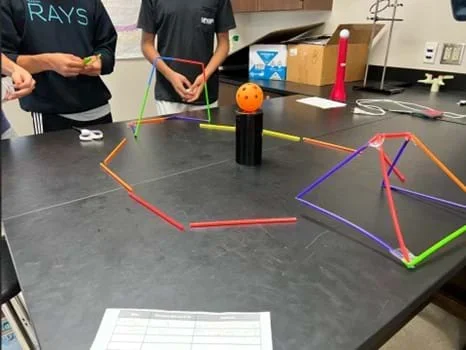 Example of student game.Copyright Tanima Mukherjee
Student groups take on the role of sports engineers as they invent a brand-new sport that features a ball and a bounce. First, they use the engineering design process to design the game, including custom rules, scoring methods, and equipment. Then, based on their game plan, they select a play surface and ball type from available classroom materials. Next, students conduct a "bounce test" to experiment with different combinations of balls and surfaces. Through this process, they explore the physical properties of materials and how they affect motion. To deepen their understanding, students apply mathematics to model and analyze motion, using quadratic equations to represent bounce behavior and interpret their results.
Sports engineers are constantly reimagining sports and equipment to push the limits of athletic performance. For example, they design golf clubs that maximize distance, analyze friction in bobsleds to build the fastest possible sleds, and redesign tennis racquets by considering factors such as surface tension and angular momentum to make the game faster and more accessible.
After this activity, students should be able to:
- Use regression methods available through technology to write and graph a quadratic function.
- Analyze the key attributes of a quadratic function (vertex, x-intercepts, axis of symmetry) in a real-world context.
- Understand and follow the steps of the engineering design process.
- Understand how materials interact with one another, depending on the texture, and how they affect freefall motion.
- CCSS.Math.Content.HSF-IF.C.7a Graph linear and quadratic functions and show intercepts, maxima, and minima.
Grades 9-12
Do you agree with this alignment? - CCSS.Math.Content.HSS-IC.B.5 Use data from a randomized experiment to compare two treatments; use simulations to decide if differences between parameters are significant.
Grades 9-12
Do you agree with this alignment?
- DCI.PS2.A.9-12.1 Newton's second law accurately predicts changes in the motion of macroscopic objects.
Grades 9-12
Do you agree with this alignment? - DCI.PS2.A.9-12.2 Momentum is defined for a particular frame of reference; it is the mass times the velocity of the object.
Grades 9-12
Do you agree with this alignment? - DCI.PS2.A.9-12.3 If a system interacts with objects outside itself, the total momentum of the system can change; however, any such change is balanced by changes in the momentum of objects outside the system.
Grades 9-12
Do you agree with this alignment? - HS-PS2-3 Apply scientific and engineering ideas to design, evaluate, and refine a device that minimizes the force on a macroscopic object during a collision.
Grades 9-12
This resource focuses on the following Three Dimensional Learning aspects of NGSS:
Science & Engineering Practices- Apply scientific ideas to solve a design problem, taking into account possible unanticipated effects.Do you agree with this alignment?
Disciplinary Core Ideas- Criteria and constraints also include satisfying any requirements set by society, such as taking issues of risk mitigation into account, and they should be quantified to the extent possible and stated in such a way that one can tell if a given design meets them.Do you agree with this alignment?
- Criteria may need to be broken down into simpler ones that can be approached systematically, and decisions about the priority of certain criteria over others (trade-offs) may be needed.Do you agree with this alignment?
- If a system interacts with objects outside itself, the total momentum of the system can change; however, any such change is balanced by changes in the momentum of objects outside the system.Do you agree with this alignment?
- Attraction and repulsion between electric charges at the atomic scale explain the structure, properties, and transformations of matter, as well as the contact forces between material objects.Do you agree with this alignment?
Crosscutting Concepts- Systems can be designed to cause a desired effect.Do you agree with this alignment?
Do you agree with this alignment? - Apply scientific ideas to solve a design problem, taking into account possible unanticipated effects.
- CCC.6.9-12.6 Investigating or designing new systems or structures requires a detailed examination of the properties of different materials, the structures of different components, and connections of components to reveal its function and/or solve a problem.
Grades 9-12
Do you agree with this alignment?
Each student needs:
- 1 Project Packet (PDF)(contains all the worksheets needed to complete the project)
- 1 Feedback Form (PDF) (used for the playtest portion of the activity)
- optional: access to Google Sheets or Microsoft Excel for plotting graphs (Data collected can be entered in Excel Graphs Sheet (XLSX)and the sheet will generate position-time graphs in forms of parabolas from the drop to first bounce, between first and second bounce, and between second and third bounce.)
- optional: plotting calculator (not necessary for the learning goals)
Each group needs:
- 1 laptop/tablet
- 1 graphing calculator (or a computer with access to Desmos)
- 1 meter stick or tape measure (use big font tape measures)
- 1 phone or camera (for slow-motion camera)
- (optional) 1 motion detector
For the class to share:
- laptop or computer with Internet access and a projector (to show YouTube videos)
- access to the following videos, which help students understand the engineering involved in designing sports and athletic equipment:
- Sports engineering video (6:45 minutes): https://www.youtube.com/watch?v=2xJ3q3q1i4c
- Unique sports video (9:46 minutes): https://www.youtube.com/watch?v=K4FAs95PM4s
- Tennis Lab (3:36 minutes): https://www.youtube.com/watch?v=9lQy78zAlFc
- Wilson “airless” basketball (0:55 minutes): https://www.youtube.com/shorts/7Lsk8qiZ7pE
- base and ball materials: A variety of base and ball materials should be provided for the class. Below is a list of possible materials with links to purchase and approximate prices for a class of 30 students. We recommend seeing what you have in the classroom, in your athletics department or at home before making any purchases. Most of these are common materials and don’t need to be purchased!
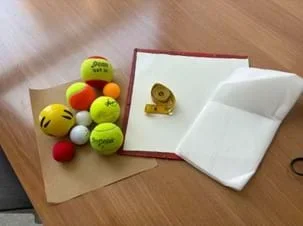 Example Materials.Copyright Faith Palombi
- Possible surface materials:
- Possible types of balls:
- Project Packet (docx)
- Project Packet (pdf)
- Feedback Form (docx)
- Feedback Form (pdf)
- Final Summative Poster (pptx)
- Final Summative Poster (pdf)
- Summative Poster Rubric (docx)
- Summative Poster Rubric (pdf)
- Formative Data Analysis Rubric (docx)
- Formative Data Analysis Rubric (pdf)
- Calculus Worksheet (docx)
- Calculus Worksheet (pdf)
- Calculus Worksheet Answer Key (docx)
- Calculus Worksheet Answer Key (pdf)
- (optional) Excel Graphs Sheet (xls)
- Final Summative Poster Example 1 (pdf)
- Final Summative Poster Example 2 (pdf)
Students should be familiar with:
- Solving algebraic equations, including linear and quadratic.
- Identifying ordered pairs and graphing.
- Concepts of position, time, velocity, and acceleration.
- Measuring position and time for an ongoing motion.
Is there any engineering in sports? How might different equipment or materials affect different sports? To explore those ideas, let’s check out this video about different playing surfaces in tennis. (Play this YouTube video [3:36 minutes] from Tennis Lab: https://www.youtube.com/watch?v=9lQy78zAlFc.)
What are some of your favorite sports? Have you experienced anything like what you saw in the video? (You can also bring up turf vs. grass in football, or playing basketball inside vs. outside.) All of these differences affect the game. There are sports engineers whose whole job is to create sports innovations. Every piece of sports equipment has been engineered for performance. ([Optional: Play this YouTube video [6:45 minutes] about sports engineering: https://www.youtube.com/watch?v=2xJ3q3q1i4c and then play this YouTube video about Wilson “Airless” Basketballs [0:55 minutes]: https://www.youtube.com/shorts/7Lsk8qiZ7pE.)
Today, you’ll become sports engineers with a fun challenge: invent a brand-new sport! You'll create original rules and design the equipment needed to play. Remember, your sport needs to be original! Check out this video on different sports around the world. (Play this YouTube video about unique sports [9:46 minutes]: https://www.youtube.com/watch?v=K4FAs95PM4s.)
You will need to create a prototype of your sport on your desks. (Note: You may have students use several desks pushed together, or a larger lab table.) Your game must include a ball that bounces at least once. The bounce can be on the base of the field or on an external tool that is interacting with the ball. A key part of your engineering design process will involve selecting a ball and a base. We will be studying different combinations of materials so that you can select the best one for your original game. Let’s get started!
Background
This activity focuses on creating freefall motion using different kinds of balls. Students drop various balls (e.g., tennis balls or ping pong balls) from a height and let them bounce on different materials (whiteboard, notepad, etc.) to create a freefall. They check the bounce height, time between bounces, and number of bounces for different combinations of balls and bases. The ball then bounces, and they check how the bounce height changes depending on the ball material and the base material.
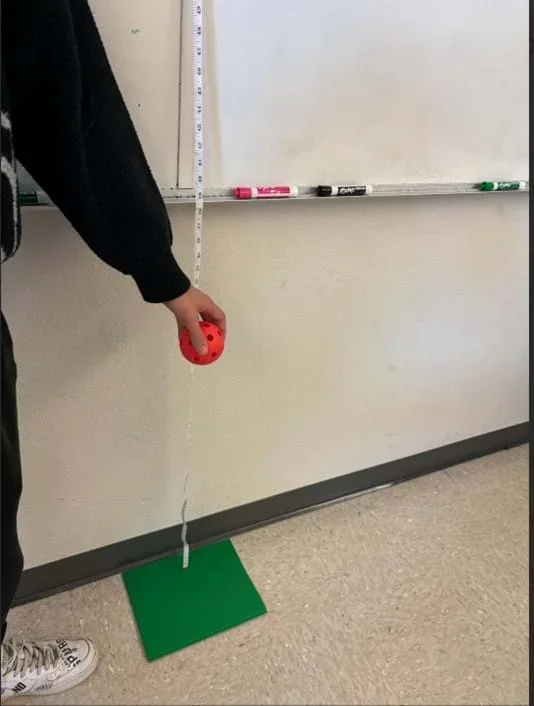 Students ready to drop the ball.Copyright Faith Palombi
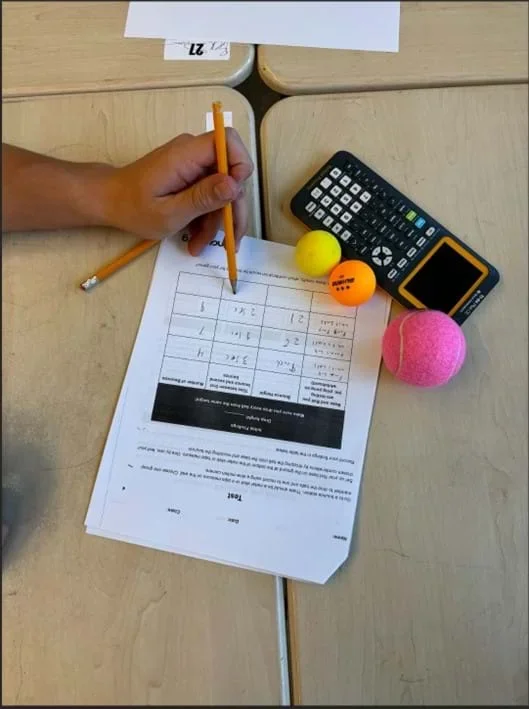 Students record data.Copyright Faith Palombi
Students can look at the bounce from a few different perspectives.
- They can study how velocity changes in a freefall motion.
- They can study how the momentum of the ball changes due to the interaction. They can compare how the material of the ball and the surface on which it is bouncing changes the output.
- They can look at how energy transformation works. They see dissipated energy as the objects interact, and it would be displayed by changes in the height of the bounces.
 Bounces modeled with quadratic regression.Copyright Faith Palombi
The motion of the bounce can be mathematically modeled as a quadratic equation. A quadratic is a U-shaped curve that can be modeled with an equation in the form of ax2 + bx + c. In the testing phase, students will collect data on position and time as the ball goes through the first two bounces. The quadratics can be modeled using three points using quadratic regression, which is the process of taking data points on the graph and turning them into an equation. We use technology to accomplish this, usually a graphing calculator or a preprogrammed Google sheet or Excel sheet. (Check out this video with instructions for the TI-84 and/or this video for instructions on Desmos online graphing calculator)
Quadratics have various properties that will correspond to real-world events. The vertex is where the projectile changes direction (for us, the highest point of the bounce, where the ball stops moving upward and starts moving downward). There are also x-intercepts, or roots, of the quadratic, where the equation crosses the x-axis. For this activity, these x-intercepts are where the ball touches the ground.
The following key concepts can be easily compared from math to physics in this activity:
- Relate vertex of the parabola to zero velocity and switching directions.
- The x intercepts of the parabola to the bouncing points.
- The height of the parabola can be used to calculate potential energy for the ball.
- The quadratic function can be used as a basic function to get velocity and acceleration of the system using derivatives.
Before the Activity
- Print out a Project Packet (PDF) for each student.
- Print out one Feedback Form (PDF) per group.
- Set up any videos you plan to show. (Note: These videos are optional; you can use whatever you have time for. They are tools to help your students start thinking about the engineering that goes into a sport.)
- Sports engineering video (6:45 minutes)
- Unique sports video (9:46 minutes)
- Tennis Lab video (3:36 minutes)
- Wilson “airless” basketball video (0:55 minutes)
- Gather base materials and different types of balls (see materials list for suggestions). It’s best to have at least four different types of bases and four different types of balls.
- Set up one bounce test station for each group by taping a measuring tape or a meter stick to the wall. Make sure the font is big enough to read on the measuring tape after zooming in on a slow-motion recording.
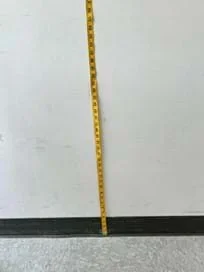 Example drop station.Copyright Tanima Mukherjee
- Optional: Contact a coach to serve as an expert evaluator and provide feedback to the students on their new sports.
- Optional: Review quadratic regression techniques with students so that they can quickly analyze their data when they get to the analysis step. Here are a few links with instructions for different technologies for quadratic regression:
- YouTube video with instructions for the TI-84 (6:52 minutes)
- YouTube video with instructions for Desmos online graphing calculator (6:35 minutes)
During the Activity
Day 1: Parts 1 – 4
Part 1: Ask and Assign Roles (30 minutes)
- Hand out one Project Packet (PDF) to each student.
- Introduce the activity using the Introduction and Motivation section and videos.
- Have students complete the “Imagine” section of the Project Packet (PDF).
- Give students two minutes to complete the questions.
- Create student groups:
- Option 1: Use student responses from the “Imagine” section of their project packet to form interest-based groups. Ask students to stand up.
- Have them move to one side of the room if their game idea is for an outdoor sport, and the other side if it’s for an indoor sport.
- Once they’re in two groups, ask them to move to different corners based on whether their game requires equipment or not.
- Repeat with other sorting questions (e.g., team vs. solo game, contact vs. non-contact) until you form groups of 3–4 students with similar ideas.
- If needed, adjust the groups to make them more balanced.
- Option 2: Randomly assign students into groups of 3–4.
- Emphasize that all students should actively participate in every part of the activity, while each group member will take the lead on a specific part of the engineering design process. Assign each student in the group one of the following roles:
- Design Engineer - Leads the planning phase. Guides the team in creating the rules, defining how scoring works, determining the necessary equipment and setup, etc. This person ensures the team doesn’t skip any key planning steps, helps keep everyone on task, and promotes teamwork and collaboration.
- Materials Engineer - Leads the team in selecting which materials to test. This person guides discussions about how different materials might affect the bounce of the ball, and helps the group decide what to test. They make sure the team has clear goals for the material experiments.
- Mechanical Engineer - Leads the design of how to test materials. This includes figuring out what should be measured, how to measure it, what equipment (if any) needs testing, and ensuring all the right data is gathered. They help the team think through the testing strategy.
- Computational Engineer - Records the data during testing and leads the team through the data analysis process. They help create motion plots and support the group in interpreting the results. This person should guide the process, not do all the work—it's their job to help the group reason through the math and analysis together.
- As a class, review the steps of the engineering design process. The basic steps are: Identify the need and constraints, research the problem, develop possible solutions, build a prototype(s), test and evaluate the prototype(s), and redesign as needed.
Part 2: Plan (15 minutes)
- Have students share their initial game ideas in their groups and brainstorm group ideas.
- Have students complete the “Plan” section of the Project Packet (PDF). Students should use this as a tool to develop a vision for their game.
- Ensure students have specific and well-defined goals for their game before moving on to testing.
- Confirm that each group has decided on 3–4 base/ball material combinations they plan to test.
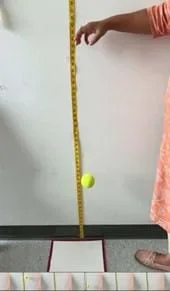 Time to drop the ball!Copyright Faith Palombi
Part 3: Research, Test and Analyze (45 minutes)
- Have students complete the “Test” section of the Project Packet (PDF). Allow about 10 minutes for students to record their drop videos. Instructions are found in the packet, but here is an overview of the procedure:
- Students are trying to accomplish their “bounce goal” (detailed in the “Plan” section).
- Mechanical engineers gather the different balls and base materials they wish to test (selected in the “Plan” section).
- Before starting the test, make sure students have designated jobs to run.
- Student 1: Place one base on the ground at the bottom of the tape measure and be ready to drop the ball.
- Student 2: Use a slow-motion camera (most smartphones have these built in) to record as Student 1 drops the ball on the base.
- Using the slow-motion video, students fill in the “Initial Findings” data chart in the “Test” section: initial bounce height, time/bounce, and number of bounces.
- Repeat the test with all other selected material combinations.
- Using the completed data table, students determine which ball/base combination best meets their bounce goal.
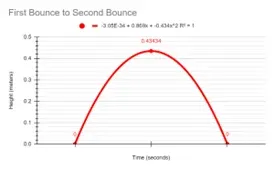 Quadratic regression in action.Copyright Tanima Mukherjee
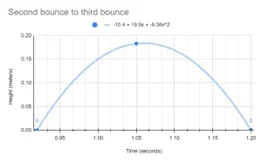 Quadratic regression in actionCopyright Tanima Mukherjee
- After about 10 minutes, have students move to the “Research and Analysis” section of the Project Packet (PDF).
- Have students use their slow-motion videos of the ball/base combinations to complete the tables in the “Research and Analysis” section. (Note that the bounce start and end times occur when the ball hits the ground.)
- For the first table, have students read the time and height of the ball from the video.
- To create graphs, have students read at least the time and height at the topmost position of the ball and the time at which it bounced from their recorded videos. Note: They should record and collect data from the drop to the third bounce.
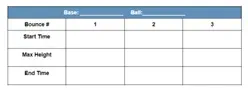 The first chart on Page 5.Copyright Tanima Mukherjee
- Using this information, have students turn the data from the first table into ordered pairs of time and height at the topmost point of the ball and the bounce points of the ball. (Note: These ordered pairs will be put into the second table.)
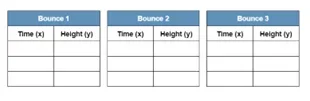 Students will use these tables to convert the raw data from the previous chart into coordinate points.Copyright Tanima Mukherjee
 - Have students continue working through the “Research and Analysis” section. The worksheet will walk them through creating a mathematical model of the bounce using quadratic regression. (Note: If you don’t want to spend as much time going over quadratic regression, you can have students make a copy of this Google sheet or give students access to the Excel Graphs Sheet to speed up the modeling process. Just have students plug in data points and sheets will generate the graph.)
- Optional: You may want to review quadratic regression with the students ahead of time or now. Here are a few links with instructions:
- YouTube video with instructions for the TI-84 (6:52 minutes)
- YouTube video with instructions for Desmos online graphing calculator (6:35 minutes)
- Have students plot the whole trajectory of the ball from the point it is dropped until it goes through the third bounce on the graph sheet in the “Research and Analysis” section. Ensure that:
- Students label the axis of the graph with units.
- Students mark the vertex and x intercepts for each parabola.
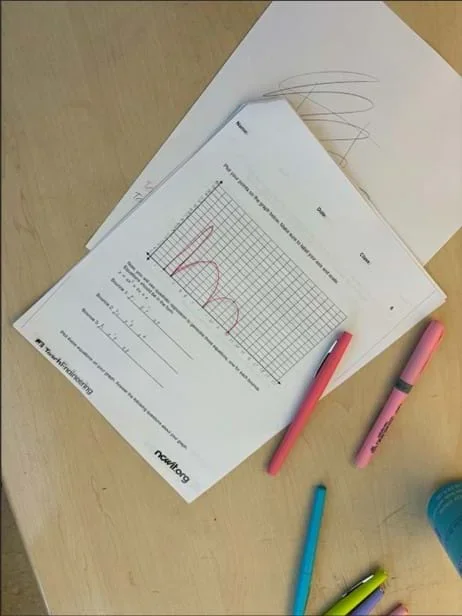
- Students write down the three quadratic regression equations, from drop to first bounce, between first and second bounce, and between second and third bounce, in the space provided on Page 6.
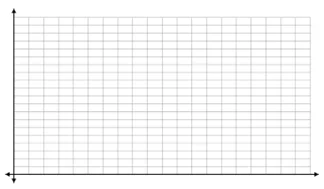 Students will plot all three bounces on a coordinate grid like this one (found on Page 6 of the project packet).Copyright Tanima Mukherjee
- Based on the graph and the quadratic equations, have students complete the questions in the “Research and Analysis” section. (Note: These questions can serve as a built-in formative assessment.)
Day 2: Parts 4 - 7
Part 4: Create (10 minutes)
- Using their chosen materials, give students 10 minutes to create and build the playing field for their game. (Note: Restrict the playing field to a tabletop for safety.)
- Have students brainstorm possible issues they might see during the play test process.
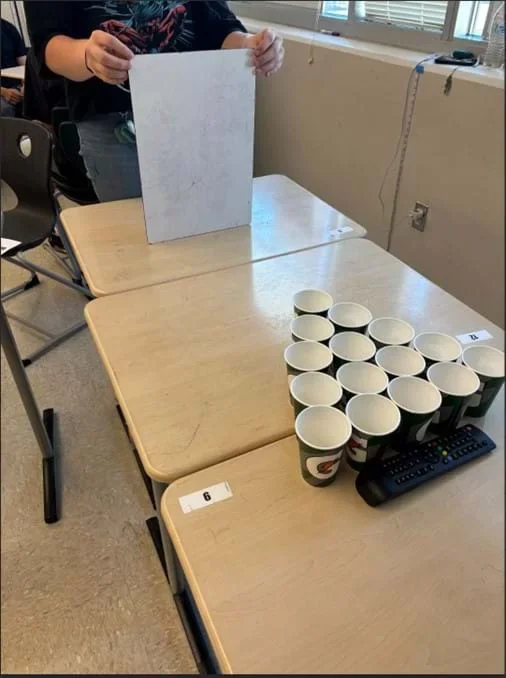 Example of student game.Copyright Faith Palombi
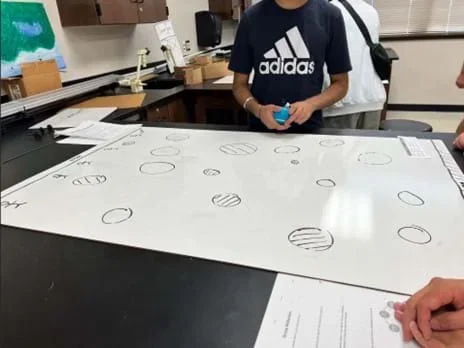 Example of student game.Copyright Tanima MukherjeeExample of student game.Copyright Tanima Mukherjee
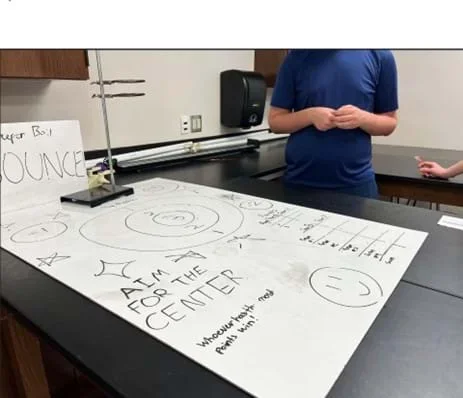 Example of student game.Copyright Tanima MukherjeePart 5: Play Test (20 minutes)
- Hand out one Feedback Form (PDF)to each group. As the students rotate through the games, the feedback form will remain in place.
- Have students turn to the “Play Test” section of the Project Packet (PDF). (Note: This is where the student who stays behind during play testing will record their observations during the play test.)
- Have the students rotate through the games of other groups. One group member (the mechanical engineer is suggested) stays behind to record data on how it’s going. The other group members will circulate throughout the room, acting as play testers for the games of other groups. Assign a time bound for each rotation. Allow about three rotations, so that there is enough feedback for each group.
- Optional: Have a guest expert (maybe a coach) participate in the play test and provide feedback as well.
Part 6: Improve (10 minutes)
- Have students turn to the “Group Reflection” section of the Project Packet (PDF).
- Have group members meet to go over the findings of the play test stage.
- Inform students they are engaging in the “Improve” step of the engineering design process, taking the feedback they received from play testers and making necessary improvements.
- Prompt students: Did they get any ideas from playing the sports of the other groups that they want to incorporate?
Part 7: Retest and Reflect (50 minutes)
- Allow students to play their new and improved sport with their group members. This is a retest of the game, and they can make the final draft of their sport.
- Have students create a write-up as if they were submitting their game to an engineering firm for approval. This will be a poster presentation.
- Have each group briefly present their poster to the class. Use the Summative Poster Rubric (PDF) to assess each presentation.
- quadratic
- A polynomial function defined by a quadratic polynomial.
- quadratic regression
- A statistical method used to model a relationship between variables with a parabolic best-fit curve, rather than a straight line. The process of taking points on a graph (at least three) and generating an equation that models a quadratic curve based on those points.
- vertex
- The place in a parabola where it turns; hence, it is also called the turning point. If the quadratic function is in vertex form, the vertex is (h, k).
- x-intercept
- The point where a line crosses the x-axis.
- domain
- All of the x-values in the function.
- range for the function
- All of the y-values in the function.
- velocity
- Rate at which an object is moving in a particular direction.
- acceleration
- Rate at which the velocity of an object changes.
- height of a projectile
- The highest height an object reaches in a freefall motion.
- range of a projectile
- The distance covered by a projectile in a horizontal direction when launched at an angle.
- impulse
- The force applied on an object for a certain time interval when it interacts with another surface or object.
- momentum
- Mass in motion.
- kinetic energy
- Energy possessed by an object by virtue of its motion.
- gravitational potential energy
- Energy possessed by an object by virtue of its height.
Pre-Activity Assessment
Brainstorming and Planning: Students brainstorm and plan their game rules and needed equipment in their small groups. Remind students that there are no right or wrong ideas at this stage.
Hypothesis: Students take educated guesses on which ball/surface combinations will help them achieve their goal bounce.
Activity Embedded (Formative) Assessment
- Questions: Ask students why different types of materials create different bounces. (friction, mass, etc.) Why does the ball eventually stop bouncing if energy is conserved? Where does the energy go? (Energy is lost as sound as the ball bounces. It is not a perfectly elastic collision.)
- Testing phase section of the Project Packet (PDF).
- Google Sheet to Generate Graphs.
Post-Activity (Summative) Assessment
Final write-up: Students will create a final game pitch as if they were submitting this to their company. The pitch will include their detailed bounce analysis and justify their choice in materials. It will also include reflection on the design process, as well as possible impacts of their game, should it be produced by the company. They can be asked to make posters for presentations.
The following safety constraints can be added the assignment:
- Groups can be made beforehand instead of using the answers to the questions in the “Imagine” section of the Project Packet (PDF).
- The sports must be playable on a tabletop (at least in prototype form).
- The balls may not bounce on walls/windows.
- The sport may not involve throwing balls at other players.
For more advanced calculus-based physics, you can have students complete Calculus Worksheet (PDF) in lieu of the quadratic regression activity. They will explore the connection between position, velocity, acceleration, and derivatives using their bounce data.
4 Ever Green. “10 Most Unusual Sports From Around The World.” YouTube, 23 April 2020, https://www.youtube.com/watch?v=K4FAs95PM4s. Accessed 2 July 2024.
Bullard, Lisa G. “Teaching Professor Department of Chemical and Biomolecular Engineering North Carolina State University.” NC State, North Carolina State, 2024, https://cbe.ncsu.edu/bullard/senior-design/grading-rubric-for-poster-session. Accessed 12 July 2024.
Gaudio, Julian Del. “An introduction to sports engineering.” YouTube, 18 July 2011, https://www.youtube.com/watch?v=2xJ3q3q1i4c. Accessed 2 July 2024.
Math and Stats Help. “Quadratic Regression TI 84.” YouTube, 18 February 2018, https://www.youtube.com/watch?v=4bevqJ54uvc. Accessed 2 July 2024.
Scared, Pi R. “Quadratic Regression in Desmos.” YouTube, 5 January 2021, https://www.youtube.com/watch?v=okiFS2DVfLI. Accessed 2 July 2024.
Tennis Lab. “What Is The Difference Between Clay, Grass and Hard Court Surfaces?” YouTube, 26 June 2023, https://www.youtube.com/watch?v=9lQy78zAlFc. Accessed 2 July 2024.
Wilson Basketball. “The Making of the Wilson Airless Prototype Basketball.” YouTube, 19 February 2023, https://www.youtube.com/watch?v=elyhSE6Tkus. Accessed 2 July 2024.
Contributors
Tanima Mukherjee; Faith Palombi
Supporting Program
Research Experience for Teachers (RET), The Material Science and Engineering Department at the University of Texas, Austin
Acknowledgements
This curriculum was developed under National Science Foundation through the Center for Dynamics and Control of Materials: an NSF MRSEC under Cooperative Agreement number DMR-1720595. Any opinions, findings, and conclusions or recommendations expressed in this material are those of the authors and do not necessarily reflect the views of the National Science Foundation.
Copyright
2025 by Regents of the University of Colorado; original © 2024 University of Texas at Austin