
Sunscreen Showdown: Engineering a Reef-Safe, Non-Carcinogenic Sunscreen
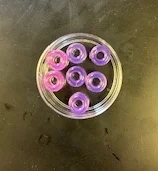 Students design a reef-safe, non-carcinogenic mineral sunscreenCopyright Ademski, E. (2026).
Students take on the role of chemical engineers tasked with designing a reef-safe, non-carcinogenic mineral sunscreen that rivals the effectiveness of leading commercial sunscreens. After learning about ultraviolet (UV) radiation, skin cancer, emulsions, and UV-filtering ingredients, students investigate the properties of different sunscreen components and use non-nano zinc oxide and non-nano titanium dioxide as mineral UV filters to formulate their own sunscreen prototypes. Working in teams, they establish design criteria and constraints, research ingredients, and create, test, and refine their formulations using UV-sensitive beads exposed to a UV lamp. Students compare the performance of their prototypes with a commercial sunscreen while also evaluating wearability, such as white cast and texture. Through iterative testing and redesign, they work to create a sunscreen that provides effective UV protection without relying on potentially more harmful chemical UV filters.
Chemical engineers use emulsion science to develop solutions for various problems. In cosmetic chemistry, emulsions are critical in skincare product design. Sunscreens are a type of emulsion (an immiscible mixture of oil and water). Similar to salad dressing, the oil forms small bubbles in the aqueous solution, which disperse UV filters and increase the surface area of skin covered in UV-reflecting metals. This dispersion is key for effective sunscreen in reducing the risk of skin cancer. However, nano UV filters such as nano-zinc oxide can harm coral reefs by damaging coral polyps, leading to bleaching and ecosystem disruption.
At the end of this activity, students should be able to:
- Understand the science of UV radiation and how it causes DNA mutations that can lead to skin cancer.
- Examine the environmental and health risks associated with common UV filters used in sunscreens, including their carcinogenic properties and harmful effects on coral reefs.
- Design and create a stable sunscreen emulsion using mineral-based UV filters (non-nano zinc oxide and titanium dioxide), while ensuring it effectively prevents UV radiation and does not leave a white cast.
- Identify and explain the function of each ingredient used in their sunscreen emulsions, particularly how they contribute to UV protection, texture, and stability.
- STEL-3G Explain how knowledge gained from other content areas affects the development of technological products and systems.
Grades 6-8
Do you agree with this alignment? - STEL-7Q Apply the technology and engineering design process.
Grades 6-8
Do you agree with this alignment? - STEL-7S Create solutions to problems by identifying and applying human factors in design.
Grades 6-8
Do you agree with this alignment? - STEL-7T Assess design quality based upon established principles and elements of design.
Grades 6-8
Do you agree with this alignment?
- MS-ESS3-3 Apply scientific principles to design a method for monitoring and minimizing a human impact on the environment.
Grades 6-8
This resource focuses on the following Three Dimensional Learning aspects of NGSS:
Science & Engineering Practices- Apply scientific principles to design an object, tool, process or system.Do you agree with this alignment?
Disciplinary Core Ideas- Human activities have significantly altered the biosphere, sometimes damaging or destroying natural habitats and causing the extinction of other species. But changes to Earth's environments can have different impacts (negative and positive) for different living things.Do you agree with this alignment?
Crosscutting Concepts- The uses of technologies and any limitations on their use are driven by individual or societal needs, desires, and values; by the findings of scientific research; and by differences in such factors as climate, natural resources, and economic conditions. Thus technology use varies from region to region and over time.Do you agree with this alignment?
- Relationships can be classified as causal or correlational, and correlation does not necessarily imply causation.Do you agree with this alignment?
Do you agree with this alignment? - Apply scientific principles to design an object, tool, process or system.
- MS-ETS1-1 Define the criteria and constraints of a design problem with sufficient precision to ensure a successful solution, taking into account relevant scientific principles and potential impacts on people and the natural environment that may limit possible solutions.
Grades 6-8
This resource focuses on the following Three Dimensional Learning aspects of NGSS:
Science & Engineering Practices- Define a design problem that can be solved through the development of an object, tool, process or system and includes multiple criteria and constraints, including scientific knowledge that may limit possible solutions.Do you agree with this alignment?
Disciplinary Core Ideas- The more precisely a design task's criteria and constraints can be defined, the more likely it is that the designed solution will be successful. Specification of constraints includes consideration of scientific principles and other relevant knowledge that is likely to limit possible solutions.Do you agree with this alignment?
Crosscutting Concepts- The uses of technologies and any limitations on their use are driven by individual or societal needs, desires, and values; by the findings of scientific research; and by differences in such factors as climate, natural resources, and economic conditions.Do you agree with this alignment?
- All human activity draws on natural resources and has both short and long-term consequences, positive as well as negative, for the health of people and the natural environment.Do you agree with this alignment?
Do you agree with this alignment? - Define a design problem that can be solved through the development of an object, tool, process or system and includes multiple criteria and constraints, including scientific knowledge that may limit possible solutions.
- MS-ETS1-2 Evaluate competing design solutions using a systematic process to determine how well they meet the criteria and constraints of the problem.
Grades 6-8
This resource focuses on the following Three Dimensional Learning aspects of NGSS:
Science & Engineering Practices- Evaluate competing design solutions based on jointly developed and agreed-upon design criteria.Do you agree with this alignment?
Disciplinary Core Ideas- There are systematic processes for evaluating solutions with respect to how well they meet the criteria and constraints of a problem.Do you agree with this alignment?
Do you agree with this alignment? - Evaluate competing design solutions based on jointly developed and agreed-upon design criteria.
- MS-ETS1-4 Develop a model to generate data for iterative testing and modification of a proposed object, tool, or process such that an optimal design can be achieved.
Grades 6-8
This resource focuses on the following Three Dimensional Learning aspects of NGSS:
Science & Engineering Practices- Develop a model to generate data to test ideas about designed systems, including those representing inputs and outputs.Do you agree with this alignment?
Disciplinary Core Ideas- Models of all kinds are important for testing solutions.Do you agree with this alignment?
- The iterative process of testing the most promising solutions and modifying what is proposed on the basis of the test results leads to greater refinement and ultimately to an optimal solution.Do you agree with this alignment?
Do you agree with this alignment? - Develop a model to generate data to test ideas about designed systems, including those representing inputs and outputs.
- MS-LS3-1 Develop and use a model to describe why structural changes to genes (mutations) located on chromosomes may affect proteins and may result in harmful, beneficial, or neutral effects to the structure and function of the organism.
Grades 6-8
This resource focuses on the following Three Dimensional Learning aspects of NGSS:
Science & Engineering Practices- Develop and use a model to describe phenomena.Do you agree with this alignment?
Disciplinary Core Ideas- Genes are located in the chromosomes of cells, with each chromosome pair containing two variants of each of many distinct genes. Each distinct gene chiefly controls the production of specific proteins, which in turn affects the traits of the individual. Changes (mutations) to genes can result in changes to proteins, which can affect the structures and functions of the organism and thereby change traits.Do you agree with this alignment?
- In addition to variations that arise from sexual reproduction, genetic information can be altered because of mutations. Though rare, mutations may result in changes to the structure and function of proteins. Some changes are beneficial, others harmful, and some neutral to the organism.Do you agree with this alignment?
Crosscutting Concepts- Complex and microscopic structures and systems can be visualized, modeled, and used to describe how their function depends on the shapes, composition, and relationships among its parts, therefore complex natural structures/systems can be analyzed to determine how they function.Do you agree with this alignment?
Do you agree with this alignment? - Develop and use a model to describe phenomena.
Each group needs:
- 10 popsicle sticks (or anything to mix with)
- at least 3 snack-sized, clear plastic bags
- 6 small cups (only 2 if they are washable/reusable)
- 1 scale (weigh in mg)
- If you only have 1 scale available, pre-weigh out the ingredients for each group for efficiency
- At least 5 reusable UV beads
- If low on budget, you can have the class share the UV beads. Just make sure they let the beads come back to their original color between each trial.
- 1 g non-nano zinc oxide powder (amounts will vary based on group preferences, but at most 1 g per group)
- 1 g non-nano titanium dioxide powder (amounts will vary based on group preferences, but at most 1 g per group)
- 7 g aloe vera gel (amounts will vary based on group preferences, but at most 7 g per group)
- 7 g glycerin (amounts will vary based on group preferences, but at most 7 g per group)
- 7 g sunflower oil (amounts will vary based on group preferences, but at most 7 g per group)
- 7 g coconut oil (amounts will vary based on group preferences, but at most 7 g per group)
- 3 g Tween 80 (amounts will vary based on group preferences, but at most 3 g per group)
- 3 g natural emulsifying wax (Olivem 1000) (amounts will vary based on group preferences, but at most 3 g per group)
- sticky notes (at least 1 per student)
- distilled water (sink water is fine)
- poster paper (any plain white paper is fine)
- PPE such as safety goggles, gloves, and/or aprons if you deem necessary
For the entire class to share:
- 1 UVB bulb to put in a bulb socket/lamp (You can also use UVB flashlights, but the 9 W UVB bulb will allow faster testing times.)
- socket lamp
- cover for light (e.g., shoe box, lamp shade, piece of black construction paper, etc.) to use as a shield when using the UVB light.
- Dana’s Sunscreen Problem (docx)
- Dana’s Sunscreen Problem (pdf)
- Dana’s Sunscreen Problem Answer Key (docx)
- Dana’s Sunscreen Problem Answer Key (pdf)
- Emulsion Research Articles (docx)
- Emulsion Research Articles (pdf)
- Sunscreen Showdown Worksheet (docx)
- Sunscreen Showdown Worksheet (pdf)
- Sunscreen Showdown Worksheet Example (docx)
- Sunscreen Showdown Worksheet Example (pdf)
- Social Media Ad Rubric (docx)
- Social Media Ad Rubric (pdf)
- UV Beads Exposure Scale Template (docx)
- UV Beads Exposure Scale Template (pdf)
- UV Beads Exposure Scale Template Example (docx)
- UV Beads Exposure Scale Template Example (pdf)
Students should:
- Understand that light waves can either be reflected off surfaces or absorbed by materials, which affects how light interacts with different objects.
- Recognize that genetic material, such as DNA, is responsible for controlling the functions of cells and guiding how organisms grow and develop.
- Be familiar with basic laboratory safety procedures, including wearing safety glasses and lab coats, especially when working with liquids and UV rays.
Turn to your neighbor and discuss the following questions:
- Do you regularly wear sunscreen? Why or why not?
- Do you read the instructions on the back of the bottle?
- Do you read the ingredients on the label?
- Have you ever had a really bad sunburn? Describe it (e.g., did you have to go to the hospital? Did your skin peel off?)
(Questions can be listed on the on the board to guide students. Wait about 5 minutes for students to share their answers. Then, call on 1-2 students to share their responses to each question.)
Some people choose to not wear sunscreen. Why do you think that is? (Call on 2-3 students to share answers and list their responses on the board. Likely answers might be: I never burn, I do not like the white cast it leaves on my skin, or I do not like how it feels.)
The CDC has reported a twofold increase in skin cancer since 1982. This means the average person’s risk of developing melanoma is rising. Skin cancer is the leading form of cancer in the United States.
Many people believe they are safe if they have not had many bad sunburns, but studies show that even one severe sunburn in childhood or adolescence can increase the risk of skin cancer by at least three times! If you tan often or use tanning beds, your risk is even higher. According to the Mayo Clinic, while it is rare for teenagers to develop skin cancer, the choices you make now can affect your health later.
What exactly is skin cancer? Can anyone describe it? (Pair up students to discuss what they know about skin cancer and how it affects the body. Wait 2 minutes, then call on 1-2 students to share.)
Some of you may have people in your lives who have had skin cancer and had parts of their skin removed. It is a serious procedure. Skin cancer occurs when the DNA in our skin cells gets damaged by UV radiation from the sun. The sun emits energy in the form of electromagnetic radiation, which includes ultraviolet (UV) rays. Specifically, ultraviolet A (UVA) and ultraviolet B (UVB) rays. Although UV radiation makes up only a small portion of the sun's energy reaching Earth, it plays an important role in living organisms and can be both beneficial and harmful. (Display Image 1 for students to view.)
Sunlight helps reptiles and other cold-blooded animals stay warm, and it provides the energy plants need for photosynthesis. UVB rays allow our bodies to produce vitamin D, which helps maintain healthy bones and supports our immune system. However, too much UV radiation can be harmful. UVA rays have wavelengths of 315–400 nm, while UVB rays range from 280–315 nm. UVA rays penetrate deeply into the skin and can damage skin cells, regardless of the amount of melanin they contain.
Excessive UV radiation can damage DNA, creating mutations that interfere with the cell's normal instructions. (Show students Image 2.) This is called a DNA mutation. If the DNA gets damaged, the skin cell can no longer function properly. The cell, which usually follows instructions from DNA to protect the body, may start to grow uncontrollably. This is how skin cancer begins. Damaged skin cells replicate, forming a tumor. Melanoma often appears as an unusual mole or skin lesion that is asymmetrical or changes in size, shape, or color. It needs to be removed quickly because it can spread rapidly to other parts of the body.
That is why it is so important to protect ourselves from too much UV exposure. Before sunscreen, people used clothing to cover their skin. It is not always practical to wear long sleeves and pants on a hot day, which is why sunscreen was invented. Sunscreen helps prevent UVA and UVB radiation from reaching and damaging skin cells, reducing the risk of sunburn and skin cancer. But, as we discussed earlier, many people do not like using sunscreen. Can anyone name some of the major sunscreen brands sold in stores? (Allow 2-3 minutes for students to discuss and write the brands they know or use on the board.)
(Pass out one sticky note to each student.) Using your best scientific knowledge, describe how a sunscreen works to protect the skin from UV rays. (Allow 3 minutes for students to write their predictions on the sticky notes. Have them place the sticky note on a different section of the whiteboard, and then as a class sort them into categories based on the themes of their predictions [e.g., sunscreen absorbs UV rays, reflects UV rays, or does both].)
Has anyone read the ingredients list on these sunscreens? (Pause to gauge responses.)
Did you know that many mineral sunscreens use metal-containing compounds, such as zinc oxide or titanium dioxide, as their active UV-filtering ingredients? Does that surprise you? (Pause and listen for student reactions.)
Sunscreens are actually an emulsion, which is a mixture of oil and water that cannot naturally blend together. (Show students Image 5.) The zinc oxide or titanium dioxide particles do not dissolve in either the oil or water. Instead, they remain suspended throughout the emulsion, allowing the sunscreen to spread evenly across the skin. This is a good thing, because the mineral particles act as UV filters by absorbing much of the incoming UV radiation and converting it into a small amount of heat, while also scattering and reflecting some UV rays. This helps prevent UV radiation from damaging skin cells. (Show Image 3 again.)
But here is the challenge: No sunscreen is perfect. Some chemical UV filters, such as oxybenzone, have raised environmental concerns in certain locations and continue to be studied for their potential health effects. Mineral sunscreens, while generally considered reef-friendlier, can sometimes leave a noticeable white cast or feel thicker on the skin. Because every sunscreen has advantages and disadvantages, chemical engineers continue designing new formulations that provide excellent UV protection while improving safety, appearance, and environmental impact.
As chemical engineers, our challenge is to use what we know about emulsions and UV-filtering materials to design a sunscreen that protects skin as effectively as leading commercial products while improving features such as appearance, texture, and environmental impact. This will be the goal of our engineering challenge over the next few days!
Background
Light is a form of energy that travels in waves, and like all energy, it cannot be created or destroyed. The sun is made primarily of hydrogen gas, and when hydrogen atoms fuse together to form helium through a process called nuclear fusion, a vast amount of energy is released (NASA). This process happens millions of times every second, sending energy to Earth in the form of tiny energy packets called photons. These photons include UV rays, which come in two types, UVA and UVB, and they carry both light and heat to Earth.
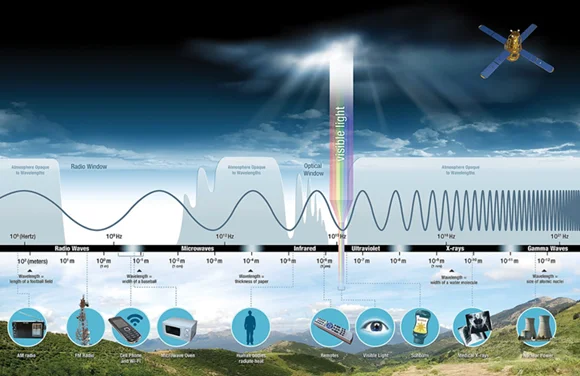 The electromagnetic spectrum.Copyright NASA. (2023, August). Electromagnetic spectrum overview [Image]. NASA Science. https://science.nasa.gov/wp-content/uploads/2023/08/ems-introduction.jpeg
We cannot see UV rays with our naked eye, but they have a significant impact. When these rays reach the Earth's surface, they are either absorbed by surfaces such as the ground, plant leaves, or human skin, or they are reflected by surfaces they cannot penetrate.
When UV photons reach human skin, the skin cells absorb this energy. UVA radiation is particularly damaging because it affects the DNA inside our cells. DNA is the blueprint of life, composed of just four nitrogenous base pairs that form the genetic code for cell functions. Skin cells are constantly being replaced, about every two to four weeks, which means they have a high turnover rate.
Despite this high turnover, when UV photons are absorbed by the skin, they can damage the DNA. This damage happens most notably when adjacent DNA thymine base pairs break apart and bond incorrectly, forming a structure called a “dimer.” This distorts the DNA strand’s shape.
The enzyme DNA polymerase, responsible for replicating DNA during cell division, cannot properly read the DNA when it is bent from the dimer. This means the DNA replication process might go wrong, skipping over the damaged section, inserting the wrong base pairs, or replicating the DNA incorrectly. When DNA is mutated, the resulting proteins produced from the damaged DNA may not work as they should. The mutated cell becomes dysfunctional, and the body’s normal repair mechanisms cannot fix the damage effectively. Over time, an accumulation of mutations in cells can lead to abnormal cell replication, where cells divide uncontrollably. Normally, the body tells cells to stop dividing when they are no longer needed, but mutated cells can sometimes ignore this signal, continuing to replicate.
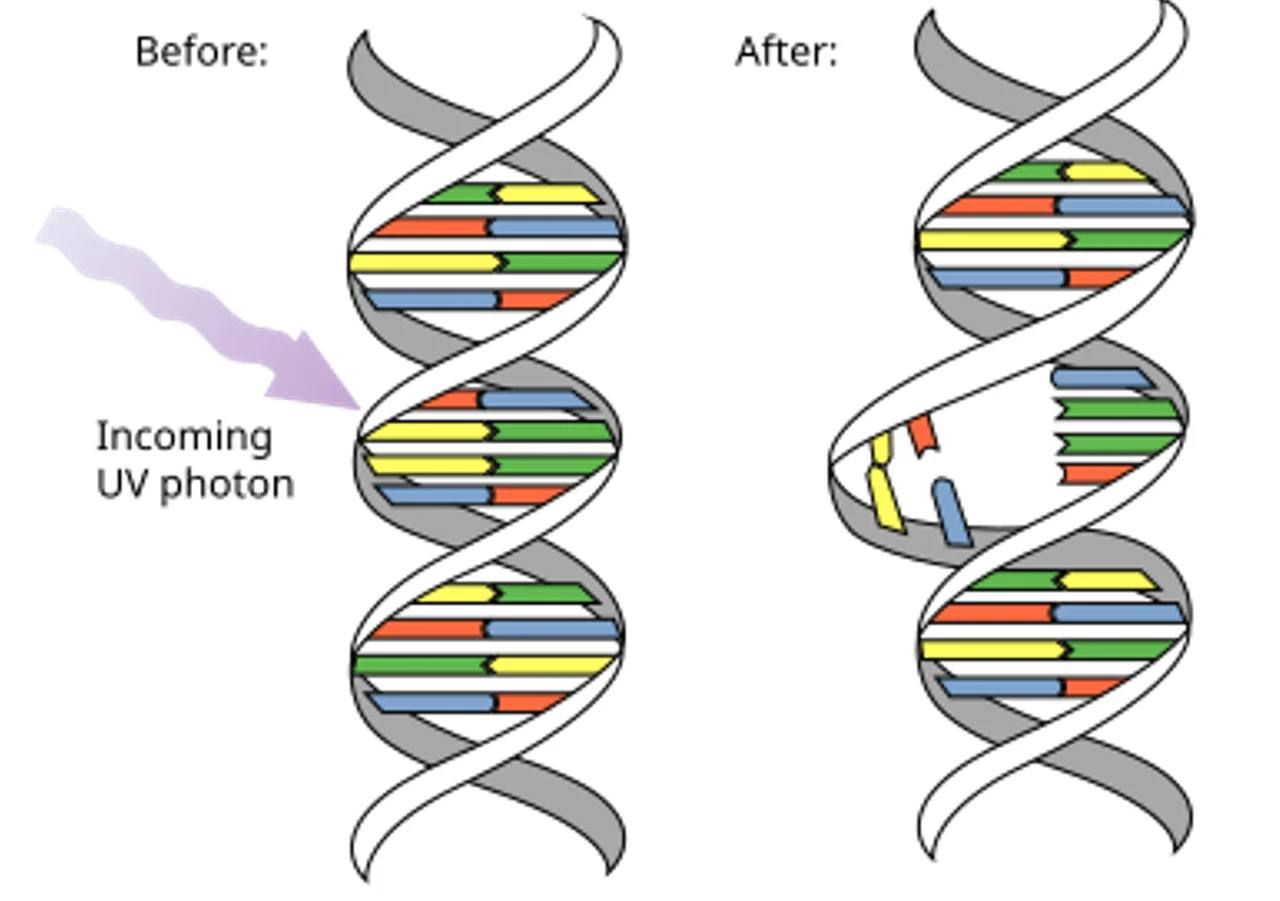 UV-mutated DNA moleculeCopyright Mouagip. (2010, September 2). DNA UV mutation [SVG image]. Wikimedia Commons. https://commons.wikimedia.org/wiki/File:DNA_UV_mutation.svg
This uncontrollable division of cells forms tumors. These tumors, which can either be benign or malignant, develop from mutated cells that cannot stop growing. Skin cancer occurs when a tumor forms in the epidermis, the outermost layer of the skin. Melanomas and carcinomas are different types of skin cancers, classified based on the layers of the skin they affect.
It takes a long time for mutated cells to form a visible tumor, but a single bad sunburn can trigger the process. When the skin absorbs too much UV energy, it increases the risk of mutations that could eventually lead to skin cancer.
Sunscreen helps reduce this risk by either reflecting or absorbing UV rays before they reach the skin. Sunscreen works in different ways depending on its ingredients. Some chemical sunscreens absorb UV radiation, while physical sunscreens, such as those containing zinc oxide or titanium dioxide, reflect UV rays away from the skin. These mineral sunscreens prevent UV photons from penetrating into the epidermis and dermis, where DNA damage occurs.
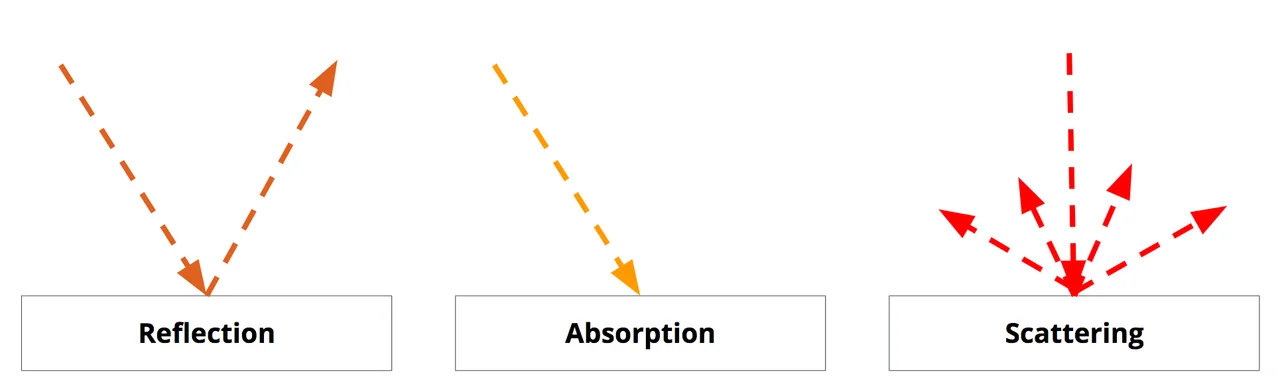 Light wave behaviorCopyright Ademski, E. (2025). Light Wave Behavior Model [Diagram]. Microsoft PowerPoint.
Skin cancer rates are increasing for several reasons. One factor is the depletion of the ozone layer, which normally absorbs and reflects 90% of UVB rays; these rays are the primary cause of sunburns and skin cancer. As chlorofluorocarbons (CFCs) break down ozone molecules, the ozone layer becomes thinner, allowing more UVB rays to reach Earth’s surface. Another factor is cultural trends that emphasize tanned skin, leading to increased sun exposure.
Many popular sunscreens use ingredients such as nano-zinc oxide, avobenzone, or oxybenzone, which are very effective at absorbing or reflecting UV rays. However, nano-zinc oxide is very small, and when people swim, it can wash off and sink into the ocean. If this happens near coral reefs, nano-zinc oxide can be absorbed by coral polyps, causing coral bleaching and damaging marine ecosystems.
Additionally, oxybenzone, another common UV filter, has been shown to be absorbed by mammalian skin. Long-term exposure to oxybenzone has been linked to cell damage in mammals, making it potentially toxic. This is why it is important to use reef-safe and mammal-safe UV filters in sunscreen products.
Mineral sunscreens containing non-nano zinc oxide or titanium dioxide offer a safer alternative. These ingredients reflect UV rays away from the skin without being absorbed into the skin or causing harm to coral reefs and marine life.
Before the Activity
- Determine whether any student has allergies to any of the sunscreen ingredients so you can find alternative options:
- You can use any oils for the oil phase, such as olive oil, shea butter, sweet almond oil, or jojoba oil.
- If students have oils at home they would like to bring in, encourage them to do so. You will just need to adjust the research articles to include this oil or have the student do research on that oil if they want to use it only for their group.
- For the aqueous phase, you can use alternatives such as cucumber gel, water, hyaluronic acid, or okra gel.
- If you need a Tween 80 alternative, you can use xanthan gum or beeswax.
- Gather all sunscreen materials, including measuring scales, popsicle sticks, cups, and PPE such as safety goggles, gloves, and/or aprons if you deem necessary. None of these items should permanently stain clothes, but having aprons could be helpful.
- Set up the UV light.
- Have a lamp socket/bulb socket for the UV light.
- Have it stabilized at 5 inches above the counter/table top.
- Use a clamp with a stand, cups, beakers, or anything else to hold it up.
- Be sure to have a cover (shoe box, lamp shade, piece of black construction paper, etc.) to use as a shield when using the UVB light. You do not want to expose the students to the UVB light for too long, so have them cover it so that the light is only able to reach the UV beads. Even holding a notebook in between the UV lamp and the students will suffice.
- A helpful thing to review with students is how to “tare” a scale. If your students have never used a scale, please review this with them prior to the experiment.
- Arrange the materials in your room to facilitate an easy flow, such as having an “assembly line style” of emulsion ingredients near the scales, and then a separate area for mixing and testing under the UV lamp. This allows for maximum efficiency.
- Make copies of the following:
- Sunscreen Showdown Worksheet (PDF) (1 per student)
- Dana’s Sunscreen Problem (PDF) (1 per student)
- Dana’s Sunscreen Problem Answer Key (PDF) (1 for teacher reference)
- Sunscreen Showdown Worksheet Example (PDF) (1 for teacher reference)
- Sunscreen Emulsion Research Articles (PDF) to tape up/spread out around the room.
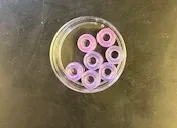
- You will need to test the UV beads and make a UV Beads Exposure Scale Template (PDF) (instructions provided) on your own before class starts. You will expose the beads to 60 seconds of UVB light at a distance of 5 inches. This should get you the most intense glow from the UV beads. You will repeat this for 40 seconds, 20 seconds, and 0 seconds. This will allow you to see how the different amounts of UV radiation change the color of the beads. (Refer to Images 6, 7, 8, and 9.) Take pictures of the beads at each time point and insert them into the UV Beads Exposure Scale Template (PDF). Display this during Part 2 of your activity so students can reference it often. You can reference the UV Beads Exposure Scale Template Example (PDF) to help guide you, as well as help calculate estimated SPF. You can also reference Image 10 to help you see how to set up your UV test with no sunscreen, and Image 11 for how to test for SPF with sunscreen.
During the Activity
Part 1: Introduction and Ask (45 minutes)
- Divide the class into groups of 3-4 students.
- Optional: Review the engineering design process.

Introduction (20 minutes)
- Go through the “Introduction and Motivation” script with the class (as outlined above).
Ask (25 minutes)
- Discuss the class sunscreen design criteria:
- Ask the students what qualities a "perfect" sunscreen would have and list their responses on the board.
- Explain that these are design criteria (e.g., goals engineers aim to achieve during the design process.)
- Specifically, we are asking “How can we create an all-natural, non-toxic, reef-safe mineral sunscreen that rivals the effectiveness of commercial sunscreens?”
- Ideally, the class design criteria should be something to the effect of “our sunscreen protects skin just as well as commercial sunscreens in lab settings.”
- Discuss custom group design criteria:
- Distribute one Sunscreen Showdown Worksheet (PDF) to each student.
- State that each group will have the freedom to define their own sunscreen criteria based on personal preferences.
- Have each group identify one additional design criterion for their sunscreen, such as texture or scent.
- Have each group member write these additional design criteria in Step 1 of their Sunscreen Showdown Worksheet (PDF).
- Identify design constraints:
- Ask the students, “What are we limited by?”
- Allow 3 minutes for brainstorming and write ideas on the board.
- Explain that these are the design constraints (e.g., time, supplies, and available emulsion materials) that engineers often face during product development.
- Have students write all class-discussed constraints in Step 1 of their Sunscreen Showdown Worksheet (PDF).
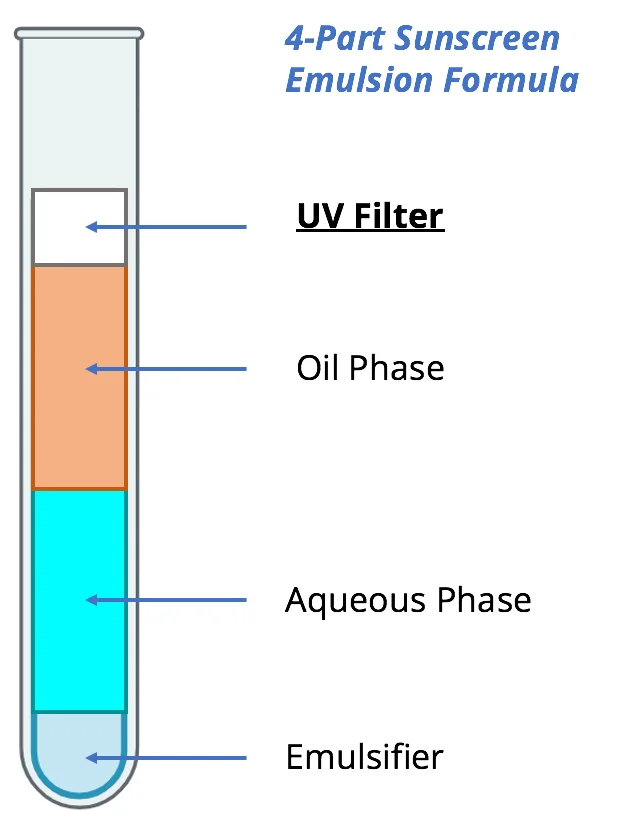 Sunscreen emulsion formulaCopyright Ademski, E. (2025). Sunscreen Emulsion Formula [Diagram]. Microsoft PowerPoint and BioRender.
Part 2: Research and Imagine (45 minutes)
Material Research (35 minutes)
- Allow groups to research the materials for their sunscreen.
- Distribute Emulsion Research Articles (PDF) to each group, or space the articles around the room so students can rotate freely to gather all information.
- Have students compare the pros and cons of different chemicals in their notebooks.
Note: It is recommended to run this as a group JIGSAW activity, where different members of the group gather data on each of the emulsion components. They then report back and share their findings, which helps them in making group emulsion decisions. You can choose to have students conduct this research in whatever way you see best fit for your class.
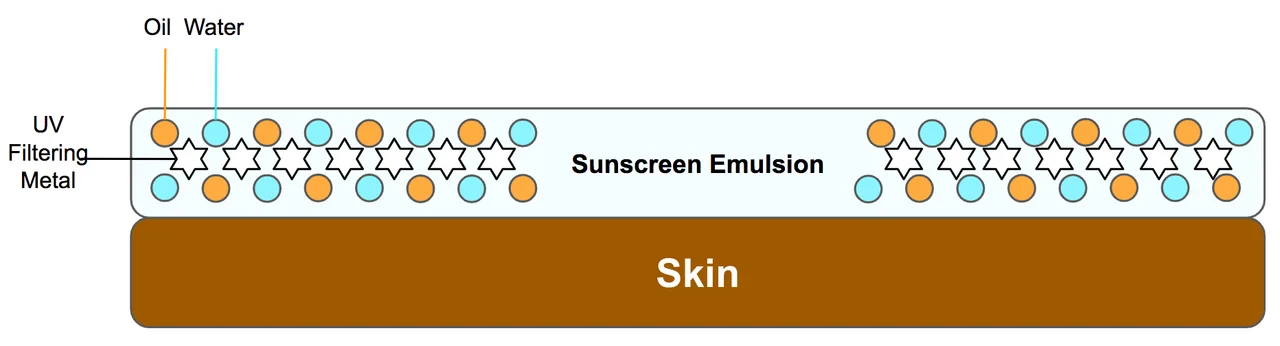 Sunscreen emulsion diagramCopyright Ademski, E. (2026). Sunscreen Emulsion Diagram [Diagram]. Microsoft PowerPoint.
Brainstorm and Plan Prototypes (10 minutes)
- After researching, have groups come back together to imagine their first sunscreen prototype using the selected materials.
- Have students select these in Step 2 of their Sunscreen Showdown Worksheet (PDF).
Part 3: Plan, Create, and Test (45 minutes)
Teacher Demonstration and Control Sample (10 minutes)
- Test Control Sample
- Conduct a demonstration test for the whole class without any UV protection.
- Under direct UVB lamp exposure, test 10 or more UV beads for 60 seconds.
- Ensure the UV lamp is 5 inches above the beads.
- Compare the beads' color to your UV Beads Exposure Scale Template (PDF).
- Have students record the results in Step 3 of their Sunscreen Showdown Worksheet (PDF).
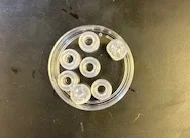 No UV exposureCopyright Ademski, E. (2026).
- Test Commercial Sunscreen
- Conduct a demonstration test of a commercial sunscreen for the whole class.
- Get a commercial liquid (not spray) sunscreen lotion containing nano zinc oxide, oxybenzone, or avobenzone as the UV filter active ingredient.
- Put 2 g of any commercial sunscreen liquid (not spray) into a snack-sized plastic bag.
- Disperse the sunscreen so it is evenly spread throughout the bag (simulating spreading the lotion evenly on skin).
- Lay the bag full of sunscreen over 10 UV beads.
- Again, hold the UV lamp 5 inches above for 60 seconds.
- Have students compare the results with the previous test and discuss any differences.
- Have students record the UV exposure in Step 3 of their Sunscreen Showdown Worksheet (PDF).
- Let students know that this is the control sample (or reference sample). It is the reference to which the students will compare their results.
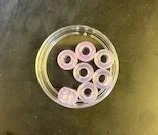 Low UV exposureCopyright Ademski, E. (2026).
 Moderate UV exposureCopyright Ademski, E. (2026).High UV exposureCopyright Ademski, E. (2026).
Plan (5 minutes)
- Have each group review its selected ingredients and planned formulation in Step 2 of their Sunscreen Showdown Worksheet (PDF).
- Have groups discuss why they chose each ingredient and predict how well they think their sunscreen will perform.
Create Prototype (10 minutes)
- Have students put on lab coats/aprons and safety goggles, and tie back their hair.
- Review lab safety guidelines based on your school’s lab safety policies (or you can refer to the Flinn Scientific Student Safety Contract for proper lab safety guidelines).
- Give students time to use scales and popsicle sticks to measure oils and gels, and then mix them to create a 5 g sunscreen sample. Note: Students should refer to Step 4 of their Sunscreen Showdown Worksheet (PDF).
Test Prototype (15 minutes)
- Test on Skin:
- Have groups test a small amount (2 g total for all members of group; each student needs about 0.5 g) of their sunscreen on their skin.
- Instruct them to check for a white cast, the feel of the lotion, and overall wearability.
- Have students record their observations to Step 5 of their Sunscreen Showdown Worksheet (PDF).
- Test and Compare:
- Under your supervision, have students repeat the UV bead test with their sunscreen (see instructions in Sunscreen Showdown Worksheet (PDF) Step 4).
- Have them then compare their results to the commercial sunscreen and calculate their estimated SPF. Note: Each group will need their own set of about 10 UV beads.
- Have students record their observations and calculations on Step 5 of their Sunscreen Showdown Worksheet (PDF)
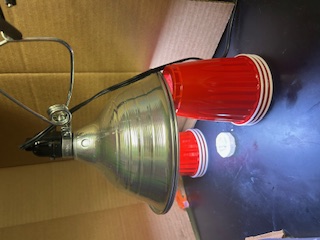 UV test without sunscreenCopyright Ademski, E. (2026).
Reflect (5 minutes)
- Instruct students to reflect in Part 5 on what went well and what did not go well in their iterations.
- Check in with each group to discuss any challenges the group is facing, and how the groups plan to overcome these in their next trial.
(Optional) Iterate
- If students have time in this session, encourage them to move on to their next trial.
Part 4: Test and Improve (45 minutes)
Check In Ticket - Formative Assessment (10 minutes)
- Challenge Problem Entrance Ticket:
- Distribute one Dana’s Sunscreen Problem (PDF) to each student.
- Have students individually and silently complete the 5-minute entrance ticket challenge problem called Dana’s Sunscreen Problem (PDF).
- After collecting all responses, invite 2–3 students to share their reasoning before discussing the correct solution as a class.
Test and Improve (35 minutes)
- Improve and Refine Sunscreen Prototypes:
- Instruct groups to continue testing, evaluating, and refining their sunscreen formula for the remainder of the class period (or as long as you see fit).
- If you have students who have already met their UV protection design criteria, here are further ideas for them to try:
- Encourage them to focus on optimizing their wearability for more skin types.
- Have them collect data on how comfortable the sunscreen feels on many skin types.
- Have them prepare a larger batch (for example, double or triple the original amount) to determine whether the formulation performs consistently when scaled up.
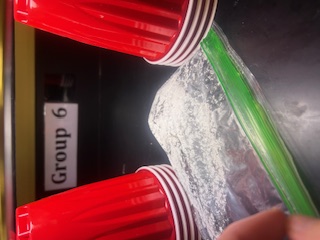 UV test with sunscreenCopyright Ademski, E. (2026).
Part 5: Communicate and Reflect (45 minutes)
Create a Poster (15 minutes)
- Explain that teams will create a poster to be shared in a gallery walk.
- Give students 15 minutes to create a poster displaying their sunscreen’s ingredients, brand name, and whether it met their design criteria.
- Explain the poster requirements:
- Unique brand name and logo
- Whether and how their prototype met the design criteria the group outlined at the beginning of the activity (they may use a bulleted list)
- An ingredient list, with a sentence explaining the function of each component of their emulsion
- An explanation and diagram, supported by evidence from the activity, of how their sunscreen addresses environmental or health considerations (such as being reef-safe, non-toxic, or reducing white cast) compared with conventional sunscreen formulations.
Gallery Walk (10 minutes)
- Have students, you, and any others participate in a 10-minute poster gallery walk, where students will view and discuss the sunscreens made by other groups.
- Make sure participants focus on comparing their sunscreen's effectiveness and wearability.
- Encourage participants to compare each sunscreen's effectiveness, wearability, and how well it met the group's design criteria.
Gallery Walk Reflection (5 minutes)
- After the gallery walk, encourage each group to share a “glow and a grow.” A glow is something that went well during activity, and a growth is a way they wish they could improve if given more time or resources.
- Poll groups to see if anyone’s emulsion formulation compared to the commercial sunscreens out there.
- Poll to see if any groups did better than the leading brand testing at the beginning of the activity.
- Remind students that usually engineers get a little more time to optimize, but the process is the same. Encourage students to be proud of their newly acquired chemical engineering skills.
Create a 60 second Ad: (15 minutes)
- For the final summative assessment, have groups create a 60-second social media advertisement video explaining how skin cancer occurs, the harm of certain sunscreens to the environment and mammals, and how their sunscreen addresses environmental or human health considerations while still providing UV protection.
- Go over the video requirements:
- Each student must speak at least once.
- Groups may use their posters in the video.
- Video will be graded using the Social Media Ad Rubric (PDF).
- Videos need to be uploaded to whatever grading platform your school uses (Google Classroom, Schoology, Skyward, email, etc.).
- Encourage as much creativity as possible in these advertisements. The more memorable and eye-catching, the more people will pay attention.
- Encourage groups to use digital tools such as Canva, Microsoft PowerPoint, Google Slides, or other school-approved software to create their advertisements.
- Note: If you do not have access to any video technology, you can ask groups to quickly present their poster to you while you grade them with the Social Media Ad Rubric (PDF).
- aqueous phase
- In an emulsion, this refers to whatever water-based substance you use.
- avobenzone
- Common UV filter that reflects and absorbs UV rays, but is harmful to coral polyps and can lead to coral bleaching.
- carcinogenic
- Cancer causing.
- dna
- Deoxyribonucleic Acid; genetic code for our cells to function properly.
- emulsifier
- A two-sided molecule with a hydrophobic (oil -loving) and hydrophilic (water-loving) side. These sides orient them around the oil and water phases, effectively “wrapping” around the oil bubbles in the aqueous phase. This prevents the emulsion from separating too soon and keeps the emulsion stable.
- emulsion
- An immiscible mixture of oil and water (e.g., salad dressing).
- melanin
- Pigment molecule in skin cells of some individuals that helps block some UV rays and contributes to a darker skin tone.
- melanoma
- Tumor of skin cancer cells.
- mutation
- A change made to DNA, causing the cell to not potentially replicate properly.
- nano
- Incredibly small in size (1 x 10⁻⁹) or 1 billionth of a meter.
- nano-zinc oxide
- A small version of the UV filter zinc oxide. Has been proven to cause damage to coral polyps (young coral), leading to coral bleaching.
- oil phase
- In an emulsion, this refers to whatever oil you use.
- oxybenzone
- Common UV filter that absorbs UV rays but can penetrate the skin and enter the bloodstream with frequent use, raising health concerns.
- reef-safe
- To be “reef-safe,” a sunscreen must meet FDA requirements that show no danger to the health of coral or coral polyps to be considered.
- spf
- Sun protective factor. This number tells you how many times longer you can stay in the sun without burning. For example, if you burn after being in the sun for 5 minutes, then wearing SPF 10 would allow you to be in that same amount of sun for 50 minutes before reapplying (5 mins x 10 SPF = 50 mins of sun protection). SPF varies depending on how easily you burn as a person, and the amount of UV radiation you are exposed to. People more likely to burn should wear higher SPF.
- uv filter
- Metal found in sunscreen that reflects or absorbs UV rays.
- uva/uvb rays
- Ultraviolet red and ultraviolet blue electromagnetic rays emitted from the sun due to the energy released from hydrogen fusing into helium.
Pre-Activity Assessment
Sticky Note Sorting: During the introduction, ask students to anonymously write their response to the question, "How do you think sunscreen protects your skin from UV rays?" on a sticky note. Allow approximately 3 minutes for students to work independently. Have students place their sticky notes on the board, then sort the responses into common themes (e.g., reflects UV rays, absorbs UV rays, blocks UV rays, unsure, or other). Use the results to assess students' prior knowledge and identify common misconceptions about how sunscreen works. The discussion can help determine how much instructional support students need before learning about UV filters, mineral sunscreens, and emulsion chemistry.
Activity Embedded (Formative) Assessment
Challenge Problem/Entrance Ticket: At the beginning of Part 3, distribute Dana’s Sunscreen Problem (PDF) to each student. Have them complete the multiple-choice challenge independently and silently before collecting their responses. After all responses have been collected, invite students to discuss their reasoning with a partner for 2–3 minutes, then review the correct answer as a class. Use students' responses to assess their understanding of the functions of emulsion ingredients and UV-filtering materials. This formative assessment can help identify misconceptions and guide instructional support before students continue testing and refining their sunscreen formulations.
Post-Activity (Summative) Assessment
Brand Name Poster and 60-Second Ad: Student teams create a poster featuring their sunscreen's brand name and logo, design criteria, ingredient list, and an explanation of the function of each ingredient in their formulation. Teams then produce a 60-second social media-style advertisement explaining how UV radiation can damage skin cells, how their sunscreen provides UV protection, and how their design addresses engineering considerations such as effectiveness, wearability, and environmental or human health considerations. Students should support their claims with evidence gathered during testing. The poster and advertisement are evaluated using the Social Media Ad Rubric (PDF) and serve as the summative assessment for the activity.
- Check for ingredient allergies or sensitivities. Before beginning the activity, determine whether any students have allergies or sensitivities to the sunscreen ingredients (such as coconut oil, aloe vera, beeswax, or other formulation components). Follow your school's health and safety policies regarding allergens. Students with known allergies should not apply the sunscreen to their skin and should instead evaluate the formulation using an alternative method such as observing its appearance, texture, or UV protection performance.
- Use the UV lamp safely. The UV lamp should only be used to test UV beads and sunscreen samples. Position the lamp approximately 5 inches (13 cm) above the samples for 60 seconds. Students should never place their hands, arms, or other exposed skin within 5 inches of the lamp during testing. All students should wear appropriate personal protective equipment (e.g., safety goggles, gloves, and aprons or lab coats) throughout the activity. If students are unable to follow these safety procedures, you should perform the UV testing while students observe from a safe distance.
- Manage testing station wait times. If students are waiting to use the UV lamp, keep them engaged by asking them to explain why they selected specific oil, aqueous, or UV-filtering ingredients for their formulation and how they expect those ingredients to affect their sunscreen's performance.
- Ensure students create a true emulsion. Students may adjust the proportions of ingredients to optimize their sunscreen formulation, but each prototype must total 5 g and include at least one oil, one aqueous (water-based) ingredient, and one UV filter to create a true emulsion. Students may combine multiple oils, aqueous ingredients, or UV filters as long as the total mass remains 5 g. Encourage groups to begin with a simple formulation (one oil, one aqueous ingredient, and one UV filter) before making additional modifications during later design iterations.
- Monitor ingredient measurements. Remind students to measure ingredients carefully using the digital scales. Small differences in ingredient ratios can affect the stability, texture, and performance of the emulsion, so accurate measurements will improve the reliability of comparisons between prototypes.
- Check for proper emulsion formation. If a mixture separates quickly into distinct oil and water layers, encourage students to remix thoroughly and reconsider the proportions of their ingredients during the next design iteration. Use this as an opportunity to discuss why stable emulsions are important in many consumer products.
To extend the project, you can:
- Allow students to use iron oxide pigments to create “tinted” mineral sunscreens.
- Offer a wider variety of oil and aqueous phase ingredients for greater formulation diversity.
- Have students expand their wearability testing by gathering feedback from a larger group, allowing them to support their conclusions with broader data.
- Have students make their formula in larger batch sizes (10 g rather than 5 g) to test consistency in their methodologies and how the sunscreen would behave “in a bottle-sized amount.”
- If you are limited on time, consider removing some of the iteration rounds or skipping the poster creation step.
- For younger or lower-grade students, you can pre-select the mineral UV filter for them but still allow choice in the aqueous and oil phases. This keeps the activity manageable while still offering creative flexibility. Also, instead of calculating estimated SPF, have students compare UV bead color changes qualitatively.
- For older or more advanced students, allow them to conduct independent research on sunscreen ingredients instead of using the pre-provided articles. This encourages deeper investigation and critical thinking.
Centers for Disease Control and Prevention. (n.d.). Skin cancer statistics. Centers for Disease Control and Prevention. Retrieved July 11, 2025, from https://www.cdc.gov/skin-cancer/statistics/index.html
Flinn Scientific. (n.d.). Safety data sheets and safety precautions. Flinn Scientific. Retrieved July 11, 2025, from https://www.flinnsci.com/api/library/download/80efae9513b548d6999c31d38ac36abe?srsltid=AfmBOorVw-xKBrkoqrdR9-A68H-Wzif_8XThXMM5-HPXnHowanFhYxR2
Mayo Clin Proc.2012 Apr;87(4):328–334. doi: 10.1016/j.mayocp.2012.01.010
NASA/David Herring. DNA UV Mutation. 8 Mar. 2005, Wikimedia Commons, commons.wikimedia.org/wiki/File:DNA_UV_mutation.png. Public Domain. Accessed 1 July 2025.
National Park Service. (n.d.). Protect yourself, protect the reef. U.S. Department of the Interior. https://www.nps.gov/articles/protect-yourself-and-protect-the-reef.htm
US EPA. (2018, November 26). Ultraviolet (UV) Radiation and Sun Exposure. US EPA. https://www.epa.gov/radtown/ultraviolet-uv-radiation-and-sun-exposure
Sander M, Sander M, Burbidge T, Beecker J. The efficacy and safety of sunscreen use for the prevention of skin cancer. CMAJ. 2020 Dec 14;192(50):E1802-E1808. doi: 10.1503/cmaj.201085. PMID: 33318091; PMCID: PMC7759112.
Scruggs, S. (2020, January). Chemical used in sunscreen analyzed for potential carcinogenicity. National Institute of Environmental Health Sciences, Environmental Factor. Retrieved from https://factor.niehs.nih.gov/2020/1/science-highlights/uv-filter
Tang CH, Lin CY, Lee SH, Wang WH. Membrane lipid profiles of coral responded to zinc oxide nanoparticle-induced perturbations on the cellular membrane. Aquat Toxicol. 2017 Jun;187:72-81. doi: 10.1016/j.aquatox.2017.03.021. Epub 2017 Mar 31. PMID: 28388481.
Contributors
Elizabeth Ademski; Sam West; Kim Collins
Supporting Program
Research Experience for Teachers (RET), The Material Science and Engineering Department at the University of Texas, Austin
Acknowledgements
This curriculum was developed under National Science Foundation through the Center for Dynamics and Control of Materials: an NSF MRSEC under Cooperative Agreement number DMR-1720595. Any opinions, findings, and conclusions or recommendations expressed in this material are those of the authors and do not necessarily reflect the views of the National Science Foundation.
Copyright
2026 by Regents of the University of Colorado; original © 2025 University of Texas at Austin