
Evaporation and Transpiration: What’s Your Function?
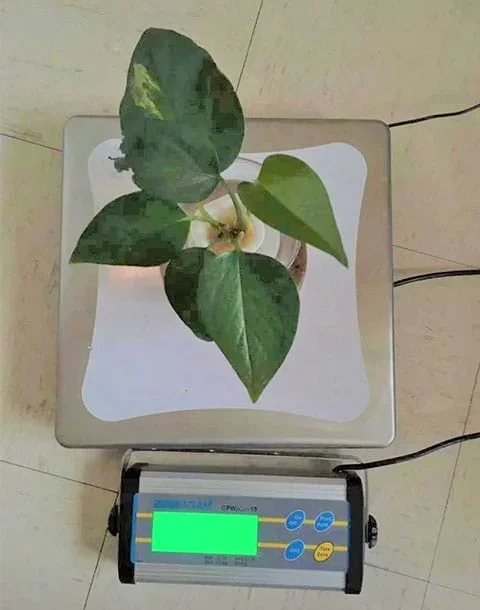 Taking the weight measurement of a plant growing in a glass jar using hydroponics.Copyright 2020 Liping Wang, University of Wyoming
What’s the difference between two common agricultural methods? What are the roles engineers play in designing better methods? In this activity, students measure and calculate evapotranspiration rates--the amount of water lost from evaporation and transpiration in a growing media (such as a pot or jar) and plant surfaces-- for living plants using soil and hydroponics. By recording changes in plant weight, students calculate evapotranspiration rates and determine which of the two growing methods is best for their design.
Hydroponics is a commonly used method for growing plants that does not use soil and is resource efficient. Hydroponic growing methods have been widely adopted for urban agriculture, such as vertical farming, within a controlled environment. Engineers concerned with sustainable methods for growing food and reducing water usage work to develop new techniques to further advance this field of sustainable urban farming. Agricultural engineers help to make farming sustainable, safe, and environmentally friendly. By analyzing agricultural operations and looking at new technologies and ways of doing things to improve land use, increase yields, and conserve resources, agricultural engineering combines mechanical, civil, electrical, and chemical engineering principles with agricultural principles.
After this activity, students should be able to:
- Explain the two different plant growth methods (soil vs. hydroponics)
- Explain the positive and negative considerations of hydroponics.
- Compare evapotranspiration for plants growing in soil and with hydroponics.
- CCSS.Math.Content.8.SP.A Investigate patterns of association in bivariate data.
Grade 8
Do you agree with this alignment? - CCSS.Math.Practice.MP2 Reason abstractly and quantitatively.
Grades K-12
Do you agree with this alignment? - CCSS.Math.Practice.MP4 Model with mathematics.
Grades K-12
Do you agree with this alignment? - CCSS.Math.Practice.MP5 Use appropriate tools strategically.
Grades K-12
Do you agree with this alignment?
- MS-LS2-1 Analyze and interpret data to provide evidence for the effects of resource availability on organisms and populations of organisms in an ecosystem.
Grades 6-8
This resource focuses on the following Three Dimensional Learning aspects of NGSS:
Science & Engineering Practices- Analyze and interpret data to provide evidence for phenomena.Do you agree with this alignment?
- Use mathematical representations to describe and/or support scientific conclusions and design solutions.Do you agree with this alignment?
Disciplinary Core Ideas- Organisms, and populations of organisms, are dependent on their environmental interactions both with other living things and with nonliving factors.Do you agree with this alignment?
- In any ecosystem, organisms and populations with similar requirements for food, water, oxygen, or other resources may compete with each other for limited resources, access to which consequently constrains their growth and reproduction.Do you agree with this alignment?
- Growth of organisms and population increases are limited by access to resources.Do you agree with this alignment?
Crosscutting Concepts- Cause and effect relationships may be used to predict phenomena in natural or designed systems.Do you agree with this alignment?
Do you agree with this alignment? - Analyze and interpret data to provide evidence for phenomena.
- MS-LS2-2 Construct an explanation that predicts patterns of interactions among organisms across multiple ecosystems.
Grades 6-8
This resource focuses on the following Three Dimensional Learning aspects of NGSS:
Science & Engineering Practices- Construct an explanation that includes qualitative or quantitative relationships between variables that predict phenomena.Do you agree with this alignment?
Disciplinary Core Ideas- Similarly, predatory interactions may reduce the number of organisms or eliminate whole populations of organisms. Mutually beneficial interactions, in contrast, may become so interdependent that each organism requires the other for survival. Although the species involved in these competitive, predatory, and mutually beneficial interactions vary across ecosystems, the patterns of interactions of organisms with their environments, both living and nonliving, are shared.Do you agree with this alignment?
Crosscutting Concepts- Patterns can be used to identify cause and effect relationships.Do you agree with this alignment?
Do you agree with this alignment? - Construct an explanation that includes qualitative or quantitative relationships between variables that predict phenomena.
- CCSS.Math.Content.8.SP.A Investigate patterns of association in bivariate data.
Grade 8
Do you agree with this alignment? - CCSS.Math.Practice.MP2 Reason abstractly and quantitatively.
Grades K-12
Do you agree with this alignment? - CCSS.Math.Practice.MP4 Model with mathematics.
Grades K-12
Do you agree with this alignment? - CCSS.Math.Practice.MP5 Use appropriate tools strategically.
Grades K-12
Do you agree with this alignment?
Each group needs:
- computer or laptop with access to Microsoft Excel
- plants, 3 cm (1.2 in) or taller, and nearly identical)—Note: Golden Pothos (Epipremnum aureum) are easy to grow and relatively low maintenance. Other common indoor plants for this activity include the prayer plant (Maranta leuconeura), cast iron plant (Aspidistra elatior), peace lily (Spathiphyllum), and heartleaf philodendron (Philodendron hederaceum).
- plastic pot or jar for soil cultivation (The size of the pot or jar will not matter in this activity because of the change of weight of plants and daily growth rate.)
- 1 L (~32 oz) yogurt plastic container with a lid (to support hydroponic plants)
- hand trowel
- scissors
For the entire class to share:
- high-resolution digital scale
- 23 L ~(25 qt) bag of potting soil, or 47 L [50 qt] if class is bigger, nutrients for hydroponics—available online
- set of measuring spoons
- set of measuring cups
- container or bucket for the nutrient solution (optional)
A basic knowledge of Excel and functions within an Excel spreadsheet.
An understanding of transpiration and evaporation in plants.
Do you think that plants can live and grow outside of the soil? Raise your hand if you have heard of hydroponics or indoor agriculture? Hydroponics is a method of growing plants without soil by using “nutrient solutions”. A nutrient solution is a carefully proportioned liquid fertilizer that allows grows plants without soil!
If plants didn’t have to be grown in soil, what kind of benefits might occur? (Answers: grow plants indoors, grow plants vertically, be more resource-efficient, use less resources, grow plants/crops near locations of consumption, grow plants regardless of outdoor environmental conditions like drought or hail, grow plants anywhere in the world, anytime of the year, increase plant/crop yield, decrease water, and land consumption, and reduce the need for pesticides.)
These benefits could positively impact our food production and help the environment! In this activity, we are going to compare evapotranspiration rates for plants growing in soil and plants grown hydroponically to see which grows better.
Background
Hydroponics refers to the method of growing plants without soil, instead using a nutrient solution. It is an alternative plant growing method that can be highly productive for indoor farming. Hydroponics can be used when traditional agriculture is not possible like in arid locations, poor soils, short growing season regions, and/or extremely hot or cold areas.
Hydroponic plants do not have their roots in soil; they hang their roots down into containers that contain nutrient solution. In an automatic system, the nutrient solution is delivered to the plants through tubes in automatically timed doses. All the nutrients and minerals needed by the plants that are normally found in soil are contained in nutrient solution (which is dissolved in water.) In this activity, students will add new nutrient solution on a regular basis.
Since hydroponic plants do not grow in soil, they are not exposed to weeds or insect pests. These plants tend to be healthier, more disease resistant and grow up to 30% faster than other plants. The root systems of hydroponically grown plants stay smaller, so the plant's growth energy is concentrated on producing plant mass.
Although hydroponics might be new to students, the concept has been around a long time. One interesting application of hydroponics is that astronauts can use this science to grow fresh food in space.
The goal of this activity is to show students that plants can grow well both in soil and hydroponically. (Based on our measurement and data collection/analysis, we found that evapotranspiration (ET) rates are comparable for Golden Pothos growing in soil or hydroponically.) Students learn to calculate ET rates for living plants with two different growing methods: soil-based and hydroponics-based by recording weight changes of plants. Students compare the two growing methods based on ET measurements.
ET represents the total amount of water lost from evaporation and transpiration via plant growing media and plant surfaces like leaves. Through the ET process, plants transfer nutrients and water from roots to leaves. A digital scale is used to measure the weight of plants and their growing media, calculated based on the weight difference over time. ET rates are calculated by dividing ET by the time period between two weight measurements.
Before the Activity
- Gather materials and make copies of the Data Recording Sheet (PDF), one per student.
- Select three to four plant species, choosing plants that are very similar in height and width.
- Calibrate the high-resolution scale before each measurement.
- Prepare the nutrient solution in one container for hydroponics. Follow product instructions for the preparation of the nutrient solution (optional; the students can mix their own nutrient solution during the activity.)
With the Students
- Organize students into two-person groups.
- Introduce the activity; present the materials and plants available.
- Have each group select one plant species to measure and grow. Note: They will need two plants of the same species which are approximately the same height and weight.
- Each group prepares their potted plant.
- Add new potting soil to the plastic container until about 1/2 full. Do not tamp down the soil too hard!
- Remove the plant from its current pot or container. To do so, turn plant sideways and gently hold it by the stems or leaves, and tap the bottom of its current pot until the plant slides out.
- Gently loosen the plant’s roots with their hands.
- Set the plant on top of the fresh layer of potting soil in the new container, making sure it's centered, then add potting soil around the plant until it is secure. Be sure not to pack too much soil into the container, as you want the roots to breathe.
- Even out the potting soil on top and water well.
- Each group then prepares their hydroponic plant.
- Cut a 2-inch hole in the lid of the yogurt container. (Note: The yogurt plastic container is to support plants growing hydroponically by staying stable in the water.)
- Mix the nutrient solution as instructed on the nutrient package.
- Remove the plant from its current pot or container. To do so, turn plant sideways and gently hold it by the stems or leaves, and tap the bottom of its current pot until the plant slides out.
- Carefully wash the plant roots with fresh water.
- Thread the roots through the 2-inch hole in the lid of the yogurt container. (Roots should be below the lid and the leaves and stems above the lid.)
- Pour the nutrient solution into the yogurt container about halfway.
- Put the lid back on the yogurt container and see where the plant roots are relative to the surface of the nutrient solution. Do not fully submerge the plant roots. Leave 1-2 inches spaces between the top of the plant roots and solution surface. It is recommended to change the solution every week.
- Once the plants are planted/settled in their pots and yogurt containers, each group weighs their two plants and records it in the Data Recording Sheet (PDF). Be sure for students to note any patterns they observe.
For the next two weeks, every day each group:
- Measures and records the weight of each of their plants before watering and/or adding nutrient solution. They should also record the date and time for each measurement. Note: Students are welcome to take measurements more than one time per day at different times of the day. The date and time MUST be recorded.
- Each student group takes photos of the two plants each day and adds the pictures to their Data Recording Sheet (PDF).
- Students should always weigh their plants before and after watering and/or adding the nutrient solution to the glass jar. The weights, time, and date-time should be recorded in their Data Analysis Worksheet (XLSX).
- Each student group can compile their data into the Excel spreadsheet Data Analysis Worksheet (XLSX) every week.
- Each student group can analyze data with the Data Analysis Worksheet (XLSX). Students use Excel to calculate ET rates.
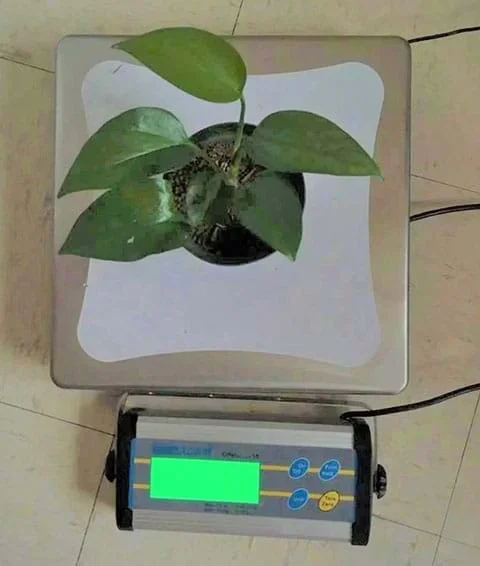 Taking the weight measurement of a plant (Gold Pothos) growing in a soil pot.Copyright 2020 Liping Wang, University of Wyoming
- evapotranspiration
- Total amount of water lost from evaporation and transpiration via plant growing media and plant surfaces.
- hydroponics
- A method of growing plants with nutrient solutions.
- nutrient
- Substance that provides nourishment for growth and maintenance of life.
- soil
- Black or dark brown material typically consisting of a mixture of organic remains, clay, and rock particles; the layer of the Earth in which plants grow.
Pre-Activity Assessment
Questions: Ask students questions as follows:
- Do you think that plants can live and grow outside of the soil? (Let students offer their answers.) What environmental conditions (temperature and relative humidity) do they grow?
Activity Embedded (Formative) Assessment
Worksheet: Students conduct measurements for ET and record date time by following the instruction. Students can successfully make use of the Data Analysis Worksheet (XLSX).
Post-Activity (Summative) Assessment
Comparison: Compare the ET performance of the plants growing in two different methods by correctly utilizing the Data Analysis Worksheet (XLSX) in Excel. Have students note any distinct patterns- what similarities and/or differences are there?
- Plants growing hydroponically do not need to be watered. Students can use a small container to refill the nutrient solution in the jar.
- Do not fully submerge the plant roots in the nutrient solution. Leave 1-2 inches spaces between the top of the plant roots and solution surface.
- Change nutrient solution for hydroponic plants once a week and water plants growing in soil when the topsoil is dry. Water the plant until water comes out of the drainage holes.
- The plants should be relatively easy to maintain. However, if a plant dies during the activity, the students will need to pick two new plants and redo the experiment. (Teachers may need to plan time for the project just in case if this happens.)
- The amount of water added to the potted plants will affect the ET rate. Overwatering or underwatering will prohibit plants to grow. We watered the Golden Pothos during the experiments every week. Since we use the weight difference between two measurement points, how much water was added each time should not be a problem as long as we are not creating water stress for the plant or drown the plant.
For upper grade or more advanced students, do not give students the Data Analysis Worksheet (XLSX) and instead have them create their own Excel Spreadsheet, equations, and functions to calculate ET rates.
Contributors
Liping Wang; Kadria Drake; Cheryl Travis; Anna Groose
Supporting Program
National Science Foundation Environmental Sustainability Program, University of Wyoming
Acknowledgements
This curriculum was developed under National Science Foundation Environmental Sustainability program Grant No. CBET 1944823— Commercial Building Indoor Greenery Systems' Effects on Thermal Environment and Occupant Comfort under Climate Change at the University of Wyoming. Any opinions, findings, and conclusions or recommendations expressed in this material are those of the authors and do not necessarily reflect the views of the National Science Foundation.
Copyright
2021 by Regents of the University of Colorado; original © 2020 University of Wyoming