
Electromagnetic Waves Are Everywhere!
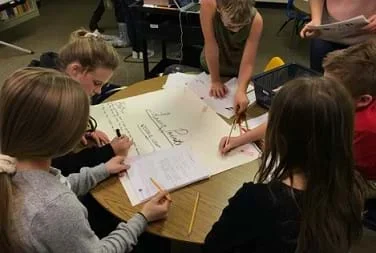 Students work together to create posters focused on various kinds of electromagnetic radiation, such as visible light.Copyright 2020 Philip Bergmaier, Wyoming NASA Space Grant Consortium
In this three-part activity, students are introduced to the electromagnetic spectrum, learn about the devices that use electromagnetic waves, and become experts on one electromagnetic radiation device. This activity allows students to get an in-depth perspective on different devices and how they operate on the electromagnetic spectrum. It allows students to research and evaluate how engineers create new technology.
Electromagnetic radiation occurs naturally around us, such as sunshine, thermal radiation, radio interference from lightning strikes, and the signals that radio astronomers gather from space. Appliances like microwaves, televisions, and computers use electromagnetic radiation. Since different devices use electromagnetic radiation, each is confined to a specific part of the electromagnetic spectrum. Engineers decide what part of the spectrum to use, depending on where the device will best work, and what is allowed by regulation.
After the On the Same Wavelength activity, students should be able to:
- Determine the next number in a sequence.
- Categorize corresponding elements of the electromagnetic spectrum.
After the Electromagnetic Exploration activity, students should be able to:
- Discuss the electromagnetic properties of various devices in their world.
- Identify possible electromagnetic frequencies of devices.
- Make educated predictions as to how devices use electromagnetic radiation to function.
After the Device Jigsaw activity, students should be able to:
- Identify what type of electromagnetic radiation a device uses.
- Relate facts about devices to the electromagnetic spectrum.
- Research and present information about a device that utilizes electromagnetic radiation.
- CCSS.Math.Content.4.OA.C Generate and analyze patterns.
Grade 4
Do you agree with this alignment? - CCSS.Math.Content.4.OA.C.5 Generate a number or shape pattern that follows a given rule. Identify apparent features of the pattern that were not explicit in the rule itself.
Grade 4
Do you agree with this alignment?
- 4-PS4-3 Generate and compare multiple solutions that use patterns to transfer information.
Grade 4
This resource focuses on the following Three Dimensional Learning aspects of NGSS:
Science & Engineering Practices- Generate and compare multiple solutions to a problem based on how well they meet the criteria and constraints of the design solution.Do you agree with this alignment?
Disciplinary Core Ideas- Different solutions need to be tested in order to determine which of them best solves the problem, given the criteria and the constraints.Do you agree with this alignment?
- Digitized information can be transmitted over long distances without significant degradation. High-tech devices, such as computers or cell phones, can receive and decode information—convert it from digitized form to voice—and vice versa.Do you agree with this alignment?
Crosscutting Concepts- Knowledge of relevant scientific concepts and research findings is important in engineering.Do you agree with this alignment?
- Similarities and differences in patterns can be used to sort and classify designed products.Do you agree with this alignment?
Do you agree with this alignment? - Generate and compare multiple solutions to a problem based on how well they meet the criteria and constraints of the design solution.
- DCI.PS4.B.3-5.3 An object can be seen when light reflected from its surface enters the eyes.
Grade 4
Do you agree with this alignment?
For the On the Same Wavelength activity, each person needs:
- pencil
- glue stick
- On the Same Wavelength Worksheet (PDF)
- calculator (optional)
For the Electromagnetic Exploration activity, each group needs:
- Electromagnetic Exploration Chart (PDF)
- pencil
- computer or device with internet capabilities
For the Device Jigsaw activity
Each group needs:
- computer or device with internet capabilities
- Device Jigsaw Organizer and Checklist (PDF)
The entire class needs:
- poster boards or paper
- markers, colored pencils, crayons
- On the Same Wavelength Worksheet (docx)
- On the Same Wavelength Worksheet (pdf)
- On the Same Wavelength Worksheet Answer Key (docx)
- On the Same Wavelength Worksheet Answer Key (pdf)
- Electromagnetic Waves are Everywhere! (pptx)
- Electromagnetic Waves are Everywhere! (pdf)
- Electromagnetic Exploration Chart (docx)
- Electromagnetic Exploration Chart (pdf)
- Electromagnetic Exploration Chart Answer Key (pdf)
- Device Jigsaw Organizer and Checklist (docx)
- Device Jigsaw Organizer and Checklist (pdf)
- Device Jigsaw Organizer and Checklist Answer Key (docx)
- Device Jigsaw Organizer and Checklist Answer Key (pdf)
Students need to have a grasp on problem solving and how to continue a pattern. Students should already have a basis of knowledge for electromagnetic waves/radiation and frequencies. Students should understand the electromagnetic spectrum, frequencies, and how to do basic research on a computer.
On the Same Wavelength Activity:
(Display the attached introductory Electromagnetic Waves are Everywhere! Presentation (PPTX)).
Can anyone tell me what electromagnetic radiation is? (Let students offer answers.) Electromagnetic radiation is energy in motion from one place to another. It exists all around us and is used in many ways for technology. But what does it look like? (Let students offer answers.) It looks like a wave. Who would like to show me what a wave looks like? A wave is a vibration that moves in space. The vibration is an up and down or side to side motion, and in the case of an electromagnetic wave the vibration is of the electric and magnetic fields. All electromagnetic waves travel at the same speed – the speed of light. The rate of the vibration is what we call its frequency. The frequency describes the number of times that a wave completes a cycle within a certain amount of time. The distance between repeating parts of the wave as it travels in space is what we call its wavelength.
Let’s say that we have no knowledge about these different wavelengths, what they’re capable of, or even what types of technology are associated with each one. How would we learn more? Well, we do know patterns, right? A wave is a type of pattern because it repeats. Today we are going to use our knowledge of patterns and continuing the sequence to help us learn more about the electromagnetic spectrum. This activity will allow you to see different parts of the electromagnetic spectrum, how they correspond, and how they are grouped. But this activity will also group you. You will all be given a sheet of paper with a different sequence on it. Your task is to complete your sequence and find the rule. This will turn into a bit of a scavenger hunt until you are led to the students in the same group.
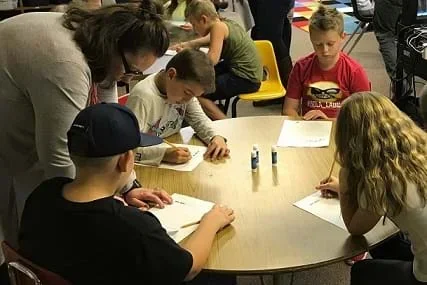 Students will complete the activity worksheet as a group.Copyright 2020 Philip Bergmaier, Wyoming NASA Space Grant Consortium
Electromagnetic Exploration Activity:
Can you think of anything that we use every day that uses electromagnetic waves to work? How about a radio, a TV, or a cellphone? What can we say about the electromagnetic radiation each uses? Are there different types of electromagnetic radiation? How do we know?
There are many devices in our world that use electromagnetic radiation. All such radiation travels at the same speed through space, and all is a vibration of the electric and magnetic fields. However, what is different about the radiation that each specific device uses, is either its frequency or its wavelength. What is a frequency? A frequency is the number of times that a pattern repeats in a specified amount of time. In electromagnetic radiation for example, we measure frequency by how many waves go past us during a period of time. A period with a smaller number of waves is a lower frequency, while a period that has a greater number of waves is a higher frequency. So, do we use these frequencies for different things? Lower frequencies are generally better for long-distance communication, they generally carry radio and television signals, while higher frequencies are better for high-speed data transfer, or radar, or even for looking inside things like X-rays do. Can you think of some devices that may use higher frequency electromagnetic waves?
Device Jigsaw Activity:
It is up to engineers to figure out how to utilize frequency to aid the function of a device. They must have a specific purpose or end goal in mind to determine which frequencies they want to harness to make the device function well. Today we are going to think like engineers and determine what electromagnetic frequencies some of the devices we use in our lives use and why they work the way that they do.
Students work together to create posters focused on various kinds of electromagnetic radiation, such as visible light.Copyright 2020 Philip Bergmaier, Wyoming NASA Space Grant Consortium
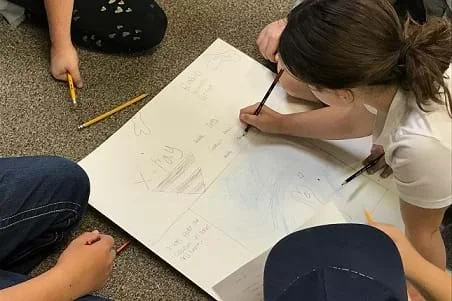 Posters can focus on other types of electromagnetic radiation such as microwaves or remote controls.Copyright 2020 Philip Bergmaier, Wyoming NASA Space Grant Consortium
Background
Spectrum is a word encountered in many places in science and engineering. It refers to an arrangement of characteristics of objects or phenomena. In the case of the electromagnetic spectrum, what we are referring to is an arrangement of waves in the electric field by their wavelength. Wavelength is related to many of the observed characteristics of electromagnetic energy. To get a feel for electromagnetic waves think of waves on the ocean and the wavelength being the distance from one wave crest to the next.
Figure 1 shows the direction of the electric field as a wave passes a stationary person. The direction of the electric field goes from pointing up at maximum strength (t=0), to down at maximum negative strength, and back to up – completing one wave at t=P. The time from up to up again is the “period” of the wave. Generally, rather than period, scientists and engineers talk about “frequency” which is one divided by the period.
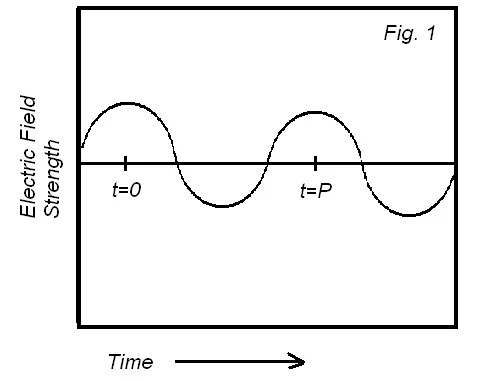 Figure 1. The direction of the electric field as a wave passes a stationary person.Copyright 2020 Philip Bergmaier, Wyoming NASA Space Grant ConsortiumFigure 2 shows the electric field at one moment in time. It goes from being up at maximum strength at one place (x=0) to maximum down, and back to maximum up at another place (x=L). The space distance from maximum up to maximum up again is the wavelength (L) of the wave. This spatial pattern of the electric field moves through space at “the speed of light”.
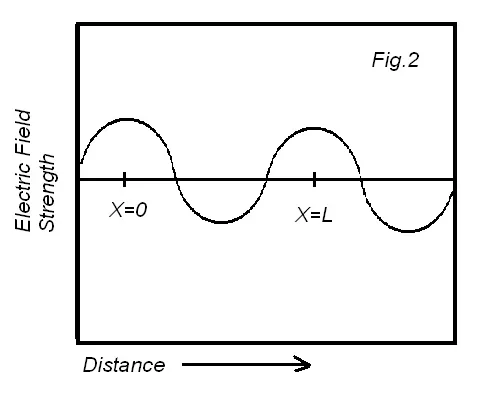 Figure 2. The electric field at one moment in time.Copyright 2020 Philip Bergmaier, Wyoming NASA Space Grant Consortium
On the Same Wavelength Activity:
While we cannot see electromagnetic wavelengths there are ways to visualize them to gain a greater understanding of them. This visualization is your greatest asset when teaching to a younger audience who may not understand the complexities of the actual numbers and values involved. Additionally, by attaching mathematical values that are at the students’ skill level, students will be more capable of making the connections necessary to understanding the different elements of the electromagnetic spectrum and how it is used in various everyday technology.
Before the Activity
- Make necessary changes to math problems.
- Make copies of the On the Same Wavelength Worksheet (PDF).
- Cut up answers.
- Prepare group lists so that you know who is supposed to end up in each group.
- Organize the materials in the classroom for easy and efficient access.
With the Students
- Give each student On the Same Wavelength Worksheet (PDF) and ask them to find each answer one at a time.
- Once each student finds their rule, they need to find the slip of paper with that rule on it.
- Students will find the rule for the next sequence and the corresponding slip of paper.
- Students will continue this pattern until all problems are completed.
- These slips of paper unveil different elements of their wavelength. Group members have the same elements.
- Once students have found their group, they should look at their different elements and write a 3-5 sentence paragraph about their wavelength.
Electromagnetic Exploration Activity:
What is Electromagnetic Radiation?
Electromagnetic radiation exists naturally all around us. It results when a charged particle moves in response to a force. The movement creates an electric field and a magnetic field that vibrate at right angles to one another, and at a right angle to the direction of travel. This is also known as a transverse wave.
The Electromagnetic Spectrum
These transverse waves occur at different frequencies. These frequencies all have different properties and capabilities when harnessed for human use. There are seven categories that make up the electromagnetic spectrum: (from lowest frequency to highest frequency) radio waves, microwaves, infrared, visible light, ultraviolet, X-Rays, and Gamma Rays.
Before the Activity
- Make copies of the Electromagnetic Exploration Chart (PDF).
- Have computers or internet capable devices prepared and available.
With the Students
- Divide the class into small groups (3-5 students).
- Ask each group to grab one computer (or more if available).
- Pass out the Electromagnetic Exploration Chart (PDF).
- Explain the directions: On this chart are three columns. In the first column are various devices that we will be working with and researching. In the second column is the frequency rating from lowest to highest. Lowest is 1, highest is 6. You will research what electromagnetic frequencies these devices use and rank them accordingly. Then, the last column says, “from your research, how might this device use electromagnetic radiation?” In this column you are going to give your best educated guess for how this device might use electromagnetic frequencies to work. Finally, at the bottom of the worksheet you will use complete sentences to write 2-4 interesting facts that you learned about frequencies, electromagnetic radiation, or any of these devices.
- Give students the opportunity to begin working (20-25 minutes).
- While students are working, observe, answer questions, and provide assistance.
Device Jigsaw Activity:
Before the Activity
- Print out the Device Jigsaw Organizer and Checklist (PDF) (1 per group)
- Gather poster boards and writing/drawing utensils.
- Make sure computers or devices with internet capabilities are available.
With the Students
- Divide the class into groups of three to five students.
- Ask one person in each group to grab a computer.
- Handout one copy of the Device Jigsaw Organizer and Checklist (PDF).
- Give instructions:
- As a group, choose one of the devices from the electromagnetic exploration chart.
- You will receive one piece of poster-board and art supplies.
- Draw the device and write its name.
- Write what category the device fits under
- Write two interesting facts about the device.
- At the end, each group will share their posters with the class.
- Give students 20 minutes to research and complete their posters.
- Remind the students to use the Device Jigsaw Organizer and Checklist (PDF) to make sure their posters are complete.
- After their time is up, ask students to prepare to present.
- Give each group 2-4 minutes to present their device.
- electromagnetic radiation
- A type of energy transfer by way of varying electric and magnetic fields.
- electromagnetic spectrum
- The range of frequencies of electromagnetic radiation.
- electromagnetic waves
- A disturbance to electric and magnetic fields which propagates through space and repeats in time (frequency) and space (wavelength). The electric and magnetic fields are perpendicular to one another.
- frequency
- The rate at which something occurs or repeats within a given amount of time.
- function
- What something does or is used for.
- gamma rays
- An electromagnetic wave with a higher frequency than X-ray that is produced by nuclear reactions. The radiation can be used to treat cancerous tumors.
- infrared
- An electromagnetic wave with a slightly higher frequency than microwave. It is still invisible to the human eye and used for transmitting heat.
- microwaves
- A low frequency electromagnetic wave of a frequency used for long-distance communication.
- radio waves
- A low frequency electromagnetic wave of a frequency used for long-distance communication.
- ultraviolet
- An electromagnetic wave with a slightly higher frequency than visible light. It is used for devices such as blacklights and is absorbed from sunlight to cause sunburn.
- visible light
- An electromagnetic wave with a slightly higher frequency than infrared that we can see. It allows us to see colors.
- wavelengths
- The distance between subsequent features of the electromagnetic waves, such as wave crests.
- x-rays
- An electromagnetic wave with a slightly higher frequency than ultraviolet radiation. X-rays are responsible for X-ray machines that allow us to see through skin.
Pre-Activity Assessment
Ask students to give a thumbs-up or thumbs-down if they understand how to find patterns. Complete a K-W-L Chart for electromagnetic frequencies. During this section, fill out the know and want to know sections. As a pre-activity assessment, ask students to grab a piece of paper and write a list of all devices that they know that use electromagnetic radiation to function in some way. Have students share out a few devices that they wrote and allow them to ask questions if they are unsure.
Activity Embedded (Formative) Assessment
While students are completing the activity, walk around the classroom and observe to gauge if students are grasping the concept of completing the pattern. Ask students for a thumbs-up or thumbs-down to gauge progress and understanding while they are working on the activity. This short assessment will allow you to provide more assistance to the groups who are struggling.
Post-Activity (Summative) Assessment
After the activity, students will have completed their patterns and have found descriptions about their wavelength. In their groups, students should write a 3-5 sentence paragraph describing devices’ wavelength. After student groups have completed the activity, they will present their interesting facts to the class, then turn in their worksheets for evaluation by the instructor. Additionally, students will fill out the learned section of the K-W-L chart. Students will present their posters to the class and hand in their checklist that has all of the items completed.
While there should be very few safety issues during this activity, students will be moving around the classroom with pencils, so remember:
- No running.
- When moving keep your pencil pointed downward so you do not poke anybody.
- Be careful when handling computers.
Some students may struggle with the math portion of completing the pattern. To combat this, check the work of all students before grouping to make sure they have the right answer. Also consider having students work with a volunteer, para, or another student to accomplish the task in a timely manner. Students may get hung up on explaining how a device might work. It is possible that they may focus too much on being right and make it too complicated. If this is something that is happening, try coming up with an example that students can model their responses after. Additionally, if time becomes an issue, have students focus solely on the frequency ratings and interesting facts that they learned. Students may be confused as to what constitutes an interesting fact. Point them in the direction of facts related to the science or engineering of the device. This will fit more with the overall purpose of the activity and give students a better understanding of how engineers use electromagnetic radiation to create devices.
If you have more time and space, feel free to make a scavenger hunt out of the On the Same Wavelength activity. Have students get an initial clue from their packets that requires them to solve a problem then go to the corresponding area to solve another problem. Do this several times until it leads them to their group. For further electromagnetic exploration, students (individually or as a group) could choose one of the devices to do in depth research on and create a presentation of some sort for this device, its specifications, and its electromagnetic properties. The Device Jigsaw activity could be extended with a writing assignment. After presentations, students could perform more in-depth research to create a one page write up about their findings.
Find a math standard that reflects the grade level being taught:
- Remove the individual element and have students work in groups to begin with, just to find their group name.
- For older students, consider incorporating more serious problem solving and actual elements of the electromagnetic spectrum.
Electromagnetic concepts:
- For lower grades, print out an electromagnetic spectrum and cut out the device pictures. Have students glue the device to the spot on the electromagnetic spectrum that the frequency lies. This could also be done as a whole group in a more direct instruction style.
- For upper grades and more advanced students, require that they write full paragraphs for their predictions and findings. Suggest that they find more in-depth research or that they use citations to support their statements.
Device Jigsaw activity:
- For lower grades, focus on how the device works. Do not worry about students working with the electromagnetic radiation concept too much, it is likely that they need exposure to the functions of some of these devices.
- For upper grades, put a greater emphasis on how the device functions with electromagnetic radiation. These students are more able to grapple with the concept and should be able to find better research on the topic.
A good resource for general information, “What is electromagnetic radiation?” - https://www.livescience.com/38169-electromagnetism.html
A good chart for visualizing and organizing the electromagnetic spectrum, “Electromagentic spectrum properties” - https://en.wikipedia.org/wiki/Electromagnetic_spectrum#/media/File:EM_Spectrum_Properties_edit.svg

For information on frequencies, “Wave Motion | Waves | Physics” - https://youtu.be/CVsdXKO9xlk
EDInformatics. What are electromagnetic waves? The electromagnetic spectrum. https://www.edinformatics.com/math_science/electromagnetic-waves-and-the-electromagnetic-spectrum.html
- Testing Cell Signal at Altitude
- Electromagnetic Waves Are Everywhere!
Contributors
Kelsy Begin; Abby Fearneyhough; Connor Hamp; Trina Kilty; Philip Bergmaier; Kevin Kilty; Andrea Burrows; Kate Muir Welsh; Shawna McBride; Jennifer Wistisen
Supporting Program
LIFT Project: Combining Project-based Learning, Citizen Science, and Authentic Research to Enhance the Success of STEM and STEM Education Majors,, University of Wyoming
Acknowledgements
This material was developed based upon work supported by the National Science Foundation under grant no. 1821566—the LIFT (Learning to Integrate Fundamentals through Teaching) Project, Wyoming NASA Space Grant Consortium, University of Wyoming. Any opinions, findings and conclusions or recommendations expressed in this material are those of the authors and do not necessarily reflect the views of the National Science Foundation.
Copyright
2023 by Regents of the University of Colorado; original © 2020 University of Wyoming