
Living Walls: Choosing a Location with Arduino
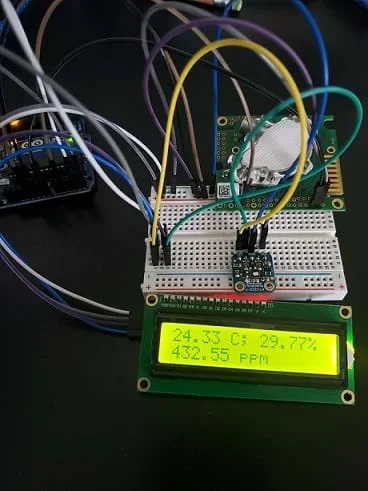 An example of the final device design.Copyright 2021 Kadria Drake, University of Wyoming
Living walls or vertical gardens can elevate indoor spaces, improve aesthetics, and bring nature inside. But how do living walls after the surrounding environment? Is it possible that living walls can improve the atmosphere where they exist? In this activity, students use an Arduino Sensing Toolkit to monitor their environment. Students collect data on CO2, temperature, and relative humidity. They then apply this data to a real-world situation of adding a living wall to a specific location and justifying their answer with data.
Engineers help create designs for buildings that have comfort and health in mind. Engineers must think about the environmental quality of a building. This means understanding the thermal environmental conditions for human occupancy as well as the ventilation necessary for their specific building purpose. They must be able to make changes to their designs to better fit the purpose of the space and thermal comfort for those who will use the building. Engineers are always using data to support or adjust their original plans and ideas. This will give the students a chance to do this.
After this activity, students should be able to:
- Develop an Arduino sensing toolkit to gather data about their environment.
- Compare data gathered to national standards/expectations for indoor air quality.
- Construct an argument based on their data to support the location of a living wall to fix an issue that they see in their thermal comfort or indoor air quality.
- STEL-3E Analyze how different technological systems often interact with economic, environmental, and social systems.
Grades 6-8
Do you agree with this alignment? - STEL-7S Create solutions to problems by identifying and applying human factors in design.
Grades 6-8
Do you agree with this alignment?
- MS-ESS3-3 Apply scientific principles to design a method for monitoring and minimizing a human impact on the environment.
Grades 6-8
This resource focuses on the following Three Dimensional Learning aspects of NGSS:
Science & Engineering Practices- Apply scientific principles to design an object, tool, process or system.Do you agree with this alignment?
Disciplinary Core Ideas- Human activities have significantly altered the biosphere, sometimes damaging or destroying natural habitats and causing the extinction of other species. But changes to Earth's environments can have different impacts (negative and positive) for different living things.Do you agree with this alignment?
Crosscutting Concepts- The uses of technologies and any limitations on their use are driven by individual or societal needs, desires, and values; by the findings of scientific research; and by differences in such factors as climate, natural resources, and economic conditions. Thus technology use varies from region to region and over time.Do you agree with this alignment?
- Relationships can be classified as causal or correlational, and correlation does not necessarily imply causation.Do you agree with this alignment?
Do you agree with this alignment? - Apply scientific principles to design an object, tool, process or system.
- MS-ETS1-1 Define the criteria and constraints of a design problem with sufficient precision to ensure a successful solution, taking into account relevant scientific principles and potential impacts on people and the natural environment that may limit possible solutions.
Grades 6-8
This resource focuses on the following Three Dimensional Learning aspects of NGSS:
Science & Engineering Practices- Define a design problem that can be solved through the development of an object, tool, process or system and includes multiple criteria and constraints, including scientific knowledge that may limit possible solutions.Do you agree with this alignment?
Disciplinary Core Ideas- The more precisely a design task's criteria and constraints can be defined, the more likely it is that the designed solution will be successful. Specification of constraints includes consideration of scientific principles and other relevant knowledge that is likely to limit possible solutions.Do you agree with this alignment?
Crosscutting Concepts- The uses of technologies and any limitations on their use are driven by individual or societal needs, desires, and values; by the findings of scientific research; and by differences in such factors as climate, natural resources, and economic conditions.Do you agree with this alignment?
- All human activity draws on natural resources and has both short and long-term consequences, positive as well as negative, for the health of people and the natural environment.Do you agree with this alignment?
Do you agree with this alignment? - Define a design problem that can be solved through the development of an object, tool, process or system and includes multiple criteria and constraints, including scientific knowledge that may limit possible solutions.
- MS-ETS1-2 Evaluate competing design solutions using a systematic process to determine how well they meet the criteria and constraints of the problem.
Grades 6-8
This resource focuses on the following Three Dimensional Learning aspects of NGSS:
Science & Engineering Practices- Evaluate competing design solutions based on jointly developed and agreed-upon design criteria.Do you agree with this alignment?
Disciplinary Core Ideas- There are systematic processes for evaluating solutions with respect to how well they meet the criteria and constraints of a problem.Do you agree with this alignment?
Do you agree with this alignment? - Evaluate competing design solutions based on jointly developed and agreed-upon design criteria.
- MS-ETS1-3 Analyze data from tests to determine similarities and differences among several design solutions to identify the best characteristics of each that can be combined into a new solution to better meet the criteria for success.
Grades 6-8
This resource focuses on the following Three Dimensional Learning aspects of NGSS:
Science & Engineering Practices- Analyze and interpret data to determine similarities and differences in findings.Do you agree with this alignment?
Disciplinary Core Ideas- There are systematic processes for evaluating solutions with respect to how well they meet the criteria and constraints of a problem.Do you agree with this alignment?
- Sometimes parts of different solutions can be combined to create a solution that is better than any of its predecessors.Do you agree with this alignment?
- Although one design may not perform the best across all tests, identifying the characteristics of the design that performed the best in each test can provide useful information for the redesign process—that is, some of the characteristics may be incorporated into the new design.Do you agree with this alignment?
Do you agree with this alignment? - Analyze and interpret data to determine similarities and differences in findings.
- MS-ESS3-3 Apply scientific principles to design a method for monitoring, evaluating, and managing a human impact on the environment.
Grades 6-8
Do you agree with this alignment? - MS-ETS1-1 Define the criteria and constraints of a design problem with sufficient precision to ensure a successful solution, taking into account relevant scientific principles and potential impacts on people and the natural environment that may limit possible solutions.
Grades 6-8
Do you agree with this alignment? - MS-ETS1-2 Evaluate competing design solutions using a systematic process to determine how well they meet the criteria and constraints of the problem.
Grades 6-8
Do you agree with this alignment? - MS-ETS1-3 Analyze data from tests to determine similarities and differences among several design solutions to identify the best characteristics of each that can be combined into a new solution to better meet the criteria for success.
Grades 6-8
Do you agree with this alignment?
Each group needs:
- laptop computer
- Arduino Uno microcontroller
- CO2 Sensor (K30 CO2Sensor)
- humidity/ temperature sensor
- LCD screen
- breadboard
- wires
- 9v battery
- Proposal and Data Collection Worksheet (PDF)
- (optional) a collection of plants, a greenhouse, or a living wall inside the school
For the entire class to share:
- graph paper
- Living Wall Introduction PowerPoint (pptx)
- Living Wall Introduction PowerPoint (pdf)
- Proposal and Data Collection Worksheet (docx)
- Proposal and Data Collection Worksheet (pdf)
- Living Wall Sensors Code (docx)
- Living Wall Sensors Code (pdf)
- Making Sense Assessment (docx)
- Making Sense Assessment (pdf)
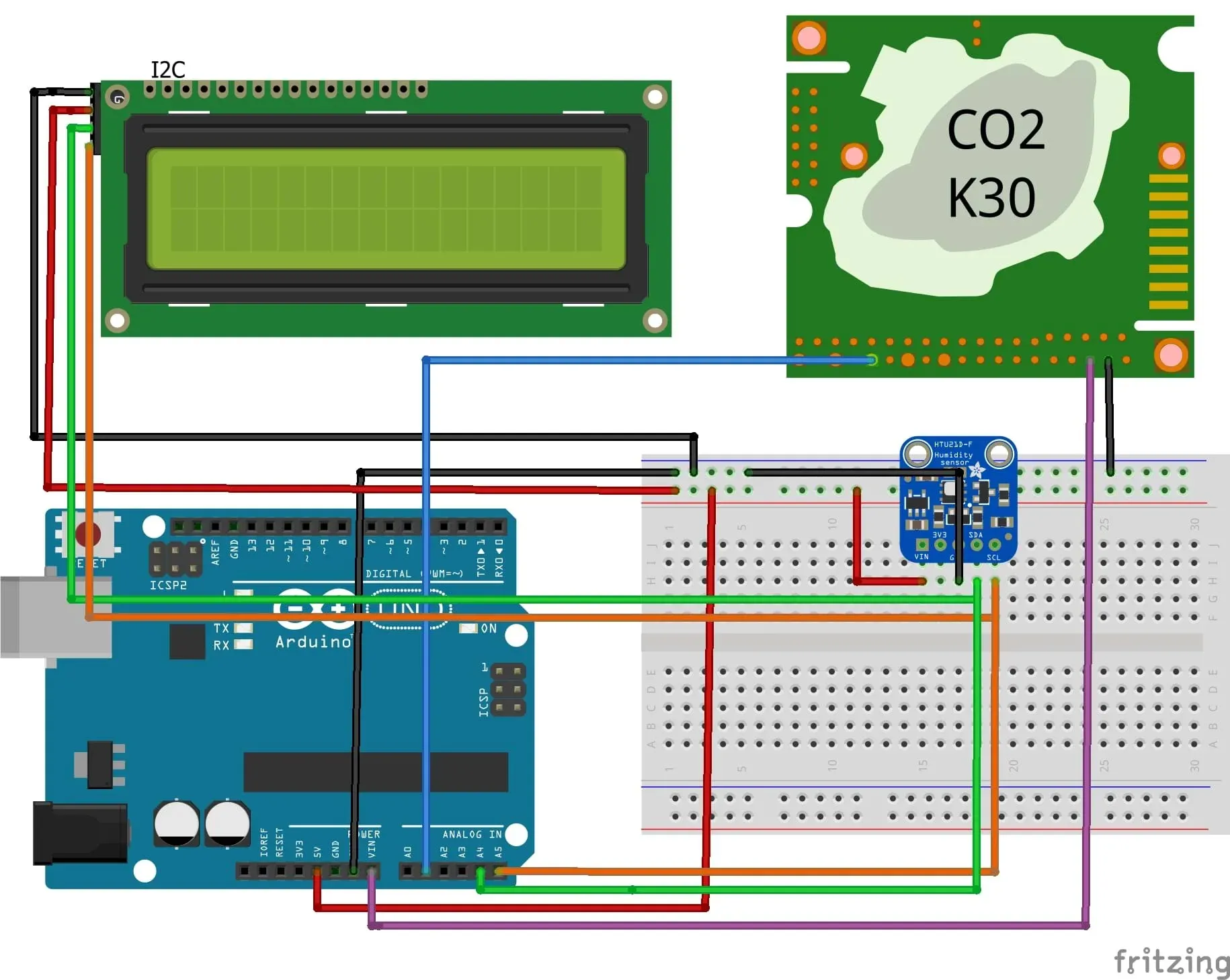
- Fritzing Diagram (jpg)
- IDE software (ino)
- Students should have a basic understanding of heat and how it is transferred.
- Students should have some background on how circuits work and have built one before. Following a fritzing diagram will improve their chances of success. Having used an Arduino IDE to load programs will help lots.
- Students should have some background in photosynthesis. Students will need to know how to calculate averages.
In our modern world, almost all commercial buildings have a heating system or a cooling system. What is the purpose? Consider a school environment: If we want the kids to be comfortable what temperature do we set it? Do humans have a specific range of temperature that they enjoy? [Consider answers for all the above questions.]
Let’s say I set the thermostat to what I feel is a comfortable temperature. But then 20 people come into the room with me. What is that going to do to the room? So how do we contrast that increase of temperature? Most large buildings have a system that monitors temperature, humidity, and CO2 levels. Why those three things? Does humidity affect the way temperature feels? What does CO2 do? What do you think would happen if we placed plants—also known as a living wall or a vertical garden—in a room, hallway, or open space inside a building? Can we make predictions or hypothesize would we expect to happen based on things you already know?
What if we could monitor or look at these levels of CO2, temperature, and humidity in the room at any given time? Would that data give us the information necessary to help us determine where we can construct put a living wall? We know that a living wall will lower CO2 in a room. So, what room should we put it in? What data do we have to know that would be the best location? Let’s learn about how to design a sensor that will allow us to explore this idea and get started!
Background
The HVAC system of most buildings looks at a variety of things to help stabilize the environment. Based on industry standards for CO2, temperature, and relative humidity levels inside a building, we can monitor those same variables using an Arduino. By looking at those three variables we can figure out the best location for a plant wall to be implemented.
Before the Activity
- Gather materials and make copies of the Proposal and Data Collection Worksheet (PDF).
- Open the Living Wall Introduction PowerPoint (PPTX) and become familiar with what is there. (Note: this is a suggestion of how to cover and introduce the topic to the students, and it can easily be manipulated to better suit different styles of teaching.)
- (optional) Print copies of the Fritzing diagram.
- (optional) Preload the code onto all the Arduino.
With the Students
Day 1
- Using the Living Wall Introduction PowerPoint (PPTX) introduce the topic and the engineering design process and challenge to the students.
- Talk about what is currently used in HVAC systems for human comfort (slides 1-5).
- Talk about what plants do: photosynthesis, and evapotranspiration.
- Introduce a way to monitor variables using the Arduino sensing toolkit.
- Divide class into groups of 2-3 students.
- Give each group of students the necessary supplies to build their Arduino monitoring device.
- Show the Fritzing diagram for the students to follow.
- Give students plenty of time to follow the diagram.
- Have students upload the code onto the Arduino using the IDE software (INO). (Note: You can have students copy the code in themselves using the Living Wall Sensors Code (PDF).)
- Note: this CO2 sensor needs to be plugged into a wall for accurate readings.
- Allow students to blow on the sensor and to watch it change.
- If students finish early, give them time to brainstorm areas of the school that they think could use a living wall.
Day 2
- Using the Living Wall Introduction PowerPoint (PPTX)start the day by asking for their ideas of where they want to go. Brainstorm ideas with them as a class until each group has a different location. Remind students that they want to put the living wall somewhere where it would be the most helpful in reducing the amount of CO2, increasing the aesthetics of the school, or affecting the humidity of a room.
- Have students use the Proposal and Data Collection Worksheet (PDF) to help gather data.
- Students are responsible for finding an area in the school for the living wall.
- Students need to observe things about that area. For example: measure how large of an area it is, what type of light it receives and any other pertinent information.
- Based on their observations, have students write a proposal as to why they think the living wall would be good in that location.
- Have students use their Arduino monitoring system to go and collect data from that location. (It is recommended that students collect at least 30 data points at different times of the day.)
- Ask students to calculate the average temperature, humidity, and CO2 for that specific location.
- All students will need to show their data to each other by writing it on the whiteboard table or in the PowerPoint itself.
Day 3
- Using the Living Wall Introduction PowerPoint (PPTX) have a discussion with the students about the class data. What trends do they see? Where are the differences?
- (optional) Take the student gathered data from the day before and create a chart/graph comparing the data.
- Using the data from the day before students will need to write an argument about where they think the grow wall should go using the data that has been collected, as well as observations they have made about the location (e.g., amount of light in the area).
- evapotranspiration
- The process by which water is transferred from the land to the atmosphere by evaporation from the soil and other surfaces and by transpiration from plants.
- hvac
- An acronym for heating, ventilation, and air conditioning.
- photosynthesis
- The process by which green plants and some other organisms use sunlight to synthesize foods from carbon dioxide and water. Photosynthesis in plants generally involves the green pigment chlorophyll and generates oxygen as a byproduct.
Pre-Activity Assessment
Brainstorming: This is the proposal. This is done before students test with the Arduino and gather data for their specific area.
Activity Embedded (Formative) Assessment
Hypothesis: This is done with the discussions after each student group has written their data on the board. There will be maybe all the same or some that are much different. Please talk with the students about what their data MEANS.
Post-Activity (Summative) Assessment
Problem solving: This is the final paper that students turn in. Their argument must be supported by the data collected.
Making Sense Assessment: Have students reflect on the science concepts they explored and/or the science and engineering skills they used by completing the Making Sense Assessment (PDF).
- We are working with Arduinos which have small metal parts; students should be careful using the wiring and be mindful of circuit board edges.
I would suggest to my students that maybe time of day is relative to their data. So could we test at different points in the day? Once the proposal is written students may want to see if their proposed location would make a difference. Since the wall is movable, place the wall in the various locations. Students may collect data in the locations and compare it to their preliminary data gathered for their proposals.
- For lower grades:
- Download the code onto the Arduinos prior to their use.
- Build Arduino LCD screen portion and only have the kids build the sensors on to the Arduino.
- Give students suggested areas as to where to test.
- For upper grades:
- Have students calculate standard deviation for their data.
- Place a living plant in the area and have them test near the plant to see if there is any difference.
- For more advanced students:
- Have students add a light sensor to the Arduino and gather light data as well.
- Calculate the standard deviation for all their averages and the class data.
ASHRAE, ANSI/ASHRAE Standard 55-2020, Thermal Environmental Conditions for Human Occupancy, 2020, American Society of Heating, Refrigerating and Air-Conditioning Engineers: Atlanta, GA.
Carbon dioxide. A union of professionals. (n.d.). Retrieved June 15, 2022, from https://www.uft.org/your-rights/safety-health/environmental-health-and-safety/building-hazards/carbon-dioxide
Indoor air quality in classrooms and COVID19. CO2 Meter. (2021, July 21). Retrieved June 15, 2022, from https://www.co2meter.com/blogs/news/7334762-indoor-air-quality-in-the-classroom.
Contributors
Kadria Drake; Liping Wang
Supporting Program
National Science Foundation Environmental Sustainability Program, , University of Wyoming
Acknowledgements
This curriculum was based on work supported by the National Science Foundation Environmental Sustainability program under grant no. CBET 1944823—CAREER: Commercial Building Indoor Greenery Systems' Effects on Thermal Environment and Occupant Comfort under Climate Change at the University of Wyoming. Any opinions, findings, and conclusions or recommendations expressed in this material are those of the authors and do not necessarily reflect the views of the National Science Foundation.
Copyright
2023 by Regents of the University of Colorado; original © 2021 University of Wyoming